


More news on this day
Field trials for the proposed Bengaluru–Mangaluru Vande Bharat Express are now under way across the Western Ghats, marking a decisive phase in efforts to introduce a faster premium service between Karnataka’s capital and the coastal city of Mangaluru.
Get the latest news straight to your inbox!
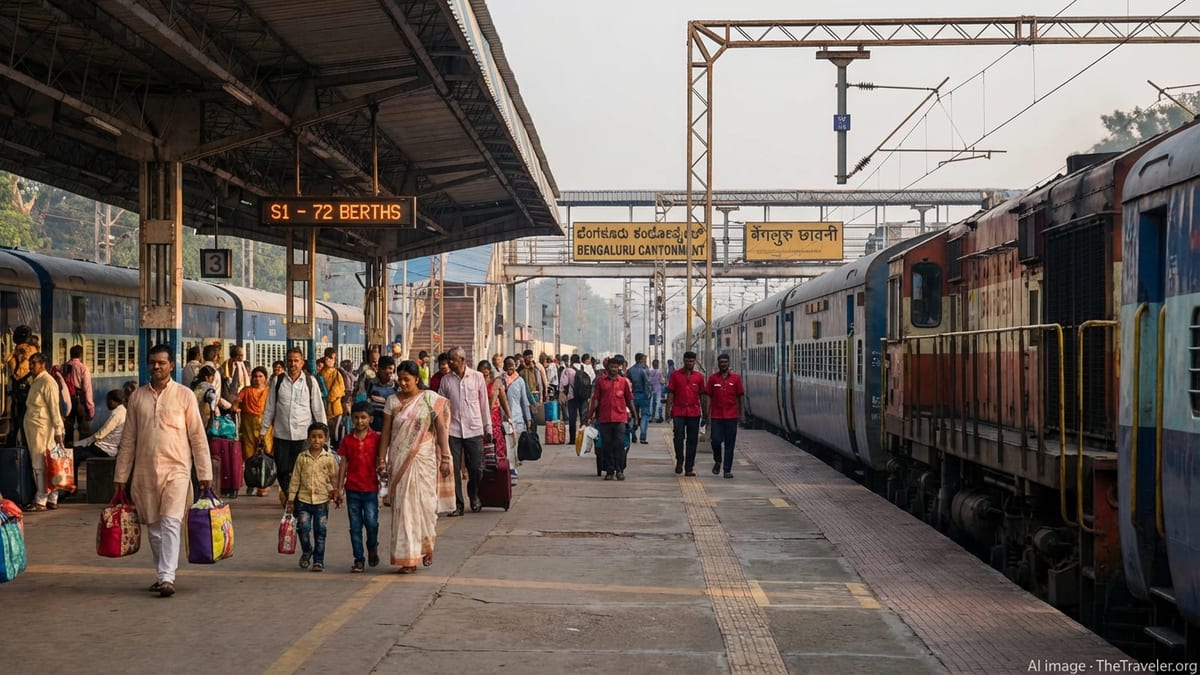
Full-route timing trial begins between Yesvantpur and Mangaluru Central
According to recent coverage, South Western Railway has commenced a full-route trial run of a 16-coach Vande Bharat train between Yesvantpur in Bengaluru and Mangaluru Central, focused on timing, sectional speeds and operational behavior over the entire stretch. Reports indicate that Saturday’s run departed Yesvantpur around 6.05 am with dedicated time checks planned at key junctions en route to the coast.
Regional media note that this is the first full end-to-end timing trial on the corridor after earlier tests on specific sections, particularly the ghat stretch. The latest run is being used to validate schedules in both directions and to understand how gradients, curves and existing speed restrictions will affect overall journey time between the two cities.
Preliminary accounts shared by local rail watchers suggest the timing trial experienced some delays, highlighting both the complexity of the terrain and the fine-tuning still required before a commercial timetable can be finalized. Observers nonetheless describe the full-route test as a milestone that moves the service significantly closer to launch.
Western Ghats ghat section trials mark technical turning point
The Sakleshpur–Subrahmanya Road section of the Bengaluru–Mangaluru line is widely described as one of India’s most demanding railway corridors, featuring a ruling gradient of roughly 1 in 50 along a 55 km stretch, with dozens of tunnels, sharp curves and numerous bridges across forested slopes. Published reports point out that these features have long constrained speed and capacity on the route, and have been a central challenge for introducing a high-end day train such as Vande Bharat.
In August, South Western Railway’s Mysuru Division conducted focused trials of the Vande Bharat trainset exclusively on this ghat section. Coverage from coastal Karnataka media and specialist outlets notes that the orange-and-grey rake was put through braking, traction and stability tests while climbing and descending the steep gradients, now fully electrified following the completion of major infrastructure works in late 2025.
Reports from that phase of testing indicate that the trial runs were aimed at validating safe operating speeds, assessing how the train handles continuous curves, and ensuring that regenerative braking and other onboard systems perform reliably on long downhill stretches. These ghat-section checks were a prerequisite to the start of this month’s end-to-end timing trials.
Electrification and infrastructure upgrades enable premium service
The current round of trials follows the completion of a major electrification project on the Sakleshpur–Subrahmanya Road ghat section, described in earlier government releases and regional coverage as one of the toughest remaining non-electrified gaps in the Southern railway network. The work involved extensive geological studies and engineering interventions to adapt existing tunnels, bridges and cuttings for electric traction along the steep hillside corridor.
Publicly available information from official channels highlights that an electric locomotive trial across the ghat in late December 2025 marked the commissioning of the new infrastructure. Since then, subsequent months have seen technical inspections and incremental operations building toward the introduction of a full Vande Bharat rake on the same alignment.
For passengers, these upgrades are expected to eventually bring a smoother ride and potentially shorter journey times between Bengaluru and the coastal belt, even if current speed limits within the Western Ghats remain modest due to curves, gradients and environmental constraints. The trials also demonstrate how premium rolling stock is being paired with incremental infrastructure improvements rather than wholesale new alignments on difficult mountain routes.
Route, potential stops and travel-time expectations
Earlier route projections reported in Bengaluru-based outlets indicate that the proposed Vande Bharat is planned to run from Yesvantpur to Mangaluru Central via Hassan and the Sakleshpur–Subrahmanya Road ghat, serving intermediate hubs that already have strong demand for overnight and conventional express trains. Trial documentation and media maps suggest that likely halts include key junctions on the Hassan line and selected stations before the train joins existing coastal tracks toward Mangaluru.
Recent explanatory pieces on the project emphasize that, despite the train’s design capability for higher speeds on plains, the Western Ghats section will continue to dictate the overall timetable. Analysts quoted in public reports and local commentary expect an eventual end-to-end timing that is faster than existing expresses but still significantly longer than high-speed corridors elsewhere in India, with expectations centered around a reduction of the present journey by roughly one to one-and-a-half hours once schedules are optimized.
Field trials like the current timing run are therefore critical for setting realistic commercial timings and identifying minor infrastructure or signalling refinements that might further shave off minutes without compromising safety or environmental safeguards in the ecologically sensitive ghats.
What the trials mean for coastal and hinterland connectivity
The Bengaluru–Mangaluru Vande Bharat has been widely discussed in regional media as a potential game-changer for rail connectivity between Karnataka’s technology hub and its coastal districts, where travelers currently rely heavily on overnight trains, long bus journeys and limited flight options. The premium train is expected to appeal particularly to business travelers, students and tourists looking for a daytime option that combines speed, comfort and scenic views of the Western Ghats.
Observers point out that successful trials and a subsequent commercial launch would also fit into a broader pattern of Vande Bharat deployments in South India, where similar services already operate between Bengaluru and cities such as Dharwad and Coimbatore. For coastal Karnataka, however, this route stands out because it converts what has historically been a challenging mountain railway into a flagship corridor for a modern semi-high-speed trainset.
While there is still no official notification of a start date or final timetable, the progression from section-focused ghat tests in August to a full-route timing trial in early September signals that the project has moved from concept to advanced operational testing. Travel industry watchers and local commuters are now looking to upcoming weeks for clarity on regular schedules, fares and booking windows once safety and performance assessments on the Western Ghats stretch are complete.
Indian Express: Yesvantpur–Mangaluru Central Vande Bharat trial run coverage
Times of India: Full-route trial between Yesvantpur and Mangaluru
NativePlanet: Trial runs on Western Ghats ghat section
Press Information Bureau: Electrification of Sakleshpur–Subrahmanya Road ghat