


More news on this day
Travellers flying to and within Europe will continue to benefit from cash compensation when their flight arrives three hours or more late, after European Union countries agreed to retain the long-standing payout threshold that applies across major markets including Germany, France, Spain, Italy and the Netherlands.
Get the latest news straight to your inbox!
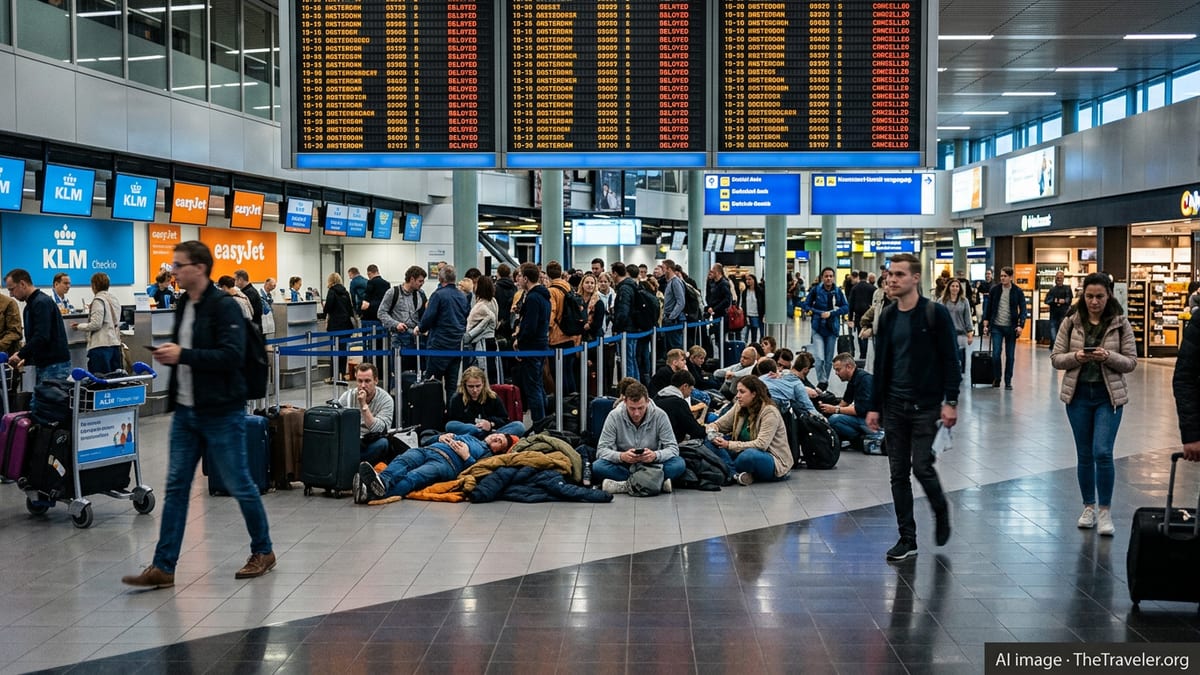
Three-Hour Rule Survives Years of Negotiations
The three-hour threshold, rooted in Regulation (EC) 261/2004 and subsequent court rulings, had been under review for more than a decade as EU institutions worked on an updated air passenger rights framework. Drafts discussed among member states had floated higher delay thresholds for compensation, particularly on short and medium-haul flights, prompting concern from consumer organisations that most disrupted passengers would lose access to payouts.
According to recent European Council and European Parliament documentation and coverage by European media, governments have now backed a compromise that maintains the core rule: passengers are entitled to fixed-sum compensation when they reach their final destination at least three hours later than scheduled, provided the airline is responsible for the disruption. The standard payment bands, broadly set at 250, 400 or 600 euros depending on distance and route type, are preserved for flights touching EU territory.
For travellers using major hubs such as Frankfurt, Paris, Madrid, Barcelona, Rome, Milan and Amsterdam, this means the legal baseline that has applied for nearly twenty years remains in place. Reports indicate that lawmakers opted to prioritise predictability and consumer confidence over the industry’s calls for looser compensation triggers, while pairing the status quo on delay payouts with clearer wording on when airlines can refuse claims.
The updated text, which still requires final legal polishing before it becomes fully applicable, will operate alongside the existing Regulation 261 framework for a transition period. In practice, passengers claiming for recent or upcoming disruptions within the European Union can continue to rely on the familiar three-hour arrival delay benchmark when assessing if a cash claim might be possible.
What Passengers Can Claim on EU Flights
Under the retained system, compensation is a fixed cash payment rather than a refund of the ticket price. Publicly available guidance summarising EU rules explains that flights up to 1,500 kilometres generally attract 250 euros, flights between 1,500 and 3,500 kilometres 400 euros, and longer intercontinental routes 600 euros when the qualifying conditions are met. The exact amount depends on both distance and whether the route is entirely within the EU or connects with non-EU destinations.
Crucially, eligibility turns on the delay at arrival, not at departure. A flight that leaves late but manages to “make up time” and arrives less than three hours behind schedule typically falls outside the compensation regime. Conversely, a missed connection in a hub such as Amsterdam or Paris that leads to a late arrival at a final destination can trigger rights, even if the original delay on the first leg appeared modest.
The rules apply broadly to flights departing any EU airport, regardless of airline, and to flights arriving in the EU when operated by an EU carrier. That captures a wide range of itineraries into Germany, France, Spain, Italy and the Netherlands from North America, the Middle East, Africa and Asia, as long as the airline is based in the EU or the departure point is inside the bloc.
In addition to compensation, travellers may also be entitled to rerouting or a refund if a disruption is severe, as well as “care and assistance” while they wait. This can include meals, refreshments, hotel accommodation and transfers when overnight stays become necessary. These service obligations apply irrespective of whether the delay reaches three hours and are not limited to the airports of the largest EU member states.
Limits, Exceptions and Extraordinary Circumstances
While the continuation of the three-hour rule is a clear win for travellers, not every major delay qualifies. EU law distinguishes between disruptions within an airline’s control and those caused by “extraordinary circumstances,” such as severe weather, security incidents, unexpected air traffic control restrictions or certain types of hidden manufacturing defects. In these cases, airlines must still provide basic care and rerouting, but compensation can be refused.
The boundary between ordinary operational problems and extraordinary circumstances has been shaped over time by case law and enforcement practice. Industry reports note that routine technical faults, crew shortages and poor rostering have generally been treated as the airline’s responsibility. By contrast, volcanic ash clouds, sudden airport closures ordered by public authorities, or widespread air traffic controller strikes outside the airline’s organisation have been recognised as beyond carrier control.
The forthcoming revision of the air passenger rights framework is expected to clarify and consolidate the list of events that can be treated as extraordinary. Public summaries of draft texts suggest that lawmakers aim to reduce disputes by giving more concrete examples, which should help passengers and airlines alike understand when compensation is realistically available. National enforcement bodies in Germany, France, Spain, Italy and the Netherlands will continue to oversee compliance at local level.
Another important limitation is the need for passengers to have a confirmed booking and to present themselves for check-in on time. Travellers who miss cut-off times, travel on heavily discounted staff tickets or accept alternative travel arrangements that lead to a similar arrival time may find that compensation is not due, even if other rights such as care and assistance remain relevant.
Practical Steps for Passengers in Germany, France, Spain, Italy and the Netherlands
For travellers departing from or connecting through major EU hubs, practical preparation remains essential. Consumer guidance consistently recommends keeping boarding passes, booking confirmations and any written communication from the airline, including emails or app notifications that confirm the cause and length of a disruption. These documents are often required when submitting a compensation claim later.
In large airports such as Frankfurt, Munich, Paris Charles de Gaulle, Orly, Madrid Barajas, Barcelona El Prat, Rome Fiumicino, Milan Malpensa, Amsterdam Schiphol and regional hubs across these countries, airlines are expected to provide information on passenger rights when problems arise. Standard forms and customer service desks are typically used to explain options for rerouting, refunds and accommodation, even if discussions about compensation are deferred until after travel is completed.
Travellers are free to submit claims directly to airlines, and many carriers offer online forms for EU Regulation 261 cases. Specialist claim firms also operate across the single market, but consumer advocates frequently remind passengers that using intermediaries is optional and that any commission charged will reduce the amount ultimately received. Passengers who believe their rights have been incorrectly denied can escalate complaints to the national enforcement body in the country of departure or arrival within the EU.
Time limits for bringing claims depend on national law, so a passenger flying from Germany may face different deadlines compared with a traveller departing Spain or Italy. Publicly available guidance urges passengers not to delay if they intend to seek compensation, as limitation periods can range from a couple of years to longer spans depending on the jurisdiction and whether additional contract or tort rules apply.
How the EU Rule Compares With the UK and Other Regions
For travellers used to flying between the United States and Europe, the European system stands out for its automatic, fixed-sum compensation linked to delay length. Reports on international air passenger rights underline that, while the United States and other jurisdictions increasingly require better information, refunds and fee transparency, few replicate the EU’s model of sizeable cash payments for delays that cross a time threshold.
Since the United Kingdom’s departure from the EU, it has retained its own version of the rules, often referred to as UK261, which mirrors the three-hour delay benchmark and similar compensation bands for flights touching UK territory. This means that passengers flying, for example, from London to Amsterdam with an EU carrier may be covered by both the UK and EU regimes, depending on the circumstances, though they can only obtain compensation once for a given disruption.
Within the EU itself, the latest agreement to preserve the three-hour rule is seen in public commentary as a signal that the bloc continues to favour strong consumer protection in aviation. Airlines had argued for higher thresholds that would have brought the system closer to the looser standards found in other parts of the world, but that approach has largely been set aside in favour of clearer definitions and better enforcement of existing principles.
For passengers planning trips to Germany, France, Spain, Italy, the Netherlands and other EU states, the message is that the familiar framework endures. A three-hour or longer arrival delay, where the airline is at fault and extraordinary circumstances do not apply, will continue to unlock a right to claim compensation, reinforcing Europe’s reputation as one of the most protective jurisdictions for air travellers.