


More news on this day
A Ryanair flight is reported to have departed a Greek airport with no passengers on board after extensive queues linked to the European Union’s new Entry/Exit System left travelers stranded at border control.
Get the latest news straight to your inbox!
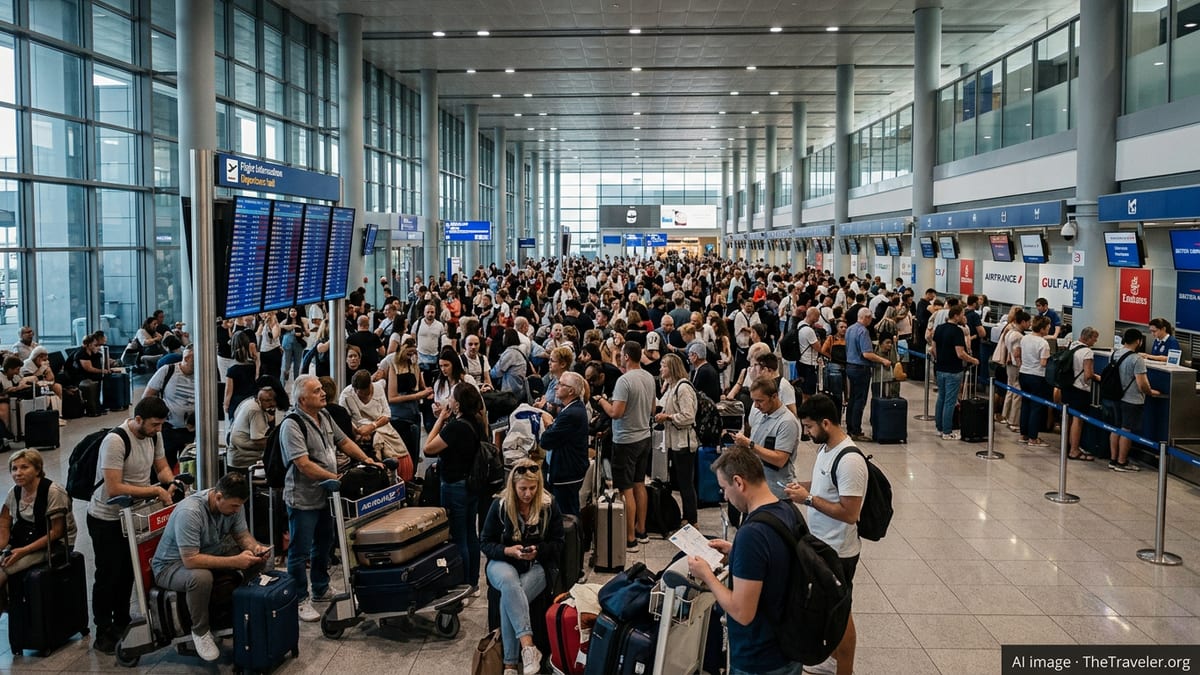
Reports of a flight leaving Greece without passengers
Accounts shared by affected travelers and travel forums indicate that a Ryanair service operating from a Greek island airport departed almost or entirely empty after passengers were held in what was described as a “mega queue” at border control. The incident is understood to have occurred in early June, at the start of the main summer holiday season, when the EU’s biometric Entry/Exit System, known as EES, began to be rolled out more widely across Schengen-area airports.
Passengers described scenes of confusion in the departure hall, with long lines forming well before boarding time as non-EU travelers attempted to complete new fingerprint and facial image checks required under EES. While some travelers reported arriving at the airport in what would traditionally be considered adequate time, they said the additional biometric procedures and bottlenecks at the booths made it impossible to reach the gate before the scheduled departure.
According to publicly available information, Ryanair has been emphatic that flights will not routinely wait for passengers delayed at passport control. The carrier argues that holding one departure can cascade delays across the network for the rest of the day, particularly at busy holiday airports where aircraft and crews operate multiple tightly timed rotations.
The combination of strict departure punctuality, unexpectedly long EES queues and limited staffing at border control appears to have produced a scenario in which a flight was ready to leave, but many or all of its ticketed passengers were still stuck in a queue beyond security.
EES rollout fuels widespread disruption across Europe
The reported episode in Greece is part of a broader pattern of disruption linked to the EES launch at airports across the European Union. The system, designed to replace routine manual passport stamping for non-EU nationals with a digital record and biometric data, has been gradually implemented this spring ahead of peak summer travel. Travel coverage from multiple outlets has documented long queues, missed flights and operational strain during the first weeks of full-scale use.
Reports from Italy, France and Spain have highlighted queues of up to several hours at passport control, particularly at weekends when leisure traffic peaks. In some cases, significantly reduced passenger loads have been documented on departures where large groups were unable to clear EES processing in time. Aviation and airport industry groups have described the early phase of implementation as a “systemic” challenge, arguing that even minor technical glitches or staffing gaps can quickly translate into large backlogs.
Greece has taken a more cautious approach than some other EU states, after initial trial periods showed that the additional checks could be particularly disruptive in smaller island airports with limited terminal space. Public guidance from Greek authorities and airport operators has stressed that certain checks may be temporarily reduced or adjusted, but passengers still report confusion about where and when biometric enrollments are required, especially when departing for non-Schengen destinations such as the United Kingdom.
The resulting patchwork of procedures means that travelers may encounter very different experiences from one airport to another. While some hubs report relatively smooth flows after an initial learning curve, others continue to see sudden spikes in waiting times when several flights are processed simultaneously.
Ryanair’s stance on punctuality and missed departures
Ryanair has built its business model around rapid aircraft turnarounds and strict on-time performance, and this approach is now intersecting with the slower processing times associated with EES. Publicly available statements and travel advisories from the airline stress that passengers are responsible for ensuring they arrive at the gate in time for boarding, even if airport queues are longer than usual due to new border rules.
Information published in consumer guidance and media reports indicates that passengers who miss a Ryanair flight because of security or border delays are typically offered rebooking subject to a missed-departure fee, rather than complimentary transfers. Passenger advocacy groups argue that this places the burden of systemic border-control issues onto individual travelers, who may have complied with the recommended arrival times but are still unable to reach the aircraft.
The incident in Greece, where a flight reportedly departed without its waiting customers, underscores the tension between airport and airline responsibilities. Border control and biometric processing are managed by states and airport authorities, while the decision to close a flight and release the aircraft rests with the carrier. Each party may point to the other as the source of the problem when passengers are left behind.
Ryanair, like many airlines, also faces slot and air traffic control constraints that can make extended waits infeasible. If an aircraft misses its departure window, it may face further holding on the ground or in the air, with knock-on effects on later flights. This operational reality increases the likelihood that flights will leave on schedule, even when a significant number of passengers are delayed by factors outside the airline’s direct control.
Greek airports brace for a challenging summer
Greek airports, particularly popular island gateways, are now preparing for what many observers expect to be one of the busiest and most complex summer seasons in recent years. Tourism demand has rebounded strongly, and the introduction of EES is adding an extra layer of procedural complexity just as passenger volumes approach record levels.
Updates published by several Greek airport operators advise departing travelers to arrive earlier than in previous years and to proceed to security and passport control as soon as possible after check-in. Warnings highlight that biometric checks for non-EU nationals can significantly extend processing times, and that queues may form outside terminals at peak hours as space inside fills up.
Travel industry commentators note that smaller island airports are particularly vulnerable. These facilities often handle large numbers of seasonal charter and low-cost flights within short daily windows, yet have limited room to expand border-control areas or install extensive EES infrastructure. When multiple flights to non-Schengen destinations depart within a narrow timeframe, even modest delays in biometric enrollment can compound into severe congestion.
The reported Ryanair episode has prompted renewed calls from tourism businesses and local officials for more staffing and clearer communication at Greek airports. Hotel operators and tour agencies fear that repeated scenes of missed flights or empty departures could damage the country’s reputation among visitors, especially families and older travelers who may be less comfortable with new technology and long-standing in queues.
What travelers can do to reduce the risk of being left behind
In response to the early weeks of EES-related disruption, airlines, airports and travel organizations are updating their guidance to passengers. Publicly available advice generally recommends arriving at the airport earlier than usual, particularly for flights to or from non-Schengen countries. For many leisure routes, that now means planning to be at the terminal at least three hours ahead of departure, and longer at heavily affected airports during peak times.
Travel experts emphasize the importance of moving quickly through each stage of the departure process. Passengers are being encouraged to check in online where possible, travel with hand luggage only if practical, and proceed directly to security and passport control rather than spending time in shops or restaurants before clearing formalities. Families and groups are advised to keep travel documents readily accessible and to follow airport signage for EES lanes to avoid unnecessary backtracking.
Some commentators suggest that travelers factor potential EES queues into their broader trip planning by allowing extra buffer time between connecting flights, avoiding very tight same-day return journeys, and considering early-morning departures when airports may be less congested. Travel insurance policies are also being scrutinized more closely, as coverage for missed flights caused by border-control delays can vary significantly between providers.
While the reported Ryanair flight leaving Greece without its passengers has become a striking example of the new risks facing holidaymakers this summer, industry observers expect further adjustments to procedures, staffing and technology as authorities and airlines learn from the first months of EES in full operation. For now, however, passengers heading to or from Greece and other popular EU destinations are being urged to treat airport queues as a major part of their travel time, not an afterthought.