


Slow travel is no longer a fringe idea. After years of frantic country-counting, more travelers now choose to live one or two months in a place, unpack fully, and spend their money more like temporary locals. If you are planning a slow-travel year in 2027, the big questions are practical: where is it still affordable, how do you stay legally, and what does a realistic one-month budget look like in each country.
Get the latest updates straight to your inbox!
How to Think About Slow Travel Budgets in 2027
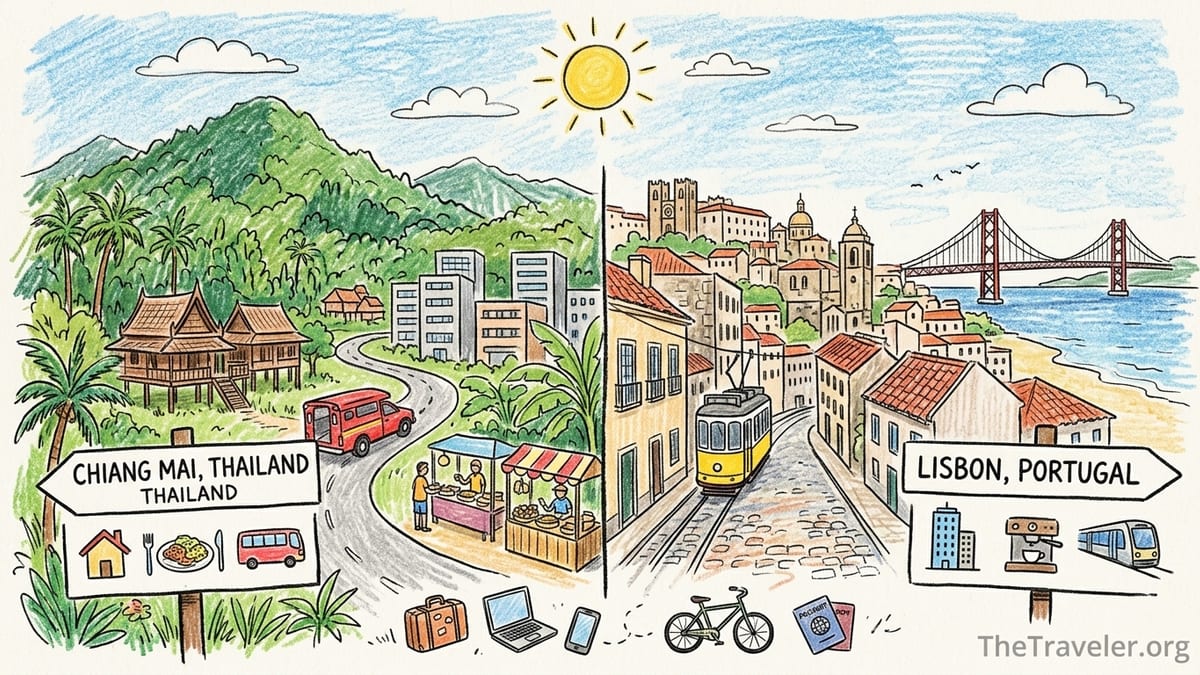
Slow travel costs look very different from a two-week vacation. Instead of nightly hotel rates, you will be negotiating monthly apartment rentals, buying local transit passes, and cooking at home. Cost-of-living comparisons compiled in 2024 to 2026 show that the same budget that covers a modest month in Lisbon can stretch to three or four months in a city like Chiang Mai in northern Thailand. That gap is widening as Western European cities absorb higher rents while Southeast Asia and parts of Latin America remain comparatively affordable.
When you plan for a month in one place, it helps to break the budget into five parts: accommodation, food, transport, coworking or mobile data, and everything else from SIM cards to gym passes. Independent aggregators that track digital nomad hubs estimate that an all-in month in Chiang Mai can be around 1,200 US dollars, versus well over 3,000 dollars for Mexico City and above 4,500 dollars for Lisbon on similar comfort levels. Even if you prefer a simpler lifestyle than those benchmarks, the ratio between destinations is a useful planning tool.
For 2027, the best slow-travel countries share a few traits. They either offer fairly priced long-stay visas or allow generous stays on a tourist entry, they have cities where mid-range rentals are still reachable without locking into year-long contracts, and they maintain reasonably priced local transport. Equally important is your daily rhythm: if you cook at home, walk a lot, and use public transit, your costs will be lower than someone eating out daily, taking taxis, and working from premium coworking spaces.
This guide focuses on five countries that consistently offer good value for slow travel: Thailand, Colombia, Mexico, Portugal, and Georgia. For each, you will find a realistic one-month budget, example cities, housing and transport options, and the visa routes that matter for a 2027 planner.
Thailand: Chiang Mai and the New Long Stays
Thailand remains one of the strongest value propositions for slow travelers. In 2026, several cost comparisons put Chiang Mai at or near the top of affordability rankings for digital nomads, with an estimated total monthly cost around 1,200 US dollars for a solo traveler renting a modest private studio and living a middle-of-the-road lifestyle. That figure includes short-term accommodation, food, local transport, and basic entertainment, and still compares very favorably to big-city prices in Europe or North America.
Accommodation is where slow travelers can save the most. In Chiang Mai, basic one-bedroom apartments outside the tourist-heavy Old City can often be rented on a month-to-month basis, sometimes directly with local landlords. As of late 2026, online rental listings for these neighborhoods commonly show studios and small one-bedrooms in the range of roughly 250 to 400 US dollars per month, with internet included and electricity sometimes billed separately. In Bangkok and the islands such as Phuket or Koh Samui, expect that figure to climb, with modern one-bedroom units often starting closer to 500 or 600 dollars for short commitments.
Local transport and day-to-day routines stay affordable if you live in a compact city like Chiang Mai. Songthaews, the red shared pickup trucks that function as buses, can still cost the equivalent of about 0.50 to 1 US dollar per ride on common routes, while basic restaurant meals at simple Thai eateries might be in the 2 to 4 dollar range. Travelers who cook at home using fresh markets and supermarkets usually find their grocery bill sits far below what they would spend back in the United States or Western Europe. On the work side, coworking spaces in Chiang Mai typically offer monthly hot-desk memberships somewhere around 100 to 150 dollars, although many slow travelers get by using cafes and mobile data.
Visa options are where Thailand becomes more complex going into 2027. Traditional 30- or 60-day tourist entries remain the simplest route for many nationalities, often extendable by 30 days at a local immigration office for a modest fee. In parallel, Thailand introduced a multi-year Destination Thailand Visa that targets remote workers and frequent visitors, which runs for up to five years and allows extended stays with conditions such as maintaining approximately the equivalent of several thousand US dollars in savings. Because remote-work and digital nomad schemes can change with little notice, it is crucial to check the latest official consular guidance before planning a year of back-to-back stays. For many slow travelers, a practical compromise is to spend one or two months in Thailand on a tourist basis, then move on to another country in the region rather than attempting to string together a full year in one place.
Colombia: Medellín and Beyond on a Moderate Budget
Colombia has steadily climbed the list of slow-travel favorites, largely on the strength of Medellín. Economic development agencies that monitor international cost indices point out that Medellín offers modern infrastructure and city amenities at a lower cost than most major Latin American capitals. Independent comparisons in 2024 and 2025 routinely place a mid-range monthly budget in Medellín between roughly 1,200 and 2,000 US dollars for a solo traveler, depending on location and lifestyle.
For accommodation, a long-stay visitor who avoids nightly vacation rentals and looks at one-month leases can often find one-bedroom apartments in neighborhoods such as Laureles or Envigado in the vicinity of 500 to 800 dollars per month. Furnished units in the more tourist-focused El Poblado area can climb higher, especially in new towers with rooftop pools and security, but month-to-month arrangements are widely advertised. Utilities for a small apartment, including internet, typically add perhaps 50 to 100 dollars.
Medellín’s integrated public transport system makes it easy to keep everyday costs predictable. The city’s metro and cable car network connects hillside barrios with the valley floor, and fares for a single trip are generally well under 1 US dollar equivalent when converted from Colombian pesos. Many slow travelers rely on the metro plus inexpensive ride-hailing services for evenings or trips to hillier neighborhoods. Simple lunches in neighborhood restaurants known as corrientazos might cost around 3 to 5 dollars, while a coffee in a specialty cafe sits closer to 2 to 3 dollars, so a modest monthly food budget in Medellín often falls in the 250 to 400 dollar range if you mix eating out with cooking.
Colombia has also become one of the clearer cases in the global digital nomad visa landscape. The country offers a dedicated remote-worker visa that, according to 2026 summaries of official rules, generally asks applicants to show an income of a little over 1,600 US dollars per month, pegged at about three times the national minimum wage and updated as that wage changes. Approved visas can allow stays of up to two years, which suits slow travelers who want to return to Colombia for several months at a time without constantly resetting the tourist counter. In practice, many visitors still come on 90-day tourist entries that can often be extended once, but anyone planning repeated or longer stays in 2027 should review the latest consular information a few months before traveling.
Mexico: Big-City Energy with Rising Prices
Mexico has long been a classic base for North American slow travelers, combining cultural depth with good air links back to the United States and Canada. Mexico City, Guadalajara, and Mérida all attract month-long stays. The trade-off in 2026 and into 2027 is that the most popular neighborhoods in Mexico City, such as Roma Norte and Condesa, now price much higher than they did even a few years ago. Recent cost-of-living comparisons often place a mid-range solo budget in Mexico City in the realm of 2,000 to 3,000 US dollars per month, and sometimes more, once you factor in rent, food, and a social life.
Accommodation is the main pressure point. Data compiled for digital nomad cost calculators suggests that a centrally located one-bedroom in Mexico City may run from about 1,000 US dollars per month on the low side to well above that for modern buildings with amenities and short commitment periods. Travelers willing to base themselves farther from the tourist core or in second-tier cities can still find sub-800-dollar options for a simple one-bedroom, particularly when renting directly from local landlords for a month or more.
Métro fares in Mexico City remain low in absolute terms, and a typical single ride on the subway or bus network costs the equivalent of a fraction of a US dollar. Taxis and ride-hailing services are inexpensive compared to many US cities, although surge pricing and traffic can add up. A basic lunch menu at a fonda, or small home-style restaurant, still often comes in below 6 or 7 dollars, while a meal at a mid-range sit-down spot featuring contemporary Mexican cuisine can easily reach 20 dollars or more per person. Coffee culture is well developed, and regular visits to specialty cafes will noticeably increase your budget.
Legally, Mexico has one of the more generous tourist regimes for many nationalities, including visitors from the United States, Canada, and much of Europe, who may be granted up to 180 days on arrival. In practice, that means a slow traveler can spend nearly six months based in Mexico City or another city without applying for a formal residency route, though immigration officers have grown stricter in some airports and now issue shorter stays more often than in the past. For longer-term planners, Mexico also runs a temporary resident route that some remote workers use, but it tends to require either consistent income above a certain threshold or savings in the tens of thousands of dollars when converted to pesos. If you intend to treat Mexico as a multi-year base, consulting a local immigration professional several months before 2027 can help avoid surprises.
Portugal: Comfortable Slow Travel at European Prices
Portugal has become a poster child for slow travel in Europe, with Lisbon, Porto, and the Algarve all drawing long-stay visitors. Several relocation guides and digital-nomad cost breakdowns compiled in 2024 through 2026 point to significantly lower grocery prices than in the United States and often lower utility costs, but they also warn that rents in central Lisbon now rival other Western European capitals. Those same sources typically place a solo slow traveler’s monthly budget somewhere between 1,800 and 3,000 US dollars for a modest lifestyle, with higher figures common in fashionable parts of Lisbon.
Accommodation absorbs a large share of that budget. In late 2026, rental estimates for a simple one-bedroom apartment in non-touristy Lisbon neighborhoods often fall between approximately 900 and 1,400 US dollars on a monthly basis when converted from euros, although prices in highly sought-after districts like Príncipe Real or Bairro Alto can surpass that range for short contracts. Cheaper options appear in smaller cities or in the interior, but slow travelers usually balance cost with access to cafes, coworking, and transport. In Porto, mid-range one-bedrooms often list for a bit less than Lisbon, while Madeira and the Algarve can vary widely by season.
Portugal shines when it comes to public transport. In Lisbon, a monthly Navegante public transport pass that covers metro, buses, and trams within the metropolitan area cost roughly 40 euros according to guides updated in 2026. That makes it realistic to live without a car, even on a tight budget. Groceries purchased at chains such as Continente or Pingo Doce remain relatively inexpensive compared to US supermarkets, and a basic lunch menu at a neighborhood tasca might cost around 10 to 12 euros, including soup, a main, and a drink. Coworking spaces in Lisbon usually offer hot-desk memberships in the ballpark of 100 to 250 euros per month.
Portugal’s legal framework is an important draw for slow travelers planning 2027. The country runs a dedicated residence visa route for remote workers, often referred to as its digital nomad or D8 visa. Summaries of 2026 rules describe an income requirement set at around four times the national minimum wage, which recently translated to a threshold in the region of 3,600 to 4,000 euros per month in gross income, calculated over recent months. Successful applicants generally receive an initial four-month visa to enter Portugal and convert it into a multi-year residence permit. For travelers who only want to spend a month or two in the country, the standard Schengen short-stay regime of up to 90 days in any 180-day period remains the simplest solution, but those days must be shared across all Schengen countries, not just Portugal.
Georgia: Easy Long Stays on a Lean Budget
Georgia occupies a special niche in the slow-travel world. For many nationalities, including US citizens and many Europeans, entry rules as of 2026 still allow stays of up to one full year on a simple tourist basis, with no formal visa application required before arrival. That policy effectively turns cities like Tbilisi and Batumi into natural bases for long-term slow travelers who want to avoid the paperwork and income thresholds attached to formal digital nomad visas elsewhere.
On the cost side, Georgia remains notably more affordable than most of Europe. Digital nomad comparison tools and budget guides that include Tbilisi often estimate a total monthly cost for a solo traveler in the range of roughly 1,000 to 1,500 US dollars, with some managing on less by choosing older apartments and eating mostly at home. Simple one-bedroom apartments in central or near-central Tbilisi neighborhoods can still be found in the equivalent of 400 to 700 dollars per month on one- to three-month contracts, especially outside peak summer. Utility costs for a small flat are often significantly lower than in Western Europe, though heating in winter can add noticeably to the bill.
Daily routines for slow travelers in Tbilisi tend to revolve around a mix of walking, using municipal buses and the compact metro, and relying on inexpensive ride-hailing for late-night returns or hilly routes. Single metro or bus rides cost the equivalent of well under 1 US dollar, especially when paid using the city’s transport card. Eating out can be excellent value if you enjoy local dishes such as khachapuri and khinkali, with a casual meal at a neighborhood restaurant sometimes coming in under 8 or 9 dollars. Specialty coffee shops and coworking spaces cater to the growing international community, with monthly hot-desk memberships typically well below Western European prices.
The main trade-offs for Georgia as a slow-travel base are less about money and more about infrastructure and climate. Outside Tbilisi and Batumi, internet speeds and coworking options can be more limited, and healthcare facilities may not match Western European standards in smaller towns. Winters in Tbilisi can be cold and grey, which may matter if your work relies on good light or regular time outdoors. For many, though, Georgia’s mix of comparatively low prices, one-year stays without a visa application, and easy onward travel to Turkey, Armenia, and the wider region outweigh those drawbacks, making it a strong candidate for a multi-month stay in 2027.
Designing a Slow-Travel Routine and Budget Template
Regardless of destination, slow travel works best with a realistic monthly template that you adapt to local prices. One approach used by many experienced nomads is to start with a broad allocation, such as 40 to 50 percent of the budget for accommodation, around 20 to 25 percent for food, 10 percent for local transport, another 10 to 15 percent for coworking or connectivity, and the remainder for entertainment, healthcare, and unexpected costs. If you decide that 2,000 US dollars per month is your ceiling, that might mean keeping rent at or below 800 to 1,000 dollars in each city you choose.
In practice, this template looks different from country to country. In Chiang Mai, you might pay 350 dollars for a studio, 250 dollars for food, 50 dollars for local transport, and 100 dollars for coworking, leaving a generous buffer for weekend trips and occasional splurges. In Lisbon, the same traveler might find themselves spending 1,100 dollars on rent, 400 dollars on food, 60 to 80 dollars on transport via the monthly pass, and 150 dollars on coworking, with far less left over. The structure of the budget is similar, but the absolute numbers shift dramatically.
Certain fixed costs also follow you regardless of where you slow travel. International health insurance or travel medical coverage is a recurring line item, often in the range of 50 to 150 dollars per month for relatively young and healthy travelers. Cloud storage, software subscriptions, and international mobile roaming add to that baseline. It is wise to keep at least one month of living expenses as a cash cushion in an accessible account, especially if you are relying on freelance or contract income that can fluctuate.
Finally, slow travel is as much about routine as it is about price. Many long-stay travelers set up a weekly rhythm that includes a regular market day, focused work blocks at the same cafe or coworking desk, language lessons two or three times a week, and one day set aside for exploring a new neighborhood or taking a local bus to a nearby town. This kind of structure makes it easier to track spending and resist the temptation to treat every day like a holiday, which is one of the fastest ways to blow through a monthly budget.
Planning for 2027: Visas, Seasonality, and Booking Tactics
Visa rules and living costs both shift over time, which matters when you are sketching out a slow-travel year as far ahead as 2027. Many of the digital nomad and remote-work visas launched between 2020 and 2024 are still being adjusted, including in Portugal, Spain, Colombia, and Thailand. Income thresholds published in 2026 already show a wide range, from roughly 1,500 US dollars per month for the most accessible schemes to more than 5,000 dollars for some European and Asian programs. Because these thresholds are often pegged to local minimum wages or average salaries, they can rise year by year without much notice.
For that reason, travelers who do not meet the published income levels for a formal digital nomad visa often default to a pattern of alternating between countries where they can stay 60 to 180 days on a tourist basis. A plausible 2027 route might involve spending January and February in Chiang Mai, March and April in Georgia, May and June in Portugal or Spain within the Schengen 90-day limit, and then several months in Mexico or Colombia. Each time you move, you reset the tourist clock while also rebalancing your budget between higher- and lower-cost countries.
Seasonality also affects both lifestyle and prices. In Chiang Mai, many slow travelers aim for November through February to avoid the hottest months and the smoky season that often arrives in March. Lisbon can be delightful in spring and early autumn when rents may be slightly lower than in peak summer. Medellín, with its spring-like climate, works almost any month, while Mexico City can feel more comfortable in the drier months from roughly November to April. Booking accommodation a month or two in advance for these shoulder seasons often yields better deals than last-minute searches for high summer or major holidays.
When booking one-month stays, it is usually cheaper to negotiate directly with local landlords or smaller agencies rather than relying exclusively on nightly vacation rental platforms. Many apartments advertised with a high nightly rate convert to a much lower monthly price if you agree to stay four weeks or more, especially in cities like Medellín, Tbilisi, or Chiang Mai. It is common for landlords to quote a lower figure if you pay the full month up front in the local currency and cover utilities separately based on actual usage.
Conclusion: Matching Your Budget to the Right Country
As 2027 approaches, the best countries for slow travel share a combination of reasonable costs, workable visa options, and cities where everyday life feels inviting rather than exhausting. Thailand offers some of the lowest all-in monthly budgets in well-established hubs like Chiang Mai, balanced against more complex visa choices. Colombia and Mexico deliver rich urban experiences at moderate to rising prices, with Colombia’s dedicated remote-work visa appealing to those ready to commit for longer. Portugal provides European comforts and strong infrastructure, albeit at higher rents, while Georgia stands out for its unusually long tourist stays and lean budgets.
No single destination is perfect for every slow traveler. Your ideal route will depend on whether you prioritize cuisine, climate, nightlife, nature, or ease of doing business in your own language. Yet across all these countries, the core principles remain the same: commit to at least a full month in each place, live more like a local than a tourist, track your spending across a few clear categories, and stay alert to evolving visa rules. With that mindset, a carefully planned sequence of one-month stays in 2027 can cost far less than a year at home, while offering far richer day-to-day experiences.