


For many travelers, the difference between a stressful airport connection and a genuinely pleasant journey comes down to one thing: lounge access. Few carriers lean into the lounge experience as heavily as Lufthansa. From its cult‑favorite First Class Terminal in Frankfurt to a dense network of Senator and Business Lounges across Europe, the German flag carrier has built a lounge ecosystem that frequent flyers often plan trips around. But how does Lufthansa’s offering really compare to other major airline lounge programs such as British Airways, Air France, Emirates, Qatar Airways or United and Delta in the United States? This guide takes a practical, example‑driven look at where Lufthansa lounges stand out, where they merely keep pace, and where competitors do better.
Get the latest updates straight to your inbox!
Lufthansa’s Lounge Ecosystem in Context
Lufthansa organizes its lounges into three main tiers: Business Lounges, Senator Lounges and First Class Lounges, topped by the standalone First Class Terminal in Frankfurt. Access depends on your ticket and your Miles & More or Star Alliance status. Business Lounges cater to business class passengers and mid‑tier elites, Senator Lounges to Star Alliance Gold and top Lufthansa elites, while First Class facilities are reserved for First Class passengers and HON Circle members, plus a small group of invited partners such as select American Express Centurion cardholders when flying on Lufthansa Group tickets.
In practice, that structure looks different from what you will find with some competitors. British Airways has Galleries Clubs for business class, Galleries First for elites and first class, and the Concorde Room as a true top tier. Air France has standard business lounges plus an ultra‑exclusive La Première lounge in Paris. In the Gulf, Emirates and Qatar Airways lean heavily on enormous business and first lounges at their home hubs in Dubai and Doha. United and American in the United States separate paid‑membership clubs from exclusive Polaris or Flagship lounges for long‑haul business class. Lufthansa’s model is closer to the European pattern: status and cabin are tightly linked, and there is a clear prestige ladder from Business to Senator to First.
For a real‑world example, consider a traveler connecting from New York to Vienna via Frankfurt in business class. On arrival into Frankfurt, they might use the Lufthansa Welcome Lounge in the arrivals area to shower and enjoy a hot breakfast before heading into the city. Later the same day, before a Frankfurt to Vienna connection, they can access a Business Lounge in Terminal 1. If they held Star Alliance Gold status through Lufthansa or another program, they would typically be directed to a Senator Lounge instead, with slightly upgraded food and quieter seating. That sort of progression within one hub is more layered than what many rival carriers offer.
The First Class Terminal and Flagship Lounges: Where Lufthansa Shines
The most distinctive element of Lufthansa’s lounge system is the First Class Terminal in Frankfurt, a dedicated building separate from the main terminals. Eligible guests clear private security, relax in a compact but luxurious lounge area with fine dining, nap rooms, bathtubs and cigar lounge, and then are driven directly to the aircraft in a Mercedes or Porsche. Travelers often treat it as a destination in itself, timing arrivals into Frankfurt early to spend several hours there before an onward flight.
Compared with other airlines’ top‑tier lounges, the First Class Terminal holds its own. Qatar Airways’ Al Safwa First Lounge in Doha and Emirates’ First Class Lounge in Dubai offer larger spaces and more spa facilities, but they are located within the main airport terminals. Air France’s La Première lounge in Paris rivals Lufthansa in personal attention and table service but does not sit in a separate building. British Airways’ Concorde Room at London Heathrow Terminal 5 has à la carte dining and private cabanas but does not include car transfers to the aircraft for most flights. On a pure “special occasion” scale, Lufthansa’s First Class Terminal is comfortably in the global top tier.
Lufthansa also operates First Class Lounges in Frankfurt’s Terminal 1 and in Munich, plus access arrangements for its first customers at key outstations such as New York JFK, where the upper level of the large combined Senator and Business Lounge includes a fine‑dining area for First Class passengers. These spaces are smaller and more intimate than the mega‑lounges in the Gulf. A traveler flying Frankfurt to Singapore in Lufthansa First Class, for example, might eat a full restaurant‑quality meal in the Frankfurt First Class Lounge, take a bath, enjoy a quiet office space to finish work, and then board the aircraft mostly using the onboard service as a top‑up rather than the main event.
Senator vs Business Lounges: Everyday Reality for Frequent Flyers
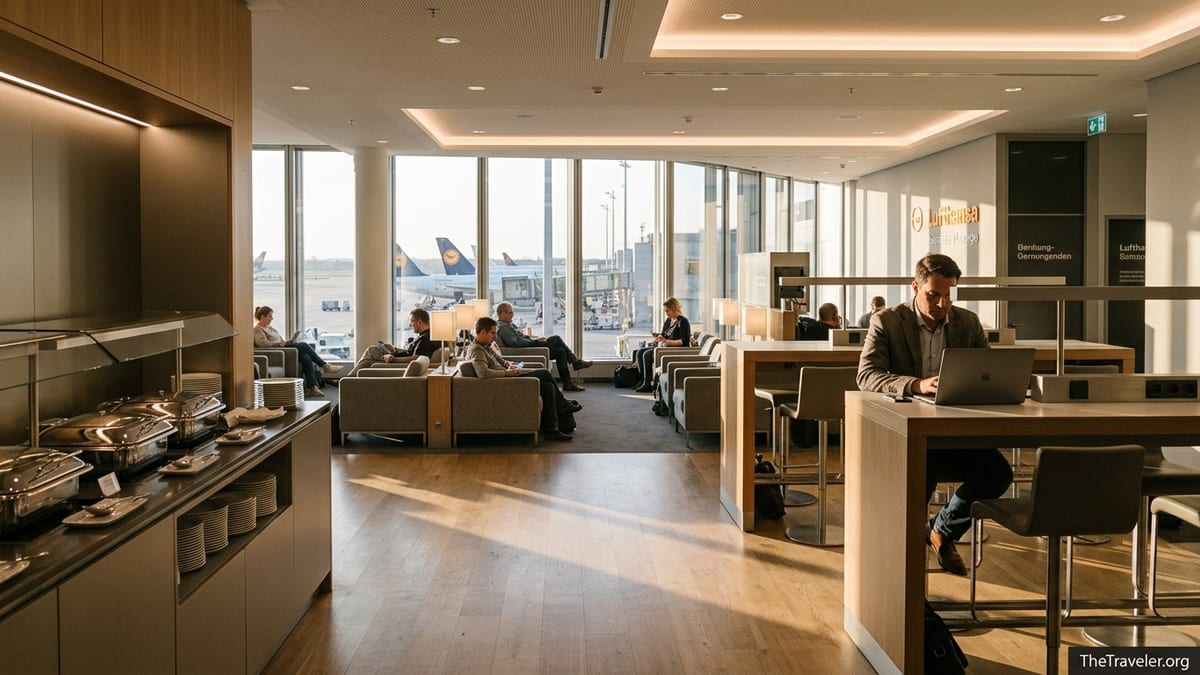
For most travelers, the more relevant comparison is between Lufthansa’s Senator and Business Lounges and the mainstream offerings from competitors like British Airways Galleries, Air France business lounges, or United Clubs and Delta Sky Clubs. Lufthansa Business Lounges are designed primarily for business class ticket holders and Miles & More Frequent Travellers. Typical amenities include a buffet with hot and cold dishes, draft beer or wine, barista‑style coffee machines, work areas, showers at major hubs and plenty of seating zones.
Senator Lounges sit a notch above and are accessible to Star Alliance Gold members and Lufthansa’s top elites, in addition to First and some business passengers. In Frankfurt and Munich, Senator Lounges often have a slightly better food selection, upgraded self‑serve spirits, quieter zones and sometimes separate working or relaxation areas. At peak times, though, both Senator and Business Lounges can be crowded, particularly in Schengen areas where short‑haul flights cluster. Travelers connecting from a morning flight from Berlin to a midday transatlantic departure from Frankfurt, for instance, frequently report that the Schengen Senator Lounges near the A gates can be busy enough that finding power outlets and seating together for a family is difficult.
Compared with competitors, Lufthansa’s mid‑tier lounges are competitive but not invariably best in class. British Airways’ refurbished Galleries lounges at London Heathrow Terminal 5 feature decent buffets, showers and runway views, but also see severe crowding during morning and evening banks. Air France’s newer business lounge in Paris Charles de Gaulle Terminal 2E Hall L offers a spa, large showers and a fresh‑cooked hot food station that many travelers rank above Lufthansa’s typical buffet. In North America, United Polaris Lounges at hubs such as Newark and Chicago offer restaurant‑quality dining and high‑design interiors that feel more premium than most of Lufthansa’s Senator spaces, although access is limited strictly to long‑haul business class travelers rather than status holders.
Access Rules: Lufthansa vs Other Programs
Lounge access rules are a major point of difference among airline programs, and this is an area where Lufthansa’s membership in Star Alliance both helps and complicates the picture. In general, a business or first class ticket on any Star Alliance airline unlocks access to that airline’s business or first lounge on departure, while Star Alliance Gold status held via Lufthansa or another member airline gives access to designated Gold or Senator‑level lounges when flying the same day on a Star Alliance carrier. That means a United Premier Gold member flying United economy from Frankfurt to Newark should be able to enter a Lufthansa Senator Lounge, and a Lufthansa Senator member flying economy on United from San Francisco to Denver often has access to a United Club or other Star Alliance lounge depending on local rules.
Lufthansa’s own rules add more nuance. First Class passengers on Lufthansa or SWISS generally have access to First Class Lounges or the First Class Terminal in Frankfurt, not only on departure but also on arrival when connecting to another same‑day flight. Long‑haul business class passengers on Lufthansa Group airlines receive lounge access on departure and often during connecting stops, even if the feeder leg is in economy. On the other hand, Lufthansa Premium Economy tickets do not automatically grant lounge access, aligning the airline more with British Airways and Air France than with some Gulf carriers that sell discounted last‑minute lounge passes.
By comparison, United and Delta in the United States do not grant lounge access with most domestic first class tickets. A traveler flying Los Angeles to Chicago in domestic first on United would not automatically gain entry to a United Club without a membership or Star Alliance Gold status, whereas the same traveler flying Frankfurt to Rome in business class on Lufthansa would be able to enter a Lufthansa Business Lounge in Frankfurt. Emirates and Qatar Airways, meanwhile, broadly include lounge access with business and first class tickets but are more selective about which elites can enter their premium lounges when flying in economy.
Hard Product: Design, Food and Amenities
Physically, Lufthansa lounges strike a distinctly German balance between function and understated style. At Frankfurt and Munich, travelers will find clean lines, neutral color palettes, hardwood or stone flooring, and seating that emphasizes practicality over plushness. Food typically consists of an all‑day buffet with salads, cold cuts, hot pasta or regional dishes such as sausages and potatoes, plus a dessert table. Self‑serve drinks include German beer, a modest choice of wines, and basic spirits in Business Lounges, with broader spirits and sometimes premium sparkling wine in Senator Lounges and First Class spaces.
Compared with peers, this is a solid but sometimes conservative offering. Air France’s flagship business lounge in Paris features an open kitchen where staff prepare hot dishes to order, plus a Clarins spa. Qatar’s Al Mourjan business lounge in Doha offers restaurant‑style dining with a wide range of international dishes and an airy, high‑ceilinged design that feels more like a modern hotel than an airport. British Airways has upgraded catering with hot options like curries and pies at Heathrow, but quality and consistency can vary, especially in outstation lounges. Lufthansa’s strengths are reliability and regional touches: morning pretzels and fresh rolls in Munich, hearty stews on winter evenings in Frankfurt, and efficient self‑serve buffets that minimize queues.
In terms of amenities, showers are widely available at larger Lufthansa lounges, and work areas with printers and quiet zones are common. The First Class Terminal and First Class Lounges add relaxation rooms, bathtubs, à la carte dining and extensive whisky or wine selections. Where Lufthansa falls a bit behind some modern competitors is in dedicated wellness offerings and high‑design spaces. Travelers who value spa treatments, designer lighting and Instagram‑friendly architecture may find the likes of Qatar, Emirates, Turkish Airlines’ Istanbul lounge or even certain newer United Polaris lounges more visually impressive.
Network Breadth and Outstation Experience
One of Lufthansa’s biggest strengths is network breadth. Between Lufthansa, SWISS, Austrian and other Lufthansa Group carriers, the company offers dozens of branded lounges across Europe and a handful of key intercontinental outstations such as New York, Washington and Dubai. At airports where Lufthansa does not operate its own lounge, it partners with Star Alliance or contract lounges, so a business class passenger flying, say, Oslo to Frankfurt usually has access to a third‑party lounge before departure. This mirrors the strategy of British Airways and Air France, both of which combine home‑hub lounges with a patchwork of outstation facilities.
However, the quality of outstation lounges can vary widely. For example, Lufthansa’s own lounge in New York JFK Terminal 1 is a large space shared between Business and Senator areas, with a buffet that many travelers find solid but not exceptional compared with some Asian or Gulf carriers. In contrast, a Qatar Airways business passenger departing from London Heathrow Terminal 4 might use the excellent Qatar Premium Lounge, known for its restaurant‑style dining and elegant interior that rivals the airline’s home base lounges. Lufthansa customers departing from smaller airports such as Manchester, Dublin or Naples will often use generic contract lounges that are broadly similar to what British Airways or KLM passengers experience at those locations.
From a traveler’s perspective, the practical advantage of Lufthansa’s network is predictability. A frequent flyer based in Frankfurt or Munich who regularly takes European business trips to cities like Madrid, Prague or Copenhagen can reasonably expect lounge access of some kind at both ends of most journeys when flying on Lufthansa or a close partner. United, by contrast, may offer strong Polaris lounges at a handful of U.S. hubs but little or no branded lounge presence at smaller European airports. Emirates and Qatar generally have high‑quality own‑brand lounges only at a few major outstations, relying on contract lounges elsewhere.
Value for Money: Tickets, Credit Cards and Day Passes
Whether Lufthansa’s lounges represent good value depends on how you gain access. For most long‑haul business and first class passengers, lounge use is bundled into the ticket. A round‑trip business fare from New York to Frankfurt might range widely depending on season and promotions, but in many cases a traveler paying a modest premium over a basic economy ticket receives not only lie‑flat seating and better onboard service but also access to lounges on both sides of the Atlantic. In that sense, Lufthansa’s value proposition is similar to British Airways, Air France and United Polaris, where lounge access is simply part of the business class package.
For economy travelers and infrequent flyers, credit cards and day passes play a larger role. In Germany and much of Europe, Lufthansa relies less on paid individual lounge memberships than U.S. airlines like United or American. Instead, it partners with premium credit card issuers. For example, certain American Express Platinum and Centurion cardholders can access Lufthansa Business or Senator Lounges when flying on Lufthansa Group tickets in any cabin, though details vary by card and fare. This contrasts sharply with Delta Sky Club or American Admirals Club in the United States, where a wide range of co‑branded credit cards and annual memberships provide entry even when flying domestically in economy.
Lufthansa does sell lounge access in some situations, particularly for passengers who have booked a lower business fare without lounge inclusion or who wish to access a lounge when flying in economy. Prices vary by location and can be substantial, typically similar to or slightly higher than what rival carriers charge for one‑time access. Travelers should compare this with alternative options such as Priority Pass lounges or airport restaurants. At Munich, for instance, a traveler might choose between purchasing one‑time access to a Lufthansa Business Lounge for a few hours before an evening departure or using a Priority Pass to enter an independent lounge nearby. In many cases, Lufthansa’s in‑house lounge will offer better food and showers, while the independent lounge might be less crowded.
The Takeaway
Viewed against the global competition, Lufthansa’s lounge program is a study in tiers. At the very top, the First Class Terminal in Frankfurt and the airline’s First Class Lounges in Frankfurt and Munich are among the most memorable ground experiences in commercial aviation. They compete directly with the finest offerings from Air France, Emirates, Qatar Airways and others, and for many enthusiasts they are reason enough to seek out Lufthansa First Class on at least one long‑haul trip.
In the mainstream business and elite segment, Lufthansa’s Senator and Business Lounges are reliably good but not always spectacular. Their strengths are consistency, a dense European network, and straightforward access rules tied to Star Alliance status and premium cabins. They compare favorably with British Airways Galleries and many standard Air France or KLM lounges, while trailing the latest generation of high‑design spaces like United Polaris Lounges, Qatar’s Al Mourjan Lounge and some Asian carriers’ hubs on food quality and wow factor.
For frequent travelers based in or transiting through Frankfurt and Munich, Lufthansa’s lounge ecosystem can be a major quality‑of‑life advantage, especially for those holding Star Alliance Gold status or higher. For occasional travelers and those departing from secondary airports, the experience is more mixed and depends heavily on whether Lufthansa operates its own lounge or relies on a partner. Ultimately, whether Lufthansa offers the “best” lounges depends on what you value most: exclusivity and ritual, reliable comfort before a flight, or dramatic spaces and spa‑level amenities. Lufthansa delivers strongly on the first two, while leaving the most theatrical airport experiences to a few of its rivals.
FAQ
Q1. Who can access Lufthansa Business Lounges, and how does this compare with other airlines?
Business Lounges are usually open to Lufthansa and Lufthansa Group business class passengers, Miles & More Frequent Travellers and certain partner elites when flying the same day. This is broadly similar to British Airways and Air France, where standard business lounges are primarily for business class and mid‑tier elites, but more generous than U.S. airlines that often exclude domestic first class passengers from lounge access.
Q2. What makes the Lufthansa First Class Terminal in Frankfurt so special?
The First Class Terminal is a standalone building with private security, high‑end dining, relaxation rooms and direct car transfers to the aircraft. Few rivals offer all of these elements together; Air France, Emirates and Qatar have superb first lounges, but generally within the main terminal rather than in a separate, private facility.
Q3. How do Lufthansa Senator Lounges differ from Business Lounges?
Senator Lounges are targeted at Star Alliance Gold members and top Lufthansa elites. They typically offer a calmer atmosphere, somewhat better food and drink and more seating options than Business Lounges. Both categories share core amenities such as buffets, drinks, Wi‑Fi and workspaces, but Senator spaces are positioned as the more premium option.
Q4. Does a Lufthansa Premium Economy ticket include lounge access?
Premium Economy on Lufthansa does not normally include lounge access by itself. Passengers in this cabin can enter lounges through Star Alliance Gold status, Miles & More Frequent Traveller or Senator status, eligible credit cards, or by purchasing access where available. This approach is similar to many European and U.S. carriers, which also sell Premium Economy without guaranteed lounge use.
Q5. How does Star Alliance Gold status help with Lufthansa lounge access?
Star Alliance Gold status, whether earned through Lufthansa or another member airline, usually grants access to Lufthansa Senator or designated Gold lounges when flying the same day on a Star Alliance carrier. In practice, this means a traveler with Gold status on a partner airline can often use Lufthansa lounges even when flying economy, a benefit that compares favorably with some non‑alliance or U.S. programs.
Q6. Are Lufthansa lounges better or worse than United Clubs and Polaris Lounges?
Lufthansa’s Senator and Business Lounges are generally comparable to or slightly better than most standard United Clubs in terms of food and amenities, especially in Frankfurt and Munich. However, United’s Polaris Lounges at major hubs typically surpass Lufthansa’s regular lounges with restaurant‑style dining and more upscale interiors, though access is restricted to long‑haul business class passengers rather than elites in economy.
Q7. Can I buy one‑time access to a Lufthansa lounge?
Lufthansa offers paid access to certain lounges in specific circumstances, for example for passengers on eligible Lufthansa Group flights who are not otherwise entitled to entry. Prices and availability vary by airport and lounge type. Travelers should compare the cost against alternatives such as Priority Pass or other independent lounges at the same airport.
Q8. How do Lufthansa’s outstation lounges compare with those of other airlines?
At key airports like New York or Dubai, Lufthansa operates its own branded lounges with similar standards to its European hubs, though often on a smaller scale. At many secondary airports it relies on partner or contract lounges whose quality can vary. This pattern is similar to British Airways, Air France and KLM, and more extensive than the outstation networks of some U.S. airlines.
Q9. Is it worth choosing Lufthansa over another airline just for the lounge experience?
For travelers who value ground experience and especially for those able to access the First Class Terminal or First Class Lounges, Lufthansa can be a compelling choice. For business and status travelers, the decision is more balanced and should factor in schedule, price, onboard product and competing lounges at the airports you use most often.
Q10. How crowded are Lufthansa lounges compared with other airlines’ lounges?
At peak times, particularly in Frankfurt and Munich Schengen areas, Lufthansa lounges can become quite busy, similar to British Airways or Air France at their hubs. Off‑peak hours and non‑Schengen areas are usually more comfortable. Compared with some U.S. lounges that regularly face severe crowding, Lufthansa’s larger hub lounges often feel more manageable, though not immune to congestion.