


Lufthansa lounges are often held up as the gold standard in Germany and across much of Europe, promising quiet workspaces, showers and hot food in airports that can otherwise feel chaotic. As lounge access rules, credit card partnerships and crowding pressures keep shifting, many travelers are asking a sharper question in 2026: should you actually trust Lufthansa lounges with your precious airport time and money, or treat them as a nice extra when things line up?
Get the latest updates straight to your inbox!
How Lufthansa Lounges Work Today
Lufthansa currently operates several lounge types, each with different access rules and expectations: First Class Lounges, the standalone First Class Terminal in Frankfurt, Senator Lounges, Business Lounges and the arrivals-focused Welcome Lounge in Frankfurt. Access depends on a mix of the cabin you are flying, your Miles & More or Star Alliance status, and, in some cases, specific credit cards or paid access. The rules are strict about flying the Lufthansa Group or Star Alliance on the same day, and lounge staff scan boarding passes to verify eligibility at the door.
As of mid-2026, Lufthansa’s own guidance makes clear that Business Class passengers on Lufthansa, SWISS and other Lufthansa Group flights can use Business Lounges, while Star Alliance Gold members and Miles & More Senators are typically directed to Senator Lounges when space allows. Frequent Traveller status in Miles & More normally unlocks Business Lounges even when you are in Economy, as long as you are flying on a qualifying Lufthansa Group or Star Alliance ticket. However, the exact lounge you are directed to can vary by airport and by how busy the lounges are at that moment.
This layered system means two passengers on the same Frankfurt to New York flight can have very different lounge experiences. A passenger flying Lufthansa Business Class with no status will usually be sent to a Business Lounge in Terminal 1, while a Senator on a discounted Economy ticket to the same destination might be invited into a Senator Lounge with a slightly higher level of food and quieter seating. Understanding which tier you realistically qualify for is the first step in deciding whether you can count on a Lufthansa lounge as part of your travel day.
What You Can Realistically Expect Inside
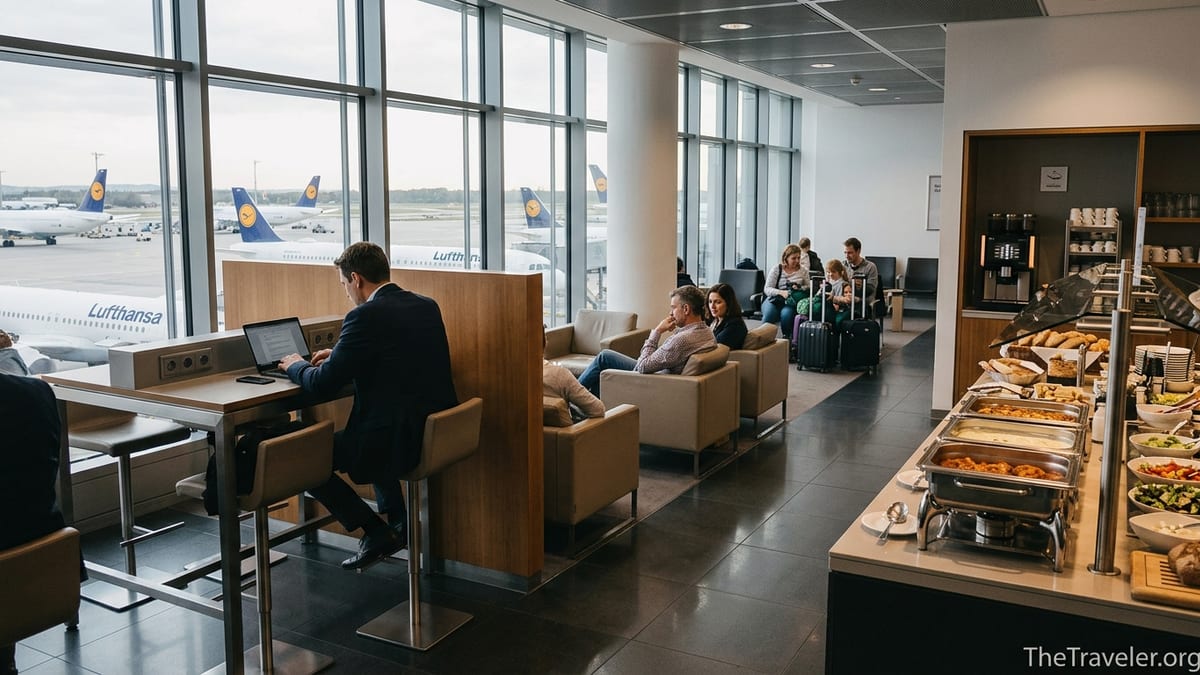
Lufthansa’s flagship lounges in Frankfurt and Munich set expectations for the wider network. In Terminal 1 at Frankfurt, for example, Business Lounges usually offer a buffet with hot dishes such as pasta, soups and German-style meatballs, cold salads, pretzels, self-serve coffee machines and beer on tap. Showers are available in several locations, and seating ranges from bar stools near the buffet to quieter armchairs with tarmac views. The Senator Lounges add upgraded spirits, often slightly better wines and somewhat calmer work corners, along with more abundant power outlets.
At peak times, though, these amenities can feel stretched. Travelers connecting through Munich’s Terminal 2 on busy mornings frequently report lines at the reception desk, delays for shower rooms and difficulty finding a free seat near a power socket. On a 7:30 a.m. departure to London, for example, you might find yourself wandering for several minutes with a plate of scrambled eggs in hand, hunting for any empty spot. Food and drink quality typically remains consistent, but the quiet, private oasis image that lounges project can clash with the reality of a crowded gate area with a door on it.
Quality can also vary dramatically outside Lufthansa hubs. In some outstations, such as medium-size European airports, Lufthansa contracts with independent lounges instead of operating its own. In these cases, a Business Class boarding pass or Senator status may still get you in, but the product might be a small room with packaged snacks and basic drinks rather than the full buffet and showers you expected from Frankfurt marketing photos. When you are planning a long layover in an unfamiliar city, this difference matters a lot in deciding whether to rely on the lounge as your main refuge.
Access Rules That Can Make or Break Your Plans
Whether you should trust Lufthansa lounges largely comes down to how stable and clear the access rules are for your situation. The simplest scenario is a long-haul Lufthansa Business or First Class ticket out of Frankfurt or Munich: you can generally assume you will get into at least a Business Lounge, and First Class passengers on Lufthansa itself are steered toward First Class Lounges or the First Class Terminal if departing from Frankfurt. Under those circumstances, building in a few extra hours to enjoy a sit-down meal and a shower before a night flight is usually a safe bet.
Things get more complicated when you rely on status or credit cards. Miles & More Senators and HON Circle members have dependable access to Senator or First Class Lounges when flying on Lufthansa Group or Star Alliance, but the guesting rules can be confusing. A Senator can normally bring one guest on the same flight, but at crowded times staff may nudge guests toward a Business Lounge instead. A Frequent Traveller with Economy tickets might be able to access a Business Lounge alone but be asked to pay extra for a companion or be turned away entirely if the lounge is at capacity. If you are planning to meet colleagues, these nuances can derail the idea of “we’ll all work from the lounge before the flight.”
Credit card access has become especially volatile. For several years, American Express Platinum and Centurion cards offered entry to selected Lufthansa Business and Senator Lounges in Frankfurt and Munich for cardholders on same-day Lufthansa Group flights. In 2026, Amex and Lufthansa announced that this partnership will end on October 1, 2026, and recent reports suggest that guest access is already tightly restricted. That means a traveler connecting through Munich on a discounted Economy fare with an Amex Platinum can enjoy the lounge today, but someone planning a similar trip in late 2026 cannot count on that benefit at all. If you are booking flights months ahead specifically to “use the lounge with my Platinum card,” you are taking a real risk.
Paying for Access: Is It Worth It?
Lufthansa has experimented with paid lounge access for Economy and Premium Economy passengers, especially on long-haul routes. In some cases you may be able to buy entry at the door in Frankfurt or online in advance for around 25 to 50 euros per person, though this is not universally available and has been withdrawn at certain terminals. For instance, travelers have reported that buying access in Munich’s Terminal 2 at the door is no longer possible, even though similar paid access at Frankfurt remained available at that time. Policies can change by terminal and season, often without much fanfare.
To judge whether paid access is worth trusting, compare it to alternatives in that specific airport. In Frankfurt Terminal 1, a typical airport restaurant meal with a main course and a drink can easily run 25 to 30 euros per person. If lounge entry costs about the same, and you also value showers, a place to recharge devices and a quieter atmosphere, paying for access before a six-hour layover between New York and Johannesburg can be good value. On a short, 90‑minute wait before a domestic hop to Berlin, you might barely have time to sit down before boarding starts, making that same fee feel wasteful.
At outstations, paid access requires even more scrutiny. Suppose you are departing from a smaller European airport served by Lufthansa and are offered a generic “business lounge” pass during online check-in for 30 euros. If the lounge is a contract operation with limited hot food, no showers and cramped seating, that money might be better spent on a decent café meal and a walk through the terminal. Without clear, up-to-date descriptions or reviews of the exact lounge at that airport, treating paid access as a guaranteed premium experience is risky. When in doubt, assume the standard is closer to “quiet waiting room with snacks” than to Lufthansa’s flagship lounges.
Overcrowding, Closures and the Risk of Disappointment
One of the biggest reasons not to over-trust any lounge, including Lufthansa’s, is capacity. As premium cabins sell well and more travelers earn elite status or hold premium credit cards, lounges that were designed for a smaller share of passengers are struggling with crowding. Travelers through Frankfurt and Munich in 2025 and 2026 repeatedly mention having to queue at reception, waiting for shower availability, or being turned away temporarily because a lounge is full. In peak morning banks before North American departures or Sunday evenings before the workweek, you may find the experience hardly calmer than the main terminal.
Operational disruptions can also catch you off guard. Renovation work, staffing shortages or local regulations can force Lufthansa to close a lounge or reduce its hours with relatively short notice. At a secondary airport, that might mean your expected Business Lounge is replaced with vouchers for a restaurant or bar, or that you are redirected to a crowded contract lounge shared with several other airlines. Even in hubs, particular lounge zones may close earlier than the airport’s last departures, leaving late-night passengers without the refuge they planned around.
Real-world examples highlight how this affects trip planning. Imagine a traveler connecting through Munich with a four-hour layover before a long-haul flight to Singapore, counting on the Senator Lounge for a shower and a quiet workspace. If their inbound flight is delayed and they arrive during an unexpected rush, they may find a line of people waiting for showers and every power outlet already plugged. Alternatively, a family that bought lounge access in advance for a holiday flight might discover on arrival that the lounge has limited seating, with children squeezed onto luggage near the snack bar. These scenarios do not make Lufthansa lounges bad, but they do reinforce that you should think of lounge access as a “nice to have” rather than a promise of serenity.
Comparing Lufthansa Lounges to Other Options
Evaluating whether to trust Lufthansa lounges also means comparing them with realistic alternatives in the same airport. In Frankfurt and Munich, many terminals now feature decent landside and airside restaurants, coffee bars and even co-working-style areas. A traveler with a Priority Pass card might be able to access an independent lounge or order à la carte dining credit at a participating restaurant instead. In some cases, a modern café with large windows and plenty of outlets can offer a more pleasant, less crowded environment than a packed Business Lounge with no free seating near the windows.
For those who hold airline-specific lounge memberships or premium credit cards focused on other networks, the equation shifts again. A United Club member connecting from a United flight to a Lufthansa segment in Frankfurt may find that their membership does not grant access to Lufthansa-branded lounges, especially after several airlines tightened reciprocal access in 2025 and 2026. On the other hand, a Star Alliance Gold member with status from a non-Lufthansa program, such as Air Canada or ANA, can often access Lufthansa lounges when flying on Star Alliance itineraries, even in Economy. In that case, relying on Lufthansa lounges might be more logical than chasing separate memberships or passes.
There are also non-lounge strategies to improve your airport time. At Frankfurt, some travelers combine a DB Lounge visit in the long-distance rail station with a quick meal in the terminal, especially if they arrive by ICE train several hours before an intercontinental flight. Others prefer to spend money on a short-stay airport hotel with a day room and guaranteed shower rather than gamble on lounge crowding. If you are traveling as a family of four, a 90‑euro day room at an airport hotel with beds and a private bathroom may feel like better value than four 30‑euro lounge passes that deliver only snacks and a fight for seats.
When You Should and Should Not Rely on Lufthansa Lounges
The pattern that emerges from recent experience is nuanced. Lufthansa lounges are generally worth trusting as part of your plan when you are flying Business or First Class on Lufthansa or SWISS from a major hub, or when you hold solid Miles & More status such as Senator or HON Circle and are traveling on a Star Alliance itinerary. Under those circumstances, you can reasonably expect to get in, find decent food and drink, and access showers on most days, even if it is busier than the marketing photos suggest. If you build a two- to three-hour buffer for a long-haul departure, you are likely to extract real value from the lounge.
You should be more skeptical in three types of situations. First, when your access hinges on a partnership that is already scheduled to end, such as American Express Platinum’s access to Lufthansa lounges in Frankfurt and Munich after October 1, 2026, it is unwise to book tickets far in advance assuming that benefit will still be there. Second, when you are relying on paid access at specific terminals where policies have been inconsistent, such as Munich’s Terminal 2, you should assume rules might change or access might be restricted during peak times. Third, when you are traveling from a small station with a contract lounge, expect something closer to a comfortable waiting room with light snacks than to a full “German hospitality plus restaurant-quality food” experience.
In practice, this means using Lufthansa lounges as an upside, not as the foundation of your travel plans. If you are traveling with kids, assume you will need a backup plan for meals and entertainment in case the lounge is full or underwhelming. If you must join a critical video call, consider booking a day room or a co-working space in addition to relying on lounge Wi‑Fi and power. If your goal is a shower after an overnight flight to Frankfurt, check in advance whether the Welcome Lounge is operating on your arrival day and time, and budget for the possibility of using a paid shower facility or airport hotel gym instead.
The Takeaway
Lufthansa lounges, particularly at Frankfurt and Munich, remain among the more reliable and better-equipped airline lounges in Europe. For many travelers in premium cabins or with solid Star Alliance status, they deliver exactly what you hope for: a comfortable seat, hot food, strong coffee, a shower and a break from the gate crowds. Used with realistic expectations, they can turn a long layover or pre-flight wait into a far more pleasant part of the journey.
At the same time, changing access rules, especially around credit card partnerships, increasing crowding and uneven quality at some outstations mean that you should be cautious about treating Lufthansa lounge access as a guaranteed anchor of your travel day. The more your access depends on fine print or third-party arrangements, the less wise it is to book flights or design itineraries around it. For most travelers, the smartest approach in 2026 is to see Lufthansa lounges as a valuable bonus when the stars align, rather than as a promise on which your whole airport experience depends.
FAQ
Q1. Who gets free access to Lufthansa Business Lounges?
Business Class passengers on Lufthansa Group airlines typically receive free access to Business Lounges, as do Miles & More Frequent Travellers and many Star Alliance Gold members when flying on qualifying same-day flights.
Q2. How can I access Lufthansa Senator Lounges?
Senator Lounges are usually reserved for Miles & More Senators, HON Circle members and Star Alliance Gold passengers, plus some Business and First Class travelers, depending on the exact route and crowding.
Q3. Do Lufthansa Premium Economy tickets include lounge access?
Premium Economy tickets on Lufthansa generally do not include lounge access by default; you need eligible status, a qualifying credit card arrangement or a separate paid lounge pass.
Q4. Can I buy Lufthansa lounge access if I fly Economy?
In some airports, especially Frankfurt, Economy passengers can purchase access at the door or in advance, but availability, prices and rules vary by terminal and can change without much notice.
Q5. Will my American Express Platinum card get me into Lufthansa lounges?
As of 2026, Amex Platinum cardholders can access selected Lufthansa lounges in Frankfurt and Munich when flying the Lufthansa Group, but this partnership is scheduled to end on October 1, 2026.
Q6. Are Lufthansa lounges usually crowded?
During peak travel times, especially mornings and evenings at Frankfurt and Munich, Lufthansa lounges can become very busy, with limited seating and waits for showers, so you should not assume a quiet environment.
Q7. What amenities do Lufthansa lounges typically offer?
Most Lufthansa lounges feature buffet-style hot and cold food, alcoholic and non-alcoholic drinks, Wi‑Fi, workspaces, power outlets and, at larger hubs, shower facilities and sometimes family areas.
Q8. Can I bring a guest into a Lufthansa lounge?
Guest policies depend on your status or ticket; Senators and HON Circle members can often bring one guest on the same flight, while Business Class passengers without status may have no free guesting rights or must pay a fee.
Q9. Are contract lounges used by Lufthansa as good as Lufthansa-branded lounges?
Contract lounges used at smaller airports tend to offer more basic food and space than Lufthansa’s own lounges, so you should temper expectations and not assume the same standard as Frankfurt or Munich.
Q10. Should I plan my itinerary around Lufthansa lounge access?
It is safer to treat Lufthansa lounge access as a valuable bonus rather than a guarantee; build backup options for meals, work and rest in case access is restricted or the lounge is crowded.