


More news on this day
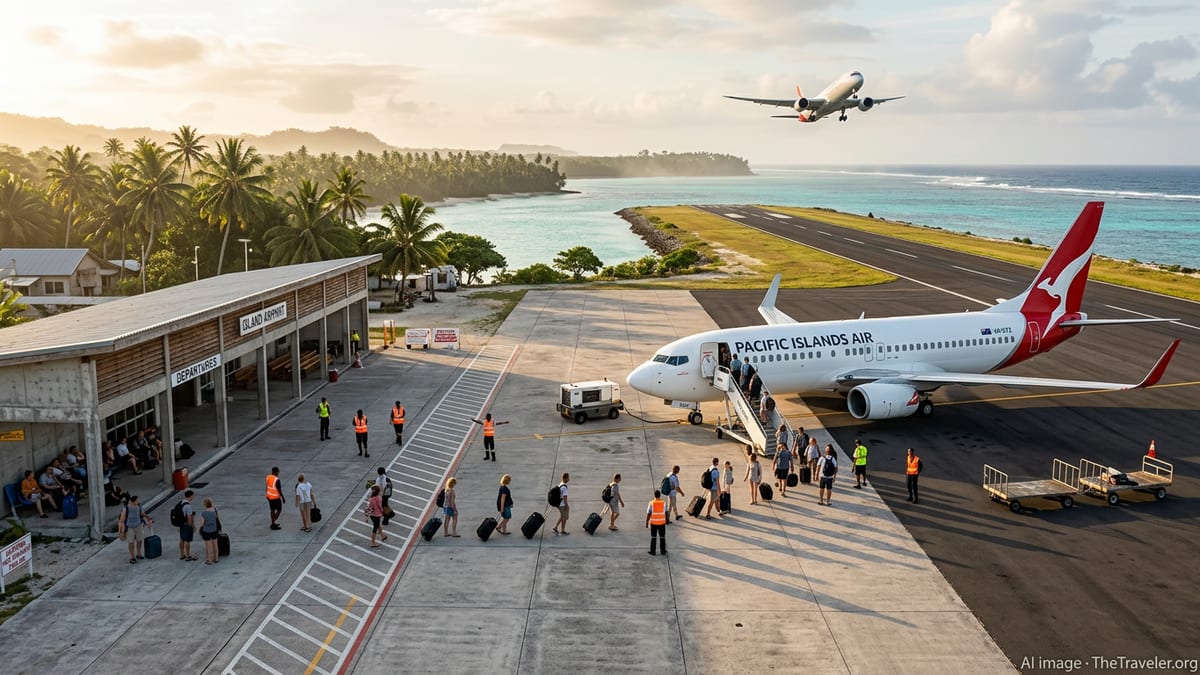
Work to upgrade Manihiki Airport in the far northern Cook Islands is gathering momentum, signalling a potential shift in tourism and connectivity for some of the Pacific nation’s most remote islands.
Get the latest news straight to your inbox!
A Long-Planned Upgrade Moves Into Focus
Manihiki, an atoll in the Northern Group of the Cook Islands, has long relied on a compacted coral runway and irregular air services that limit visitor numbers and constrain economic growth. Publicly available planning documents show that successive infrastructure strategies have identified Manihiki Airport as a priority for sealing and safety improvements, seeing it as a potential aviation hub for the wider northern archipelago.
A 2013 feasibility study on Cook Islands airports highlighted Manihiki as the most suitable Northern Group airfield for upgrade, recommending a sealed runway capable of taking larger regional turboprop aircraft. Subsequent national infrastructure plans and economic development reviews repeated those recommendations, placing airport sealing for the northern islands on the government’s medium term agenda.
More recent information from the Ministry of Infrastructure and the Cook Islands Investment Corporation points to the project moving from concept into active preparation. An environmental impact assessment specific to Manihiki Airport has been completed, and project materials describe a staged upgrade focused on runway sealing, drainage, and safety-related works, alongside improvements to terminal facilities and support infrastructure.
In parallel, budget papers and public briefings refer to earmarked funding for the Manihiki upgrade, with the project framed as part of a wider push to address long-standing infrastructure gaps between the more developed southern islands and the sparsely populated north.
Strategic Role Within the Northern Group
The Northern Group, which includes Manihiki, Penrhyn, Pukapuka, Rakahanga, Nassau and Suwarrow, is far less connected to global travel networks than the southern Cook Islands. Population is small and distances are vast, with long sea journeys and limited flights shaping daily life and making visitor access challenging. Manihiki’s central location and existing airstrip have increasingly been viewed as critical to changing that picture.
National infrastructure plans indicate that an upgraded, sealed runway at Manihiki could support scheduled services by larger aircraft, improving reliability compared with smaller planes operating on loose-surface strips. Aviation planning material notes that regional carriers have signalled potential interest in operating higher-capacity turboprops into Manihiki once safety and performance standards are raised.
Positioning Manihiki as a northern hub would not only improve direct access to the atoll itself, but could also support onward connections by boat or small aircraft to nearby islands such as Rakahanga and Penrhyn. Public reports describe this “hub and spoke” approach as a way to reduce travel costs, improve freight logistics and strengthen resilience for far-flung communities that currently depend on intermittent shipping.
For the tourism sector, the prospect of more reliable access into at least one northern island is significant. Travel guides and independent commentators often describe Manihiki as one of the Cook Islands’ last frontiers for visitors, offering lagoon scenery, black pearl farms and cultural experiences in a setting that remains almost entirely untouched by large-scale tourism.
From Coral Runway to Tourism Gateway
At present, Manihiki receives only a handful of visitors, largely due to limited flights and the high cost of travel from the capital, Rarotonga. Publicly available accounts from travellers and local stakeholders describe fares that can exceed the price of international flights, reflecting small aircraft capacity, long distances and the cost of operating in such a remote environment.
Project documentation for the airport upgrade links improved runway conditions to the possibility of larger aircraft and more consistent services, which could moderate costs over time and make short-stay tourism more feasible. Aviation assessments point out that a sealed surface would increase operational reliability in wet weather, reduce foreign object damage risks and enable more predictable scheduling for both passenger and freight flights.
Tourism analysts following developments in the Cook Islands say that any shift in access to the Northern Group is likely to favour low-volume, high-value travel rather than mass-market tourism. The atoll’s limited accommodation, fragile lagoon environment and cultural expectations around land and resource use make large visitor numbers impractical. Instead, small groups interested in diving, lagoon excursions, pearl farm visits and cultural immersion are seen as the most compatible market.
Published coverage on Manihiki’s tourism potential often highlights the atoll’s reputation as the “Island of Pearls”, referencing its history of black pearl cultivation in the lagoon. Improved air access is expected to support niche tourism built around this identity, with opportunities for visitors to learn about pearl farming, participate in lagoon outings and spend time in village communities.
Partnership Funding and Climate-Resilient Design
Financing for the Manihiki Airport project is being woven into a broader package of support aimed at strengthening infrastructure and climate resilience in the outer islands. Public statements from the Cook Islands and New Zealand governments reference the use of an infrastructure trust fund and climate finance mechanisms to back priority projects in remote communities, including energy and transport upgrades in the Northern Group.
In earlier announcements related to northern infrastructure, New Zealand committed millions of dollars to renewable energy upgrades on islands such as Manihiki, with accompanying references to potential support for airport improvements. Subsequent reports on climate resilience initiatives describe aviation and maritime infrastructure as critical lifelines for low-lying atolls that face rising sea levels, stronger storms and increasing coastal erosion.
Environmental assessments for Manihiki Airport outline design considerations that take these pressures into account, including attention to coastal processes, drainage and the management of construction impacts on the lagoon environment. The documents highlight the need to balance safety and connectivity gains against the vulnerability of a narrow atoll ring where land, infrastructure and community areas sit only a few metres above sea level.
Local development plans also emphasise that any airport works must be integrated with energy, water and telecommunications improvements, so that additional visitors do not strain already limited services. Tourism growth on the island is expected to be carefully calibrated, with visitor numbers aligned to the capacity of community-based accommodation, transport and lagoon management.
Balancing Opportunity and Isolation
The prospect of a more capable Manihiki Airport raises wider questions about how remote islands choose to engage with global tourism. The Northern Group has historically been insulated from many of the pressures seen in the southern Cook Islands, where Rarotonga and Aitutaki host the bulk of the country’s visitor nights and infrastructure investment.
Economic development reviews suggest that residents in the north are keen to see better access for health care, education and trade, while also expressing caution about sudden changes that could unsettle local life. In that context, a gradual shift driven by infrastructure upgrades, modest tourism activity and improved freight links is often portrayed in planning documents as the most sustainable path.
If the Manihiki project continues to advance, the atoll could become an important test case for how small Pacific communities can use targeted aviation investments to unlock new forms of tourism without sacrificing environmental and cultural integrity. The combination of a sealed runway, strengthened energy systems and tighter integration with national transport networks may give the island more control over when and how visitors arrive.
For now, Manihiki remains among the Cook Islands’ most isolated destinations, reached by infrequent flights and rarely included on mainstream itineraries. The ongoing progress around its airport, however, suggests that this remote atoll may soon occupy a more prominent place on the country’s tourism map, reshaping perceptions of what is reachable in the far north of the Cook Islands.