


Montenegro’s short Adriatic coastline squeezes in an extraordinary variety of beaches, from pink-tinged pebble bays below stone villages to long sweeps of true sand where kitesurfers skim the horizon. This guide focuses on the stretches you are most likely to weigh up on a first or second trip, with clear explanations of sandy versus pebble beaches, where to park, and which towns make the best bases for exploring the coast.
Get the latest updates straight to your inbox!
Understanding Montenegro’s Coast: Sand vs Pebbles and How Beaches Work
The first surprise for many visitors is that most classic postcard beaches in Montenegro are not soft sand but fine pebbles or a sand-and-gravel mix. Spots such as Sveti Stefan, Mogren and much of the Budva Riviera shimmer with small, rounded pebbles that make the water incredibly clear yet feel different underfoot than the long sand strands people often expect. True sand dominates only in a few areas, particularly around Ulcinj’s Velika Plaža, parts of Bečići and several coves on the Luštica Peninsula.
Practically, this means packing water shoes if you plan to swim around Budva, Petrovac or most Luštica coves. You might walk comfortably barefoot on the damp pebbles at the shoreline, but entering and exiting the sea is easier with light reef shoes, especially for children. In return, the pebble and gravel mix keeps the water limpid even on busy days, which is why photos of Mogren or Queen’s Beach near Sveti Stefan can look almost unreal in their clarity.
Montenegro’s beaches operate on a mix of paid and free zones. A typical organized section rents two sunbeds and a parasol for roughly 15 to 25 euros per day on popular Budva Riviera beaches in high season, and sometimes less on quieter stretches. At prestige locations beside luxury hotels, like the public side of Sveti Stefan beach, prices can be substantially higher, while simpler family areas in Ulcinj or Petrovac are often cheaper, especially outside late July and August.
Parking is another factor that shapes your beach choices. Large, accessible bays such as Jaz and Velika Plaža have structured parking areas where you can expect to pay a few euros for the day. In or near busy towns like Budva and around Sveti Stefan, private lots and informal spaces signed by local residents are common in summer, usually charging by the hour or a fixed daily fee. Away from the hubs, many Luštica coves and smaller wild beaches rely on gravel tracks and limited roadside parking, rewarding early arrivals with easier access.
Sveti Stefan and the Surrounding Coves: Iconic Views and Pricey Sunbeds
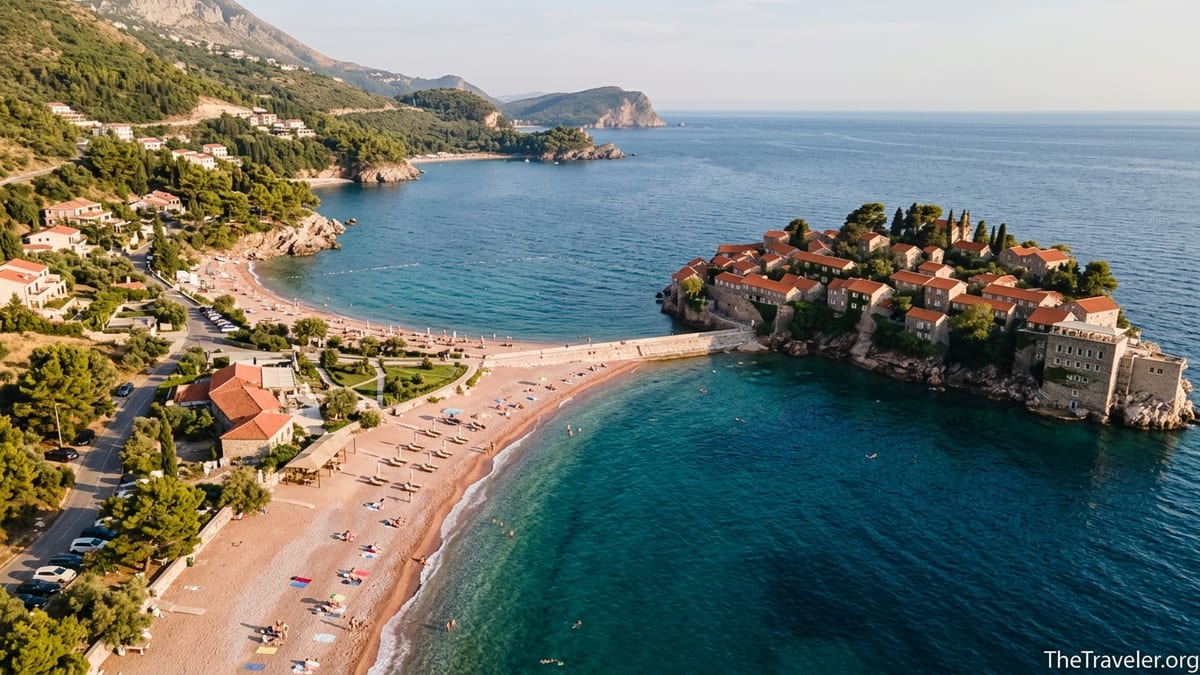
Sveti Stefan is the image that sells Montenegro: a tiny fortified island of stone houses and terracotta roofs, linked to the mainland by a narrow causeway of pale pink pebbles. The islet functions as an exclusive resort, and the island itself is reserved for hotel guests and occasional prearranged tours, but the flanking beaches remain public, creating one of the most spectacular yet accessible sea swims on the coast.
The main Sveti Stefan beach on the village side is a broad arc of smooth, pink-tinged pebbles and coarse sand. The water is usually calm in the sheltered bay, with a fairly quick drop-off that suits confident swimmers. Organized zones occupy much of the space in peak summer, with sunbed sets here among the most expensive in Montenegro, often several times the Budva average, reflecting both the scenery and the association with the luxury resort. A free public strip typically runs along part of the shoreline, so you can still enjoy the view with just a towel if you are content to share space.
Walking south on the coastal path from Sveti Stefan brings you in around fifteen minutes to the coves of Miločer and the more secluded Queen’s Beach. These pebbly bays sit below a forested park and former royal villa, with water so clear that individual stones on the seabed are visible even on busy August days. Queen’s Beach itself usually remains reserved for resort guests when the hotel is operating, but the setting illustrates what makes this stretch special: a series of small, fragrant coves framed by pines and cypresses rather than tower blocks.
Parking around Sveti Stefan is limited and fills quickly in July and August. Expect to pay several euros for a place in one of the private lots lining the main road above the village, or use buses from Budva and Petrovac, which stop near the access path to the beach. For independent travelers with a car, a realistic strategy is to arrive early, swim or photograph Sveti Stefan before day-trippers arrive, then continue along the coastal road to quieter spots such as Drobni Pijesak or Petrovac for the rest of the day.
Mogren, Jaz and Bečići: The Budva Riviera’s Big-Hitting Beaches
The Budva Riviera concentrates some of Montenegro’s liveliest and most varied beaches within a relatively short hop of one another, making Budva a practical base if you want to sample different atmospheres without constant hotel changes. Within a fifteen-minute drive you can move from the dramatic cliff-backed coves of Mogren to the festival field of Jaz or the family-friendly sands of Bečići, which is why many visitors settle here for a week and then day-trip to Kotor, Sveti Stefan or Petrovac.
Mogren actually consists of two small coves west of Budva’s old town, connected by a short tunnel cut through the rock. The beach surface is a mix of fine pebbles and coarse sand, backed by steep cliffs and accessed by a scenic coastal walkway from the town. Facilities typically include a bar or two and organized sunbed sections, but the coves remain fairly compact, so they feel crowded in high season. On the positive side, the proximity to Budva’s old town means you can combine a morning stroll on the city walls or coffee on the square with a midday swim just fifteen minutes’ walk away.
Jaz, about 2.5 kilometers northwest of Budva, is one of the largest beaches on the Montenegrin coast, an arc of around 1.2 kilometers of mixed sand and fine pebble facing the open Adriatic. This is a classic all-purpose beach: there are broad organized zones with reasonably priced sunbeds, beach bars serving simple grilled fish, salads and burgers, a campsite at the western end, and plenty of space to spread out a towel between the concessions. The gently shelving seabed suits families, while older kids and adults have access to jet skis and other water sports in peak season. Large car parks behind the beach typically charge a modest daily fee, and in summer small boats shuttle between Budva harbor and Jaz for those without a car.
Bečići stretches east from Budva for about two kilometers and is one of the coast’s rare predominantly sandy bays, though the surface is usually described as a soft sand and fine gravel mix rather than powder. The strand is quite wide, which allows hotels and guesthouses to line the back of the beach without totally overwhelming it, and organized zones alternate with free strips. Facilities are extensive, from paddleboard rentals to kids’ play areas, and the calm shallow water appeals to families and less confident swimmers. You can walk along the seafront promenade all the way from Budva, through Rafailovići to the small cove of Kamenovo, making it easy to beach-hop on foot.
Petrovac and Nearby Bays: A Softer Side to the Budva Coast
South of Sveti Stefan, Petrovac offers a quieter, more small-scale alternative to Budva while still providing an attractive town beach and easy access to several scenic coves. Petrovac’s main strand curves for roughly 600 meters below a waterfront promenade of low-rise hotels, cafes and ice-cream stands. The surface is mostly fine reddish pebbles, gentle enough underfoot for children, with a shallow entry into the sea. Sunbed rentals are generally more affordable here than at Sveti Stefan or central Budva, and a short paved strip at the western end gives access for strollers and people who prefer to avoid stairs.
From the seafront, small excursion boats run out to the islets of Katič and Sveta Nedjelja, combining sightseeing with swims in deeper water away from the town. For independent explorers, nearby coves such as Lučice and Perazića Do are the real draw. Lučice, about a twenty-minute walk or a brief taxi ride over the low headland, is a picturesque bay backed by pines, with clear water and a steeper drop-off than Petrovac’s town beach. Perazića Do, reached by road or a scenic coastal path in around half an hour, feels more dramatic, with a narrow beach squeezed below cliffs and largely undeveloped surroundings, though sea conditions can be livelier.
Petrovac works well as a base if your priority is relaxed days on the beach rather than nightlife. Accommodation tends to be more low-key, with family-run apartments and modest hotels in the streets behind the seafront, and parking is generally easier than in Budva, though midsummer still sees the central spaces fill quickly. Buses connect Petrovac with Budva and Bar, and if you hire a car you can reach Sveti Stefan, Drobni Pijesak and the quieter coves to the south in fifteen to thirty minutes, making it a convenient middle point between the busier and wilder stretches of coast.
Velika Plaža and the Ulcinj Coast: True Sand and Wide Horizons
Travel further south toward the Albanian border and Montenegro’s coastline changes character. Around the old town of Ulcinj, the cliffs and pebble bays give way to long, open beaches of genuine sand, culminating in Velika Plaža, literally Long Beach, which runs roughly 12 to 13 kilometers along a low, dune-backed shore. This is the best choice in Montenegro if your ideal day involves walking barefoot on soft sand, paddling in shallow warm water and watching a broad sunset over the open Adriatic.
The northern end of Velika Plaža near Ulcinj town has a cluster of organized beach clubs with sunbeds, casual restaurants and simple hotels or apartment complexes. Farther along, sections become progressively quieter, with patches of undeveloped dunes in between beach bars and kitesurfing centers. The water remains shallow far from shore, making this area popular with families and beginners on boards, though the onshore afternoon breeze and waves can make swimming feel rougher than in sheltered Budva bays. For many visitors, it is enough to drive or take a taxi to one of the mid-beach clubs, rent a pair of loungers for a modest fee, and spend the day alternating between swims, sunbathing and long beach walks.
Compared with the Budva Riviera, Velika Plaža feels more spacious and less vertical, with low-rise development and a more relaxed, sometimes bohemian atmosphere. Prices for food and drink are often slightly lower than in Budva, and parking is typically straightforward: many beach clubs and sections have their own gravel lots, charging a small daily fee or rolling it into sunbed rental. The trade-off is that you are further from the concentration of historic towns like Kotor or Budva, so Velika Plaža works best as a base if your priority is uncrowded sand and kitesurf-friendly afternoons rather than cultural sightseeing.
Ulcinj itself has a distinctive character, with a predominantly Albanian population and a hilltop old town that feels different from the Venetian-influenced centers farther north. The small city beach below the old town is convenient but crowded in high season, so many visitors combine an evening stroll and dinner in town with days spent at Velika Plaža or at smaller nearby coves such as Valdanos, where a shingle beach nestles among ancient olive groves. Having a car here increases your options significantly, though taxis between Ulcinj and Long Beach are common in summer and relatively inexpensive for short hops.
Luštica Peninsula and Hidden Coves: Clear Water, Rough Roads
The Luštica Peninsula, marking one side of the Bay of Kotor’s mouth, collects some of Montenegro’s clearest waters and most atmospheric small coves. This is where you come if you want to swim off white pebbles into bright turquoise water, lunch at a simple seaside konoba, and then watch boats heading to the famous Blue Cave while you stay put in the quieter bay. The trade-off is that many of the best spots require driving narrow rural roads, accepting limited parking and sometimes walking down steep paths.
One of the best-known exceptions, because it is both beautiful and relatively accessible, is Plavi Horizonti, a shallow sandy bay bordered by pine forest. The sand here is finer than on most of the Budva Riviera and the seabed remains shallow for tens of meters, making it extremely popular with families from Tivat and Kotor. In summer there are organized sunbed zones, a beach bar and simple facilities, with parking in a large lot behind the trees. It can feel busy in peak season but still far less urban than Slovenska Beach in Budva or the central seafronts of larger towns.
On the outer, more exposed side of Luštica, beaches such as Žanjice, Mirište and the smaller coves nearer the Blue Cave offer classic pebble entries and luminous, deep water. These are often reached by boat from Herceg Novi or Kotor rather than by car, especially in high season when the narrow coastal road clogs and parking spaces near the water disappear early in the day. Smaller rocky spots like Veslo or the wild bay of Dobreč are even more secluded, with no large developments onshore and services limited to a seasonal restaurant or beach bar at most.
Because Luštica’s best coves often rely on boat transfers or rough tracks, it is wise to treat them as day trips rather than as your only beach option for a short holiday. Base yourself in Kotor, Tivat or Herceg Novi, then book a small-boat excursion that stops at a couple of swimming spots and the Blue Cave, or drive early in the morning to Plavi Horizonti or Žanjice and plan to stay for several hours. Compared with Budva, sunbed prices on Luštica are usually similar or slightly lower, but fuel and boat excursions add to the total cost of a day out.
Best Beach Town Bases: Budva, Petrovac, Ulcinj and Beyond
Choosing the right base is as important as picking individual beaches. Budva is the most obvious hub, with a walled old town, lively nightlife and bus connections that fan out to Jaz, Bečići, Sveti Stefan and Petrovac. If you stay in or near Budva, you can reach several of Montenegro’s headline beaches within a 30-minute drive or short bus ride, and organized excursions connect you to Kotor, Skadar Lake and even day trips into the mountains. The downside is summer congestion, with traffic jams on the coastal road and higher prices in July and August.
Petrovac, by contrast, feels more compact and family oriented, with a calmer evening scene yet easy road access north to Sveti Stefan and Budva, and south to Bar and Ulcinj. Staying here suits travelers who want a walkable town with a pleasant beach, a few good seafood restaurants and simple day trips rather than nightclubs or shopping malls. You can still drive or bus into Budva for a livelier night out, but many visitors are content to spend evenings on the seafront promenade and prioritize exploring the local coves.
Ulcinj works best for those who place a premium on sand and space over architectural charm. The town’s hillside streets and small old quarter are appealing, but the main draw is Velika Plaža and the relaxed, sometimes music-heavy beach clubs that dot its length. This is a good base for kitesurfers, families who value shallow water and runners who enjoy long uninterrupted stretches of sand for early-morning exercise. Because the town lies further from the main concentration of resorts, prices for accommodation and day-to-day expenses can feel more moderate than in Budva in peak season.
Farther north, towns such as Kotor, Perast and Herceg Novi are primarily known for their bayside promenades and historic centers rather than classic wide beaches, but they still offer swimming jetties and small local beaches. For travelers who prefer to sightsee in Kotor Bay and then sample sandy beaches via day trips, a common pattern is to split time: a few nights in Kotor or Perast for culture and boat trips, followed by several nights in Budva, Petrovac or Ulcinj focused on the sea.
The Takeaway
Montenegro’s beaches resist easy ranking because they are so different from one another. Sveti Stefan is unmatched for drama, but its pebble causeway and high sunbed prices make it a place to savor for a few hours rather than a full week. Mogren and Jaz show two faces of the Budva Riviera, one intimate and cliff-framed, the other open and sociable. Bečići and Petrovac deliver family-friendly shallows with plenty of facilities, while Velika Plaža in Ulcinj remains the country’s purest expression of long, sandy freedom.
If your priority is soft sand and room to spread out, focus on Ulcinj’s Long Beach, Plavi Horizonti on Luštica and the sandier stretches of Bečići. If you care more about scenery and clear water than about the feel under your feet, you will likely fall for Sveti Stefan’s outlook, Queen’s Beach and the pebble coves of Luštica. Travelers who want nightlife within walking distance should gravitate toward Budva, while those who prefer a softer rhythm can base themselves in Petrovac or Ulcinj and visit busier hubs only when the mood strikes.
Whatever you choose, plan for summer crowds between mid-July and late August, arrive early to secure parking at headline beaches, and keep a pair of light water shoes in your bag. With a little strategy and realistic expectations about sand versus pebbles, Montenegro’s compact coastline reveals a string of bays and coves that feel remarkably varied for such a small country, rewarding both first-timers and repeat visitors who come back to chase a favorite cove or discover a new one.
FAQ
Q1. Are most Montenegro beaches sandy or pebble?
Most of Montenegro’s beaches are fine pebble or a sand-and-gravel mix, especially around Budva and Kotor, with true sand concentrated near Ulcinj and at a few specific bays.
Q2. Which beach in Montenegro has the best soft sand?
Velika Plaža near Ulcinj offers the longest run of soft sand, while Plavi Horizonti on Luštica and much of Bečići near Budva also have comfortable sandy or sand-mix surfaces.
Q3. Where should I stay for easy access to several famous beaches?
Budva makes the most practical base, with regular buses and short drives to Mogren, Jaz, Bečići, Sveti Stefan and Petrovac, plus many accommodation and dining options.
Q4. Is parking difficult at popular beaches like Sveti Stefan and Jaz?
At Sveti Stefan and central Budva beaches, parking can be tight and relatively pricey in high season, while Jaz and Velika Plaža generally have larger paid lots with easier access.
Q5. Are Montenegro’s pebble beaches suitable for children?
Yes, many pebble beaches have gentle entries and clear, calm water, but children are usually more comfortable with light water shoes, especially at Mogren, Petrovac and Luštica coves.
Q6. Which beach town is best for a quieter family holiday?
Petrovac and parts of Ulcinj are good choices for families wanting calmer evenings, walkable town beaches and easy day trips to nearby coves and sandier stretches.
Q7. Do I need a car to enjoy Montenegro’s best beaches?
A car gives maximum flexibility for reaching hidden coves, but between Budva, Petrovac and Ulcinj many main beaches are accessible by bus, taxi or, in some cases, small boat.
Q8. How expensive are sunbeds on Montenegro beaches?
On busy Budva Riviera beaches, a pair of sunbeds with an umbrella typically costs around 15 to 25 euros per day, with higher rates at prestige spots and lower prices on quieter strands.
Q9. When is the best time to visit Montenegro for beaches?
Late June, early July and September usually balance warm sea temperatures with lighter crowds, while mid-July to late August is the hottest and busiest period on the coast.
Q10. Are there still quiet coves in Montenegro during peak season?
Yes, but you usually need to arrive early, walk a little or take a boat; smaller Luštica bays, less-developed sections of Velika Plaža and coves near Petrovac can stay relatively calm even in August.