


New Year’s Eve 2026 to 2027 will again see major cities compete to put on the most spectacular show. From tightly managed fireworks on Sydney Harbour to the controlled chaos of Times Square, understanding how public events, hotel prices, transport and crowd management actually work on the ground can make the difference between a magical night and a stressful misadventure. The destinations below stood out in recent years for scale, organization and atmosphere, and current plans indicate they will be among the top choices for welcoming 2027.
Get the latest updates straight to your inbox!
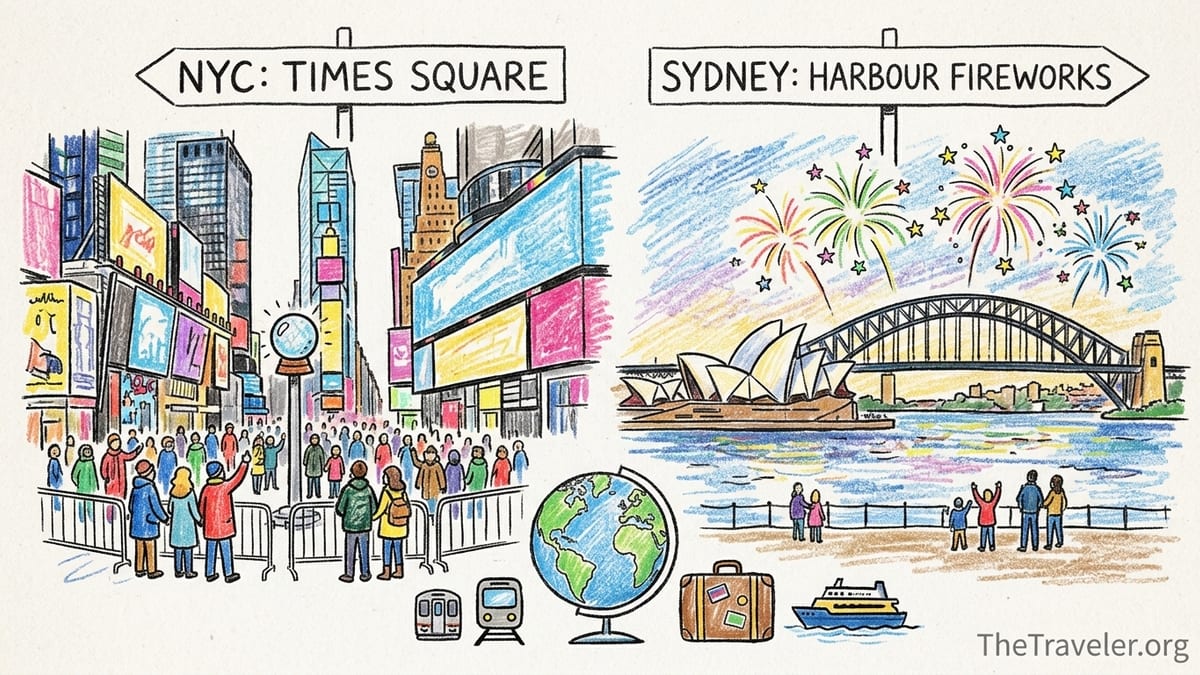
New York City: Times Square and Beyond
New York’s Times Square ball drop remains one of the world’s most watched New Year’s Eve spectacles, with hundreds of thousands crowding the blocks around One Times Square and millions more tuning in on television. The Times Square Alliance and New York City authorities treat the event as a large-scale security operation, closing streets to traffic from the afternoon and funneling pedestrians into steel barricaded viewing “pens.” Official schedules in recent years show entertainment beginning around 6 p.m., when the illuminated crystal ball is raised, with musical performances and confetti interludes running right up to the midnight countdown.
There are no tickets for the public ball drop area itself. Access is free but strictly first come, first served, with security checkpoints screening for alcohol, large bags and umbrellas as people enter the pens. City agencies and eyewitness accounts from recent celebrations indicate that serious viewers often arrive by midafternoon to secure a spot with a direct sightline, and once inside they cannot leave for bathrooms or food without forfeiting their place. New York Police Department officers manage each pen’s capacity and begin turning people away from the most central blocks well before 10 p.m., redirecting latecomers to side streets with partial views or encouraging them to watch from nearby bars and hotels.
Accommodation around Times Square on 31 December is priced accordingly. A recent comparison of hotel costs for New Year’s Eve 2026 found that top centrally located properties in New York were among the most expensive studied, with median rates several times higher than equivalent January midweek stays. Luxury hotels overlooking the square often impose multi night minimums around the holiday, and party packages with direct ball views can exceed one thousand dollars per person, as seen in recent rooftop and terrace events marketed by large properties such as the Marriott Marquis. Travelers willing to stay in Midtown East, Long Island City or Brooklyn often find significantly lower rates and can still reach Times Square by subway in under 30 minutes.
Public transport is the most realistic way to reach and leave the celebration. The Metropolitan Transportation Authority runs subways and many buses through the night, although several stations around Times Square may be exit only or closed for crowd control close to midnight. City guidance in recent years has warned against driving anywhere near Midtown, with extensive road closures and parking restrictions. After the countdown, police move quickly to clear the square, and many revelers are back on trains within 30 to 45 minutes. Those who prefer slightly less intensity can opt for organized New Year’s cruises on the Hudson or East River, or neighborhood fireworks and parties in Brooklyn, the Bronx or Queens, all of which offer a more relaxed but still distinctly New York experience.
Sydney: Harbour Fireworks and Integrated Transport
Sydney is one of the first major cities to welcome the new year, and its harbour fireworks are consistently among the most visually impressive in the world. Official information from the New South Wales government and City of Sydney shows that for New Year’s Eve 2026, programming around the harbour includes early evening projections, a “Calling Country” fireworks display at 9 p.m. and the main midnight fireworks launched from Sydney Harbour Bridge, barges and city skyscrapers. In recent years more than one million people have spread out around the foreshore to watch, and a similar turnout is expected for the 2026 to 2027 event.
Crowd and waterway management are taken very seriously. The state’s maritime authorities publish special navigation maps for the night, designating exclusion zones where private vessels cannot anchor and controlled areas with timed access. On land, local councils such as North Sydney manage ticketed vantage points in parks like Bradfield Park and Blues Point Reserve, which offer sought after bridge and Opera House views and commonly reach their safe capacity early in the evening. Service NSW and the City of Sydney provide an interactive vantage point map to show viewing areas, accessibility features, alcohol rules and approximate crowding levels so visitors can avoid bottlenecks.
New South Wales public transport planners treat New Year’s Eve as a major event in the same category as large sporting finals. For 31 December 2026, the transport agency has already outlined additional late night train, light rail and bus services into and out of central Sydney, along with temporary changes such as closed city centre stations and special event bus stops around the harbour foreshore. Roads in the central business district and on approach routes to the bridge are progressively closed to private cars through the afternoon and early evening. Visitors are strongly encouraged to use trains or ferries in and out of the core, and to walk between vantage points once in the harbour area.
Hotel prices in Sydney’s central districts spike for the night of 31 December. One recent survey of New Year’s Eve 2026 accommodation found the city among the most expensive of six global destinations studied, with median rates at selected central hotels significantly higher for New Year’s Eve than three weeks later in January. Harbour view hotels in The Rocks and Circular Quay can charge several hundred dollars more than usual, and some bundle access to private terraces or rooftop parties where guests can watch the fireworks without braving the largest crowds. Staying in inner suburbs such as Surry Hills, Newtown or North Sydney can reduce costs while keeping travel times to main vantage areas to 15 to 30 minutes by public transport.
London: Ticketed Fireworks on the Thames
London’s New Year’s Eve fireworks on the Thames have evolved into a tightly managed ticketed event. Following years when uncontrolled crowds overwhelmed the riverfront, the Greater London Authority moved to a paid ticket model for central viewing areas. Recent editions, including the 2023 to 2024 and 2024 to 2025 shows, allocated around 100,000 tickets split across zones along Victoria Embankment, the South Bank and Westminster Bridge. Information about the 2026 to 2027 program is expected to follow the same pattern, with timed entries, dedicated viewing zones and strict limits on alcohol and large bags to keep walkways clear.
Tickets are typically released in phases in the autumn before New Year’s Eve and often sell out quickly, especially the sections with direct views of the London Eye and Big Ben. Prices in recent years have been modest by big event standards, roughly comparable to a concert ticket, and the income helps offset staging and security costs. Those without tickets are encouraged by authorities to watch the show on television or attend local fireworks and town hall events in other parts of the city rather than making an unnecessary trip into an already saturated central area.
London’s public transport network is central to crowd management. Transport for London traditionally runs Underground, Overground and many bus services through the night on 31 December, with some years offering free or reduced fares during particular hours, though travelers should check closer to the date for 2026 specific policies. Several central Tube stations near the riverfront are designated as exit only or closed when platforms become overcrowded, and temporary one way walking routes are set up around Waterloo, Embankment and Westminster to prevent gridlock. River services and special late night trains to airports like Gatwick and Stansted give visitors options to return to hotels far from the city centre without relying on cars.
Hotel patterns mirror other capital cities. Properties directly on the Thames or near Trafalgar Square and Covent Garden often insist on two or three night minimum stays that include New Year’s Eve, with nightly rates on 31 December significantly above early January levels. Travelers who do not need to be in the middle of the fireworks can often secure better value in districts like King’s Cross, Shepherd’s Bush, Canary Wharf or Stratford, all of which offer fast Tube access to central London. Many Londoners themselves avoid the riverfront and celebrate in local pubs, restaurants and neighbourhood street parties, which can be appealing for visitors seeking a more intimate and less tightly controlled New Year.
Rio de Janeiro: Copacabana Beach and Oceanfront Hotels
Rio de Janeiro’s Réveillon celebration on Copacabana Beach ranks among the largest New Year’s Eve parties on the planet. In recent years the city has drawn crowds well into the millions for free concerts along the waterfront and a midnight fireworks show fired from barges just offshore. News coverage of the transition into 2026 highlighted Rio alongside Sydney and Paris as global focal points, with drone and aerial footage showing the entire curve of Copacabana lit by synchronized bursts above the Atlantic.
Managing those crowds requires extensive preparation. Rio’s municipal authorities close Avenida Atlântica, the main road behind the beach, to vehicle traffic and deploy large numbers of police officers and security guards along the sand and promenade. Designated access points and pedestrian corridors are set up to prevent crushing near the music stages and key intersections. The city also coordinates with metro and bus operators to run late night services, and special lines bring revelers from inland neighbourhoods and nearby cities to the beachfront and back again after the show.
Hotel pricing along Copacabana and neighbouring Ipanema reflects the event’s popularity. Even in ordinary years, New Year’s Eve is one of the most expensive nights of the year in Rio, and market reports for 2024 and 2025 show oceanfront hotels charging multiple times their low season rates and selling multi night Réveillon packages that include dinner and access to rooftop or poolside viewing parties. While specific 2026 tariffs vary by property and are subject to change, visitors can reasonably expect premium pricing for rooms with direct sea views. Booking well in advance and considering slightly inland neighbourhoods like Botafogo or Flamengo can bring costs back toward what a standard high season stay in Rio might look like.
Crowd behaviour at Copacabana tends to be festive but relatively relaxed, in part because people can spread out along several kilometres of beach rather than being compressed into city blocks. Families, groups of friends and tourists mingle on the sand in white clothing, a traditional Brazilian New Year custom, while music stages at different points host national and international performers. Visitors should still take standard big city precautions: keeping valuables concealed, using official taxis or app based rides from designated pickup zones, and avoiding carrying unnecessary bags that could become cumbersome in dense areas when the fireworks end and the long walk to public transport begins.
Edinburgh: Hogmanay and Managed Street Festivities
Edinburgh’s Hogmanay festival offers one of Europe’s most atmospheric New Year experiences, combining historic streetscapes, live music and fireworks above Edinburgh Castle. The modern version of the event emerged in the 1990s after informal street gatherings became too large to manage safely. Since then the city has relied on ticketing, capacity limits and professional event management to keep the celebrations controlled. The main street party on Princes Street is usually a paid entry event with a set maximum number of attendees, along with separate tickets for concerts in Princes Street Gardens and a ceilidh, the traditional Scottish dance party.
Hotel pricing data compiled for New Year’s Eve 2026 by travel analysts shows Edinburgh among the more expensive European cities for that date relative to mid January stays, reflecting the demand created by Hogmanay. Central hotels near Princes Street, the Royal Mile and the Grassmarket commonly impose minimum stay requirements, while midmarket chains on the outskirts of the city offer more moderate increases. Many visitors also book self catering apartments in neighbourhoods such as Leith or Bruntsfield and reach the centre by bus or on foot.
Edinburgh’s compact size helps with crowd management. The main party area is concentrated along Princes Street, which is closed to traffic, while local authorities put temporary barriers and staffed gates in surrounding streets to regulate the flow of people. Police Scotland and private stewards run security checks at entrances and monitor crowd density, and the city publishes detailed arrival and departure advice, including recommended walking routes, park and ride sites and last departure times for buses and trains. For those who prefer a quieter evening, community ceilidhs and pub events in districts away from the centre offer a less crowded way to take part in Scotland’s New Year traditions.
The weather in Edinburgh at the end of December is often cold, wet and windy, which shapes practical planning. Visitors should bring waterproof outer layers, hats and gloves, and expect to be outside for several hours if they want a clear view of the midnight fireworks above the castle. In recent years the city has also experimented with earlier “bairns” or children’s Hogmanay activities, including earlier fireworks and light shows, which may be of interest to families who do not want to keep young children out until midnight on 31 December.
Dubai and the Gulf: Vertical Fireworks and Strict Rules
Dubai has cultivated a reputation for extravagant New Year’s Eve displays, particularly around the Burj Khalifa and the Palm Jumeirah. The Burj Khalifa show combines fireworks, lasers and LED animations on the world’s tallest building, attracting large crowds to Downtown Dubai and the surrounding Business Bay area. In recent years nearby emirates such as Abu Dhabi and Ras Al Khaimah have also staged major New Year or national day fireworks, creating multiple options within the Gulf region for travelers seeking warm weather and large scale spectacles.
Across the United Arab Emirates, authorities manage these events with extensive security perimeters, controlled access and strict rules on behaviour. Alcohol consumption is limited to licensed venues such as hotel bars and restaurants, and it is illegal to drink on the street. Roads around key sites like Downtown Dubai are closed to non resident vehicles, and large parking lots feed shuttle buses into the event zones. Public transport, including the Dubai Metro, normally runs extended hours on 31 December, but stations closest to the Burj Khalifa can be temporarily closed when crowd numbers surge, forcing latecomers to walk longer distances.
Hotel prices in central Dubai rise sharply over New Year’s Eve, particularly in Downtown, Dubai Marina and on the Palm. Travel industry snapshots from recent years indicate five star hotels overlooking the Burj Khalifa and the Dubai Fountain commanding rates several times those of a standard January night, with gala dinner packages including set menus, live entertainment and reserved terrace seating for the fireworks. Budget conscious travelers might instead base themselves in Deira or Al Barsha and use the metro or taxis to reach central events, accepting that the return journey in the early hours will be slow as tens of thousands of people leave at once.
For visitors, the key to a successful New Year’s Eve in Dubai is to plan around the rules. Booking into a hotel or restaurant with an organized event simplifies access and transport, as staff handle permits and transfers. Those who choose public viewing areas should research which roads will close, how bag checks will work and where family zones are located. Respecting local customs and regulations is particularly important in the Gulf, where authorities have little tolerance for disorderly conduct, but well organized infrastructure and a strong focus on spectacle mean that many visitors still find it to be a memorable and comfortable way to ring in the new year.
Honolulu and Waikiki: Beachfront Celebrations with Evolving Plans
Honolulu on the island of Oahu offers a more laid back but still lively New Year’s option for travelers in the United States. Waikiki’s hotels, bars and beachfront host numerous private parties, and in some years coordinated public fireworks have been launched over Waikiki Beach or nearby harbours. In late 2026, local tourism information has noted that public fireworks for the 2026 to 2027 New Year’s Eve period had not yet been formally confirmed and advised visitors to wait for official announcements before committing to specific viewing spots.
This evolving situation reflects a broader trend in Hawaii, where environmental considerations, community concerns about noise and air quality, and the cost of large scale displays have led officials to reassess how pyrotechnic events are staged. Some celebrations have experimented with synchronized drone light shows or reduced duration fireworks, while others have shifted funding toward live music and cultural performances instead of extended pyrotechnic sequences. Travelers planning a Waikiki New Year’s Eve should monitor local government and tourism channels in the final months of 2026 to see whether a centralized public show is confirmed or whether celebrations are likely to be decentralized among hotel properties.
Regardless of the final fireworks plan, hotel and flight demand into Honolulu around New Year’s is strong. Oceanfront hotels along Kalakaua Avenue typically require several night stays that combine New Year’s Eve with adjacent dates, and room rates for that period are considerably above shoulder season levels. Many properties host their own countdown parties on rooftop bars, pool decks or ballrooms, often with Hawaiian music, buffet dinners and champagne toasts at midnight. These offer a contained environment and avoid some of the crowd management challenges found in denser urban centres, though guests should still expect queues for elevators and bars at peak times.
Transport within Waikiki and central Honolulu is relatively straightforward compared with megacities. TheBus network operates on holiday schedules, and rideshare services are widely used, though surge pricing around midnight on 31 December is common. Road closures are more limited in scope than in places like New York or Sydney, but certain blocks near major hotel events may be restricted to pedestrian traffic. For many visitors the main challenge is navigating crowds along the beachfront promenades and finding a comfortable spot with space to sit, rather than dealing with dense pen style security setups or multi hour waits.
Safety, Budgeting and Choosing the Right Celebration
Large New Year’s Eve gatherings share a few common characteristics regardless of location: road closures, heavy police presence, security screening and strains on public transport immediately after midnight. Recent years have also seen heightened attention to fire safety and crowd control, partly in response to incidents worldwide where poorly managed events led to tragedy. Cities such as Phoenix have documented increased enforcement campaigns around fireworks misuse and celebratory gunfire in the run up to the holiday, illustrating how seriously many jurisdictions now take the risks associated with the night.
For travelers, realistic budgeting is as important as choosing the right city. Independent analyses comparing hotel prices across destinations for 31 December 2026 show substantial spikes in popular New Year’s Eve cities such as Sydney, New York, Rio, Dubai and Edinburgh compared with mid January. In practice this means that a trip that seems affordable in shoulder season may require a significantly higher accommodation budget if it includes the year’s final night. Booking early, considering neighbourhoods slightly outside the main viewing zones and looking for bundled event plus hotel packages can all help manage costs.
Personal comfort and expectations should guide the final choice. Travelers who enjoy dense crowds, long outdoor waits and highly choreographed shows might gravitate toward Times Square, Sydney Harbour or Dubai’s Downtown. Those who prefer ticketed but still busy events with more structured access could find London’s Thames fireworks or Edinburgh’s Hogmanay more appealing. Visitors seeking warmth and beach atmospheres might look at Rio or Honolulu, understanding that both have their own evolving approaches to fireworks and public gatherings. In every case, checking the latest local guidance on transport, security and event timing in the weeks before departure is essential, as plans can and do change when cities respond to weather, budget or safety considerations.
However and wherever you decide to welcome 2027, thoughtful planning will pay off. Allocate enough time to reach your chosen viewing spot, dress for the local climate, keep your belongings light and secure, and have a clear plan for getting back to your accommodation once the last firework fades. The greatest New Year’s Eve memories tend to come not just from the big moments on the skyline, but from the sense of shared celebration with people around you, whether you are shoulder to shoulder in a famous square or watching distant bursts of color from a quiet hilltop just outside the city centre.