


Tivoli is often treated as a quick detour from Rome, a simple checklist of Villa d’Este and Hadrian’s Villa before racing back to the city. Yet this small hill town rewards anyone willing to slow down. Beyond the headline sights lies a dramatic river gorge, an ancient sanctuary, medieval alleys, and a lived-in historic center where everyday Tiburtini still shop, gossip, and sip espresso under ivy-covered walls. If you have even half a day more, Tivoli turns from a box to tick into a place you genuinely experience.
Get the latest updates straight to your inbox!
Soak in Nature and History at Parco Villa Gregoriana
If there is one place that changes how you think about Tivoli, it is Parco Villa Gregoriana. Managed by the Italian Environmental Fund (FAI), this romantic 19th-century landscape park plunges down into the former riverbed of the Aniene, a limestone gorge that locals once called the Valley of Hell for its roaring waters and sheer cliffs. Today the atmosphere is more quietly dramatic than infernal, but you still hear the rush of water as you follow shaded paths past mossy staircases, grottoes, and viewpoints over the town’s acropolis.
The park’s star is the Grande Cascata, an engineered waterfall of roughly 100 meters created in the 1830s when Pope Gregory XVI diverted the Aniene through tunnels to prevent catastrophic flooding. The result is one of Italy’s tallest waterfalls and a cool mist that rises from the valley on hot summer days. Simple wooden railings let you peer safely into the gorge, while small terraces provide places to sit, take photos, and simply watch the water tumble between travertine walls.
Allow at least two hours to wander the main loop, which includes the Grotta di Nettuno, an atmospheric cave shaped by the river, and the Grotta delle Sirene, with small viewpoints carved into the rock. Paths are generally well marked but involve many stairs and uneven surfaces, so sturdy shoes are more useful here than fashionable sandals. In peak season there is often a small kiosk at the entrance selling bottled water and snacks, but you should not expect full restaurant facilities inside the park itself.
Admission is typically a modest fee per adult, with discounts for EU residents under 26, children, and FAI members. Audio guides in several languages are usually available for a small extra charge and are worth considering if you enjoy context on the engineering and landscaping choices that shaped the park. Visits run mostly in daylight hours, with longer opening times in spring and summer, so this is a perfect late-morning or mid-afternoon escape from the stone and asphalt of central Tivoli.
Explore Tivoli’s Historic Center Like a Local
Step out of the ticketed world of villas and into Tivoli’s historic center and you suddenly find yourself in a real town rather than an open-air museum. The centro storico climbs the hill in layers of narrow lanes, stone staircases, and small piazzas, each with its own rhythm. The main square, often referred to as Piazza Garibaldi or Piazza Trento depending on where you stand, is the town’s social hub. Here you will find a cluster of bars serving cappuccino and cornetti in the morning, then spritz and local wine in the early evening as commuters arrive from Rome.
From the square, slip into the medieval quarter behind the cathedral. Streets like Via del Colle and Via della Missione twist between tall, timeworn houses, some still bearing tiny street altars and faded frescoes. Laundry hangs from windows, and you may see older residents perched on stools chatting in dialect. It feels far removed from the day-trip rush, even though you are just a few minutes from the main villa entrances.
Shopping here is low-key but satisfying. Instead of international chains you will find family-owned bakeries selling pizza al taglio and ciambelle al vino, small alimentari for picnic supplies, and butchers offering local sausage seasoned with fennel. A typical mid-range trattoria in the center charges roughly 12 to 16 euros for a plate of fresh pasta and 15 to 20 euros for a main course like grilled lamb or trout from nearby rivers. Budget travelers can grab a slice of pizza and a drink for around 6 to 8 euros from one of the take-away spots near the main piazza.
Visiting on a weekday morning, you may encounter a small market with fruit, vegetables, and household goods, depending on the season and municipal schedules. Even without special events, the center rewards aimless wandering. Use the towers of the cathedral and the line of the gorge as orientation points, and do not worry too much about getting lost. You are never more than ten minutes from a bar where you can order an espresso, ask for directions, and enjoy a quick people-watching break.
Visit the Ancient Sanctuary of Hercules Victor
Perched on a terrace above the Aniene valley, the Santuario di Ercole Vincitore, or Sanctuary of Hercules Victor, was once one of the most important religious complexes in Roman Italy. Built in the late 2nd or early 1st century BC along the ancient Tiburtina road, it combined a monumental temple, theater, porticoes, and commercial facilities in a strategic position controlling the route between Rome and the Apennines. Today, visitors can walk through the remains of this vast sanctuary and imagine the crowds that once gathered here to trade, worship, and petition the god for protection.
The site’s scale still impresses. You enter through a modern reception area and soon find yourself on expansive terraces overlooking the valley, with fragments of vaulted structures and staircases carved into the rock. Archaeologists believe the sanctuary once housed a treasury linked to merchants who dedicated a portion of their profits to Hercules. Standing on the upper levels, it is easy to see how such a place would have projected power and wealth to anyone approaching Tivoli from the west.
Allow at least 60 to 90 minutes for a relaxed visit. The site combines indoor exhibition spaces, where you can see inscriptions and sculptural fragments, with outdoor areas exposed to sun and wind. Comfortable shoes again matter here, as some paths are sloped or uneven. Information panels in Italian and English outline the sanctuary’s history, but many travelers find it useful to bring a guidebook or audio guide app that covers Roman sanctuaries and theater-temple complexes, since this helps make sense of the scattered remains.
Practical access is straightforward. From Tivoli’s historic center, it is a reasonable walk downhill, though some visitors prefer to arrive by local bus or taxi to avoid climbing back up in the heat. Ticket prices are moderate and sometimes combined with other local monuments depending on current promotions. Opening hours vary by season but generally follow the pattern of other state-managed archaeological sites in Italy, with closures on some Mondays and major holidays, so it is wise to confirm times before setting out.
Admire Temples and Views at Tivoli’s Acropolis
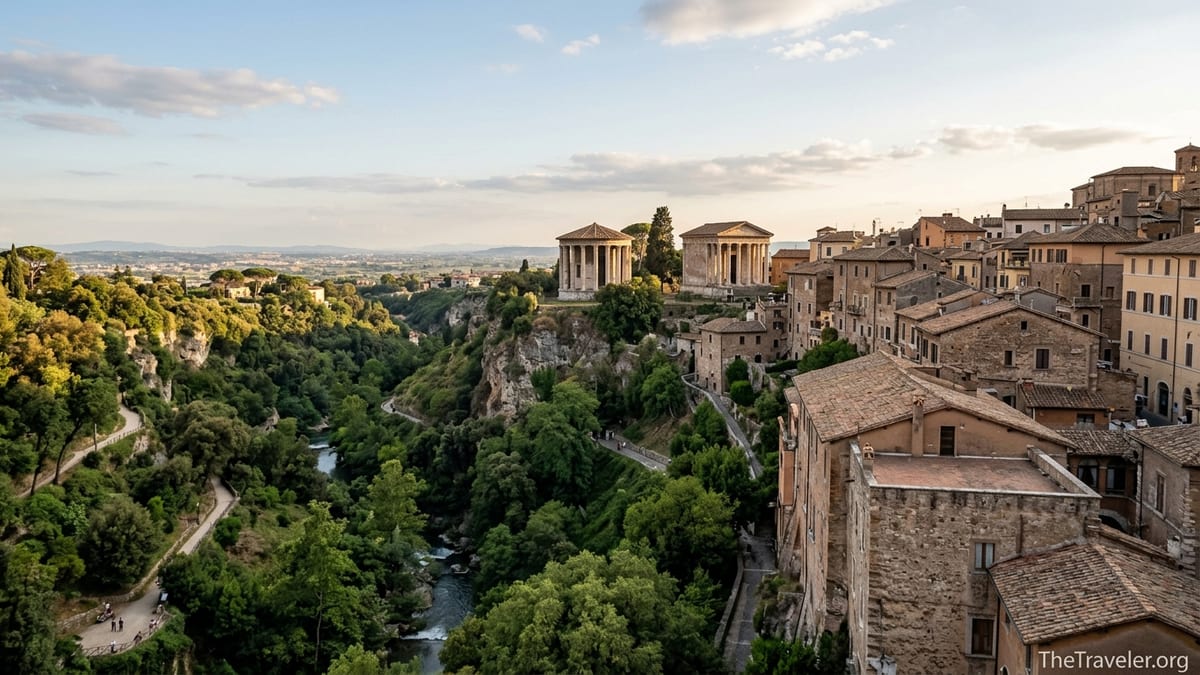
On the edge of the gorge above Parco Villa Gregoriana, Tivoli’s ancient acropolis rises on a rocky spur, crowned by two small temples that have become icons of the town’s skyline. One is traditionally known as the Temple of Vesta, a round structure ringed by Corinthian columns. The other is generally referred to as the Temple of the Sibyl, a rectangular building with a colonnaded porch. Their exact original dedications are still debated by scholars, but their photogenic setting above the waterfall has attracted artists and travelers for centuries.
Today, you can approach the acropolis from the historic center by walking toward the Belvedere area, where balconies open onto sweeping views of the gorge, the valley, and the distant Roman Campagna. Sunset is particularly atmospheric, when the stone turns warm shades of orange and pink. Many visitors pause here for photos before or after visiting Parco Villa Gregoriana below. The temples themselves are visible from multiple angles: from the viewpoints in the park, from the bridge across the gorge, and from the terrace in front of one of Tivoli’s most famous restaurants.
That restaurant, often simply called La Sibilla by travelers, makes the most of its location with outdoor tables directly facing the temples and the drop into the valley. Prices reflect the setting, with main courses typically in the 18 to 28 euro range, but lingering over a plate of pasta and a glass of Lazio white wine while staring at structures that have stood for more than two millennia can feel like money well spent. For a more budget-friendly option, you can simply order a coffee or dessert and still enjoy the same panorama.
Even if you are not eating, plan at least 30 minutes to explore this area. Small churches and chapels dot the surrounding streets, and from some corners you can glimpse the rooftops of modern Tivoli spilling down the slope behind you. The combination of temples, gorge, and town encapsulates what makes Tivoli unique: layers of history packed into a tight, walkable space, all tied together by the relentless presence of water.
Experience Tivoli’s Food and Wine Culture
Beyond postcard views, Tivoli rewards visitors who take the time to sit down and eat like a local. The town lies in a region known for robust, straightforward cooking, with dishes that use olive oil from nearby groves, fresh vegetables from the Aniene valley, and meats slow-cooked in traditional ways. Many restaurants emphasize seasonal menus, so you may find artichokes in spring, porcini mushrooms in autumn, and hearty stews in winter.
A classic Tivoli meal might begin with bruschetta drizzled in local extra-virgin olive oil, followed by a plate of fresh pasta such as tonnarelli cacio e pepe or fettuccine with porcini. Second courses often feature abbacchio, young lamb roasted with herbs, or grilled pork chops served with simple contorni like roasted potatoes or cicoria ripassata, sautéed chicory with garlic and chili. Expect to pay around 25 to 35 euros per person for a full meal with house wine at a mid-range trattoria near the center.
Day-trippers on tighter budgets have plenty of options. Close to the main square and villa entrances you will find pizza al taglio shops where you pay by weight. A generous slice of pizza topped with potatoes and rosemary or fresh tomatoes and mozzarella usually costs between 3 and 5 euros, and adding a soft drink or small beer keeps the total under 8 to 10 euros. Many bakeries also sell panini filled with prosciutto, cheese, or grilled vegetables, ideal for picnics in Parco Villa Gregoriana or on a bench overlooking the valley.
Wine lovers should pay attention to regional labels from Lazio, including Frascati and other whites from the hills southeast of Rome. While you will not find the prestige names of Tuscany or Piedmont here, prices are fair and the wines pair well with local dishes. Some enotecas in Tivoli offer informal tastings where you can try a flight of regional wines for roughly 10 to 15 euros, often accompanied by small plates of cheese and cured meats. Even a simple glass of house wine in a trattoria, typically 3 to 5 euros, tells a story of the volcanic soils and sunny slopes surrounding the town.
Walk, Hike, and Enjoy the Landscape Around Tivoli
Part of Tivoli’s appeal lies in its setting on the first range of hills that rise east of Rome. The landscape here transitions from suburban sprawl to olive groves, terraced gardens, and wooded slopes, offering a gentler, more breathable version of central Italy. Travelers who enjoy walking will find several straightforward routes that connect the town’s monuments and viewpoints without requiring advanced hiking skills.
One particularly scenic path links Villa Gregoriana with other sites via a network of lanes and staircases that climb the hill. Starting from the park entrance near the river, you can ascend toward the historic center, pause in the main piazza, then continue uphill on quiet streets that eventually offer glimpses back toward the acropolis and temples. The whole circuit can take 60 to 90 minutes at a leisurely pace, including photo and gelato stops, and requires no special gear beyond comfortable shoes, a hat, and a bottle of water.
For a slightly more rural feel, look into short trails on the slopes of Monte Catillo, the hill that looms over Tivoli and was partly tunneled to divert the Aniene into the Grande Cascata. Local walking groups and municipal tourism offices sometimes provide simple maps showing loops through Mediterranean scrub and oak woods, with occasional clearings that frame Tivoli and the Roman plain beyond. These routes are typically of low to moderate difficulty, though heat in summer can make them more demanding, so starting early in the morning is advisable.
Even if you do not commit to a full hike, prioritize time for simple viewpoint walks. The belvedere terraces near the acropolis, the stone bridges over the gorge, and the streets at the upper edge of town all give different perspectives on the same dramatic landscape. Many travelers rush between ticket offices by bus or taxi and miss the pleasure of just walking these short distances. In Tivoli, some of the best moments are the unscheduled ones when you turn a corner and suddenly see the temples or waterfall framed between two old houses.
Planning Practicalities: Getting To, From, and Around Tivoli
Most travelers reach Tivoli from Rome, typically as a day trip. The two main public transport options are regional trains and intercity buses. Trains from Rome’s Tiburtina station usually take about 35 to 45 minutes to reach Tivoli, with tickets priced in the lower single digits of euros each way. From Tivoli’s train station, it is roughly a 15 to 20 minute uphill walk to the historic center and Villa d’Este area, or a short ride on a local bus or taxi.
Long-distance buses operated by regional companies also connect Rome’s Ponte Mammolo metro station to Tivoli along the Tiburtina or motorway routes. Travel times are broadly similar to the train, though subject to traffic, especially on workdays and summer weekends. Tickets are typically bought at kiosks near the departure point or from tobacconists, and prices usually align with regional public transport fares. Bus routes also continue beyond Tivoli toward Hadrian’s Villa and other suburbs, which is useful if you are combining sites in one day.
Within Tivoli, most of the attractions beyond Villa d’Este and Hadrian’s Villa are walkable for reasonably fit visitors. The main challenge is elevation: streets can be steep, and surfaces are often cobbled. Take this into account if you are traveling with young children, older relatives, or heavy luggage. Taxis cluster near key points like the train station and main square, and local buses offer short hops around town, though schedules can be irregular in the middle of the day.
If you are driving, be aware that the historic center has restricted traffic zones and limited parking. Public lots at the edge of town, usually paid by the hour, are generally the most stress-free option. From there you can walk or take a local bus uphill. When planning your visit, consider that many museums and archaeological sites in Italy close one day per week, often Monday, and may shut in the early afternoon during the quiet season. It is worth checking current opening hours before leaving Rome to avoid surprises.
The Takeaway
Seen only through its two famous villas, Tivoli is already impressive. But spend a little extra time and the town reveals a richer personality. The roar of the Grande Cascata in Parco Villa Gregoriana, the vast terraces of the Sanctuary of Hercules Victor, the crooked streets of the medieval center, and the simple pleasure of a plate of local pasta eaten within sight of ancient temples all combine into an experience that feels both grand and intimately human.
For travelers looking to escape Rome’s intensity without surrendering history, Tivoli offers exactly the right scale. You can walk almost everywhere, shift easily between nature and archaeology, and still be back in the capital by evening if you wish. The key is to resist the urge to rush. Plan for one or two additional stops beyond Villa d’Este and Hadrian’s Villa, build in time for a slow lunch or coffee, and let the town’s layers reveal themselves. Tivoli rewards curiosity, and its best moments often come after you have seen the famous fountains and decide to keep exploring anyway.
FAQ
Q1. Is Tivoli worth visiting if I have already seen Villa d’Este and Hadrian’s Villa on a previous trip?
Yes. Parco Villa Gregoriana, the Sanctuary of Hercules Victor, the acropolis temples, and the medieval center all offer new experiences even if you have already toured the two main villas.
Q2. How much time should I plan in Tivoli beyond the main villas?
If you have already seen the villas, a full day in Tivoli is ideal. You can comfortably visit Parco Villa Gregoriana, explore the historic center, and see the acropolis and Sanctuary of Hercules Victor without rushing.
Q3. Can I visit Parco Villa Gregoriana and the Sanctuary of Hercules Victor on the same day trip from Rome?
Yes. Many travelers combine these two sites with a stroll through the historic center in a single day. Start early, wear comfortable shoes, and allow time for breaks on Tivoli’s hills.
Q4. Is Parco Villa Gregoriana suitable for children or people with limited mobility?
The park has many stairs, steep paths, and uneven surfaces, so it can be challenging for strollers or visitors with mobility issues. Families with active children, however, often enjoy the caves, viewpoints, and waterfall.
Q5. What should I wear and bring for walking around Tivoli?
Comfortable walking shoes, a hat, sunscreen in warmer months, and a reusable water bottle are important. Many paths are cobbled or sloped, and shade can be limited at midday.
Q6. Are there good places to eat near the lesser-known sites?
Yes. Trattorias and pizzerias cluster around the main square and along streets leading to Parco Villa Gregoriana and the acropolis. You will find everything from simple pizza slices to full multicourse meals.
Q7. Do I need a guided tour to appreciate sites like Parco Villa Gregoriana and the Sanctuary of Hercules Victor?
A guide is not essential, but audio guides and printed maps help bring the history to life. Independent travelers can enjoy these sites with basic background reading and the on-site information panels.
Q8. When is the best time of year to explore Tivoli beyond the main villas?
Spring and autumn offer comfortable temperatures for walking and hiking, with greener landscapes and fewer crowds. Summer can be hot and busy, while winter visits are quieter but shorter on daylight.
Q9. Can I reach Tivoli’s lesser-known attractions using public transport only?
Yes. Regional trains or buses from Rome take you to Tivoli, and from there you can walk or use local buses and taxis to reach Parco Villa Gregoriana, the sanctuary, and other sites.
Q10. Is Tivoli a good base for staying overnight instead of just a day trip?
It can be. Staying in Tivoli lets you enjoy evenings in the historic center, visit sites at quieter times, and use the town as a base for exploring the surrounding hills and countryside.