


Rome makes it wonderfully easy to swap urban buzz for hill towns and villa gardens in a single day. Two of the most popular escapes are Tivoli, famed for its imperial ruins and fountain-filled Renaissance gardens, and Orvieto, a clifftop Umbrian town crowned by one of Italy’s great Gothic cathedrals. Both are within roughly 60 to 90 minutes of the capital, both feel worlds away from Rome, and both can fill a very satisfying day. Which one fits your travel style better depends on what you love most about Italy: ancient history or medieval alleys, grand ruins or leisurely wine tastings, garden strolls or slow lunches with a view.
Get the latest updates straight to your inbox!
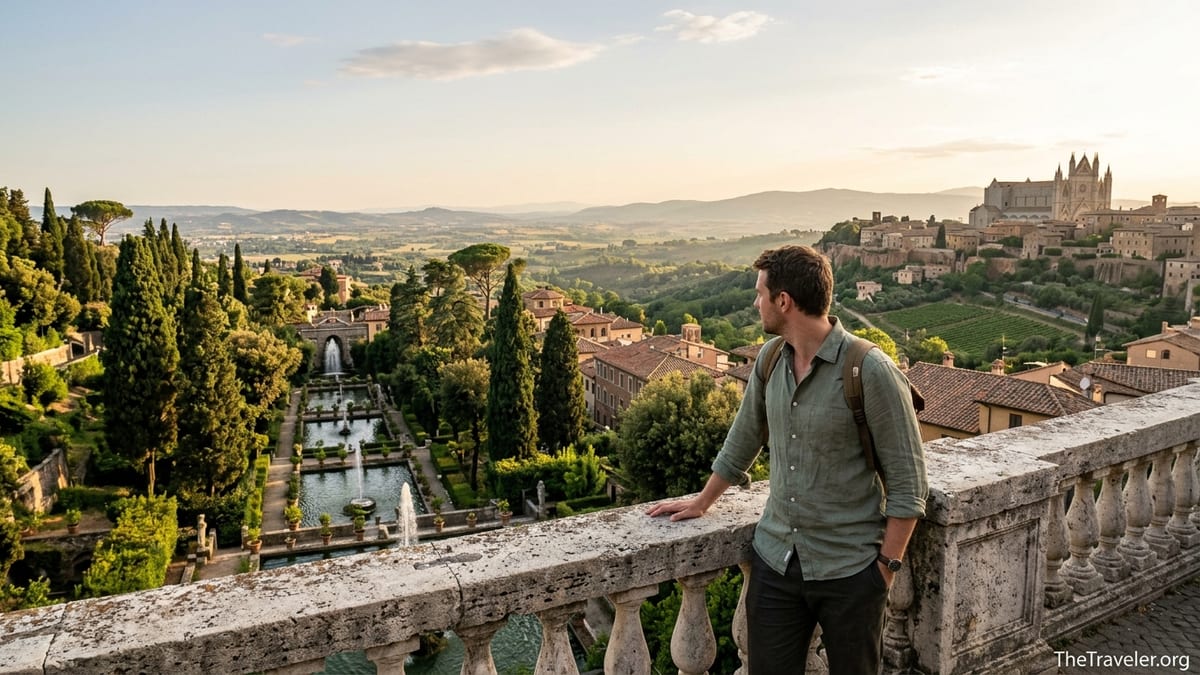
Tivoli vs Orvieto at a Glance
If you picture your ideal day trip as a deep dive into history among major archaeological and architectural sites, Tivoli usually comes out on top. The town hosts two UNESCO World Heritage sites: Hadrian’s Villa, the vast 2nd-century CE imperial retreat, and Villa d’Este, a 16th-century cardinal’s villa whose terraced gardens and playful fountains are among the most iconic in Italy. You can easily spend three hours or more wandering Hadrian’s pools and temples, then another two or three hours exploring Villa d’Este’s frescoed rooms and water gardens.
Orvieto, by contrast, is about atmosphere and views as much as “must-see” monuments. Its star attractions are the striped Gothic Duomo with its dazzling facade, the Renaissance engineering marvel of Pozzo di San Patrizio (St Patrick’s Well), the warren of underground caves and tunnels below town, and the Torre del Moro bell tower with panoramic views across the Umbrian countryside. Many travelers spend a relaxed six to eight hours here, punctuating sightseeing with wine tastings of local Orvieto Classico and unhurried meals on terrace-lined piazzas.
In broad strokes, Tivoli suits travelers who enjoy structured sightseeing and major, ticketed cultural sites. Orvieto is ideal if you crave slower wandering, photography, and lingering over coffee or a glass of white wine in a medieval square. Both can be done comfortably as independent day trips using public transport or as fully organized tours if you prefer to have logistics handled for you.
Travel Time, Transport and Ease of Getting Around
Getting to Tivoli from Rome is relatively quick but involves one more layer of logistics once you arrive. Regional trains from Roma Tiburtina to Tivoli typically take around 40 to 55 minutes, and one-way tickets often cost in the range of 2.60 to 3 euros. From Tivoli station, it is a short local bus or 15 to 20 minute walk up into the historic center for Villa d’Este. Hadrian’s Villa, however, lies several kilometers outside town, so most visitors either take a Cotral bus that stops near the site, a local CAT bus, or a short taxi ride.
In practice this means many Tivoli daytrippers start from Rome’s Ponte Mammolo bus station, ride a Cotral bus for about an hour directly toward Hadrian’s Villa, spend the morning exploring the archaeological area, then hop a local bus or taxi up to Tivoli town for Villa d’Este and possibly Villa Gregoriana in the afternoon. Buses are inexpensive, usually just a couple of euros per ride, but schedules can be irregular and figuring out which bus stop to use can take a bit of patience if your Italian is minimal.
Orvieto is more straightforward. Direct regional trains from Roma Termini or Roma Tiburtina to Orvieto Scalo usually take between one hour and 1 hour 30 minutes, with prices often under 15 euros return depending on timing and how far in advance you book. When you step off the train at Orvieto’s lower station, you simply walk across the street to the funicular station. The funicular glides you up the cliff in a few minutes and drops you at the edge of the historic center, where a small shuttle bus or a 10 to 15 minute walk leads to the Duomo.
Once on top, Orvieto is compact and easily walkable. The main sights cluster within a 10 to 15 minute radius: the Duomo, Torre del Moro, Orvieto Underground tour offices, and the entrance to St Patrick’s Well. If you dislike dealing with suburban buses or deciphering local transit apps, Orvieto offers a gentler landing. Tivoli rewards those comfortable with a little extra transport puzzle in exchange for two truly world-class historic sites.
What You See in Tivoli: Ruins, Villas and Water Gardens
Hadrian’s Villa is the centerpiece of a Tivoli day, especially for history lovers. Spread across a large estate, it was the country residence of Emperor Hadrian, with thermal baths, residential quarters, temples, libraries and lush gardens. Today you wander among ruins of grand colonnades and pools such as the Canopus, a long rectangular basin framed by statues and caryatids. Audio guides or guided tours help bring the lost grandeur to life, describing how Hadrian imported art and architectural ideas from across his empire.
Most visitors allow at least two and a half to three hours at Hadrian’s Villa, more if you enjoy photography or lingering. There are shaded spots but also a lot of open ground, so in summer sun a hat and water bottle are essential. Entry fees for the site tend to be moderate by Italian museum standards, often in the low to mid teens in euros for a standard adult ticket, and there is sometimes a combined “Villae” pass that includes Villa d’Este and other local sites if you want to make a full day of Tivoli.
Villa d’Este, up in the town itself, is a complete contrast in mood: Renaissance elegance layered over medieval fabric. Inside, you walk through halls decorated with frescoes and grand staircases, but the real show is outside. The hillside garden steps down in terraces packed with fountains, including the grand Oval Fountain with its cascading pools and the Hundred Fountains, a long mossy wall where dozens of spouts pour into a channel. On a hot afternoon you can literally feel the air cool as you descend among the water and trees.
Depending on the season, Villa d’Este typically opens in the morning and closes around early evening, with last entry roughly an hour and a half before closing time. Ticket prices are usually slightly below or around those of Hadrian’s Villa, and you can expect to spend two to three hours between the villa interiors and gardens. If you still have energy and daylight, the nearby Villa Gregoriana offers dramatic views into a forested gorge with waterfalls, reached via walking paths just a few minutes from Tivoli’s main square.
What You See in Orvieto: Duomo, Underground and Cliffside Views
Orvieto’s star is its cathedral, visible even from the train as it crowns the volcanic tuff plateau. The Duomo’s facade is a riot of striped black and white stone, gilded mosaics, and carved reliefs that sparkle in the afternoon sun. Inside, the stark striped nave leads to side chapels with intense fresco cycles by artists such as Luca Signorelli, whose depictions of the Last Judgment have influenced painters for centuries. Entry to the cathedral itself is usually inexpensive, while the combined ticket that includes side chapels, museum spaces or tower access can cost a bit more but remains reasonable for most travelers.
Just a few minutes’ walk from the Duomo, the Orvieto Underground tours lead you beneath the streets into a honeycomb of ancient caves and tunnels carved into the soft rock beneath town. These spaces were used across centuries as storage, workshops, and even dovecotes. Guided tours, often around one hour, give a vivid sense of how the medieval city functioned below ground. Commentary is usually in Italian with English-language tours or audio available at set times.
On the western edge of town, St Patrick’s Well descends more than 50 meters into the rock, a double-helix staircase ingeniously designed in the 16th century so mules could carry water up and down without colliding. Today, visitors pay a modest fee, often around 5 euros, to climb down and back up the spiral ramps past small windows glowing with greenish light. It is atmospheric, mildly strenuous, and particularly appealing for engineering buffs and photographers.
To round out the day, many travelers climb the Torre del Moro near the central Corso street. The small entrance fee rewards you with sweeping views over rolling Umbrian hills, vineyards and olive groves. Combined with a leisurely lunch in a trattoria serving umbrichelli pasta with truffles and a glass of Orvieto Classico, you end up with a day focused less on ticking off major “sights” and more on soaking up a distinctly Umbrian rhythm of life.
Costs, Tickets and Tours: What to Budget
For both Tivoli and Orvieto, transport from Rome by regional train is usually one of the smaller line items in your budget. A return ticket to Tivoli from Roma Tiburtina often falls in the 5 to 10 euro range depending on specific trains and time of purchase. Travel to Orvieto from Termini or Tiburtina may cost slightly more overall, but still typically remains under 30 euros round-trip for standard regional services if you buy directly from Trenitalia or other official channels.
Once on site, Tivoli tends to be a bit more ticket-heavy if you want to see everything. Hadrian’s Villa and Villa d’Este each charge separate admission in the low teens in euros for adults, and Villa Gregoriana adds another modest fee. If you purchase a combined pass that includes the two main villas, you might save a few euros compared with buying individual tickets. Allow additional small amounts for local buses between sites, usually around 1 to 2 euros per journey, and possibly a taxi if you want to save time.
In Orvieto, individual sights are generally cheaper, but you will likely visit more of them. A realistic day that includes the Duomo, St Patrick’s Well, a guided underground tour and the Torre del Moro can add up to somewhere in the mid 20s in euros for entrance fees if paid separately. Some visitors opt for a city pass that bundles several attractions together at a slightly higher price, around the mid 30 euro mark, which only becomes a better value if you are determined to visit nearly everything on the list.
Guided day tours from Rome provide another option for both destinations. Full-day small group tours to Tivoli, including transport, guided visits to Hadrian’s Villa and Villa d’Este, and sometimes lunch in a local restaurant, commonly run around 90 to 130 euros per person, depending on group size and season. For Orvieto, day trips are sometimes paired with another Umbrian stop such as Civita di Bagnoregio and can reach similar price ranges. Tours appeal if you prefer not to navigate timetables and want an expert to bring context to what you are seeing, but independent travelers can absolutely organize either day trip on their own with some light planning.
Vibe and Travel Style: Which Traveler Will Prefer Which?
Your personal travel style is the single most important factor in choosing between Tivoli and Orvieto. Tivoli generally appeals to travelers who are energized by “sightseeing days” full of big-name monuments. If your perfect day includes walking 15,000 steps among ruins, reading interpretive panels, taking dozens of photos of fountains and pools, and fitting in three major sites, Tivoli will feel incredibly rewarding. The day can be structured, with clear time blocks for Hadrian’s Villa, Villa d’Este and possibly Villa Gregoriana.
Orvieto suits travelers who prefer to let the day unfold more gently. While there are obvious sights, much of the pleasure lies in wandering cobbled lanes, ducking into ceramics shops, or pausing on a quiet side street to watch daily life. It is particularly good for couples seeking a romantic, slower-paced escape from Rome, or for solo travelers who want somewhere easy to navigate without constantly checking bus schedules. Photographers and food lovers tend to rave about the combination of skyline, vineyards and hearty Umbrian cooking.
Family travelers might find Tivoli incredibly stimulating for older children and teens interested in emperors and engineering, but the logistics of buses and the size of Hadrian’s Villa can be tiring for younger kids. Orvieto’s compact center and funicular ride are often easier with children, and climbing St Patrick’s Well can feel like an adventure. Mobility issues also favor Orvieto slightly, as you can limit yourself to the flattest parts of town once you are up on the plateau, although both destinations involve cobblestones and some inclines.
If you are visiting Rome in mid-summer, temperature can also influence your choice. Tivoli’s archaeological site at Hadrian’s Villa offers little shade in places, and the wide open spaces can be very hot at midday. Villa d’Este’s gardens mitigate this with water and trees. Orvieto, perched at elevation, can feel marginally cooler and often catches breezes, though it still gets hot in July and August. Starting early in the morning and planning a long lunch break in the heat of the day works well in either place.
Sample Itineraries: A Realistic Day in Each Place
Imagine a Tivoli day that starts with an 8:00 a.m. metro ride on line B to Ponte Mammolo, arriving in time for a mid-morning Cotral bus. Around 10:00 a.m. you step off near the entrance road to Hadrian’s Villa and spend the late morning exploring the Maritime Theatre, the Canopus and the baths, perhaps joining a one-hour small group tour to make sense of the ruins. After a simple panino or salad at the on-site café, you catch a local bus or short taxi ride up to Tivoli town by early afternoon.
By 2:00 p.m., you enter Villa d’Este, weaving through a few frescoed rooms before heading out into the shaded gardens. You might spend an hour or two strolling from terrace to terrace, stopping frequently for photos of the Organ Fountain or to lean on a balustrade overlooking the valley. If time permits, you detour to Villa Gregoriana for a shorter late afternoon walk through the gorge to see waterfalls and viewpoints. Back in town around 6:00 p.m., you reward yourself with a gelato or aperitivo in Piazza Garibaldi before catching a train from Tivoli station back to Rome.
A day in Orvieto plays out differently. You leave Rome on a 9:00 a.m. regional train and step into Orvieto Scalo roughly an hour later. After boarding the funicular and a short uphill walk, you find yourself in the medieval center by late morning. The striped Duomo facade is your first stop, followed by a visit inside and possibly a guided look at the frescoed chapels. Around lunchtime, you slip into a trattoria just off the main piazza, ordering a plate of local cinghiale stew or truffle pasta and a glass of crisp Orvieto Classico.
In the afternoon you descend the ramps of St Patrick’s Well, pause for a coffee with a view over the valley, then join an Orvieto Underground tour that departs from a small office near Piazza Duomo. Later, you climb Torre del Moro just before golden hour, watching the light roll across vineyards and farmhouses. With your camera full and your legs pleasantly tired, you wander back toward the funicular for the ride down and an evening train to Rome, arriving back in the city in time for a late dinner.
The Takeaway
If you are choosing between Tivoli and Orvieto for a single day trip from Rome, first ask yourself what kind of stories you want to tell when you get home. If you dream of saying you walked an emperor’s country estate and wandered through one of Europe’s great Renaissance water gardens, Tivoli is the better match. It is the choice for travelers who do not mind dealing with local buses and who revel in dense, site-focused days packed with art, archaeology and panoramic viewpoints.
If, instead, you picture a day of slow wandering through medieval streets, pausing for wine tastings and peering out from a clifftop town over rolling countryside, Orvieto is likely to steal your heart. It suits travelers seeking atmosphere, manageable logistics, and a gentler rhythm: one impressive cathedral, one remarkable well, one tower view, and ample room in between simply to sit and soak up Umbrian life.
With more time in Rome, you could of course visit both on different days and enjoy two very different slices of central Italy. But if you have to pick just one, let your travel style decide. Go to Tivoli for grand ruins, fountains and structured sightseeing. Choose Orvieto for slow streets, tufa cliffs and a glass of white wine sipped as church bells ring across the valley.
FAQ
Q1. Is Tivoli or Orvieto easier to reach on a first visit to Italy?
Orvieto is generally easier, since you take a direct regional train from Rome and then a simple funicular to the historic center, with no need to navigate suburban buses.
Q2. Which destination is better if I love ancient Roman history?
Tivoli is the stronger choice for ancient history thanks to Hadrian’s Villa, which offers extensive Roman ruins and a clear sense of imperial life outside the city.
Q3. Where will I find better food and wine experiences?
Both are good, but Orvieto has a slight edge for wine and long, scenic meals, thanks to local Orvieto Classico whites and a dense cluster of traditional trattorias.
Q4. Can I visit both Hadrian’s Villa and Villa d’Este in Tivoli in one day by public transport?
Yes, it is realistic to see both in one day by combining regional trains or buses with local buses or short taxi rides, as long as you start reasonably early and keep an eye on closing times.
Q5. Is Orvieto a good choice for travelers with limited mobility?
Orvieto’s center is compact and you can focus on flatter streets near the Duomo, but there are still cobblestones and some slopes, so a lightweight mobility aid can be helpful.
Q6. Which day trip is better for families with young children?
Orvieto often works better for younger kids because everything is close together, the funicular is fun, and sights such as St Patrick’s Well feel like small adventures.
Q7. Are there good guided tour options if I do not want to plan logistics myself?
Yes, many Rome-based tour companies offer full-day trips to Tivoli that include transport and guided visits, and some run Orvieto tours, often paired with another Umbrian town.
Q8. How crowded do Tivoli and Orvieto get in peak season?
Both attract summer visitors, but Tivoli’s main sites can feel busier at bottlenecks such as Villa d’Este’s terraces, while Orvieto’s crowds are more spread out through the town.
Q9. If I only have half a day free, which is more realistic?
With only a half day, Tivoli is difficult unless you join a focused tour. Orvieto also deserves a full day, but you could still enjoy the Duomo and a short stroll in a tighter schedule.
Q10. Can I visit both Tivoli and Orvieto in one very long day from Rome?
In theory it is possible, but it would be rushed and transport-dependent. Most travelers find each destination easily fills a full day and is best enjoyed on its own.