


On a busy day along Barcelona’s Passeig de Gràcia, thousands of people stop to photograph Casa Batlló’s dragon-backed roof and skeletal balconies. Yet even many ticket-holding visitors walk through this UNESCO-listed icon without realizing how densely Antoni Gaudí packed it with symbolic details. From marine metaphors baked into the tiles to subtle religious and political references, Casa Batlló rewards the traveler who slows down, looks twice, and questions why every curve, color, and window is exactly where it is.
Get the latest updates straight to your inbox!
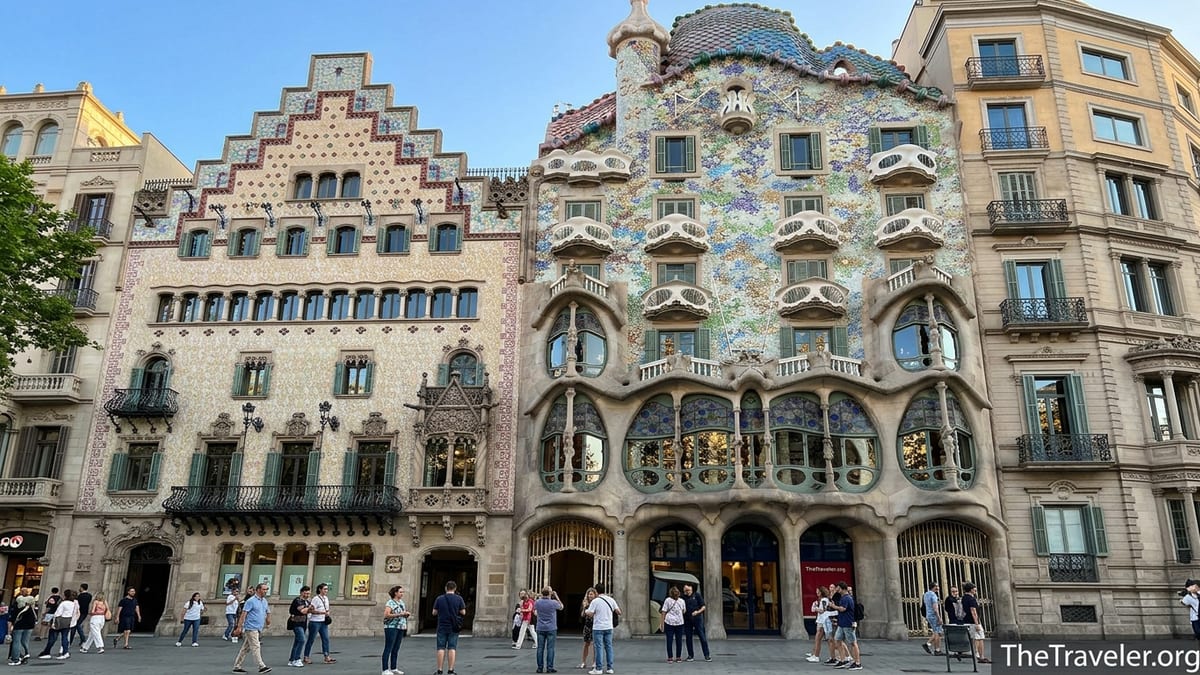
The Dragon, the Sea and a Quiet Story of Catalonia
Most visitors know that Casa Batlló is often called the House of the Dragon, but few pause long enough on the street to connect all the pieces of Gaudí’s narrative. Look up from the sidewalk on Passeig de Gràcia and you will see the tiled roof arching like the back of a beast, its ceramic "scales" shifting from green to deep blue and pink as they catch the light. Architectural guides on site frequently explain that many historians read this as the dragon from the legend of Saint George, Catalonia’s patron saint. The bulbous turret crowned with a cross on the left side of the roof can be read as the knight’s lance or sword, piercing the monster’s spine.
What most travelers do not realize is that this dragon story sits on top of a second, parallel metaphor: the Mediterranean Sea. Casa Batlló’s official interpretation points out that the shimmering facade, covered in broken glass and ceramic discs, can be seen as a water surface stirred by soft waves rather than a battlefield. Colors bleed from sandy ochres to sea greens and deep marine blues, evoking both a dragon’s scales and light rippling across shallow water. Stand at the pedestrian crossing across the street around late afternoon and you will see how the sun turns the trencadís mosaic into something that feels more like moving water than static stone.
In practice, this means the same building can be understood as a patriotic legend and as a peaceful marine landscape, depending on the angle and the guide you listen to. Some official Casa Batlló audio routes now explicitly mention both readings, and if you join one of the premium small-group tours that include the roof, guides sometimes invite guests to decide which story they prefer. For travelers, recognizing that duality shifts Casa Batlló from a quirky postcard facade into a layered cultural commentary that quietly reflects Catalan identity, Christian symbolism, and Gaudí’s lifelong fascination with nature.
Bones, Masks and the Unseen Drama of the Facade
Even those who have heard the nickname House of Bones often treat it as a bit of marketing rather than a description rooted in the architecture itself. Step closer to the main floor gallery on the facade and study the thick stone columns that frame the large windows. Their shapes resemble long femurs, smoothed by time, holding up the building like a skeleton. Above them, the undulating balcony line can be read as a row of vertebrae or a ribcage. It is easy to walk past this area while queuing at the entrance, looking at your time slot on your phone, without noticing that you are literally standing beneath carved "bones."
Then there are the smaller wrought-iron balconies scattered across the upper floors. To most visitors they are simply pretty Art Nouveau railings, good for a photograph. Yet if you tilt your head slightly and block out the rest of the facade, they suddenly read as masks or skulls, with hollowed "eye" openings and a central "nose" ridge. Some art historians see them as the remains of the dragon’s victims from the Saint George legend, others as carnival masks watching the boulevard. You will not find a plaque on the street spelling this out, but once you see the skull-like pattern, it becomes nearly impossible to unsee.
In real-world terms, this means that a standard photo stop on the pavement barely scratches the surface of what Gaudí was doing. If you arrive a little before your timed entry, use those few minutes to move along the building line instead of staying fixed in front of the main door. Look up from different spots so the curves overlap and separate. This shifting street-level choreography reveals how he choreographed bone, mask and wave motifs into a single continuous, moving surface, rather than a static facade.
Inside the Beast: Staircases, Shells and a Dragon’s Spine
Once inside, crowd attention usually jumps straight to the main salon’s famous stained-glass windows. Yet the most symbolically charged element in the entrance is the sculpted wooden staircase that rises from the private vestibule. Its banister curves and swells like a living spine, vertebra by vertebra, guiding the visitor upward. Scholars have connected this directly to the dragon on the roof: outside you see the creature’s back, inside you walk along its internal backbone. Day-trippers hurrying to the rooftop terrace often treat it as just another staircase, but if you run your hand gently along the polished wood, the tactile effect is more organic than architectural.
Nearby, in what was once Josep Batlló’s office, hides one of Casa Batlló’s most surprising details: the so-called mushroom fireplace. This alcove, now roped but fully visible, is shaped like a giant toadstool complete with curved seats tucked into the sides. Official explanations often connect it to Gaudí’s obsession with biomimicry, but few visitors stop to think about its symbolic role. One popular interpretation is that this was the warm heart of the dragon, an intimate cavity inside the creature where family could gather by the fire. Others simply see it as Gaudí’s gentle tribute to the humble fungi that break down dead matter in forests, echoing the cycle of life and decay suggested by the bone-like columns on the facade.
Overhead, the ceiling of the main living room spirals in a whirlpool pattern, like water stirred by a dropped stone or a distant galaxy. The central light fixture acts like an eye at the center of a storm. Taken with the shell-like door handles and turtle-shell skylights on the main floor, the space blurs the line between a marine cave and the belly of a beast. As you move between rooms, pay attention to how often you encounter forms that could belong equally to sea life, animal anatomy or the cosmos. Gaudí’s symbolism is rarely one-dimensional; it stacks meanings the way the building stacks levels.
The Light Well as a Submerged Cathedral
One of the most quietly astonishing symbolic spaces in Casa Batlló is the central light well, which many visitors rush past as merely a photogenic staircase backdrop. Its walls are tiled in a gradient of blues, darkest at the top, fading to softer shades and almost white near the bottom. Conservation reports and museum texts note that Gaudí designed this deliberately so natural light would be evenly distributed across all floors, compensating for the brighter upper levels. Symbolically, though, you can read it as a vertical slice of the sea, from deep indigo waters above to sunlit shallows below.
If you stand on one of the intermediate landings and look up, the small windows and wooden frames lining the shaft resemble the portholes of a ship or the openings of a submerged building. The effect for many visitors is subconscious; they simply describe the space as calming or aquatic without knowing why. Only when you compare photographs taken from different floors do you notice how the color of the tiles changes subtly with each step, as if you were ascending from ocean floor to the surface. There is a practical side to this as well. Guides often demonstrate how the inward-opening wooden vents above the doors can be adjusted like gills, regulating airflow so the “underwater” house can breathe naturally without mechanical ventilation.
From a traveler’s perspective, this is one of the easiest places to engage directly with Gaudí’s symbolic thinking. You do not need special access or a premium ticket tier to experience it; every standard entry route passes through here. Instead of snapping a single quick photo, linger on one landing long enough to observe how the reflections shift as sunlight filters down. If you visit during a quieter early morning or late evening slot, you may even catch the well nearly empty and discover why some curators describe it as a kind of submerged cathedral of light.
Windows, Doors and the Hidden Logic of Comfort
Visitors often assume that any talk of symbolism will be abstract, but in Casa Batlló, many of the most meaningful details are anchored in physical comfort and climate. Take the huge living-room windows overlooking Passeig de Gràcia. At first sight they look like a purely decorative flourish, with blobs of stained glass in watery blues and ambers. In practice, their curved wooden frames and irregular panes break up the harsh Mediterranean sun, scattering it into a softer, dappled glow that resembles light filtered through water or leaves. The visual metaphor of being under the sea doubles as a tool to make a bright front room pleasant on a hot day.
The same practical symbolism appears in the window hardware and interior shutters. Original handles and latches, many of them recently restored as part of a multi-year conservation project, twist and curve like shells, vines or animal bones. There are no straight, industrial shapes here. When you close a door or adjust a window vent, your hand automatically follows these organic lines. You are performing an everyday domestic gesture, but Gaudí has quietly turned it into a tactile reminder that the house is rooted in natural forms rather than mechanical ones.
For modern travelers who may have visited other Gaudí landmarks like Casa Milà or Park Güell on the same trip, these details help connect the dots between his various works. The hexagonal floor tiles with marine motifs he designed for Casa Batlló later reappear on the sidewalks of Passeig de Gràcia. The shifting, almost liquid quality of his stained glass echoes the colorful ceramic skin of Park Güell’s benches. Understanding these links turns a day of sightseeing into a larger story about how Gaudí tried to bring nature and comfort into dense urban life, using symbolism that you can literally touch in the form of a doorknob or shutter vent.
Roofscape, Chimneys and the Science Behind the Symbols
The rooftop terrace, now a highlight of most Casa Batlló ticket categories, is typically read as a pure fantasy: dragon’s back, soldier-like chimneys in mosaic helmets, and sweeping views over the Eixample grid. Yet each of these elements carries a functional meaning that reinforces its symbolic role. The dragon’s arched spine conceals the building’s sloping roof structure, while its glazed scales protect against rain and channel water. The whimsical chimney groups, some of which twist in pairs or fours, are shaped to prevent downdrafts; air flows smoothly around their curves rather than forcing smoke back into the house.
Symbolically, the chimneys read like watchful sentinels or knights’ helmets, supporting the Saint George narrative that many visitors see on the facade. Their patterned trencadís mosaics can be read as both armor and as shimmering sea surfaces. During guided night visits, when colored lighting washes over them, this duality becomes even more pronounced. Travelers who book after-dark experiences sometimes describe the sensation of being on the deck of a ship, with the dragon’s back like a living hull and the chimneys like crew members standing guard.
In recent years, Casa Batlló has developed new rooftop experiences that subtly emphasize this blend of symbolism and science. Interactive explanations point out how the orientation of the chimneys responds to dominant wind directions in Barcelona, and how the curved parapets help deflect gusts. When you understand that the fairy-tale dragon also functions as a sophisticated piece of environmental engineering, the rooftop shifts from being just a scenic viewpoint into a final chapter that ties the house’s deeper themes together: nature as teacher, beauty as a byproduct of function, and myth layered over practical design.
The Newly Revealed Domestic Gaudí
One detail almost no first-time visitor expects is that Casa Batlló still contains an original Gaudí-designed apartment that was lived in by descendants of the Batlló family until the late 2010s. After a meticulous restoration, this third-floor residence began opening to the public in 2026 as part of exclusive, small-capacity experiences that let guests spend focused time inside a historic domestic interior. While the standard tourist flow mostly showcases the noble floor and rooftop, this quieter level offers a more intimate look at how Gaudí imagined daily life inside his symbolic shell.
Here, symbolic details switch from grand gestures to subtle domestic cues. Restored floral wall decorations echo the aquatic colors of the facade but use recognizable plants such as olive leaves and gladiolus blossoms, tying the sea metaphor back to the Mediterranean landscape and Christian iconography. Door frames, ceiling moldings and even the geometry of floor tiles reinforce the fluid, wave-like language established elsewhere in the house, yet everything is scaled to human proportions. There are no dragon battles on display here, only small flourishes that make an ordinary hallway or bedroom feel lightly enchanted.
For travelers willing to plan ahead, reserving one of these new private or semi-private visits can dramatically change how you read Casa Batlló as a whole. Instead of a one-hour circuit through the most photogenic spots, you spend longer moments in spaces that were never designed as spectacle. You notice how Gaudí’s symbolism survives in the everyday: the curve of a window that frames the street as if it were a moving painting, or a simple wooden handle that feels like a polished river stone in your hand. It underscores a crucial point that many rushed visits miss: for Gaudí, symbolism was not a layer sprinkled on top of a building. It was the building.
The Takeaway
Casa Batlló will always draw crowds for its dragon roof, undulating facade and flamboyant colors. Yet the most rewarding discoveries here are often the quiet ones: the way a staircase banister mimics a spine, how a light well recreates a vertical slice of the sea, or how a mushroom-shaped fireplace turns a business office into a cozy grotto. By looking for these details, travelers move beyond the standard picture-stop and begin to understand why this house remains a reference point in discussions of sustainable design, biomimicry and narrative architecture.
Next time you walk along Passeig de Gràcia, try approaching Casa Batlló as a story rather than a façade. Read the dragon and Saint George on the roof, then dive under the waterline to notice the sea and shells, the bones and masks, the practical vents and chimneys. Book a time slot that allows you to linger, and if your budget stretches, consider one of the more in-depth visits that includes quieter areas like the third-floor apartment. In doing so, you will join the small minority of visitors who leave not only with beautiful photos, but with a deeper sense of how Gaudí used symbolic details to turn an urban townhouse into a living, breathing myth.
FAQ
Q1. What is the main symbolic theme of Casa Batlló?
The most widely discussed theme is the legend of Saint George and the dragon, layered with a second major metaphor that evokes the Mediterranean Sea through colors, forms and light.
Q2. Why is Casa Batlló called the House of Bones?
The nickname comes from the facade’s sculpted stone columns and balcony supports, which resemble bones and a ribcage, especially around the main floor gallery facing Passeig de Gràcia.
Q3. How does the roof of Casa Batlló relate to the dragon legend?
The tiled roof curves like a dragon’s back, with ceramic "scales" and a turret topped by a cross that many interpret as Saint George’s weapon plunging into the creature’s spine.
Q4. What symbolic details should I look for inside the house?
Inside, focus on the spine-like main staircase, the mushroom-shaped fireplace, shell-like skylights, spiral ceilings and organic door handles that echo animal and marine forms.
Q5. What is special about the central light well?
The light well is tiled in a gradient from dark blue at the top to pale tones below, equalizing light on each floor and creating the sensation of moving through underwater space.
Q6. Are the balconies really meant to look like masks or skulls?
Many historians and guides interpret the wrought-iron balconies as mask- or skull-like forms, possibly representing the dragon’s victims or anonymous onlookers watching the drama.
Q7. Is there a right way to interpret Gaudí’s symbolism at Casa Batlló?
There is no single official reading. The house supports multiple interpretations, and Gaudí’s forms are intentionally open-ended, mixing natural, religious and cultural references.
Q8. How can I best appreciate these symbolic details during a visit?
Choose a timed entry that avoids peak crowds, move slowly, change your viewing angle often and, if possible, join a guided or premium tour that includes explanations and quieter areas.
Q9. Does the rooftop have symbolic meaning beyond the dragon shape?
Yes. The chimneys suggest armored figures while their curves improve airflow, blending symbolism with function so that the rooftop reads as both sculpture and environmental design.
Q10. Are there newly opened areas that reveal more of Gaudí’s ideas?
Recently restored spaces on the third floor, once a private family apartment, can be visited on special experiences and show how Gaudí extended his symbolic language into everyday rooms.