


Ask any Roman about the best day trips from the capital and a familiar list appears: the wine hills of Frascati, the papal town of Castel Gandolfo, perhaps medieval Viterbo or clifftop Orvieto. Yet one name consistently sits in a category of its own: Tivoli. Just 30 kilometers east of Rome, Tivoli combines imperial ruins, Renaissance spectacle and roaring waterfalls in a way no other historic town around the capital can match. Understanding what truly sets Tivoli apart helps travelers decide whether it deserves a full day, an overnight stay, or even a dedicated stop on a longer Italy itinerary.
Get the latest updates straight to your inbox!
A Landscape Shaped by Water and Rock, Not Just by Stone
Many hill towns around Rome owe their beauty to volcanic cliffs and distant views. Orvieto rises dramatically from a tuff plateau, while Castel Gandolfo surveys the still waters of Lake Albano. Tivoli, however, is defined by something more dynamic: the Aniene River cutting through limestone at the very edge of town. For centuries this river hurled itself in thunderous cascades right below the acropolis, creating a waterfall so celebrated that Romantic painters crossed Europe to depict it. Today the falls have been partially diverted for flood control, but in Villa Gregoriana park you can still hear the rush of water in deep gorges and see the sheer rock walls that gave Tivoli its reputation as a wild, sublime landscape.
That combination of vertical cliffs, ravines and engineered cascades is rare among Lazio’s historic centers. Frascati and the Castelli Romani offer rolling vineyards and lake views, but you do not walk from their main piazzas straight into a canyon. In Tivoli, five minutes from the central streets, visitors descend into Villa Gregoriana where damp rock, mossy stairways and suspended paths feel almost Alpine. It means a single day here can move from Renaissance frescoes to shaded waterfalls without leaving the town limits, a contrast that neighboring destinations simply do not provide.
The town’s topography also dictates its viewpoints. From the terrace near the Temple of Vesta and Temple of the Sibyl, the Aniene valley opens in a wide sweep of olive groves and distant hills. Travelers accustomed to the soft horizons around Castel Gandolfo or the wide open countryside near Viterbo often describe Tivoli’s outlook as sharper and more dramatic, shaped as much by erosion as by human hands.
Two UNESCO World Heritage Sites Side by Side
What truly makes Tivoli stand out on any map of central Italy is the presence of not one but two UNESCO World Heritage Sites in the same small town: Hadrian’s Villa and Villa d’Este. Hadrian’s Villa, about a 10 minute drive from Tivoli’s center, was the vast country retreat of Emperor Hadrian in the 2nd century. Spread across roughly 120 hectares, it was a kind of experimental city of palaces, baths, libraries and gardens that blended Greek, Roman and even Egyptian influences. Modern visitors wander among long reflecting pools like the Canopus, half collapsed domes and mosaic floors, often with far fewer crowds than in central Rome.
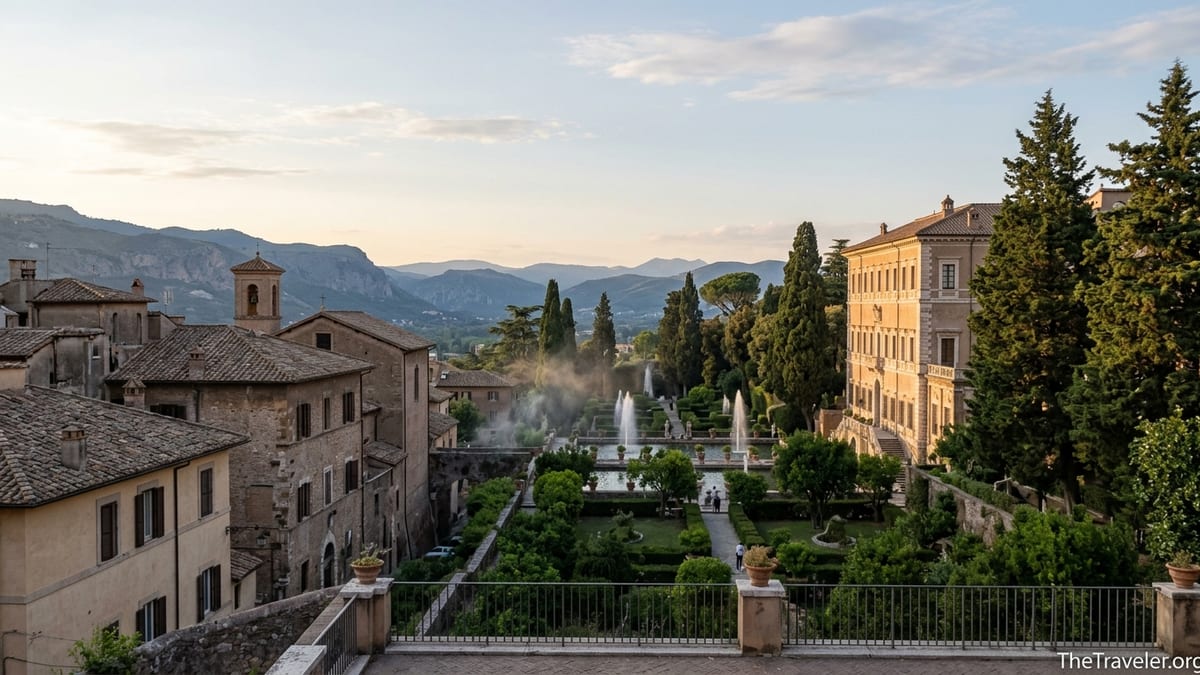
Villa d’Este, by contrast, sits right in Tivoli’s historic core. Built in the 16th century for Cardinal Ippolito II d’Este, its hillside Renaissance gardens are famous for hundreds of gravity-fed fountains, from the grand Oval Fountain to the long perspective of the Hundred Fountains. UNESCO recognized the site in 2001 for the way its design influenced formal gardens across Europe. In practical terms, this means that on a single day trip from Rome, a visitor can stand in the ruins of an imperial dream city in the morning and in the afternoon stroll through one of the most influential Renaissance gardens ever built, with a plate of gelato or slice of pizza in between.
No other town near Rome offers this double UNESCO identity. Castel Gandolfo has the papal palace and gardens, significant but not on the World Heritage list. Frascati is dotted with noble villas, yet they are mostly private and lack the same global recognition. Travelers who are collecting major heritage sites find Tivoli uniquely efficient: regional buses link Rome’s Ponte Mammolo station with Tivoli’s center in about an hour, and a separate shuttle or local bus continues to Hadrian’s Villa. Combining both complexes in one day requires planning and comfortable shoes, but it is entirely feasible for independent travelers.
From Imperial Grandeur to Renaissance Spectacle
Historic towns around Rome often tell a story concentrated in one era. Viterbo immerses visitors in a well preserved medieval quarter, while Orvieto dazzles with its Gothic cathedral and Etruscan roots. Tivoli, by contrast, showcases a long narrative that runs visibly from ancient Rome through the Renaissance to the Romantic era. At Hadrian’s Villa, you walk the outlines of an imperial residence where the emperor reimagined the best architecture he had seen across the empire, including Greek theaters and Egyptian sanctuaries. Fresco fragments and marble piles still hint at an opulence that once rivaled anything in the capital.
Fast forward more than a millennium and Tivoli becomes the setting for a very different kind of ambition. Cardinal d’Este, frustrated at not becoming pope, poured his energy and money into creating a showpiece villa that would outshine his rivals. With engineers diverting the Aniene’s waters through underground channels, the gardens of Villa d’Este became a demonstration of technical prowess as much as artistic taste. Fountains play without pumps, relying purely on gravity and water pressure, a detail that modern visitors can appreciate when they see the sheer volume of water rising in the Fountain of Neptune or whispering along the Hundred Fountains walkway.
Later centuries added another layer: romantic fascination. Nineteenth century travelers who had already admired Rome’s Forum and Florence’s palaces came to Tivoli for its mood. Writers and painters sought out the mist over the valley below the temples of the acropolis, the crumbling arches at Hadrian’s Villa overgrown with vegetation. While many Italian towns can claim a medieval or Renaissance heart, Tivoli’s appeal has always rested on this combination of power, artistry and atmosphere, which still shapes the way contemporary visitors experience it today.
A Historic Center Framed by Temples and Waterfalls
In many Lazio hill towns, the historic center is a compact knot of stone houses, churches and piazzas that could almost be interchangeable at first glance. Tivoli’s centro storico, though narrow and medieval in layout, is framed by landmarks that give it a distinctive identity. On one side, the remnants of Tivoli’s ancient acropolis rise in the form of the so called Temple of Vesta and the Temple of the Sibyl, small classical temples perched on a rocky spur. Seen from Ponte Gregoriano or from viewpoints in Villa Gregoriana park, these structures seem almost to grow out of the cliff, an image that has appeared in countless artworks and guidebooks.
Below them the Aniene once plunged dramatically in a series of waterfalls cutting through the town. After destructive floods in the 19th century, engineers redirected much of the river through tunnels, but the reshaped cascades, caves and viewpoints in Villa Gregoriana still give a sense of how closely Tivoli’s urban life has always coexisted with raw nature. Visitors can start their morning with espresso in Piazza Rivarola, then within minutes be watching water vanish into a cavern at the base of a sheer rock wall, a juxtaposition that rarely exists in places like Frascati, where vineyards and villas lie at a gentler distance from town.
Even everyday experiences carry this imprint of landscape. A trattoria terrace near the temples might offer a lunch of local sheep’s cheese and grilled lamb with a panoramic view of the valley, while small bars tucked into alleys just off Via delle Cascatelle echo faintly with the sound of water below. Tivoli’s residents live with this geography in a way that visitors quickly notice: teenagers cut through the park paths on their way home, and older locals pause at railings to glance down into the gorge as casually as Romans glance at the Colosseum from a bus window.
Tivoli Versus Other Day Trips: How the Experience Feels
For many travelers planning from Rome, the practical question is not whether Tivoli is interesting but how it compares to other nearby options. Frascati tends to attract food and wine lovers with its white wine cellars and simple osterie. Castel Gandolfo appeals for leisurely lake walks and the novelty of visiting a former papal retreat. Orvieto, farther away, offers a full scale medieval town with a striking cathedral. All of them make rewarding excursions, but the rhythm of a day in Tivoli feels different.
A typical Tivoli itinerary involves more walking through archaeological sites and gardens than time spent stationary. At Hadrian’s Villa you might easily cover several kilometers tracing routes between the Maritime Theater, the Canopus and the grand bath complex. At Villa d’Este, paths climb and descend along terraces, and there is a constant sensory mix of water sounds and changing perspectives. Compared with a castle stroll in Viterbo or a lakeside promenade in Castel Gandolfo, Tivoli is more immersive and physically active. Comfortable shoes and a willingness to spend several hours on your feet will shape your experience here more than in a small wine town where much of the day is seated at tasting tables.
On the other hand, Tivoli usually offers more shade and coolness in summer than sites like Ostia Antica or the open plateau around Orvieto. The combination of flowing water, tree cover and stone structures can bring a noticeable temperature drop, which is part of why Romans historically sought this area as a retreat from the city’s heat. Travelers who visit in July or August often comment that Villa Gregoriana and parts of Villa d’Este feel refreshingly cooler than central Rome’s streets at midday.
From a cultural perspective, Tivoli also concentrates a wider variety of stories. A day in Frascati might revolve mainly around wine production and noble villa architecture. A day at the seaside near Ostia focuses on ancient port life and beach culture. In Tivoli, one moment you are reading about imperial political intrigues at Hadrian’s residence; an hour later you are admiring 16th century Mannerist frescoes commissioned by a powerful cardinal; and by late afternoon you are following 19th century romantic pathways past grottoes and lookout points. For travelers who enjoy multiple historical periods or who are sightseeing with companions of varied interests, this mix can be a deciding factor.
Practicalities That Set Tivoli Apart
From Rome, a day in Tivoli is logistically different from other popular excursions. Trains from Roma Tiburtina reach Tivoli in roughly 45 to 60 minutes, depending on the service, and regional Cotral buses from the Ponte Mammolo metro station offer an alternative that drops you close to the historic center. In contrast, Orvieto requires about 90 minutes by train from Termini, while Castel Gandolfo sits on a different rail line toward the Alban Hills. Tivoli’s slightly shorter travel time and frequency of services mean that even in shoulder season, many locals treat it as a straightforward day out rather than a once in a lifetime adventure.
Transport within Tivoli also shapes the experience. While Frascati or Castel Gandolfo can be explored almost entirely on foot directly from the station, Tivoli’s main archaeological jewel, Hadrian’s Villa, lies a few kilometers outside town. Visitors typically use a local bus or a short taxi ride from the train station to reach the site, then return to the centro storico for Villa d’Este and Villa Gregoriana. This extra step can feel like a small complication, but it also contributes to a sense of leaving the town and entering a separate, almost rural world when you arrive at Hadrian’s sprawling estate.
Ticketing is another area where Tivoli stands out. Access to Hadrian’s Villa and Villa d’Este is through separate paid tickets managed by the same cultural institute, and there are often combination tickets or reduced rates for visitors under certain ages or from EU countries. In practice, travelers who plan to visit both main sites should check current prices in advance and budget for at least two substantial entry fees, whereas a trip to a town like Frascati or Castel Gandolfo might involve only a single museum ticket or castle visit. The upside is that the quality of maintenance and interpretation at both Tivoli sites is usually high, with clear signage, guided tour options and occasional evening openings in warmer months.
Food and drink costs in Tivoli remain broadly similar to other Lazio towns. A coffee at a bar near Piazza Garibaldi is typically only slightly higher than in neighboring villages, while a sit down lunch close to Villa d’Este may be moderately priced compared to touristy streets in central Rome. Visitors accustomed to high restaurant prices in the capital often find that a plate of fresh pasta with local pecorino and a glass of house wine in Tivoli delivers better value, which can help offset museum ticket costs.
The Takeaway
When travelers compare historic towns near Rome, the conversation often starts with convenience and scenery. Tivoli certainly holds its own in both categories, but what lifts it above the rest is the depth of experiences packed into a relatively compact area. Few places anywhere allow you to trace such a clear arc from imperial experimentation at Hadrian’s Villa, to the theatrical confidence of Villa d’Este, to the romantic reinvention of nature at Villa Gregoriana, all within a short bus ride from the capital.
Other destinations around Rome excel in specific niches. Frascati is a convivial place for wine and simple food, Castel Gandolfo an elegant balcony over a volcanic lake, Viterbo a textbook of medieval urbanism. Tivoli, uniquely, asks you to move constantly between nature and architecture, ruin and refinement, engineering and beauty. Its waterfalls and cliffs shape every view; its UNESCO sites set a global benchmark for both ancient and Renaissance design. For travelers deciding how to spend limited days around Rome, this combination of variety, drama and cultural weight is what makes Tivoli different, and for many, what makes it unforgettable.
FAQ
Q1. Is Tivoli worth visiting if I have already seen a lot of ancient sites in Rome?
Tivoli offers a very different experience from central Rome, with Hadrian’s Villa spreading over open countryside and Villa d’Este focusing on water gardens rather than dense urban ruins, so even repeat visitors to Rome usually find it fresh and worthwhile.
Q2. How much time do I need in Tivoli to see the main highlights?
Most travelers need a full day to visit Hadrian’s Villa and Villa d’Este without rushing, with Villa Gregoriana added if you start early; trying to fit all three sites into a half day generally feels too compressed.
Q3. How does Tivoli compare with Frascati or Castel Gandolfo as a day trip?
Frascati and Castel Gandolfo are more about leisurely food, wine and lake views, while Tivoli is more active and focused on major heritage sites and dramatic landscapes, so it suits travelers who enjoy walking and sightseeing as much as relaxing.
Q4. Can I visit Tivoli on my own, or do I need a guided tour from Rome?
It is entirely possible to visit Tivoli independently using regional trains or buses and local transport, though some visitors choose guided tours for convenience and expert explanations, especially at Hadrian’s Villa.
Q5. Is Tivoli suitable for children or travelers who are not very fit?
Children often enjoy the fountains at Villa d’Este, but both Hadrian’s Villa and Villa Gregoriana involve uneven paths and some slopes, so families and less mobile travelers may prefer to focus on Villa d’Este and the historic center where walking can be more easily managed.
Q6. When is the best time of year to visit Tivoli?
Spring and early autumn are usually ideal, with milder temperatures and flowing fountains; summer can be hot but shaded gardens help, while winter brings quieter sites and a more contemplative atmosphere.
Q7. Do I need separate tickets for Hadrian’s Villa and Villa d’Este?
Yes, each site has its own ticket, and while combination options are sometimes available, visitors should expect to purchase separate entry for the main complexes in Tivoli.
Q8. Is Tivoli more crowded than other towns near Rome?
Tivoli sees steady day trip traffic, especially on weekends and in high season, but its main sites are spacious enough that the experience often feels less crowded than compact hill towns where all visitors concentrate in a small historic core.
Q9. Can I see Tivoli and another town like Frascati on the same day?
It is technically possible, but most travelers find that combining two towns in one day leaves too little time for Tivoli’s major sites, so it is usually better to dedicate a full day to Tivoli alone.
Q10. Is Tivoli a good base instead of Rome for exploring the region?
Tivoli can work as a quieter base with frequent connections to Rome, but it has fewer accommodation options and late night services than the capital, so many visitors prefer to stay in Rome and treat Tivoli as a day trip.