


Plage de la Salis is one of Antibes’ most beloved sandy beaches, sitting where the old town gives way to the Cap d’Antibes peninsula. With shallow water, postcard views of the Alps and the ramparts, and easy access from town, it is a classic Côte d’Azur beach day. It is also a busy urban beach with very specific rhythms, rules and quirks. Knowing what to expect before you go will make your time here far more relaxed and enjoyable.
Get the latest updates straight to your inbox!
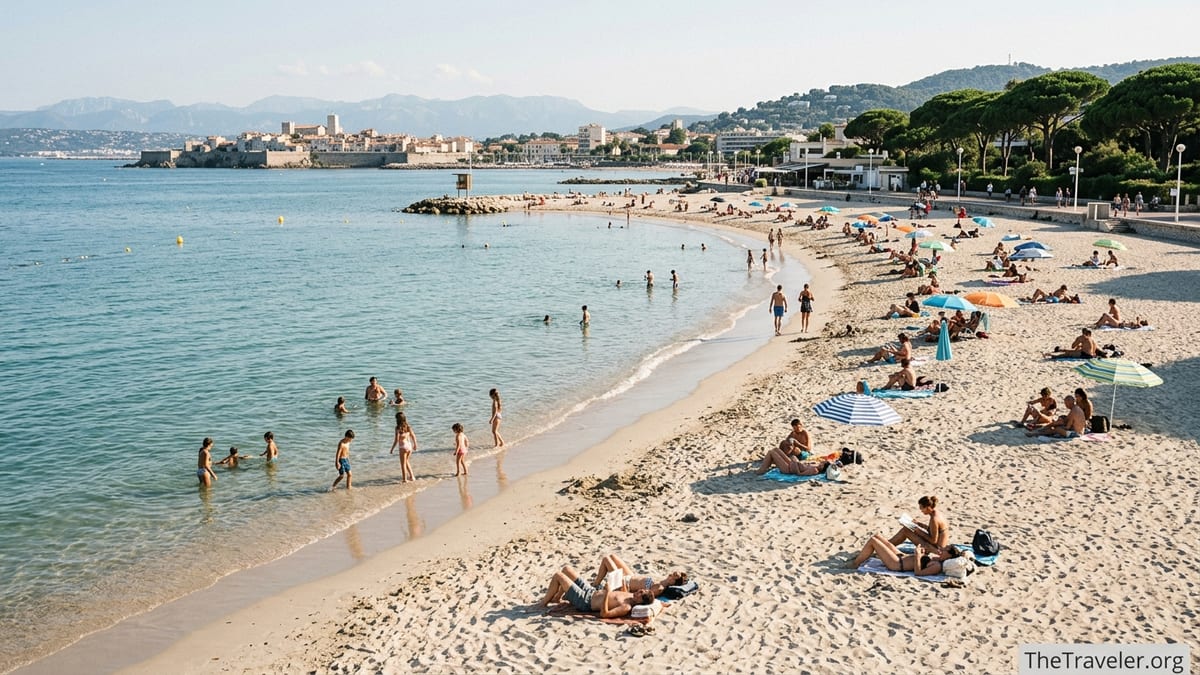
Where Plage de la Salis Is and What Makes It Special
Plage de la Salis stretches along Boulevard James Wyllie, at the point where central Antibes merges into the start of Cap d’Antibes. On one side you look back to the fortified old town and the towers of the Musée Picasso; on the other you see the pine-covered headland curling around the Baie des Anges. It feels close to everything yet still distinctly seaside, with low buildings and a backdrop of umbrella pines rather than high-rises.
This is a proper sand beach, a rarity along parts of the French Riviera where pebbles are the norm. The sand is light and fairly fine, and the bay is sheltered. On clear days you can often see the Alps in the distance behind the old town skyline, which gives Salis a dramatic setting you notice as soon as you arrive and set down your towel.
The water here stays shallow for quite a distance, which is why local families favor it over some of the rockier coves further around Cap d’Antibes. Parents with small children often cluster near the central section of the beach, where the slope into the sea is particularly gentle. You are unlikely to find big waves; instead, expect small, lapping swells and generally calm conditions in summer.
Unlike many Riviera beaches that are divided between expensive private clubs and small public sections, Plage de la Salis is entirely public. That means there are no mandatory lounger fees or exclusive terraces blocking access to the sea. In practice, this also means you should be ready for crowds in July and August, because everyone from local school groups to visitors from Nice and Cannes can easily claim a patch of sand here.
Getting There and Understanding Local Transport
Reaching Plage de la Salis is straightforward whether you are staying in Antibes or visiting on a day trip. From Antibes old town, many people simply walk. From the harbor area, it is roughly 15 to 20 minutes on foot along the waterfront, passing first Plage du Ponteil and then continuing until you see the curve of Salis and the small port at its southern end. The promenade is mostly flat, which makes it manageable even with a stroller.
If you prefer not to walk in the midday heat, the local Envibus network serves the beach. Line 14 currently stops at Port de la Salis and Handiplage on Boulevard James Wyllie, only a few meters from the sand, with more frequent service in high season. Single bus tickets within the Antibes area are usually just a couple of euros and can be bought from the driver, while a day or week pass from Envibus is good value if you plan to explore the wider area by bus.
Travellers arriving by train from Nice, Cannes or the airport will get off at Gare d’Antibes. From there, you can either walk to Plage de la Salis in about 25 to 30 minutes, cutting through the old town and then following the coast, or transfer to a local bus at Place Général de Gaulle. Many visitors combine a stroll through the Provençal market with an afternoon swim at Salis, timing their walk so that they arrive at the beach after lunch.
Driving is possible but not always convenient in peak season. There is a public car park at the eastern edge of the beach and some roadside spaces along Boulevard James Wyllie. Outside the core summer period, parking is often free or inexpensive. Between mid-June and mid-September, however, spaces fill quickly by late morning, and drivers sometimes circle repeatedly without luck. If you are staying in central Antibes in summer, walking or taking the bus is usually less stressful than trying to park at the beach.
Facilities, Safety and Water Quality
For a public city beach, Plage de la Salis is relatively well equipped. You will find several outdoor showers along the sand, and public toilets are available around the Antibes Yacht Club area at the northern end. Changing directly on the beach is common, with people using towels for modesty; there are no large dedicated changing cabins like you might find at some resort complexes.
Lifeguards are typically on duty from mid-June to mid-September, with a supervised zone clearly marked by flags. Outside this period there may be no formal surveillance, so stronger swimmers often still take a dip, but you are responsible for your own safety. When the red flag is hoisted, swimming is prohibited; an orange flag indicates caution, for example after heavy rain or when the sea is choppy. Most summer days, you will see the green flag, and the sea is calm enough for children and less confident swimmers.
Water quality around Antibes is monitored regularly, and Salis has a reputation for generally good results. Municipal information boards near the beach often display recent test summaries in French, using a simple color code from excellent to poor. After exceptional weather events, such as very heavy rain, authorities may temporarily advise against swimming until the water clears. This usually affects only a short window, but it is wise to glance at the noticeboard or the flag system when you arrive.
The beach has a designated handiplage area in summer, designed to improve access for people with reduced mobility. Seasonal staff can assist with amphibious wheelchairs that roll over the sand and into the water, and access ramps reduce the need to cross soft sand. If someone in your group has mobility challenges, it is worth timing your visit for the main summer season and heading directly to the clearly marked handiplage point near the central section of the beach.
When to Go, Weather and Crowd Patterns
Plage de la Salis is technically accessible year-round, but its character changes with the seasons. From late June through August, the beach is at its busiest, with local families, day trippers and holidaymakers all competing for space. In this period, arriving before about 10:00 in the morning gives you a much better chance of finding a comfortable spot, especially near the waterline. By midday on a sunny July weekend, the sand can feel almost completely covered in towels and parasols.
May, early June and September often deliver the best balance of warm temperatures and manageable crowds. The sea has usually warmed up enough for comfortable swimming by mid to late May, and sunny days can still be common into October. In these shoulder months, you can often arrive late morning and still find plenty of space, and the mood on the beach tends to be more relaxed than in high summer.
Winter and early spring are quiet and can be beautiful in their own way. Locals use the promenade for jogging, dog walking and Sunday strolls, and you might see only a few hardy swimmers taking quick dips even in January. The sand remains accessible, but services are reduced or closed, and lifeguards are normally absent. This is a good time if you prefer a contemplative seaside walk rather than sunbathing.
Weather on this stretch of the Riviera is generally sunny, but strong mistral or easterly winds can make a beach day less pleasant. On windy days, lighter items such as beach towels and umbrellas may blow around, and the shallow water can become choppier than usual. If the forecast mentions strong gusts, consider planning your Salis visit for another day or shifting your main beach time to the morning before winds pick up in the afternoon.
What to Bring and How Much You Will Spend
Because Plage de la Salis is fully public and has no private clubs renting loungers along most of its length, what you bring will shape your comfort level. Local families often arrive with a compact parasol, foldable beach chairs and a small cooler bag filled with water, fruit and simple picnic food from the market. If you are traveling light, at least pack a good beach towel or mat, sun protection, a refillable water bottle and sandals suitable for hot sand.
There are several simple snack kiosks along the beach and in nearby streets that sell items such as paninis, socca, ice creams and cold drinks. Expect to pay slightly more than supermarket prices; for example, a cold soft drink could be a couple of euros, and a basic sandwich may cost in the mid single digits. A sit down pizza or pasta dish at a casual restaurant across the road, such as those around the boulevard, typically costs into the mid teens per person before drinks, depending on what you order.
Using the beach itself is free. Your main expenses during a visit are food, drinks and transport. A single Envibus ticket from central Antibes to Salis is usually around the cost of a modest coffee, and trains from Nice or Cannes to Antibes are often in the range of a few euros each way if you book standard regional services. A taxi from Antibes old town to the beach might come to a little over ten euros depending on traffic and time of day, which can be worth it for families carrying gear.
Water sports are available via the local sailing and water sports centers near Salis, especially around the yacht club. In summer, you may see kayaks and stand up paddleboards available to rent by the hour. Prices vary, but a simple paddleboard rental for an hour is commonly in the low to mid twenties in euros at Riviera beaches, and sailing lessons for children are often sold in multi-day packages. If you are interested, it is sensible to check schedules and prices in person a day or two in advance.
Beach Rules, Etiquette and Local Culture
As a French public beach, Plage de la Salis is governed by municipal rules that are similar to those along much of the Riviera. Dogs are generally not allowed on the sand in summer, and signs at the entrances explain seasonal restrictions. Smoking regulations can vary, but many sections of Riviera coastline now promote smoke free areas, and you may see signs or ashtray posts indicating where smoking is discouraged or prohibited.
Glass bottles are officially discouraged on the sand, and you will see most people using cans or plastic containers for drinks. Playing loud music from speakers is frowned upon, particularly close to families with small children or older beachgoers. Locals tend to keep music to a low volume or use headphones. If you want to play ball games or paddleball, watch where you choose your spot; the ends of the beach are better for this than the crowded central stretches.
Topless sunbathing is legal on most French beaches and not unusual at Plage de la Salis, although it is less common than in previous decades. Visitors are expected to be relaxed and respectful. Changing from swimwear into clothes on the sand using a towel screen is tolerated, but full nudity is not. Late afternoon often brings a more social atmosphere, with groups sharing rosé and small snacks, but this remains a family friendly place rather than a party beach.
Rubbish bins are placed along the promenade and near the entrances. Beach clean up campaigns are common in Antibes, and leaving litter on the sand is strongly condemned by locals. If you organize a picnic, plan ahead with a bag to carry your waste back to a bin. The sea here is a shared resource, and you will see local residents caring about water quality and the condition of the shoreline.
Family Friendliness and Accessibility
One of the main reasons Plage de la Salis is so popular with Antibes residents is its suitability for children. The shallow gradient of the seabed means that youngsters can play close to shore without suddenly finding themselves in deep water, though they still need supervision. Inflatable toys and small bodyboards are common sights, and parents often set up camp just behind the wet sand line where they can watch children both on the beach and in the shallows.
There are no large playground structures directly on the sand, but the promenade behind the beach works as a natural corridor for scooters and small bikes outside the most crowded hours. Toilets and showers are within short walking distance, which matters if you are with toddlers. On busy weekends, it can help to identify a clear meeting point, such as near the yacht club or a particular lifeguard tower, in case family members get separated in the crowd.
Accessibility has improved significantly in recent years. The handiplage scheme at Salis offers adapted facilities in summer, including reserved parking spaces nearby, beach wheelchairs and assistance from trained staff during set hours. Beach access paths reduce the need to navigate soft sand. If someone in your party uses a wheelchair or has limited mobility, you can plan your arrival around these services and enjoy time close to the water without having to rely on improvised solutions.
For families with strollers, the flattish promenade and coastal path make the journey to Salis manageable, though the sand itself will always be more challenging to cross. Many parents choose lightweight, compact strollers and bring a simple blanket instead of a bulky beach tent to minimize what they have to push or carry across the sand during the hottest part of the day.
Combining Salis With Nearby Walks and Sights
A visit to Plage de la Salis can easily form part of a wider day exploring Antibes and Cap d’Antibes. Many visitors begin in the old town, touring the Provençal market and the narrow streets near the cathedral, then walk along the sea toward Salis for an afternoon swim. The route takes you past bastion walls, the busy Port Vauban marina and then onto the more relaxed waterfront of Ponteil and Salis.
At the southern end of the beach, near the small port, the road begins to curve around Cap d’Antibes. This is the starting point for some of the peninsula’s famous coastal walks. One popular option is to follow the path further around the headland toward the rocky coves and viewpoints of the Cap. While this coastal path is more rugged and involves some steps, it rewards you with views back across the bay to Antibes and the mountains beyond, especially in the late afternoon light.
If you prefer a gentler stroll, simply continuing along the promenade beyond Salis lets you admire the villas and gardens that make Cap d’Antibes so well known. You can then loop back into town by bus from a later stop or retrace your steps along the sea at sunset. Visitors often comment that one of the pleasures of staying near Salis is being able to leave their towel on the sand, walk for 30 or 40 minutes along the headland, and then finish with a cooling swim before dinner.
Photography enthusiasts will find plenty to work with. Early morning brings soft light over the old town and relatively empty sand, while evening can paint the Alps in pastel shades behind the skyline. If you are planning to take photos, remember that this is a family beach and be discreet; focus on landscapes rather than close ups of people you do not know.
The Takeaway
Plage de la Salis offers a combination that is rare even along the Côte d’Azur: a fully public sandy beach with shallow water, lifeguards in summer, and views that take in both medieval ramparts and alpine peaks. Its popularity means it can feel crowded in high season, but with a little planning around timing and transport, it remains one of the easiest and most rewarding places in Antibes to swim.
To make the most of your visit, think practically. Arrive early in midsummer, bring your own shade and snacks, and check the flag system when you reach the sand. Use local buses or your feet instead of counting on a last minute parking space, and be prepared for a laid back, mixed crowd of locals and visitors. Respect the beach rules, keep noise and litter down, and treat the handiplage area with consideration.
Combine your time at Salis with a wander through old Antibes or a walk further around Cap d’Antibes, and the beach becomes more than just a sunbathing stop. It is a hinge point between town and peninsula, where you can feel close to both history and nature with your feet in the sand. With the right expectations and a few simple preparations, Plage de la Salis can anchor some of your best memories of the Riviera.
FAQ
Q1. Is Plage de la Salis free to use?
Yes, Plage de la Salis is fully public and free to access. You only pay for optional extras like transport, food, drinks or any water sports you choose to book.
Q2. How do I get from Antibes old town to Plage de la Salis without a car?
The easiest options are to walk along the waterfront in about 20 to 30 minutes or to take an Envibus line that stops at Port de la Salis or Handiplage on Boulevard James Wyllie.
Q3. Is the beach suitable for small children?
Yes. The water stays shallow for quite a distance and waves are usually gentle in summer, which makes it a popular choice for families, though children should always be supervised.
Q4. Are there lifeguards at Plage de la Salis?
Lifeguards generally operate in the main summer season, typically from mid-June to mid-September, with a supervised swimming zone marked by flags.
Q5. Can I rent sunbeds or umbrellas on the beach?
Plage de la Salis does not have extensive private beach clubs, so you should not rely on renting loungers. Most visitors bring their own towels, mats and compact parasols.
Q6. What about food and drink options near the beach?
You will find snack kiosks and small cafés selling sandwiches, ice creams and drinks along and behind the beach, as well as casual restaurants across the road for sit down meals.
Q7. Is Plage de la Salis accessible for wheelchair users?
In summer, a designated handiplage area offers improved access, including adapted equipment and assistance. Access paths and nearby parking also help, but the sand can still be challenging.
Q8. When is the best time of year to visit?
Late May, June and September often offer warm weather with fewer crowds. July and August are liveliest but also busiest, so early morning and late afternoon are preferable then.
Q9. Are dogs allowed on the beach?
Dogs are generally restricted or prohibited on the sand, especially in summer. Check posted signs at the entrances for current local rules and any seasonal exceptions.
Q10. Is the water at Plage de la Salis clean?
Water quality is monitored regularly and is usually rated good or better. After heavy rain, authorities may temporarily advise caution, so check beach notices and flag colors when you arrive.