


Most visitors come to Piazza della Signoria in Florence for one thing: the statues. The copy of Michelangelo’s David, the Fountain of Neptune and the muscular marbles under the Loggia dei Lanzi tend to steal the show. Yet if you only point your camera at the sculptures and move on, you miss what makes this square one of Europe’s most layered urban spaces. From a working town hall and fashion museum to political scars in the paving stones, Piazza della Signoria rewards travelers who slow down, look up and step inside the surrounding buildings.
Get the latest updates straight to your inbox!
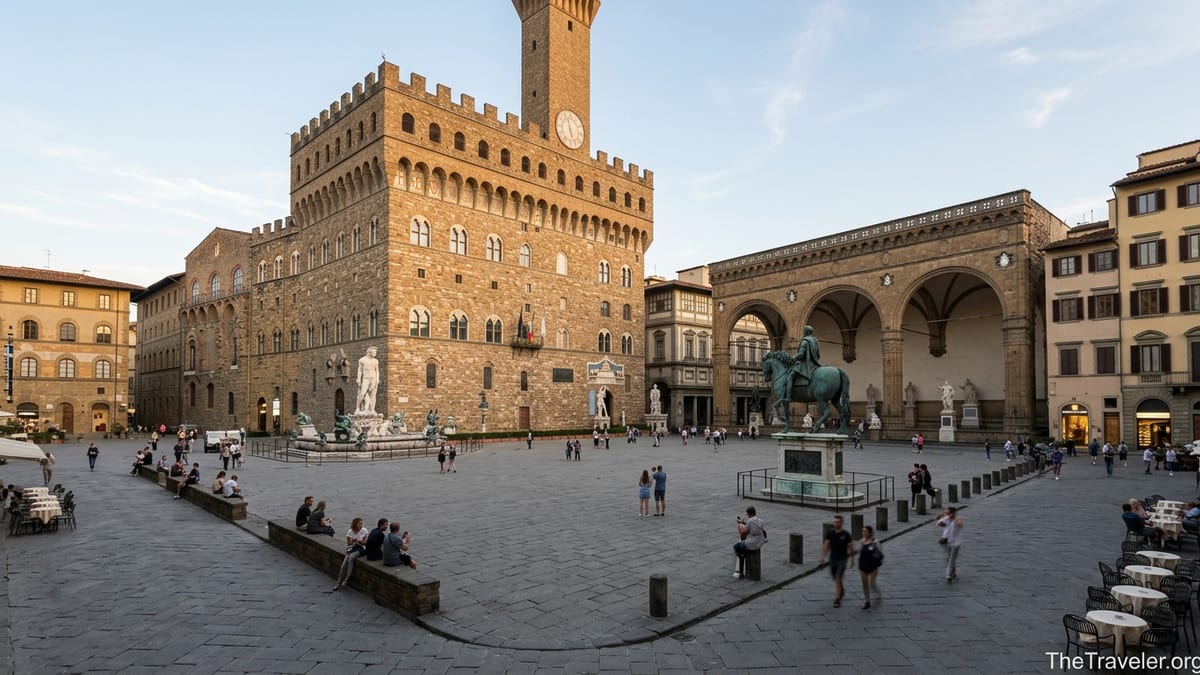
Start With the Square Itself: A Stage for Florentine Power
Before diving into individual sights, take a few minutes simply to stand in the middle of Piazza della Signoria and imagine it as Florence’s open-air parliament. Since the late 13th century, this irregularly shaped square has been the setting for public assemblies, executions, celebrations and protests. Today, cafés and gelato counters hug the edges, but the space still works as the city’s civic living room: locals cross it on their way to work, tour groups cluster around flag-waving guides, and street musicians use the stone walls for their acoustics.
Look down as well as around. Near the Fountain of Neptune, a round marble plaque in the paving marks the spot where the Dominican friar Girolamo Savonarola was hanged and burned in 1498. It is easy to walk over it without noticing, but pausing there connects the elegant square with a darker chapter of religious fanaticism and political upheaval. The modest disk in the ground is one of the most powerful “sights” in the piazza, precisely because it is so understated compared with the marble giants nearby.
The square’s uneven, almost wedge-like outline is another reminder that it was carved out of a medieval neighborhood rather than planned on a drawing board. Archaeological work in the 1980s revealed layers of earlier houses and streets underneath. When you stand by the equestrian statue of Cosimo I and look toward Via dei Calzaiuoli, you can sense how the buildings were cut back to open this space, leaving a slightly off-kilter geometry that gives the piazza much of its character.
Practical tip: If you can, visit twice in one day, once in the early morning when café staff are setting up tables and the square belongs to locals, and once in the evening when the stone glows amber and the statues are dramatically lit. Both moments reveal different sides of Piazza della Signoria that you will not see at midday in peak season.
Palazzo Vecchio: Inside Florence’s Working Town Hall
The crenellated fortress on the north side of the piazza, Palazzo Vecchio, is not only a museum but also Florence’s city hall. That dual role means visitors can climb its tower, wander through lavish Renaissance chambers and, at the same time, see municipal offices where people queue to file paperwork. Enter through the main doorway beneath the copy of David and you immediately step into the Cortile di Michelozzo, a richly painted courtyard with a small fountain and frescoed walls depicting the cities of the Habsburg Empire.
Most travelers head straight upstairs to the grand Salone dei Cinquecento, a vast ceremonial hall lined with massive battle paintings and ornate wooden ceiling panels. Yet some of the most atmospheric corners are quieter: the map room with its painted globes and secret passages, or the modest chapel where Duke Cosimo I once prayed before addressing the people in the square below. Buying a standard museum ticket, currently around the high teens in euros for adults, gives access to these rooms, while a combined ticket lets you climb the Arnolfo Tower for a close-up view of the bell and spectacular panoramas over the red rooftops.
Because this is still a functioning town hall, opening hours can shift for official events. As of 2026, you can normally visit daily from morning until early evening, with shorter hours on Thursdays, though parts of the building may close temporarily for civic ceremonies. It is wise to check times just before you go or ask your accommodation to confirm them the day before, especially in spring and early summer when institutional events are frequent.
One underrated experience is simply sitting on the low stone wall outside Palazzo Vecchio and watching how Florentines use the building. You will see wedding parties pose for photos in the courtyard, city employees popping in for meetings, and, occasionally, a protest or rally assembling in front of the main doors. It is a reminder that this palace is not a frozen relic but part of Florence’s current political life.
Loggia dei Lanzi: An Open-Air Sculpture Gallery and Its Guardians
On the south side of the square, the elegant arches of the Loggia dei Lanzi form what is effectively a free open-air museum. Many visitors rush in to snap Perseus with the Head of Medusa or Giambologna’s twisting Rape of the Sabine Women, and then move on. To appreciate the Loggia beyond its famous pieces, stand just outside the arches and notice how the structure frames both the piazza and the entrance to the Uffizi Gallery, creating a theatrical wing to the civic stage.
The arrangement of statues here was never purely about decoration. Grand Duke Cosimo I deliberately placed mythological scenes of conquest and punishment under these vaults to project his authority. Hercules grappling with the centaur Nessus, or the violent energy of the Sabines, were chosen to communicate messages about power and order to the crowds gathered below. When you walk slowly from one sculpture to another, reading the small plaques at their bases, you begin to see the Loggia as political storytelling in stone, not just a random collection of masterpieces.
Flanking the entrance steps are the Medici lions, two marble predators that have guarded this corner of the square since the late 18th century, when they were moved here from the Villa Medici in Rome. They are easy to overlook because selfie-takers often use them as casual backrests, yet the severe expressions and detailed manes are as compelling as many of the more famous figures inside the arches. Children in particular tend to gravitate toward the lions, making them a natural spot to pause if you are visiting with a family.
Because the Loggia is open 24 hours a day and free to enter, it can be a welcome refuge from both heat and ticket queues. In summer, come early in the morning or late in the evening to avoid the densest crowds and to see how the artificial lighting models the sculptures differently from the midday sun. The stone floor can be slippery after rain, so wear shoes with decent grip if you plan to wander among the plinths.
Fountain of Neptune and the Equestrian Cosimo: Reading Stone Propaganda
At first glance, Bartolomeo Ammannati’s 16th-century Fountain of Neptune looks like just another photogenic backdrop. Nicknamed “Biancone” or “big white one” by locals, the central figure stands on a chariot drawn by sea horses, surrounded by bronze river gods and nymphs. The fountain was built in the 1560s to celebrate a new aqueduct, bringing fresh water to the city, but its symbolism went further: the face of Neptune was modeled on Duke Cosimo I, presenting him as a ruler of the seas at a time when Florence sought maritime influence.
Recent restoration campaigns have cleaned decades of pollution from the marble and repaired damage from vandalism, so if you have not visited Florence in some years you may notice the figures now appear brighter and more detailed. Look closely at the bronze decorations around the basin: you will see dolphins, shells and mythological creatures that children enjoy spotting. In hot weather, guards are quick to blow whistles at anyone tempted to dip a hand or foot into the water, so resist the urge and respect local rules.
A few steps away, Giambologna’s bronze equestrian statue of Cosimo I shows the duke in armor on a powerful horse. It is easy to treat it as just another photo subject, but consider how radical this monument once was. Completed in the late 16th century, it was among the earliest large-scale equestrian statues north of Rome since antiquity, consciously echoing ancient imperial imagery. Stand at the base and walk a slow circle around it; the sense of motion in the horse’s lifted leg and the careful rendering of the duke’s armor become more apparent from different angles.
Together, the fountain and the equestrian monument acted as open-air propaganda for Medici power. When you view them not simply as art but as carefully scripted public messaging, the entire piazza begins to read like a political brochure carved in marble and bronze. This perspective adds another layer to your visit, especially if you have already seen Medici portraits inside the Uffizi and can match faces between painted canvases and outdoor monuments.
Gucci Garden and the Palazzo della Mercanzia: Fashion Meets History
On the southwest corner of Piazza della Signoria, facing the statues and cafés, stands the Palazzo della Mercanzia, the former merchant tribunal of Florence. Behind its late Gothic façade you will now find Gucci Garden, the fashion house’s hybrid museum, boutique and exhibition space. This is one of the most unexpected experiences in the square: a contemporary brand using Renaissance rooms to tell its story through archival garments, advertising campaigns and immersive installations.
Gucci Garden typically charges a modest entry fee compared with major art museums in the city, with occasional free sections such as the ground-floor boutique and bookshop. Exhibitions change periodically, so one season you might find a retrospective of iconic handbags and runway pieces, while another features a more conceptual show about print design or collaborations with artists. For travelers who enjoy fashion or graphic design, it offers a fresh lens on Italian creativity that contrasts sharply with the medieval stonework outside.
Even if you are not a shopper, step inside the courtyard or at least study the building from the piazza. The Palazzo della Mercanzia once housed guild officials who regulated trade disputes and quality control for imported goods. Today, when you see global shoppers browsing Gucci accessories under its vaulted ceilings, you are literally watching centuries of Florentine commerce evolve in real time. The juxtaposition of 14th-century architecture and 21st-century branding captures Florence’s ability to reinvent its heritage without discarding it.
Because Gucci Garden’s hours can vary for special events or exhibition changeovers, it is sensible to check the schedule earlier in the day or ask at the door if you are passing by. The space is compact compared with a full-scale museum, so even a focused 45-minute visit can be worthwhile, especially in the heat of the afternoon when you need a break from the square’s glare.
Hidden Stories in the Paving, Plaques and Side Streets
Beyond the headline monuments, Piazza della Signoria rewards those who look for smaller details. In addition to Savonarola’s plaque, keep an eye on the façades for coats of arms and inscriptions that record past governments and alliances. On the walls of Palazzo Vecchio, for example, you can spot carved symbols of the Florentine Republic and later Medici emblems layered on top of one another, a literal stone palimpsest of changing regimes.
Walk toward the narrow side streets that radiate from the square and you will quickly transition from grand public space to intimate medieval lanes. Via dei Magazzini, for instance, leads you between tall, shadowed buildings that once served as storage for merchants trading in the piazza. The sudden drop in noise and sunlight just a few steps from the square gives a vivid sense of how medieval Florentines moved between public and private worlds. Turning back toward the piazza, you can frame the tower of Palazzo Vecchio between the tight walls for an atmospheric photograph.
Another overlooked experience is stepping into the arcaded courtyard of the Uffizi, which opens off the southeast corner of the piazza. This long, linear space was designed as government offices in the 16th century and now forms the entrance to one of the world’s great art museums. For travelers who are not visiting the Uffizi itself, walking a short way into the courtyard still offers a striking perspective: statues of famous Tuscan thinkers line the walls, street artists sell sketches under the arches, and buskers fill the space with music. From here, when you look back toward Piazza della Signoria, you see how the two spaces are visually and historically locked together.
If you arrive early in the day, you may also encounter local delivery workers and maintenance staff using discreet service entrances around the edges of the piazza. Observing these everyday routines, whether it is a florist wheeling buckets of blooms into a nearby hotel or municipal crews checking the fountain, underscores that the square is not a stage set but a working part of the city’s infrastructure.
Experiencing the Piazza Like a Local Visitor
For all its art and history, Piazza della Signoria is also a place where people simply live their lives. One of the best ways to experience it beyond the statues is to schedule practical errands here, as Florentines do. For instance, plan a mid-morning coffee at one of the bars that cater more to office workers than tour groups, where you will see residents standing at the counter for an espresso rather than occupying terrace tables. Prices are usually lower when you drink at the bar, and ordering like a local can transform the square from a sightseeing stop into a temporary neighborhood.
Meal choices in and around the piazza range from high-priced, view-heavy terraces to simple sandwich counters tucked under arcades. If you are budget-conscious, consider grabbing a panino from a side-street deli and eating it on a nearby bench instead of one of the most prominent terraces. This allows you to enjoy the same view of the Palazzo Vecchio and Loggia dei Lanzi without paying a premium for the table. Just remember that sitting directly on monument steps is discouraged, and in peak season police may ask people to move if they block entrances.
Time of day makes a huge difference to the atmosphere. Early morning, before most day-trippers arrive from cruise ships and nearby cities, the square feels almost intimate. You might see street cleaners hosing down the paving stones and delivery vans unloading at the back entrances of cafés. Late at night, after the Uffizi and Palazzo Vecchio close, musicians often gather near the Loggia dei Lanzi, and couples stroll across the now spacious-feeling piazza while the statues glow under spotlights.
Finally, do not underestimate the value of simply sitting still for 20 minutes and watching the choreography of the square. You will notice walking tours coalescing, art students sketching the statues, families negotiating gelato flavors, and office workers cutting diagonally across the space with practiced efficiency. In a city dense with museums, Piazza della Signoria offers a rare chance to absorb art, politics and everyday life in a single glance.
The Takeaway
Seen from a distance, Piazza della Signoria is an almost overwhelming showcase of sculpture. Step closer, and it becomes something richer: a working town hall, a layered political stage, a fashion museum housed in a medieval tribunal, and a daily crossroads for Florentines and visitors alike. The statues are still magnificent, but they are only part of the story.
To get the most from the piazza, balance your time between looking up at the marble and bronze and looking around at the buildings, paving stones and people who animate the space. Visit Palazzo Vecchio not just for its frescoes but to glimpse a living city government, linger under the Loggia dei Lanzi to decode its messages of power, study the propaganda embedded in Neptune’s fountain and Cosimo’s equestrian monument, and duck into side streets and courtyards that reveal quieter perspectives.
Whether you spend ten minutes crossing the square or half a day exploring its museums and corners, approaching Piazza della Signoria as a complete urban experience rather than just a cluster of famous statues will deepen your understanding of Florence. You will leave not only with better photographs, but with a more nuanced sense of how art, history and everyday life continue to intersect in this remarkable space.
FAQ
Q1. Is Piazza della Signoria free to visit?
Piazza della Signoria itself is completely free and open 24 hours a day. You only pay for attractions around it, such as Palazzo Vecchio or Gucci Garden.
Q2. How much time should I plan to spend in Piazza della Signoria?
If you only walk through and take photos, 20 to 30 minutes is enough. To visit Palazzo Vecchio, linger under the Loggia dei Lanzi and explore side streets, plan 2 to 3 hours.
Q3. What are the current opening hours for Palazzo Vecchio?
As of 2026, Palazzo Vecchio generally opens daily from morning until early evening, with shorter hours on Thursdays. Check just before your visit because hours can change for official events.
Q4. Do I need tickets in advance for Palazzo Vecchio or the tower?
Buying tickets in advance is strongly recommended in spring and summer, especially for climbing the tower, because same-day slots can sell out and ticket queues in the piazza may be long.
Q5. Can I enter the Loggia dei Lanzi and get close to the statues?
Yes, the Loggia dei Lanzi functions as a free open-air gallery. You can walk inside, stand near most of the sculptures and photograph them, although touching is not allowed.
Q6. Is Gucci Garden worth visiting if I am not a big fashion fan?
If you are interested in design, branding or contemporary culture, Gucci Garden can be a refreshing contrast to traditional museums. It is compact, so even a short visit can be worthwhile between other sights in the square.
Q7. Are there good places to eat around Piazza della Signoria that are not tourist traps?
Many restaurants on the square itself charge premium prices for the view. For better value, look a few streets back, or grab a sandwich from a side-street deli and enjoy it on a bench while people-watching.
Q8. When is the best time of day to photograph Piazza della Signoria?
Early morning and the hour before sunset usually offer the softest light and thinner crowds. At night, spotlights on the statues and buildings create dramatic images with fewer people in the frame.
Q9. Is Piazza della Signoria suitable for children?
Yes. Children often enjoy spotting animals in the Fountain of Neptune, meeting the Medici lions at the Loggia and watching street performers. Just keep a close eye on them near crowds and fountains.
Q10. How does Piazza della Signoria connect with the Uffizi Gallery?
The southeast corner of the piazza opens directly into the Uffizi courtyard, which leads to the museum entrance. Even without a museum ticket, walking into the courtyard offers a striking perspective linking the square with Florence’s most famous gallery.