


Piazza della Signoria is one of those names that appears on every Florence itinerary, often bundled with the Uffizi, Ponte Vecchio and the Duomo. But when time is tight, travelers reasonably ask: is this famous square actually worth a stop, or is it just another crowded landmark? The short answer: if you care about Renaissance art, Florence’s political history, or simply want an atmospheric place to sit with a coffee and watch the city unfold, Piazza della Signoria more than earns a place on your route. Here is what to expect in 2026, and how to make the most of a visit.
Get the latest updates straight to your inbox!
Why Piazza della Signoria Matters in Florence
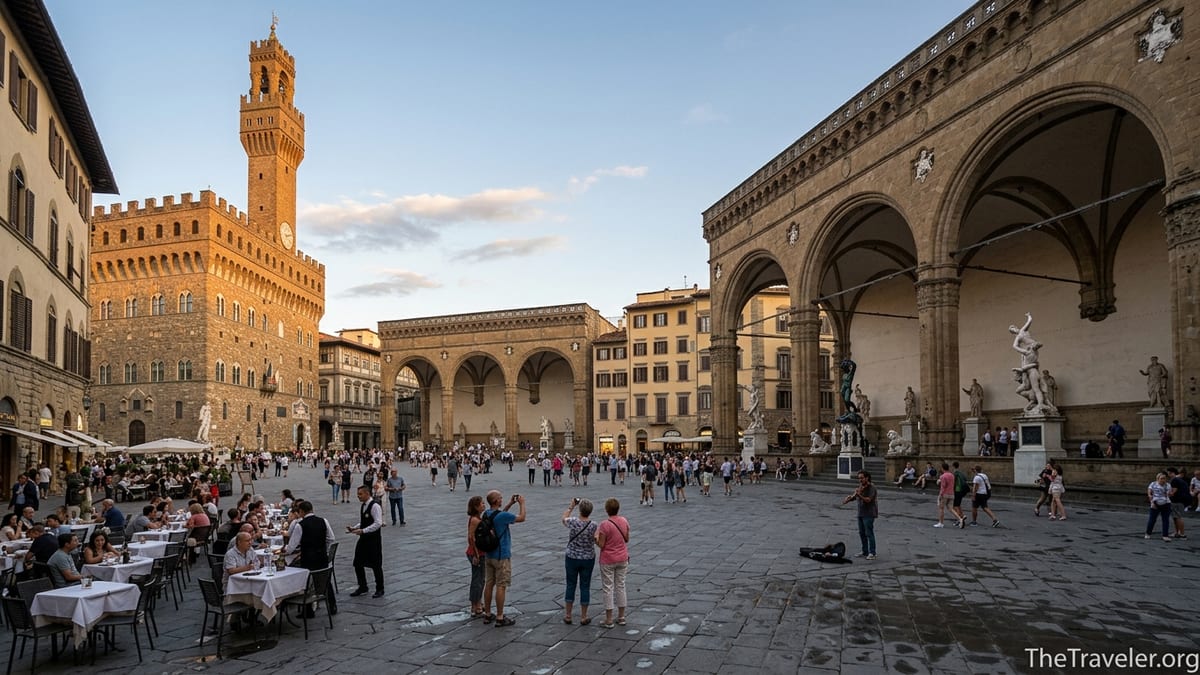
Piazza della Signoria is the historic civic heart of Florence, a W‑shaped square that has been the city’s political stage since the late Middle Ages. It fronts the fortress‑like Palazzo Vecchio, once the seat of the Florentine Republic and still the town hall today, and sits beside the Uffizi Gallery, one of the world’s leading art museums. This is where public assemblies were held, where executions took place, and where the Medici family projected their power. Standing in the middle of the square, you are effectively on the set where much of Renaissance history unfolded.
For many visitors, the square offers a concentrated hit of Florence’s greatest hits without an entry ticket. You can see a copy of Michelangelo’s David where the original stood, admire fountains and mythological statues, and walk right into an open‑air sculpture gallery under the Loggia dei Lanzi. Because it is completely free to enter and open 24 hours a day, Piazza della Signoria is an easy addition to any walking route between the Duomo and the Arno River.
The square also has strong emotional appeal. Travelers often describe it as one of their favorite places in Italy, precisely because you can feel the layers of history while street musicians play and café terraces fill around you. Unlike some monumental spaces that feel like backdrops for photos, Piazza della Signoria still functions as a lived civic space, with locals cutting across it on their way to work and city events occasionally spilling into the square.
If your goal in Florence is to move beyond a checklist of museums and experience the mood of the city, an unhurried half hour in Piazza della Signoria, especially in the evening, is hard to beat. Even if you never enter a museum, understanding this piazza will help you make sense of the rest of the historic center.
What You Actually See: Statues, Loggia and Palazzo Vecchio
The most obvious draw is the dense concentration of monumental sculpture. Outside the entrance to Palazzo Vecchio stands the famous copy of Michelangelo’s David, flanked by Bandinelli’s muscular Hercules and Cacus. Around the corner, Giambologna’s bronze equestrian statue of Cosimo I de’ Medici dominates the center of the square, while the Fountain of Neptune, with its towering marble sea god surrounded by bronzes, anchors the side nearest the Uffizi.
On the south side of the piazza, the Loggia dei Lanzi functions as a free, open‑air museum. Under its wide stone arches you will find Benvenuto Cellini’s dramatic bronze Perseus holding the severed head of Medusa, Giambologna’s twisting Rape of the Sabine Women, and a cluster of ancient Roman marbles brought here from Medici collections. You can walk right up to these works, photograph them from different angles, and linger as long as you like, all without a ticket. For travelers watching their budget, this is one of Florence’s best no‑cost art experiences.
Palazzo Vecchio itself is worth considering if you have time. Recent visitor information from the city’s museum network shows a standard adult ticket is around 12 to 13 euros for the museum portion, with separate or combined tickets available if you want to climb the Arnolfo Tower for skyline views. Entry gives access to grand rooms covered in frescoes and gilding, including the Salone dei Cinquecento, plus smaller chambers decorated for the Medici court. Guided tours offered through the official museum channels sometimes include access to secret passages or the archaeological remains under the palace, which appeal to history‑minded travelers.
Because the Uffizi Gallery complex wraps around one side of the square, Piazza della Signoria is also your visual introduction to one of Europe’s top museums. The Uffizi’s main entrance sits just off the piazza. As of 2026, official prices for a standard Uffizi ticket start at around 25 euros when bought on the day, with slightly higher rates for advance booking and combination passes that include other Medici sites. Even if you are not going inside, watching the flow of visitors in and out of the long Uffizi courtyard helps you appreciate how central this area is to Florence’s cultural life.
How Long to Spend and When to Go
Because Piazza della Signoria is compact, you can technically “see” it in ten minutes as you walk between the Duomo and Ponte Vecchio. In practice, most travelers benefit from planning at least 30 to 45 minutes to really explore the sculptures, step into the Loggia dei Lanzi, and absorb the atmosphere. If you are adding a visit to Palazzo Vecchio, expect the museum itself to take about 60 to 90 minutes, plus time for any tower climb.
Timing makes a big difference to the experience. From late morning through mid‑afternoon, especially in high season between May and September, the square fills with tour groups clustering around guides with flags or umbrellas. If you arrive around 9:00 a.m., you can often enjoy softer light, fewer crowds in the Loggia, and easier photo angles toward Palazzo Vecchio without rows of people in the frame. Another sweet spot is early evening, around sunset, when the stone buildings turn warm gold and café tables begin to fill.
Nighttime visits offer a different mood altogether. By around 10:30 or 11:00 p.m., the big tour groups are gone, leaving a quieter, more atmospheric square under warm street lighting. Recent safety guides and local tourism resources describe central Florence, including Piazza della Signoria, as generally safe after dark thanks to steady foot traffic and police presence, though you should still use normal big‑city common sense and keep valuables secure. Travelers who return to the piazza at night often report it as one of their most memorable Florence moments, with musicians playing under the Loggia and the statues dramatically lit against the sky.
Weather is another factor. In July and August, the exposed stone can make the square feel very hot in mid‑day. If you are visiting in peak summer, it is worth planning your time here for early morning or after 5:00 p.m. In cooler months such as March or November, you may find the piazza pleasantly uncrowded and the light ideal for photography, even in the middle of the day.
Costs, Cafés and What You Might Spend
One of the strongest arguments in favor of visiting Piazza della Signoria is that most of what you see is free. Walking through the square, enjoying the statues, and exploring the Loggia dei Lanzi costs nothing. If you are on a tight budget, this is an easy way to experience world‑class art and architecture without adding to your ticket list or needing reservations.
Costs begin to rise when you sit down at one of the cafés or restaurants directly on the piazza. A simple espresso at a table can easily cost 4 to 6 euros, compared with 1.50 to 2 euros if you drink it standing at the counter in a side‑street bar a few minutes away. Aperitivo cocktails or glasses of wine at outdoor tables facing the statues may run 10 to 15 euros each, sometimes plus a per‑person cover charge for live music. That said, many travelers decide the premium is worth it for a single drink or dessert with an unbeatable view of Palazzo Vecchio and the Loggia.
Nearby museum tickets are the other major cost to consider. As of 2026, a regular adult ticket for Palazzo Vecchio is just over 12 euros, with additional fees if you add the tower climb or a special themed tour. Uffizi Gallery tickets start around 25 euros in standard season, with combination passes costing more but giving multi‑day access to the Uffizi, Pitti Palace and Boboli Gardens. Families or couples might find better value in these bundled tickets if they are planning to explore several Medici sites over two or three days.
Souvenir stalls are less dominant here than around the Duomo, but you will still find leather shops and art print sellers in the neighboring streets. Prices vary, and quality can be inconsistent. If you want a Florence‑themed print or postcard of the square, it may be worth browsing a couple of shops and comparing paper quality and color before buying. For leather goods, many locals suggest looking just a bit farther away from the most famous piazzas to find better value.
Fitting Piazza della Signoria Into Your Florence Itinerary
Because Piazza della Signoria sits between the Duomo and the Arno River, it is easy to build into almost any walking route through Florence’s historic center. A common first‑day plan is to start at the Duomo complex, then wander down Via dei Calzaiuoli to the piazza, continue through the Uffizi courtyard to Ponte Vecchio, and finally cross to the Oltrarno district. This gives a strong overview of central Florence with minimal backtracking and makes good logistical sense if you are staying in a hotel near the train station or Piazza Santa Maria Novella.
If you have a timed ticket for the Uffizi, it often works well to arrive in Piazza della Signoria 45 minutes earlier than your reserved slot. You can explore the statues, take photos while you are still fresh, and locate the museum entrance without rushing. After a two or three‑hour gallery visit, you can return to the piazza for a coffee or gelato break, using the open space as a mental palette cleanser before tackling the rest of the city.
Travelers who enjoy guided experiences might choose a small‑group walking tour that starts or ends here. Many English‑language walking tours of Florence include a stop in Piazza della Signoria precisely because it allows guides to weave together tales of the Medici, Savonarola’s bonfire of the vanities, and the birth of the Renaissance in a single, visually rich setting. If you prefer exploring independently, you can download an audio guide from a reputable travel app to help identify the sculptures and historical episodes connected to the square.
For those with only one full day in Florence, it is still worth allocating at least one dedicated stop here, ideally in the early evening. Even if your schedule is packed with the Duomo and either the Uffizi or the Accademia, a sunset pause in Piazza della Signoria can act as a natural anchor to the day, tying together the art and stories you have encountered elsewhere.
Pros, Cons and Who Will Enjoy It Most
The main advantages of visiting Piazza della Signoria are its concentration of free art, its central location, and its powerful sense of place. Within a single glance you can take in medieval, Renaissance and later architectural layers, surrounded by sculptures that would be the centerpiece of a museum in most other cities. The square also works beautifully for people‑watching: you will see everything from office workers on their lunch break to street performers, school groups and fellow travelers.
There are, however, some trade‑offs. Crowds can be intense in peak daylight hours, with large guided groups filling the central area and blocking sightlines to the statues. The vibe immediately around tourist‑oriented restaurants can feel generic, and prices for food and drink on the square are significantly higher than just a few streets away. In the height of summer, heat and glare from the stone paving can be uncomfortable if you linger too long without shade.
Despite these drawbacks, most visitors who are interested in history, art or urban atmospheres find the piazza very much worth their time. Art enthusiasts will appreciate the chance to study Cellini and Giambologna pieces up close, while history buffs can stand on the spot where key political dramas played out. Photographers will enjoy the play of light on stone, especially in early morning or late afternoon, and couples often find the square romantic after dark when the statues and palace are illuminated.
If your priorities in Florence lean more toward shopping and dining, you might use Piazza della Signoria primarily as a scenic waypoint rather than a focus. In that case, passing through twice, once by day and once at night, may give you enough of a feel for the space without devoting a long block of time solely to it.
Practical Tips: Safety, Accessibility and Nearby Amenities
In terms of safety, current reports and local guidance describe Florence’s historic center, including Piazza della Signoria, as generally safe both by day and in the evening, especially compared with larger European cities. The square is well lit at night, and the constant presence of visitors, locals and police patrols reduces the likelihood of serious incidents. The main risk is the same as at any major European attraction: pickpocketing in crowds. Keeping bags zipped, phones out of back pockets, and small valuables in a money belt or inner pocket is usually sufficient.
The piazza is largely flat and paved, which helps with accessibility for travelers with mobility challenges. There are some mild slopes and occasional uneven cobblestones at the edges, but the main central area and the space under the Loggia dei Lanzi are generally manageable for wheelchairs and strollers. Palazzo Vecchio offers elevators and accessible routes to many, though not all, of its rooms; if accessibility is a priority, checking the latest details on the official museum site or in person at the ticket desk when you arrive is wise.
Public restrooms directly on the square are limited, so many travelers rely on cafés. If you are not planning to sit for a full drink or meal, ordering even a simple espresso at the counter in a nearby bar usually grants access to the toilet facilities. For families, it can be helpful to combine a restroom break with a brief snack stop here before continuing to the Uffizi or across the river.
Finally, consider footwear and sun protection. You will likely arrive here as part of a longer walking route, and standing still while listening to a guide or studying sculpture can be harder on the feet than walking itself. Comfortable shoes and a hat or sunglasses, especially from late spring to early autumn, will make your time in the piazza significantly more pleasant.
The Takeaway
So is Piazza della Signoria worth visiting during your Florence trip? For almost every type of traveler, the answer is yes. The square delivers an unusually rich combination of history, free open‑air art, urban atmosphere and practical convenience. It sits at the crossroads of many major sights, so including it rarely requires a detour, and you can tailor your time here to suit your interests, whether that means a five‑minute photo stop or an extended visit with a tour of Palazzo Vecchio and an evening drink on the square.
For first‑time visitors, Piazza della Signoria also serves as a kind of decoder ring for Florence itself. Understanding that this was the city’s political heart, surrounded by art commissioned for public consumption rather than private palaces, helps explain why Florence looks and feels the way it does. Seen by soft morning light or under the glow of streetlamps at night, it is a place where the city’s past remains unusually legible in the present.
If your itinerary is tight, prioritize at least one purposeful visit, ideally outside the busiest midday hours. Even a brief pause to stand beneath the statues and look up at the crenellated tower of Palazzo Vecchio can anchor your memories of Florence far more deeply than another quick glance at a shop window. In a city full of masterpieces, Piazza della Signoria holds its own and rewards every minute you choose to spend there.
FAQ
Q1. Is Piazza della Signoria free to visit?
The piazza itself and the Loggia dei Lanzi are completely free to visit at any time of day or night. You only pay if you choose to enter nearby museums like Palazzo Vecchio or the Uffizi Gallery.
Q2. How much time should I plan for Piazza della Signoria?
Plan at least 30 to 45 minutes to walk around the square, see the statues up close and enjoy the atmosphere. If you add a visit to Palazzo Vecchio, expect 1.5 to 2.5 hours in total.
Q3. Is Piazza della Signoria safe at night?
Yes, the square is generally considered safe at night, with good lighting and regular foot traffic. As in any busy city, keep an eye on your belongings and avoid isolated side streets late at night.
Q4. Can I see Michelangelo’s David in Piazza della Signoria?
You will see a full‑size replica of Michelangelo’s David in front of Palazzo Vecchio, standing where the original once stood. The original marble statue is displayed inside the Accademia Gallery elsewhere in Florence.
Q5. Are there places to eat and drink in the square?
Yes, there are several cafés and restaurants with terraces on the piazza, although prices are higher than in side streets. Many travelers choose to have one drink or dessert here for the view, then eat main meals a few minutes’ walk away.
Q6. Is Piazza della Signoria suitable for children?
Families often enjoy the open space and dramatic statues, but parents should be aware that some sculptures depict mythological scenes with nudity or violence. Young children may also need supervision in crowds and near café seating areas.
Q7. What is the best time of day to visit?
Early morning offers softer light and fewer crowds, while early evening and night provide a more relaxed, atmospheric experience. Midday, especially in summer, is the busiest and hottest period.
Q8. Do I need a guided tour to appreciate the piazza?
A guided tour or audio guide can add depth by explaining the history and symbolism of the statues and Palazzo Vecchio. However, even without a guide, you can enjoy the visual impact and general atmosphere of the square.
Q9. Is Piazza della Signoria accessible for wheelchair users?
The main areas of the piazza and the Loggia dei Lanzi are relatively flat and accessible, though some cobblestones and slight slopes exist. Palazzo Vecchio provides elevators and adapted routes to many areas, but not every part of the historic building.
Q10. Can I visit Piazza della Signoria if I am not going to museums?
Absolutely. Many travelers with limited time or budget still make the piazza a priority, since the sculptures, palace exterior and overall setting can be enjoyed fully from outside at no cost.