


In a country defined by grand piazzas, Piazza della Signoria in Florence manages to feel unmistakably different. It is at once an open-air sculpture gallery, a centuries-old political stage and the city’s informal living room, all compressed into a space smaller than many train stations. For travelers who have already strolled across Piazza San Marco in Venice or sipped espresso on Rome’s Piazza Navona, understanding what sets Piazza della Signoria apart helps reveal a deeper layer of how Florence works and why this square still shapes daily life around it.
Get the latest updates straight to your inbox!
A Political Heart Rather Than a Church Square
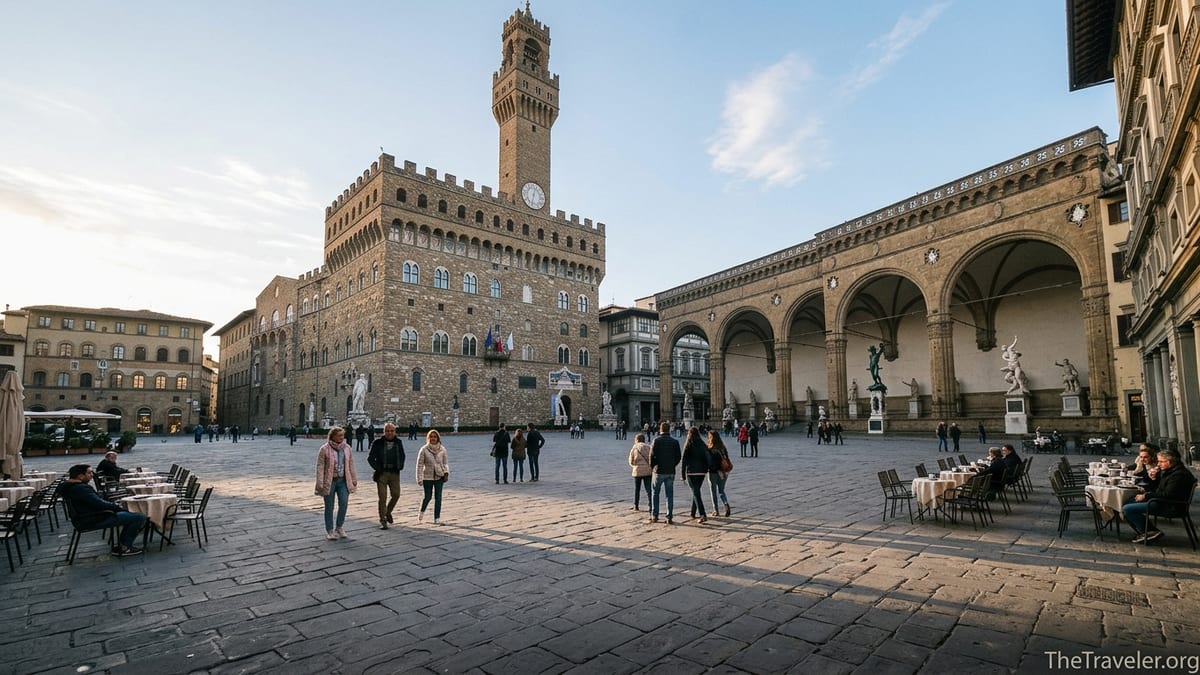
Most famous Italian squares grew up around a cathedral or basilica. In Rome, Piazza San Pietro is the ceremonial forecourt of St Peter’s; in Venice, Piazza San Marco is dominated by the basilica and its campanile. Piazza della Signoria, by contrast, has no church at all. Its dominant building is Palazzo Vecchio, the fortress-like town hall that served as the seat of the Florentine Republic and later of the Medici dukes. This gives the space a distinctly civic, almost secular character: you stand not in front of a house of worship, but at the front door of a government.
The difference is obvious in the architecture. Palazzo Vecchio’s crenellated tower and rusticated stone walls look more like a defensive castle than a palace for receptions. Where many Italian piazzas are framed by porticoed shops or baroque facades, here the main elevation is heavy, austere and medieval, punctuated by coats of arms and banners. Travelers who have just come from the luminous marble of Piazza del Duomo, a three-minute walk away, often feel as if they have stepped into a different city, one where politics and power take visual precedence over religion.
This political identity still shapes the way the square is used. Florence’s city council sits inside Palazzo Vecchio, and protests, demonstrations and rallies regularly gather in front, something you rarely see in more overtly tourist-oriented spaces like Verona’s Piazza delle Erbe. It is not unusual in high season for visitors to weave between small local marches and flag-bearing groups, a reminder that Florence is a living city and that this space remains its civic stage.
For travelers, that means you are often sharing Piazza della Signoria with Florentines attending a sit-in, a union rally or a cultural event rather than only fellow tourists. Spending a half hour on a bench at the edge of the square can feel less like standing in a museum and more like watching a city negotiate its present in front of its medieval past.
An Open-Air Sculpture Museum You Can Walk Through for Free
Many Italian squares boast a central statue or fountain, but few offer anything close to the dense concentration of masterpieces found in Piazza della Signoria. The square is effectively an open-air annex of Florence’s major museums. Copies of famous works such as Michelangelo’s David stand shoulder to shoulder with originals like Benvenuto Cellini’s bronze Perseus with the Head of Medusa under the Loggia dei Lanzi. The overall effect is closer to walking through a sculpture gallery than crossing a public plaza.
The Loggia dei Lanzi, on the square’s southern edge, is particularly unusual. Built in the late 14th century as a stage for public ceremonies, it now shelters large-scale marble and bronze works, including Giambologna’s twisting Rape of the Sabine Women and Pio Fedi’s dramatic Rape of Polyxena. Unlike the sculptures in the nearby Uffizi Gallery, which require a timed ticket and advance booking in busy months, these pieces can be approached at any time, at no cost. On a hot July afternoon you might see a group tour listening to an art historian’s explanation of Perseus while, a few steps away, a local office worker eats a quick panino on the steps after work.
Compared with other Italian squares that showcase a single dominant monument, such as the Vittoriano in Rome’s Piazza Venezia or the Fountain of Neptune in Bologna’s Piazza Maggiore, Piazza della Signoria feels curated. Many of the statues were placed here deliberately by the Medici to project power and cultivate a particular image of Florence as heir to classical antiquity. Yet visitors can walk directly around Hercules and Cacus or pose next to the copy of David without barriers or ticket gates. That combination of art-historical weight and casual access is rare.
For budget-conscious travelers, this matters in practical terms. A family that finds Uffizi prices or queues daunting can still give children a close look at Renaissance masterpieces simply by wandering through the square at dusk. Street performers often set up just beyond the sculptures, so it is entirely possible to listen to a violinist playing Vivaldi while looking up at Medici-era bronzes, all without spending more than the cost of a gelato from a nearby bar.
Layered Urban History Under Your Feet
Many Italian piazzas were created by clearing medieval markets or expanding open spaces, but Piazza della Signoria condenses several epochs of Florence’s history in one compact area. Archaeological work has revealed that the site once held Roman-era structures and, in the Middle Ages, the houses and towers of powerful families who were later expelled. Their buildings were demolished in a kind of political urban renewal, and the new square became the symbolic center of the Republic that replaced them.
This violent reordering of space makes Piazza della Signoria almost a diagram of Florentine politics. Where Piazza del Campo in Siena was carefully planned as a cohesive shell-shaped civic space, Florence’s governing elite deliberately carved this piazza out of a dense tangle of rival properties to assert their authority. When you walk across the wide stone paving today, you are tracing lines laid down to erase the memory of earlier factions. Guides often point out markers in the pavement that reference these hidden layers, but even without commentary, the sense of intentional design is strong.
The square has also staged pivotal moments in religious and intellectual history. Here the Dominican friar Girolamo Savonarola preached against what he saw as the city’s moral corruption; this is where his famous Bonfire of the Vanities took place, and where he was executed in 1498. A round marble plaque near the center of the piazza marks the spot. It is an unusual thing to stumble upon in a space that, at first glance, looks like just another photogenic backdrop for holiday pictures.
By contrast, many other Italian squares emphasize continuity and festival more than conflict. In Piazza San Marco, the narrative is largely about Venice’s serene power and its links to the sea. In Naples’ Piazza del Plebiscito, the royal palace and church speak to Bourbon monarchy and national unification. Piazza della Signoria, however, makes the tension between religion, republicanism and princely rule part of the visitor’s experience. Travelers who pause to read the discreet plaques or listen to guided commentary quickly realize they are standing on a kind of open-air history book.
Where Everyday Life Shares Space With High Culture
Despite its art and history, Piazza della Signoria is not preserved as a quiet monument. It is a functioning crossroads between Florence’s shopping streets, the Uffizi, the Arno riverfront and the cathedral district. Office workers cut across it in the morning, students linger on the steps of the Loggia dei Lanzi in the late afternoon, and families meet under the equestrian statue of Cosimo I de’ Medici before dinner. This constant local traffic sets it apart from more purely touristic spaces like the wide Piazza del Duomo in Milan, where daily life tends to flow around rather than through the square.
Cafes and restaurants on the edges of Piazza della Signoria are very much part of this mix. A cappuccino at a historic cafe facing the square will usually cost more than at a bar a few blocks away, but many visitors consider the view of Palazzo Vecchio and the statues worth the mark-up. Practical examples give a sense of the contrast: a coffee at a standing bar in a side street might be two or three euros, while a cappuccino brought to your table here can run closer to five or six, with a significant surcharge for terrace seating. Travelers who understand they are paying for the front-row view often linger longer, watching groups file into Palazzo Vecchio for guided tours while street musicians set up nearby.
Because the square is entirely pedestrianized, it is also one of the few central spaces in Florence where children can move about fairly freely without constant traffic worries. Parents often let kids circle the Neptune Fountain or climb the shallow steps of the Loggia while keeping an eye on them from a nearby bench. This relaxed circulation is different from busier thoroughfares like Piazza della Repubblica, where trams, buses and delivery vehicles continually pass close by.
In the evenings, especially in late spring and autumn, the atmosphere shifts again. Office workers have gone home, tour groups have thinned, and the square fills with couples and small groups passing through on their way to dinner in the Oltrarno or along the river. The statues and Palazzo Vecchio are lit warmly, encouraging slow circuits around the space. For many travelers, a night-time visit here, when musicians play under the arches and the stone pavement still radiates the day’s heat, becomes one of their strongest memories of Florence.
A Gateway Linking Museums, Riverfront and Shopping Streets
Another way Piazza della Signoria stands apart from other Italian squares is its role as a hinge between very different parts of the city. On one side, the narrow canyon of the Uffizi’s courtyard leads directly toward the Arno and the Ponte Vecchio. On another, Via dei Calzaiuoli runs straight toward the Duomo, lined with international brands and local shops. Smaller lanes connect to artisan workshops, wine bars and neighborhood trattorias. The square is less a destination you reach and more a crossroads you constantly return to.
This positioning makes it particularly convenient for travelers who only have a short time in Florence. A walking route might start at the Duomo, follow Via dei Calzaiuoli down to Piazza della Signoria for an hour among the statues, continue through the Uffizi courtyard to catch sunset on the river, and then loop back across one of the bridges to dine in the Santa Croce area, all within a compact radius. Few other Italian squares offer such direct access to an equivalent cluster of major museums, river views and shopping streets in under ten minutes on foot.
Compared to Piazza San Marco, where you often feel enclosed by water and must use vaporetto boats to move on, Florence’s main square belongs to a tightly woven urban fabric meant for walking. Even Rome’s Piazza Navona, for all its charm, is tucked slightly off the main routes through the historic center. Piazza della Signoria, by contrast, feels almost unavoidable: even visitors without a map tend to drift toward it again and again as they explore.
From a practical standpoint, this centrality means that services cluster nearby. Within a few streets of the square you will find everything from small grocery shops and pharmacies to mid-range trattorias and gelaterie. Travelers can easily break up a museum-heavy day by stepping out of the Uffizi or Palazzo Vecchio, crossing the square for a quick panino or spritz, and then continuing on to another sight, all without using public transport.
Living With Crowds, Security and Preservation
Like many much-loved Italian spaces, Piazza della Signoria also illustrates the challenges of balancing preservation, public use and mass tourism. Visitor numbers can spike dramatically in peak season, especially when large cruise groups arrive for day trips from the coast. At midday in July or August, moving from the copy of David to the Loggia dei Lanzi may require slipping between several tightly packed tour groups, each following a raised umbrella or flag.
Local authorities respond with measures that further distinguish the square from more relaxed provincial piazzas. Security cameras are visible on building corners, and police patrols are common, especially during major events. Rules about where people can sit and what can be consumed near the statues are periodically enforced to protect the artworks from accidental damage. Travelers may notice occasional barriers or temporary cordons around the Neptune Fountain or particular sculptures during restoration campaigns.
These restrictions can surprise visitors expecting a purely laid-back experience, but they also remind you that you are sharing the space with irreplaceable works of art and active municipal offices. It is a contrast with squares like Turin’s Piazza San Carlo, which, while elegant, houses fewer vulnerable monuments and so feels more like a conventional urban living room. In Piazza della Signoria, the city treats even ordinary evenings as occasions that must be managed to safeguard centuries of heritage.
For travelers, understanding this context can make small inconveniences easier to accept. Finding a police van parked discreetly near the entrance to Palazzo Vecchio or being asked not to picnic on the Loggia steps is part of how Florence tries to keep the square accessible to everyone while still protecting the very elements that make it unique.
The Takeaway
In a country full of beautiful piazzas, Piazza della Signoria stands apart because it compresses so many layers of meaning into a single, walkable space. It is at once a political heart without a church, an open-air museum of Renaissance sculpture, an archaeological palimpsest and a busy everyday crossroads used by locals as much as visitors. Its statues are not tucked away behind ticket desks but stand in the open air, weathered yet close enough to touch, framed by a fortress-town hall that still houses the city’s government.
Compared with other Italian squares that revolve around a single function, whether religious ceremony, royal display or modern shopping, Piazza della Signoria’s power lies in its complexity. Standing here at dusk, when the tower of Palazzo Vecchio glows over the crowd and street musicians play under the Loggia, you feel Florence’s identity as a place where art, politics and daily life have collided for seven centuries. For travelers, recognizing what makes this square different is not just an exercise in comparison. It is an invitation to slow down, look more closely and let the city’s history reveal itself under your feet.
FAQ
Q1. Where exactly is Piazza della Signoria in Florence?
Piazza della Signoria sits in the historic center of Florence between the Duomo area and the Arno river, directly in front of Palazzo Vecchio and beside the Uffizi courtyard. It is about a three-minute walk down Via dei Calzaiuoli from the cathedral.
Q2. Is there an entrance fee to visit Piazza della Signoria?
No, the square itself and the open-air sculptures, including the Loggia dei Lanzi, are free to visit at any time. You only pay if you choose to enter nearby museums such as Palazzo Vecchio or the Uffizi Gallery.
Q3. What makes Piazza della Signoria different from Piazza del Duomo?
Piazza del Duomo is dominated by Florence’s cathedral and is primarily a religious and ceremonial space. Piazza della Signoria is a civic square focused on politics and public art, with Palazzo Vecchio as its centerpiece rather than a church.
Q4. Are the statues in Piazza della Signoria originals or copies?
Several key works, such as Perseus with the Head of Medusa and the statues inside the Loggia dei Lanzi, are originals. Others, like the famous David in front of Palazzo Vecchio, are high-quality copies, with the originals preserved in museums for protection.
Q5. When is the best time of day to visit Piazza della Signoria?
Early morning and evening are usually the most pleasant times, with softer light on the stone facades and fewer large tour groups. Night-time visits are especially atmospheric, as the statues and Palazzo Vecchio are beautifully lit.
Q6. Can you sit and eat in Piazza della Signoria?
You can sit on benches and some steps around the square, but picnicking right next to the statues or within the Loggia dei Lanzi is often discouraged or restricted to protect the artworks. Many visitors opt for a cafe table on the edge of the piazza instead.
Q7. Is Piazza della Signoria suitable for children and strollers?
Yes. The square is pedestrianized, mostly flat and paved in stone, so it is generally easy for strollers. Parents should watch children around fountains and statue bases, but many families appreciate the relative freedom compared with nearby streets with traffic.
Q8. How long should I plan to spend in Piazza della Signoria?
Most travelers spend at least 30 to 60 minutes exploring the statues, Loggia dei Lanzi and the exterior of Palazzo Vecchio. If you combine a visit to the square with a tour inside Palazzo Vecchio or a nearby museum, you can easily spend half a day in the immediate area.
Q9. Is it safe to visit Piazza della Signoria at night?
The square is usually busy and well lit into the evening, with a visible police presence and many people passing through. As in any popular urban area, normal precautions apply, but most visitors find it feels comfortable and lively after dark.
Q10. Do I need a guided tour to appreciate Piazza della Signoria?
A guided tour or audio guide can add depth by explaining the political stories and symbolism behind the sculptures and buildings. However, even without a tour you can enjoy the art, atmosphere and views simply by wandering, reading on-site plaques and returning at different times of day.