


Few places in Europe inspire as much awe as St Peter’s Basilica in Vatican City. Its vast marble interior, Michelangelo’s soaring dome and Bernini’s dramatic altar canopy draw millions of travelers every year. But with long queues, strict dress rules and confusing ticket options, many visitors wonder if visiting St Peter’s is truly worth the time and effort, especially on a short Rome itinerary. In 2026, with ongoing crowds and the after-effects of the 2025 Jubilee Year, smart planning matters more than ever.
Get the latest updates straight to your inbox!
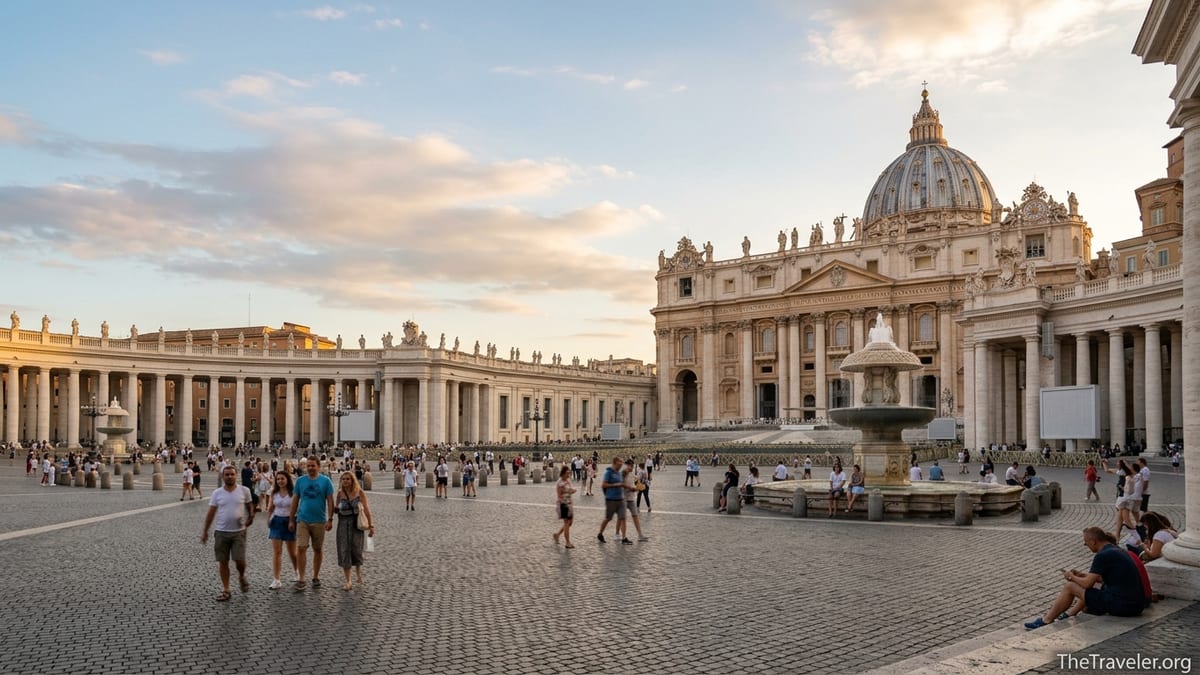
Why St Peter’s Basilica Is Still Worth Your Time
St Peter’s Basilica is not just another church in Rome. It is one of the largest churches in the world, traditionally believed to stand over the tomb of the apostle Peter and at the heart of the Catholic Church’s spiritual life. Even for non‑religious travelers, walking into the main nave for the first time is often a defining Rome memory: the floor stretches the length of several football fields, the bronze canopy over the high altar towers above you, and natural light pours through the base of the dome high overhead.
From a purely visual perspective, the basilica is a masterclass in Renaissance and Baroque art. Michelangelo designed the famous dome, Bernini created the monumental bronze Baldacchino above the papal altar, and his sweeping colonnades embrace St Peter’s Square outside. Inside, you can see Michelangelo’s Pietà near the entrance, the Cathedra Petri at the far end, richly decorated side chapels and a forest of marble columns. For travelers who might skip museums but love grand spaces like the interior of Florence Cathedral or Paris’s Notre-Dame, St Peter’s delivers that same sense of scale and history, but amplified.
Equally important is the way a visit ties into a broader Vatican experience. Many itineraries combine St Peter’s with the Vatican Museums and Sistine Chapel on the same day. While the museums require paid tickets and careful advance booking, the basilica itself remains free to enter, which is rare for such a world‑class sight. The main costs come from optional extras like the dome climb, guided tours or audio guides, which lets budget‑conscious travelers choose how deep to go without skipping the site entirely.
Is it worth it if you hate crowds? In peak months like May, June and September, you should expect intense foot traffic and security bottlenecks. A midday arrival can easily mean 90 minutes or more in line on the square. That said, travelers who time their visit for early morning or late afternoon often report a much smoother experience. For many, the reward of standing under Michelangelo’s dome or stepping onto the terrace with a panoramic view of Rome outweighs the logistical headaches, provided you know what to expect before you go.
Essential Practicalities: Hours, Costs and How Long to Allow
As of 2026, St Peter’s Basilica generally opens at 7:00 in the morning and closes between 6:00 and 7:00 in the evening, with slightly shorter hours in the winter months compared with summer. The dome usually opens a bit later and closes earlier than the basilica floor, with last admission roughly one hour before closing. Hours can shift for major religious events, papal liturgies and remaining Jubilee‑related celebrations, so it is wise to double‑check the schedule a few days before your visit on an official Vatican or basilica information page rather than relying on old guidebooks.
Entry to the main basilica remains free. There is no standard admission ticket to walk into the nave and side chapels, which makes St Peter’s exceptional compared with sites such as the Colosseum or the Vatican Museums. The main paid extras are the dome climb and optional guided services. The dome ticket is typically around 8 to 10 euros per person depending on whether you choose the elevator plus stairs combination or stairs‑only option. Expect these prices to edge up gradually over time, so bring a small cash buffer if you are budgeting closely.
For planning purposes, count on at least 90 minutes inside the basilica itself if you want to see the Pietà, the main nave, the Baldacchino, several side chapels and the Vatican Grottoes where many popes are buried. Add another 60 to 90 minutes if you intend to climb the dome, plus whatever time you spend queuing for security and the dome ticket office. Realistically, a full visit that includes basilica, grottoes and dome can take three to four hours door to door, particularly if you arrive in the late morning when crowds are thickest.
Travelers often underestimate transit time. The closest metro stop is Ottaviano on Line A, about a six‑minute walk from the square. From central Rome locations like Piazza Navona or Campo de’ Fiori, walking to St Peter’s can take 20 to 30 minutes at an easy pace. When you add in a security queue that might stretch across the square and a dome line that snakes along the side of the basilica, it becomes clear why many experienced visitors dedicate at least half a day to the Vatican area, especially in high season.
Dress Code, Security and What You Can Bring
The Vatican’s dress code is strictly enforced at St Peter’s Basilica and often catches travelers by surprise in summer. Shoulders and knees must be covered for both men and women. That means tank tops, strapless or off‑the‑shoulder dresses, and shorts above the knee can lead to being turned away by security staff. Light T‑shirts, knee‑length skirts, linen trousers or capri pants that reach the knee are generally accepted. Many travelers keep a thin scarf in their day bag to throw over bare shoulders or short shorts right before entering.
Dress enforcement happens in the security line. Staff may pull people aside before the metal detectors and ask them to adjust clothing or wrap a shawl. While vendors on nearby streets sell disposable paper shawls or scarves, they are often overpriced, and options can sell out on particularly hot days. A practical real‑world example: a traveler in August wearing athletic running shorts that sat several centimeters above the knee was stopped and asked to purchase a cover‑up before being allowed into the queue, costing extra time and about 10 euros for a basic wrap.
Security itself is similar to an airport but slightly less formal. You pass through metal detectors, and your bag goes through an X‑ray scanner. Large backpacks, suitcases, long tripods and sharp objects are not allowed. Small daypacks, compact umbrellas and cameras typically pass with no issue, though extra screening may add a few minutes. Unlike some museums in Rome, St Peter’s has limited or no convenient cloakroom service at times, so you should avoid bringing big luggage directly from the airport or train station.
Photography is allowed inside the basilica without flash, but you must remain respectful around areas where Mass is being celebrated or where people are praying quietly. Security staff and ushers may ask you not to use selfie sticks or to move along if you spend too long blocking major walkways while framing the perfect shot. In practice, a small mirrorless camera or smartphone is ideal. Travelers carrying large camera backpacks sometimes worry about being refused entry; recent reports suggest that as long as the backpack is reasonably sized and does not contain banned items, it is usually allowed, though you might be asked for a quick manual check.
The Dome Climb: When It Is Worth It and Who Should Skip
Climbing Michelangelo’s dome is one of the most talked‑about experiences at St Peter’s. The views over Rome’s terracotta roofs, the Colosseum and the distant Apennine hills are spectacular on a clear day. Visitors reach the dome in two stages. First you take an elevator or climb stairs to the base of the dome inside, where you can look down into the basilica from the circular gallery. Then a narrower staircase runs between the inner and outer shells of the dome, eventually bringing you out on the open‑air lantern at the top.
The last part of the climb is not for everyone. The stairways curve sharply, are quite steep and in some sections the ceiling tilts so low that you need to lean inward as you walk. There are roughly 500 steps in total if you skip the elevator and about 300 after the lift. In warm weather the confined space can feel hot and airless. Travelers with claustrophobia, significant mobility issues, severe vertigo or heart conditions may find the final stretch especially challenging. A common real‑world example: parents who climbed with an eight‑year‑old and a ten‑year‑old in April described the kids loving the adventure, while a grandparent decided to wait at the base terrace cafe because the spiral steps felt too confining.
From a timing and cost perspective, the dome is an excellent value if you are reasonably fit. For roughly the cost of a casual gelato and espresso in central Rome, you get one of the city’s best viewpoints, and the experience often becomes the highlight of a Vatican day. However, queues can be long. The dome entrance is to the right side of the basilica facade. In high season, lines for tickets and the lift can easily stretch to 45 to 90 minutes by late morning. Many 2025 and 2026 visitor reports mention arriving at the dome immediately after the basilica opened at 7:00 or 7:30 and still facing only a short wait, compared with more than an hour later in the day.
If you are on a tight schedule or visiting in the height of summer heat, it may be smarter to skip the dome and instead climb other viewpoints in Rome like the Vittoriano terrace near Piazza Venezia or the Pincio Terrace over Piazza del Popolo, which involve less claustrophobic staircases and more frequent elevator options. The basilica on its own is impressive enough that you will not feel short‑changed if you decide that a 500‑step climb is not for you.
Managing Crowds, Lines and “Skip the Line” Options
The longest waits at St Peter’s are almost always for security, not for tickets, because entry to the basilica is free. In practical terms, that means any so‑called “skip the line” product you see advertised online is either a timed entry slot for a separate, shorter security line or a guided service that uses a priority lane. It does not let you bypass metal detectors. Travel forums are filled with 2025 and 2026 stories of visitors who paid extra and still waited an hour or more on very busy days, particularly around Easter, in late June and during autumn weekends.
Timing your arrival is the single biggest lever you control. Early morning on a regular weekday is still the sweet spot. Arriving around 7:00 to 7:30 often means walking straight through security or facing a short line that moves quickly. By mid‑morning, particularly between 10:30 and 13:00, queues can swell to several thousand people with estimated waits of 60 to 120 minutes in the sun. Late afternoon, after 16:00, can also be calmer, though you risk being rushed if the basilica or dome closes earlier that day due to a liturgy.
If you are already planning to visit the Vatican Museums and Sistine Chapel, a guided tour that includes a direct passage into the basilica used to be a popular way to avoid queuing twice. However, in recent years access from the Sistine Chapel directly into St Peter’s has changed periodically due to crowd management and security policies. Some tours now finish back near the museum entrance, leaving guests to walk around the Vatican walls and join the regular security line on St Peter’s Square. Because of these shifting rules, you should read recent reviews rather than assuming all tours still offer a guaranteed shortcut to the basilica.
One paid service that many independent travelers find worthwhile is the official basilica audio guide or a small‑group guided tour starting in St Peter’s Square. These products sometimes include access to a dedicated security line separate from the general crowd. In practice, on extremely busy days even the priority line can be slow, but on moderate days it can cut your waiting time significantly while adding structured context to what you are seeing inside. A realistic example: a couple in October who joined a 29‑euro small‑group basilica tour reported clearing security in about 20 minutes when the public line was estimated at more than an hour.
How St Peter’s Fits into a Rome Itinerary
Whether St Peter’s Basilica is “worth it” often depends on how much time you have in Rome and what you value most. For first‑time visitors with three or more full days in the city, most travel planners consider at least half a day in the Vatican area non‑negotiable, splitting time between the basilica, St Peter’s Square and, if desired, the museums. On two‑day whirlwind trips focused on landmarks like the Colosseum, Trevi Fountain and Trastevere, the basilica can still fit if you dedicate a morning or evening to it and accept that you will not see every chapel or climb the dome.
One popular strategy is to visit St Peter’s on a separate morning from the Vatican Museums to avoid “art fatigue.” For instance, you could attend an early Mass or walk straight in at opening time, explore until mid‑morning, climb the dome while it is still relatively cool, and then stroll into the nearby Prati neighborhood for coffee at a local bar or lunch at a trattoria. This spreads out your Vatican experiences and leaves the afternoon free for another neighborhood like the Centro Storico or Trastevere.
Travelers combining the basilica with the museums on the same day need to map out their route carefully. The entrances are not next to each other. Walking from the basilica to the museums along the Vatican walls typically takes about 20 to 30 minutes at a normal pace. If you book an 11:00 entrance to the museums, it is risky to plan a dome climb immediately before unless you are at St Peter’s security line at opening time and ready to move quickly. Many visitors who tried to squeeze in both in a single tight window report feeling rushed and skipping either the grottoes or the dome to avoid missing timed museum tickets.
Families and older travelers should budget energy as much as time. The basilica’s marble floors are hard on the feet, and you will spend most of your visit standing or walking. Bringing comfortable, closed‑toe shoes and taking breaks against side walls or in quieter chapels can make the difference between a memorable morning and an exhausting slog. Allowing an unscheduled hour afterward to sit in a nearby cafe, watch life unfold in St Peter’s Square and process what you have seen helps many visitors appreciate the basilica more deeply.
Making the Most of Your Visit: Art, Worship and Quiet Moments
While the sheer scale of St Peter’s can be overwhelming, slowing down and choosing a few focal points can make the visit more meaningful. Near the right side of the entrance, Michelangelo’s Pietà is protected behind glass but still powerful up close. Many travelers spend ten or fifteen minutes here, letting their eyes trace the sculpture rather than snapping a quick photo and moving on. Further inside, standing under the central dome and looking straight up allows you to appreciate how the structure inspired later domes around the world, from London’s St Paul’s Cathedral to the Capitol in Washington, D.C.
The basilica is also an active place of worship. Multiple Masses are celebrated daily at side altars and at the main altar on special occasions. Visitors are generally welcome to attend, provided they respect the sacred atmosphere and follow dress and conduct guidelines. For some travelers, joining a weekday morning Mass at St Peter’s, even without understanding every word of the liturgy, becomes the most moving part of their Vatican day. For others, simply sitting quietly in a side chapel, away from the main tourist flow, offers a chance to catch their breath and reflect.
Below the main floor, the Vatican Grottoes house the tombs of many popes and historically significant figures. Access is usually free and reached via marked stairways inside the basilica. The atmosphere here is calmer and more subdued, with lower ceilings and soft lighting. Photography regulations can be stricter in this area, and staff may remind visitors to remain silent. The nearby but separate Scavi (necropolis) tour beneath the grottoes, which passes near what is believed to be Peter’s tomb, requires advance booking through the Vatican and is limited to small guided groups. If you are interested in early Christian history and archaeology, planning this tour months in advance can greatly deepen your understanding of the basilica’s origins.
Simple details such as listening to the echo of footsteps on marble, watching a beam of afternoon sun catch dust in the air under the dome or hearing the murmur of a choir during rehearsal can stay with you as much as the big‑name artworks. Travelers who rush from highlight to highlight often leave St Peter’s with blurred memories of crowds and camera flashes, while those who give themselves small pockets of unstructured time inside tend to recall specific, vivid moments long after the trip.
The Takeaway
So is St Peter’s Basilica worth visiting in 2026? For most travelers, the answer is yes, provided you approach it with realistic expectations and a bit of strategy. The basilica offers world‑class architecture and art, deep historical and spiritual significance, and the chance to see the Vatican at work, all without a standard entry fee. The main trade‑offs are time spent in security lines, navigating strict dress rules in hot weather, and deciding whether the dome climb suits your fitness level and comfort with tight spaces.
If your itinerary in Rome is extremely short, you dislike crowds intensely or you have serious mobility limitations, you might opt to admire St Peter’s from the square instead, perhaps pairing it with a quiet walk across the Tiber. Yet for most visitors who can spare a morning or afternoon, stepping inside the basilica and, if possible, visiting the grottoes or climbing partway up the dome remains one of the city’s most memorable experiences.
With a bit of preparation, you can minimize the hassles and maximize the wonder. Dress with the code in mind, travel light, arrive early or late in the day, and leave space in your schedule to slow down once you are inside. Do that, and the scale, light and artistry of St Peter’s have every chance of becoming a highlight of your time in Rome rather than a box to tick on a rushed checklist.
FAQ
Q1. Is St Peter’s Basilica free to visit?
Yes. Entry to the main area of St Peter’s Basilica is free. You only pay for extras such as the dome climb, some guided tours or audio guides.
Q2. How long should I plan for a visit to St Peter’s?
Most travelers should allow at least 90 minutes inside the basilica itself, and three to four hours total if they also plan to visit the grottoes and climb the dome.
Q3. What is the dress code for St Peter’s Basilica?
The Vatican requires shoulders and knees to be covered for both men and women. Avoid short shorts, mini skirts, strapless tops and backless dresses, and carry a light scarf if in doubt.
Q4. Do I need to book tickets in advance?
You do not need a ticket to enter the basilica, but you may wish to prebook services such as guided tours, audio guides or dome climb time slots in busy seasons to manage queues.
Q5. When is the best time of day to visit?
Early morning around opening time is usually the quietest, followed by late afternoon. Mid‑morning to early afternoon often sees the longest security queues, especially in summer.
Q6. Is the dome climb suitable for everyone?
The dome climb involves steep, narrow staircases and several hundred steps. It is not recommended for travelers with serious mobility issues, strong claustrophobia, severe vertigo or heart problems.
Q7. Can I bring a backpack and camera inside?
Small daypacks and cameras are generally allowed after security screening. Large backpacks, suitcases, sharp objects and long tripods may be refused or require leaving them elsewhere.
Q8. Can I attend Mass at St Peter’s?
Yes. Daily Masses are celebrated at various altars. Visitors are usually welcome to attend if they dress appropriately, arrive on time and respect the liturgical setting.
Q9. How does St Peter’s fit with a visit to the Vatican Museums?
Many travelers visit the basilica on a different morning from the museums to avoid fatigue. If combining both in one day, allow at least 30 minutes to walk between their separate entrances.
Q10. Is St Peter’s Basilica worth it if I only have two days in Rome?
If you can spare half a day and are comfortable with some crowds, most visitors find St Peter’s worth including, especially if you enjoy architecture, religious history or panoramic city views.