


The Vatican Museums may draw the crowds, but the Vatican Gardens are where Vatican City breathes. Spread over roughly half of the tiny state, this landscaped sanctuary mixes Renaissance terraces, Baroque fountains, modern papal monuments and unexpected ecological projects. With access tightly controlled through guided tours, it remains one of Rome’s least-understood sites. For travelers willing to plan ahead, the gardens offer a rare chance to see a quieter, greener Vatican and understand how popes have shaped this space over six centuries.
Get the latest updates straight to your inbox!
How to Actually Get Into the Vatican Gardens
The most important thing to understand about the Vatican Gardens is that you cannot simply wander in after visiting the Sistine Chapel. Access is only possible with a pre-booked guided visit, usually bundled with entry to the Vatican Museums on the same ticket. Official Vatican tours are offered either as a walking visit of around 90 minutes or via a panoramic minibus that loops through the main avenues in about 45 minutes. Independent operators resell these products, but the underlying access rules are set by the Vatican Museums.
Prices change periodically, but as of 2025–2026 most combined garden-plus-museum tickets sit in the range of a typical Vatican Museums skip-the-line ticket, with a supplement for the garden component. Some operators quote total prices in the 45 to 65 euro range depending on season, language and whether a live guide is included inside the museums afterward. Children receive reduced admission and very young children are usually not allowed on the minibus tours. Since numbers are capped, departures often sell out several weeks in advance in spring and early autumn.
The practical implications for travelers are concrete. You will be given a fixed entry time and must arrive at the Vatican Museums entrance with enough cushion to clear security. Once inside, the garden visit always comes first, followed by free time in the museums and Sistine Chapel. There is no option to leave Vatican City and return later on the same ticket, and you cannot skip directly to St Peter’s Basilica from the gardens. Planning a simple lunch nearby, carrying water, and wearing fully closed, respectful clothing will help you enjoy several hours on site without stress.
Different tour formats suit different travelers. The walking tour is more immersive and allows you to pause in front of particular fountains or Marian shrines, but it involves hills, cobbled paths and standing for long stretches. The minibus option is better for visitors with limited mobility or tight schedules. Audio commentary is typically available in multiple languages, but it can feel rushed if you are keen to photograph details. Deciding in advance whether you prioritize comfort, flexibility for photos, or in-depth commentary will guide you toward the right format.
Historic Landscapes: From Medieval Orchard to Papal Showcase
Long before selfie sticks appeared in St Peter’s Square, the land behind the Apostolic Palace served as orchards and defensive slopes. The modern Vatican Gardens took shape in the 16th century, when Renaissance popes enclosed the hill of the Vatican with walls and began laying out formal Italianate terraces. Today, as you ride or walk through the grounds, you move through a kind of open-air archive of papal tastes, with each era leaving its stamp through tree species, fountains and statuary.
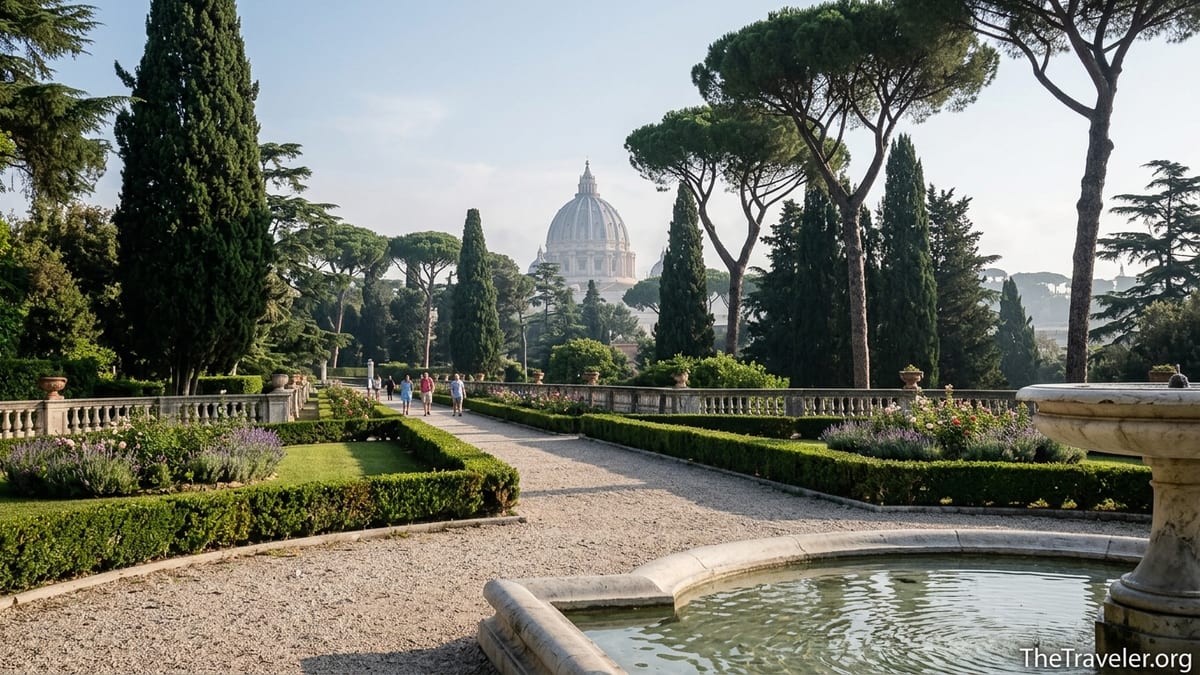
One of the highlights on most routes is the so-called Italian Garden, a textbook example of geometric Renaissance design. Here low boxwood hedges outline parterres in strict patterns, framing gravel paths and seasonal flower beds. It is not simply decorative. The view back toward the dome of St Peter’s from this area gives a sense of how the gardens were meant to work with, not against, the architecture of the basilica. Guides often stop here to point out how the aqueduct built under Pope Paul V allowed water to feed both the fountains and the Vatican apartments, a reminder that hydraulic engineering was as crucial as theology in early modern papal Rome.
Elsewhere in the gardens, the layout shifts into a more Romantic English-style landscape, with winding paths and scattered groves. This is particularly evident near older stone walls and shaded slopes, where tall pines and cypresses dominate. The transition between strict symmetry and looser planting schemes helps you read the evolution of garden design over four centuries. For garden-lovers used to the flat expanses of Paris or the tidy lawns of London, the topography here, constantly climbing and dipping around the Vatican hill, adds a dramatic dimension that photos rarely convey.
Pay attention to the small details: fragments of ancient Roman sarcophagi built into retaining walls, discreet papal coats of arms carved into fountains, and terracotta pots that hint at ongoing experimentation with Mediterranean and subtropical plants. These touches embody the Vatican’s habit of recycling stone and ornament from earlier monuments, creating a palimpsest where archaeology and gardening intertwine.
Marian Shrines, Grottos and Places of Quiet Prayer
Beyond the postcard views of the dome, the Vatican Gardens are dense with Marian shrines. These are not only decorative chapels but active devotional sites where popes and staff still come to pray. Many tours highlight the Lourdes Grotto replica, a faithful stone evocation of the French sanctuary built against a hillside and framed by evergreens. Here, successive popes have paused to entrust travels and crises to the Virgin Mary, and visiting groups often stop for a few minutes of silence or a brief prayer before continuing.
Other shrines reproduce famous Marian images from around the Catholic world. You may glimpse a version of Our Lady of Guadalupe, popular among Mexican pilgrims, or statues associated with European sanctuaries. Seeing these clustered in a relatively small space brings home how the Vatican understands itself as a crossroads of global Catholic devotion. For non-Catholic visitors, it offers a compact survey of religious art styles, from late 19th-century plaster to sleek 20th-century bronze.
These devotional corners change the emotional rhythm of a garden tour. After long explanations about architecture or papal history, entering a shaded niche lit by candles and vases of fresh flowers can feel unexpectedly intimate. Many guides will invite a short pause for reflection, regardless of your religious background. Travelers who normally skim past churches in Rome sometimes cite these simple grottos as the moments when the Vatican felt most human and accessible.
Because these are active religious spaces, it is worth behaving as you would in a small church: speak quietly, avoid blocking paths for selfies, and be ready for the possibility that a small group is praying when you arrive. The combination of birdsong, distant city noise and murmured rosaries is part of what makes the Vatican Gardens feel like a lived-in sanctuary rather than a static open-air museum.
Art, Monuments and the Unexpected Vatican Observatory
The Vatican Gardens hold far more art than most visitors expect. Scattered across lawns and terraces are statues of saints, missionaries and national patrons offered as diplomatic gifts. You might pass a monument to Our Lady of Guadalupe from Mexico, an image of the Sacred Heart popular in France, or figures representing newly canonized saints. The styles range from classical marble to contemporary bronze, sometimes side by side, revealing how different cultures visualize sanctity.
One of the most distinctive features, if your route allows, is the view of the Governor’s Palace and adjacent technical buildings that house parts of the Vatican Observatory’s historic instruments. While the main working observatory moved long ago to darker skies outside Rome, telescopes once stood on towers within these gardens. Some tours point out domes or rooftop structures associated with past astronomical work, a reminder that this green enclave has also been a laboratory for science. For travelers with an interest in the relationship between faith and science, this glimpse of observatory heritage inside a papal garden is especially resonant.
Modern papacies have also left their imprint through memorials and inscriptions. You may notice stones commemorating significant events, like synods or jubilees, that opened with ceremonies among the trees. In recent years, environmental encyclicals and appeals for climate action have been symbolically launched from the gardens, with popes planting trees in front of small crowds of diplomats and religious leaders. These gestures turn the landscape itself into a stage for the Vatican’s messaging on ecology.
Photography is generally permitted for personal use, but telephoto lenses help capture these details from a distance, especially if you are on a moving minibus. Wide-angle shots are ideal near open lawns and terraces where the curves of the paths and the distant basilica dome create compelling compositions. Serious photographers should consider the walking tour option and check tour times for softer morning or late-afternoon light.
Ecology in Action: A Living Classroom on Papal Green Policy
For many travelers, the most surprising aspect of the Vatican Gardens is how actively they are managed as an ecological project rather than a static showpiece. In the last decade, Vatican officials have described shifts toward more organic gardening methods, including reduced chemical treatments on lawns and a stronger focus on biodiversity. Even without technical briefings, you can see this in areas where wildflowers are allowed to bloom among the grass or where insect hotels and bird nesting boxes are tucked discreetly into hedgerows.
These choices reflect broader Catholic teaching on “integral ecology,” a concept popularized by Pope Francis that links care for the environment with social justice. Environmental messages are no longer confined to documents; the gardens themselves are curated as a visible sign of that commitment. When popes host tree-planting rituals here tied to global events like the Season of Creation or major synods, the ceremonies are carefully staged against backdrops of mature pines and new saplings, underlining the long-term nature of ecological responsibility.
Visitors who follow Vatican news may recall climate-focused events held in the gardens, from prayer services for the Amazon rainforest to the presentation of environmental exhortations in front of assembled media. While you are unlikely to witness a major ceremony during a standard tour, guides sometimes point out locations where these gatherings took place. Knowing that diplomatic delegations, indigenous leaders or scientists once stood in the same clearings adds another layer to an apparently tranquil lawn.
If you are traveling with teenagers or young adults, this is an opportunity to connect classroom conversations about climate change with a concrete site where religious and political language about the environment converges. Ask your guide how the gardening team handles water use, pest control or extreme heat, and how recent summers have affected plant health. Their practical answers often reveal more than official press releases about what ecological conversion looks like on a day-to-day basis in a microstate like Vatican City.
Beyond Vatican City: The Pontifical Gardens at Castel Gandolfo
Once you have strolled the Vatican Gardens, it is worth considering their larger cousin outside Rome. In the hill town of Castel Gandolfo, about an hour from the city center by regional train and shuttle, the former papal summer residence opens onto expansive terraces, avenues of cypress and working farmland. In recent years, the Vatican has transformed part of this estate into Borgo Laudato Si’, an experimental center dedicated to sustainable agriculture, vocational training and ecological education.
For travelers, this means you can now book visits that combine art-filled papal apartments, lakeside views over Lake Albano and guided walks or train-style tours through orchards, vineyards and experimental plots. Reports from the opening period describe greenhouses shaped to echo Bernini’s colonnades in St Peter’s Square, aquaponic fish tanks that supply organic fertilizer, and educational programs for groups ranging from schoolchildren to corporate teams. The project is designed to put into practice the environmental teachings laid out in Pope Francis’s encyclical on care for our common home.
Compared with the Vatican Gardens inside the city walls, Castel Gandolfo offers a more agricultural landscape. You can expect to see olive groves, grazing areas and traditional crops alongside cutting-edge sustainability features like solar arrays or circular economy systems that reuse water and waste. Some itineraries include tastings of products made on site, such as olive oil or seasonal jams, giving a literal flavor to the idea of ecological stewardship.
Because Castel Gandolfo lies in the Alban Hills, weather can be a few degrees cooler than central Rome, making garden visits pleasant on hot summer days. However, transport logistics are more involved. Plan at least half a day, preferably a full day, and check tour times carefully when organizing rail tickets or private transfers. When combined with the Vatican Gardens in Rome, a trip to Castel Gandolfo rounds out the story, showing how papal environmental policy unfolds across very different kinds of landscapes.
Planning Your Visit: Timing, Comfort and Crowd Strategy
Seeing the Vatican Gardens at their best involves more than simply securing a ticket. Time of day matters. Morning departures often benefit from cooler air and softer light that accentuates sculpted hedges and stone textures. Afternoon visits can be hotter, especially in July and August, but the slanting sun may deepen colors and shadows around fountains and walls. If you are sensitive to heat, favor spring and autumn months or choose the minibus tours, which provide shade and a breeze even on warm days.
Comfort is crucial on the walking tours, which cover uneven cobbles, steps and inclines. Closed, stable shoes are preferable to sandals, and a light scarf or linen shirt will help you maintain the required modest dress code while staying cool. Bringing a small bottle of water is advisable, as there are long stretches without vending machines or fountains accessible to visitors. The gardens are generally well maintained, but expect natural surfaces rather than perfectly flat pavements.
Crowd strategy is slightly different here than in the museums. Tour groups are strictly limited, so you will never face the same density as in the Sistine Chapel. However, the relative scarcity of departures means that availability, not congestion, is your main constraint. Book as soon as your Rome dates are firm, ideally at least 30 to 60 days ahead in peak seasons. If you are already in Rome and find official slots sold out, reputable local agencies sometimes have allocations, though often at a premium over direct purchase.
Factor in the rest of your Vatican day when planning. A typical sequence might be an 8:30 a.m. garden tour followed by a mid-morning circuit of the Vatican Museums and a late-afternoon visit to St Peter’s Basilica reached via the square rather than the internal museum exit. If you try to squeeze the gardens into a half-day before a flight or long train ride, you may find the schedule too tight. Giving the gardens a relaxed morning or afternoon allows you to appreciate their calm contrast with the usual Vatican crowds.
The Takeaway
The Vatican Gardens are far more than a pretty backdrop to the Apostolic Palace. They are a condensed history of papal aesthetics, a living stage for environmental messages and a network of devotional spaces that still shape the daily rhythm of Vatican City. Walking or riding through their avenues, you glimpse the machinery behind the public image of the Holy See: water systems, observatory domes, maintenance depots and quiet staff entrances threaded through lawns and shrines.
For travelers, the gardens offer something rare in Rome: genuine quiet in the heart of one of the world’s most visited sites. Here the roar of crowds fades into distant murmur, replaced by fountains and birdsong. Whether you are drawn by gardening, architecture, spirituality or contemporary debates about ecology, a carefully planned visit to the Vatican Gardens opens a side of the city-state that the standard museum circuit only hints at.
By pairing a garden tour with time in the museums and, if possible, a later excursion to Castel Gandolfo, you can trace a continuous story from Renaissance display to 21st-century sustainability experiments. The result is a deeper, more nuanced understanding of how this tiny state uses its green spaces to think about power, beauty and responsibility toward the planet.
FAQ
Q1. Can I visit the Vatican Gardens without a guide?
Access to the Vatican Gardens is only allowed on pre-booked guided tours or official minibus visits that include a Vatican Museums ticket; independent wandering is not permitted.
Q2. How far in advance should I book a Vatican Gardens tour?
In busy months like April, May, September and October, aim to book 30 to 60 days in advance, as daily departures and group sizes are strictly limited.
Q3. Are the Vatican Gardens suitable for visitors with limited mobility?
The minibus tour is usually the better option for those with mobility issues, as walking tours involve slopes, cobbles and steps that can be challenging.
Q4. How long does a typical Vatican Gardens visit take?
The garden portion usually lasts 45 minutes by minibus or about 90 minutes on foot, followed by as much time as you wish inside the Vatican Museums the same day.
Q5. Is there a dress code for visiting the gardens?
Yes. The same modest dress code as the Vatican Museums applies, meaning covered shoulders and knees, and no beachwear or very low-cut clothing.
Q6. Can I take photos and videos in the Vatican Gardens?
Photography for personal use is generally allowed, but tripods, drones and extensive filming setups are not permitted, and you should respect the quiet near shrines.
Q7. Do garden tours include direct access to St Peter’s Basilica?
No. Garden and museum tickets do not provide a shortcut to St Peter’s Basilica; you will exit via the museums and then reach the basilica through St Peter’s Square.
Q8. Are the Vatican Gardens open year-round?
The gardens are normally visitable most of the year, but access depends on the Vatican Museums schedule and can be reduced around major religious holidays or events.
Q9. Can children join Vatican Gardens tours?
Children are welcome on most walking tours, though some minibus options have minimum age limits; reduced-price tickets are often available for school-age visitors.
Q10. How do the gardens at Castel Gandolfo differ from the Vatican Gardens?
The Castel Gandolfo estate combines formal terraces with working farms, vineyards and ecological projects, offering a more rural and expansive experience than the urban Vatican Gardens.