


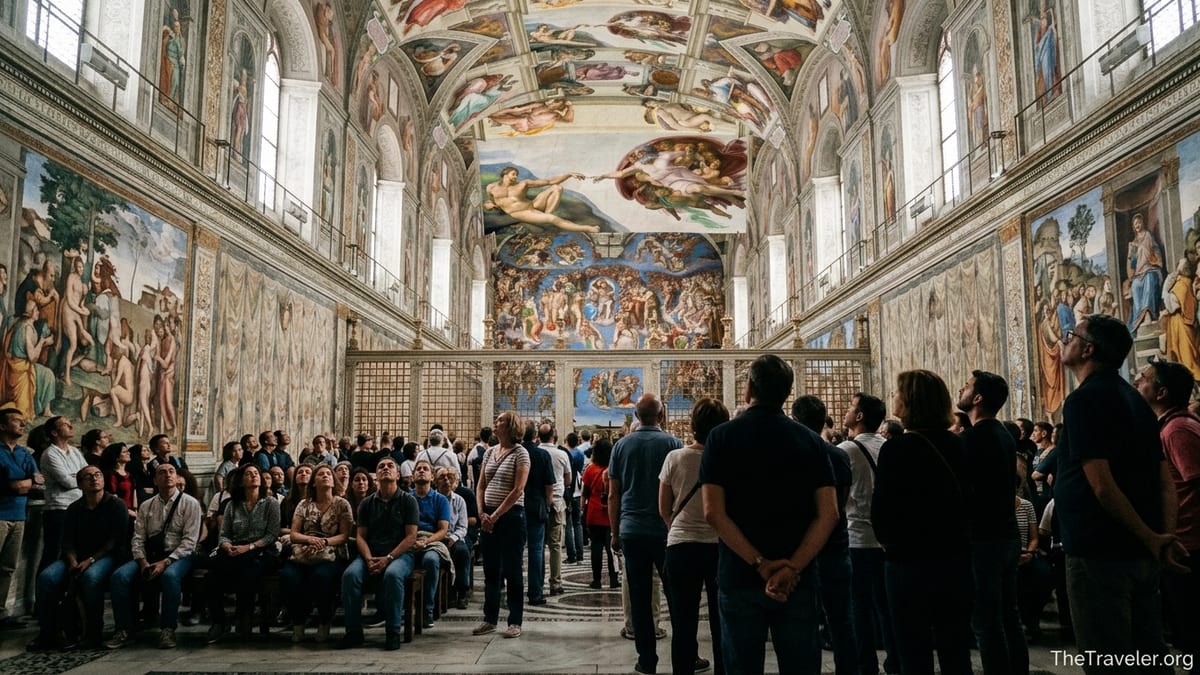
The first time you step into the Sistine Chapel, you realize that no photograph, documentary or coffee-table book has prepared you for the reality above your head. The space is crowded and carefully controlled, yet the moment you look up, you stand inside one of humanity’s greatest artistic experiments: an entire universe of painted stories, bodies and symbols compressed into a single rectangular room. More than a checklist sight in Vatican City, the Sistine Chapel is one of the most extraordinary artistic experiences in the world because it overwhelms you at every level at once: scale, beauty, history, spirituality and the intimacy of seeing a single artist measure himself against the infinite.
Get the latest updates straight to your inbox!
A Modest Room That Contains an Immense World
Part of what makes the Sistine Chapel so surprising is how unassuming it looks from the outside. From the Vatican courtyards, the chapel is a plain brick box attached to the Apostolic Palace, with little to hint at the drama inside. Yet once you enter, you find yourself in a hall around 40 meters long and 13 meters wide, its proportions echoing those ascribed to the Temple of Solomon. Every surface, from the floor to the vault, is wrapped in imagery. It is a controlled visual overload that makes many visitors instinctively fall silent, even before the guards request it.
The visual experience begins long before you reach the famous ceiling. You walk through the Vatican Museums past classical statues, Raphael’s Stanze and long galleries of tapestries and maps. By the time you finally file into the Sistine Chapel, your eyes are already saturated. The shock is that the chapel somehow resets your perception. Travelers who have spent years seeing reproductions of "The Creation of Adam" or "The Last Judgment" say that seeing them in situ, high on the walls and ceiling, feels like encountering them for the first time.
The effect is intensified by the chapel’s role as a working space. This is not just a museum gallery. It is the pope’s private chapel and the room where cardinals meet in conclave to elect a new pontiff. Knowing that the same frescoes you are craning to see have watched over five centuries of papal elections gives even the most secular visitor a sense of stepping into living history rather than an art-historical diorama.
All of this hits you within minutes. A traveler who has queued in the Roman heat, passed security, navigated tour groups and climbed museum stairs discovers that the real journey starts only when you look up and realize just how much one human being painted on that vault.
The Ceiling: Michelangelo’s Theater of the Human Body
The ceiling of the Sistine Chapel, painted by Michelangelo between 1508 and 1512, is the heart of the experience. Roughly 40 meters long and more than 13 meters wide, the vault covers about 800 square meters of surface. From the floor it reads as a single, coherent cosmos, but step-by-step you realize it is built from nine central scenes from the Book of Genesis surrounded by prophets, sibyls and ignudi, those famously muscular nude youths that have become a shorthand for Michelangelo’s art.
What makes this ceiling so extraordinary in person is the physical presence of the painted bodies. In travel books, the figures can look smooth and almost polished. In the chapel, seen foreshortened and at a distance, they feel sculpted out of air. Adam, reclining and half-awake, is not an idealized doll but a weighty, vulnerable man. God, hurtling toward him in a swirling cloak, is an older, bearded figure whose urgency you can read even from the far end of the room. Visitors often find themselves shuffling back and forth along the center line, trying to position themselves directly under "The Creation of Adam" to see that tiny charged gap between the two hands.
The restoration completed in the late 20th century, and further conservation work since, means the colors today are startlingly bright. The pale pinks of flesh, acid greens of draperies and deep blues of the architectural framing stand out much more clearly than in mid-century photographs. Some art historians still debate whether the palette now appears more vivid than Michelangelo originally intended, but for the traveler standing under the vault, the effect is of a sky suddenly switched on. That intensity is one reason why guides often recommend you rest your neck on the wall benches for a moment and simply absorb the whole ceiling without trying to analyze each panel.
It is also a physically immersive experience. Imagine having walked for two hours through the Vatican Museums in August, with temperatures outside hovering around 33 degrees Celsius. You step into the chapel, and the air is cooler but charged with body heat and low murmurs. As your neck tilts back and your field of vision fills with painted architecture and flesh, your body position mirrors the upward thrust of the figures themselves. For many travelers this bodily strain becomes part of the memory: you leave with a sore neck but also the feeling of having taken part in a kind of secular pilgrimage.
The Last Judgment: A Wall That Feels Like It Moves
If the ceiling is a meditation on creation, the altar wall is a roaring confrontation with destiny. Michelangelo returned to the Sistine Chapel in the 1530s, more than twenty years after finishing the ceiling, to paint "The Last Judgment" on the sanctuary wall. The fresco, completed in the 1540s, is a single, swirling mass of more than 300 figures centered on a commanding, muscular Christ. Unlike the carefully framed Genesis stories above, this wall is almost frame-less humanity in motion, rising and falling around the judge of the world.
To stand near the altar rail and look up at "The Last Judgment" is to feel the ground tilt slightly. The figures are larger than life. Saint Bartholomew, holding his own flayed skin, floats not far from the center. Saints with clear attributes, like Catherine with her wheel, cluster closer to Christ, while the damned tumble toward the lower corners where demons drag them down. You will see visitors raise their hands to their mouths or step closer to pick out these details, even as guards ask people not to linger directly in front of the altar.
Recent maintenance and conservation work on the altar wall means that travelers visiting in 2026 encounter a surface that has been carefully cleaned and stabilized. The tones of flesh and sky appear more legible than they did just a few decades ago, and subtle expressions in faces that once seemed lost in shadow now read more clearly. This can be especially powerful if you have seen older reproductions in art books that show a gloomier, more monochrome wall. In the chapel, the blues and pinks of "The Last Judgment" link visually with the ceiling above and earlier frescoes along the side walls, knitting the entire space into a single dramatic cycle.
Emotionally, the experience differs from the ceiling. Tourists who chatter under the Genesis panels often fall quiet when they finally face the altar wall. Even without religious belief, it is hard not to feel the painting as a commentary on human vulnerability. After an hour of looking at idealized bodies and heroic prophets, you suddenly confront a vision in which those bodies can rise or fall in an instant. The room, full of people from every continent, becomes a kind of theater audience witnessing a performance in which they are also, implicitly, cast members.
Beyond Michelangelo: A Total Renaissance Environment
Although Michelangelo dominates the Sistine Chapel, one reason the experience feels so rich is that you are surrounded by a whole team of Renaissance masters. Along the long side walls are fresco cycles begun in the early 1480s by artists like Botticelli, Ghirlandaio, Perugino and Rosselli. On one wall you see scenes from the life of Moses. On the opposite wall, events from the life of Christ unfold. This pairing sets up a dialogue between Old and New Testaments that Michelangelo later echoed in his own work on the ceiling.
In practice, most visitors focus first on the ceiling, then the altar wall, and only later begin to notice these earlier cycles. You might spot Botticelli’s "Punishment of the Rebels" with its dramatic depiction of Korah’s revolt, or Perugino’s "Delivery of the Keys to Saint Peter" with its calm, symmetrical piazza. Guides who know the chapel well will often point out how these frescoes use recognizable contemporary architecture of 15th century Rome and Florence to make biblical stories feel as if they are happening in the viewers’ own cities.
Above these narrative panels run painted portraits of earlier popes, and below them once hung a set of tapestries designed by Raphael, woven in Brussels in the early 16th century. The original tapestries are rare and not always on display, but reproductions or occasional showings hint at how dazzling the chapel must have looked during major ceremonies, with textiles, candles, music and incense added to the permanent wall and ceiling decorations.
What you experience now is a layered time capsule of the High Renaissance. Standing in the middle of the room, you can see in a single glance the evolution from the softer, more orderly world of Botticelli and Perugino to Michelangelo’s almost overwhelming dynamism. For travelers who love art history, this makes the chapel a compact seminar. For those who have never studied the period, it becomes an intuitive lesson in how quickly artistic language changed around 1500, when artists started pushing anatomy, perspective and emotion to new extremes.
Silence, Crowds and No Photos: The Ritual of Visiting
The way you experience the Sistine Chapel is shaped not only by the art, but also by the strict rules that govern the room. Photography is not allowed, whether with flash or without, and guards enforce a near-constant request for silence. At peak visiting hours, you may hear a recorded voice repeating "silence" in several languages, punctuated by staff members calling out reminders. For some visitors this can feel jarring, but it is part of the chapel’s modern ritual.
The photography ban has historical roots in a contract signed with a Japanese broadcaster in the 1980s that helped fund the massive restoration project. Although those rights have long since expired, the Vatican continues to uphold a strict no-photo policy, officially to protect the fragile frescoes and to preserve a contemplative atmosphere. In practical terms, this means you should put your phone away before you enter. Guards do ask visitors to delete images if they are caught taking them, and repeated disobedience can get you escorted out.
The crowd management also shapes your perception. In high season, such as June and July, the chapel can feel as full as a commuter train at rush hour. Independent travelers who book standard timed-entry tickets might find themselves shoulder to shoulder with tour groups, all craning their necks in the center of the room. One way to change that experience is to book an early-morning or late-entry Vatican Museums ticket, which often costs a bit more than the basic 20 euro museum admission plus booking fee, but may limit the number of people entering at the same time.
Understanding these constraints in advance can actually deepen your appreciation. Knowing that you cannot take a photo encourages you to look more carefully. Realizing that you may only be able to remain in the chapel for 15 or 20 minutes before your group moves on pushes you to decide how to focus that time. Some visitors choose to stand in the middle and absorb the whole ensemble. Others head first to a side wall bench, sit down and make slow, deliberate scans of the ceiling. Either way, the enforced limits turn the visit into a concentrated moment rather than a casual wander.
From Restoration to Today: Seeing the Chapel in Its Brightest Light
Travelers today see the Sistine Chapel in a condition that would surprise visitors from a few generations ago. For centuries, candle smoke, incense and previous restoration attempts darkened the frescoes. By the mid-20th century, the ceiling had a brownish, muted appearance that many people associated with Michelangelo’s style. Beginning in 1979, a large-scale cleaning and conservation project, completed in the 1990s, removed layers of grime and old varnish, revealing unexpectedly vivid blues, greens and pinks.
The result is that when you stand beneath "The Creation of Adam" today, the drapery around God reads as a crisp, cool pink against a mint green background, and the architectural "frame" looks sharply defined. Likewise, the ignudi and prophets appear with a clarity and brightness that makes them feel newly painted. Ongoing conservation work has focused on monitoring humidity, visitor numbers and subtle changes in pigments to ensure that this freshness is preserved without over-cleaning.
For visitors who have only ever seen the chapel in person after restoration, it can be hard to appreciate how radical this shift was. Imagine having grown up with art books that show the ceiling in olive and beige tones, then visiting Rome after the cleaning and discovering a vibrant, almost modern palette. This is essentially the shock that art critics described when the scaffolding came down in the 1980s and 1990s. Today, you inherit that transformed version as your baseline and can pay attention instead to the subtler play of light across the vault as the day progresses.
That light is worth noticing. If you enter the chapel in the morning when the Vatican Museums first open, indirect light from the high windows creates a cooler overall impression. In late afternoon, the sun can angle differently and pick up certain colors more strongly. While you cannot control the exact timing of your entry, knowing that the frescoes will look slightly different at different hours encourages a heightened awareness. For some enthusiasts, this is reason enough to schedule two separate museum visits during a trip to Rome so they can see the chapel under distinct conditions.
Practical Ways to Turn Your Visit Into a Deeper Experience
Because the Sistine Chapel is part of the Vatican Museums, your experience begins with planning. Standard adult tickets for the museums hover around the 20 euro mark, with an additional online booking fee commonly bringing the total to about 25 euros per person. Guided tours that include skip-the-line entrance, a structured museum route and commentary inside the chapel can range from roughly 50 to 80 euros, depending on group size and time slot. Early-morning "before opening" tours or after-hours visits typically cost more but may reduce the crush of people.
Dress code is another practical detail that shapes the experience. The Vatican requires shoulders and knees to be covered in the Museums, Sistine Chapel and Saint Peter’s Basilica. In summer, this often means carrying a light scarf or packable shawl to throw over a sleeveless top and choosing longer shorts or a skirt that reaches the knee. Travelers caught in line wearing very short shorts or bare shoulders are sometimes turned away at security, a frustrating outcome that can be avoided with advance planning.
Inside the museums, the route to the Sistine Chapel can take an hour or more if you stop to look at everything, or about 20 to 30 minutes if you walk briskly and follow the crowd. Some experienced visitors recommend heading directly to the chapel when the museum opens, spending time there while it is relatively quiet, and then backtracking to explore other galleries at a slower pace. Others prefer to book an afternoon slot and combine a leisurely museum visit with a sunset stroll in nearby neighborhoods like Prati.
However you time it, set realistic expectations. The Sistine Chapel is almost always busy. You will likely hear the hum of many languages, feel the brush of backpacks and camera straps, and have moments when your view is briefly blocked. Approach it less as a personal meditation retreat and more as a shared civic experience, akin to attending a major concert or standing in Times Square on New Year’s Eve. Within that bustle, you can still carve out small, concentrated moments of looking that will stay with you long after you leave.
The Takeaway
What ultimately makes the Sistine Chapel one of the world’s most extraordinary artistic experiences is the way it compresses so many layers of meaning into a single, finite space. Architecturally modest but imaginatively boundless, it fuses the genius of a single artist with the collaborative energy of an entire era. Michelangelo’s ceiling and altar wall are not isolated masterpieces hung at eye level. They are part of a total environment that wraps around you and forces you to move, tilt your head and negotiate shared space with strangers in order to see.
For the modern traveler, this experience is as much about presence as it is about art history. You cannot take photos. You cannot linger indefinitely. You stand in a crowd, yet your attention is utterly individual, fixed on a fingertip, a twist of muscle, a flash of blue. In that tension between mass tourism and private contemplation lies the chapel’s continued power. Long after you have left the Vatican Museums, dodged traffic on Via della Conciliazione and moved on to your next Italian stop, the memory of that painted sky tends to return at unexpected moments.
You may remember the soreness in your neck, the cool stone under your feet, the murmur of guards calling for silence. You may replay the scene of Adam reaching toward God, or of souls ascending beside Christ’s outstretched arm. Whatever detail lodges in your mind, it becomes part of your own inner gallery. And that, perhaps, is the real measure of the Sistine Chapel’s greatness: not only that millions travel to see it each year, but that they carry it away with them in countless, personal fragments of color and light.
FAQ
Q1. Do I need a separate ticket for the Sistine Chapel?
The Sistine Chapel is included in the standard Vatican Museums ticket, so you do not buy a separate ticket just for the chapel.
Q2. How much time should I plan to spend inside the Sistine Chapel?
Most visitors spend about 15 to 30 minutes in the chapel itself, depending on crowd levels, tour timing and how strictly staff manage circulation.
Q3. Can I take photos or videos of the ceiling and The Last Judgment?
No. All photography and video recording are prohibited inside the Sistine Chapel, and guards actively enforce this by asking people to put phones away.
Q4. What is the best time of day to visit for smaller crowds?
Early-morning entry slots and some late-afternoon visits tend to be less crowded than mid-morning, though the chapel is rarely truly quiet in high season.
Q5. Is there a dress code for visiting the Sistine Chapel?
Yes. Shoulders and knees must be covered for both men and women, so avoid sleeveless tops, very short shorts or mini-skirts when planning your visit.
Q6. Can I sit down inside the chapel to look at the ceiling?
There are benches along some walls, and visitors are usually allowed to sit there briefly, though seating is limited and often quickly occupied.
Q7. Are children welcome in the Sistine Chapel?
Children are allowed, but parents should be prepared for strict rules about silence, no running and no photography in a very crowded, formal space.
Q8. Can I visit Saint Peter’s Basilica directly from the Sistine Chapel?
Some guided tours use a side exit from the chapel to reach Saint Peter’s Basilica more quickly, but this shortcut is not always available to independent visitors.
Q9. Is the Sistine Chapel accessible for visitors with mobility issues?
The Vatican Museums route to the Sistine Chapel includes elevators and ramps, but there can be long walks; visitors with mobility needs should mention this when booking.
Q10. Do I need a guided tour to appreciate the Sistine Chapel?
You can visit with only an admission ticket, but many travelers find that a guided tour or detailed audio guide helps them understand the scenes and artists more deeply.