


I had carried the Sistine Chapel in my head for years before I ever set foot inside Vatican City. Like many travelers, I pictured a hushed, half-empty chapel where I could stand alone beneath Michelangelo’s ceiling in quiet wonder. The reality, when I finally visited in 2026, could not have been more different. It was louder, more crowded, more controlled and, in an unexpected way, more human than anything I had imagined.
Get the latest updates straight to your inbox!
What I Thought the Sistine Chapel Would Be Like
My expectations had been shaped by coffee table books, art history documentaries, and that iconic image of Adam’s outstretched hand almost touching God’s. In my mind, the chapel was a kind of sacred gallery for the lucky few who made the pilgrimage. I pictured maybe a dozen people scattered across wooden benches, heads tipped back in silence, with the occasional whisper quickly shushed by a stern guard. I imagined having the space to move around, to sit, to study the details at my own pace.
I also underestimated how the Vatican Museums themselves frame your experience. I had assumed the Sistine Chapel functioned like an independent church, something you could simply walk into from St Peter’s Square. Only when I began planning my visit did I realize that the chapel is the final room of a long museum route, and that every standard Vatican Museums ticket automatically includes it. There is no such thing as a simple "Sistine Chapel only" ticket; you pay for the museums, and the chapel is the finale.
Even the ticket prices surprised me. I had imagined something comparable to a regular church donation, but the official 2026 adult ticket for the Vatican Museums, purchased on the Vatican’s booking portal, is 20 euros plus a 5 euro online reservation fee. That means most visitors are already 25 euros in, before adding optional audio guides or tours. Third-party sites and guided packages often cost considerably more. By the time I clicked "confirm" on my booking, the experience already felt more like a major museum visit than a simple spiritual stop.
In my head, I was going to see a pristine, almost untouched relic of the past. I did not anticipate how much of the visit would be defined by present-day logistics: timed entry slots, security checks, dress codes, photo bans, and the constant movement of thousands of other travelers who had come with exactly the same dream.
The Long Journey Before You Even See the Ceiling
What no glossy art book quite prepares you for is how much walking happens before you ever step into the Sistine Chapel. Once you scan your ticket at the Vatican Museums entrance and clear security, the chapel is more than a kilometer of galleries away, at the very end of the route. On a busy day in high season, it can easily take 90 minutes or more to reach it, even if you move steadily through the corridors.
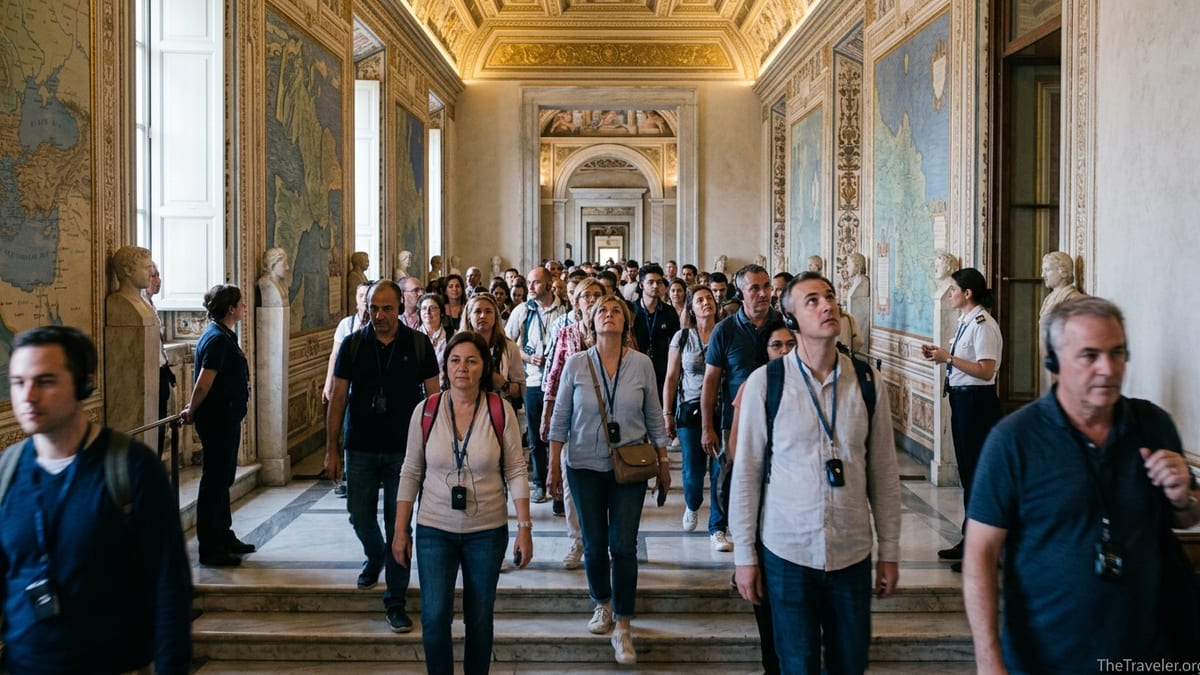
My own visit started with timed entry at 9:30 a.m. The line to collect pre-booked tickets at the official entrance on Viale Vaticano moved fairly quickly, but there was still a crush of people at the security checkpoint. Inside, the one-way flow carried us through the Pio-Clementino sculptures, the Gallery of Maps, the Gallery of Tapestries, and the Raphael Rooms. Each of these spaces could easily justify a dedicated visit, yet most people, like me, were visibly pacing themselves with one goal in mind: get to the Sistine Chapel before our energy ran out.
The sheer volume of tour groups was another reality check. Many had booked Vatican Museums plus Sistine Chapel guided visits, which typically start around 40 euros per person with an official guide and more with private operators. Guides marched under raised umbrellas or colored paddles, speaking into wireless microphones connected to headsets worn by their groups. At several choke points in the galleries, particularly near the Raphael Rooms, we shuffled shoulder to shoulder in bottlenecks that made it clear just how popular this museum complex has become.
By the time we saw the discreet signs pointing toward the "Cappella Sistina," the atmosphere felt less like approaching a sanctuary and more like joining the final queue at a theme park ride. The air was warm, the noise level rising, and museum staff were repeatedly reminding visitors to keep moving. It dawned on me that my experience inside the chapel would be profoundly shaped by the collective presence of the crowd around me.
The Shock of Stepping Inside: Crowds, Silence, and No Photos
The first sensation when I crossed the threshold into the Sistine Chapel was physical: the press of bodies, the sudden cooling darkness, and an almost immediate need to look up. Any idea of entering an empty, meditative space disappeared in an instant. The chapel was packed wall to wall, with people standing in dense rows in the center and every inch of bench space along the walls taken. Museum attendants kept urging newcomers to "move to the center" to prevent the entrance from clogging.
Contrary to the peaceful stillness I had expected, the room hummed with low conversation in a dozen languages. Every few minutes, a guard’s firm voice cut through the murmur with a reminder: "Silenzio, per favore. Silence. No photos." Another attendant walked briskly across the floor, signaling to someone to put their phone away, gesturing sharply at a raised camera. Photography is strictly prohibited, and enforcement is active. I watched one visitor asked to delete the shot they had just taken, under close supervision.
The no-photo policy reshaped the experience in ways I had not anticipated. I had imagined snagging one carefully framed image of the Creation of Adam for my own archives. Instead, I realized I would have to rely on my memory. Surprisingly, that limitation made me pay more attention. Without a screen between us, the ceiling felt less like a backdrop and more like a living surface I had to read with my eyes alone.
It was not the hushed chapel of my imagination, but there were pockets of real quiet. Periodically, after a loud reminder from the staff, the crowd would fall into a few seconds of near-silence. In those brief windows, the low rustle of clothes and the distant echo of footsteps became audible, and the colors overhead seemed to pulse more vividly. The contrast between the ideal of contemplation and the reality of mass tourism was stark, yet those fleeting silent moments were some of the most powerful of my visit.
Seeing the Art Up Close Was Overwhelming, Not Serene
Standing in the middle of the chapel, craning my neck, I realized how incomplete my mental image of the Sistine ceiling had been. I had been fixated on a handful of famous scenes, especially the Creation of Adam, but in person those panels are just one part of a vast, intricately organized tapestry. The barrel-vaulted ceiling is crowded with prophets, sibyls, ignudi, and architectural trompe-l’oeil elements that frame the central scenes from Genesis. It is not a single image to be "seen" and checked off; it is a dense narrative cycle that rewards slow, careful looking.
The problem is that slow, careful looking is hard when you are packed tightly in the center of the room and your neck starts to ache after a few minutes. I watched several visitors try to stand still for as long as possible, only to be nudged forward by the flow of the crowd. Others leaned against the walls, tilting their heads back until a guard reminded them to keep the passage clear. The chapel was not just visually overwhelming; it was physically demanding.
I found that focusing on smaller segments helped. One moment I was tracing the muscular twist of a prophet’s arm, the next I was noticing how the deep blue in one corner faded into a softer, almost smoky tone elsewhere. Years of restoration have made the colors far brighter than the sepia-toned reproductions I had grown used to. The Last Judgment on the altar wall, partially surrounded by temporary scaffolding for ongoing maintenance during my visit, still radiated an almost electric intensity. Even partially obscured, the cluster of resurrected bodies spiraling upward into light was impossible to ignore.
The result was not the quiet epiphany I had imagined. It was more akin to sensory overload, a flood of details that my brain was struggling to process in the time available. Far from diminishing the experience, that overload reminded me just how ambitious this chapel really is. It is not a postcard; it is a thundering visual argument about creation, judgment, and human frailty, compressed into a single rectangular room.
How Logistics, Rules, and Timing Shape Your Experience
Only after leaving the chapel did I fully appreciate how much the practical logistics had shaped the emotional tone of my visit. Time of day is crucial. I had gone in mid-morning on a weekday, which is busy but not quite peak chaos. Travelers who visit in high season afternoons often report even denser crowds and longer dwell times in the crush of the museum corridors. By contrast, early-morning "first entry" tours or limited-number evening openings can mean fewer people in the chapel, though they cost more than the standard 25 euro ticket and often sell out weeks in advance.
The rule set is strict and enforced. Modest dress is mandatory, which in practice means shoulders and knees covered; I saw several people drape rental scarves around bare shoulders at the entrance. Large backpacks, tripods, and bulky items are funneled into the cloakroom. Inside the chapel, staff continuously patrol for uncovered shoulders, raised phones, and people who stop too long in the doorways. None of this was part of my original, idealized vision, yet it is part of how the Vatican manages the intense pressure of visitor numbers.
Ticketing also affects how you feel once you finally arrive. Booking directly through the Vatican’s portal is usually the cheapest option, with the standard adult ticket listed around 20 euros plus the 5 euro online booking supplement for skip-the-line timed entry. However, popular dates can sell out weeks ahead. That is when many travelers turn to third-party platforms or "escort to the entrance" services, which can easily run to 60, 80, or even over 100 euros per person once guide services are added. Standing inside the crowded chapel, aware that everyone around me had paid widely different prices for the same 20 minutes of ceiling-gazing, added another layer of complexity to the experience.
One unexpected detail: exit routes matter. In the past, some tours included a special exit from the chapel that led directly to St Peter’s Basilica, saving a long walk back around the walls. Depending on Vatican policies at the time of your visit and the type of ticket you hold, that shortcut may or may not be available. On my visit, individual visitors exited with the general flow back into the museums, and I had to circle around to the basilica separately. It was a reminder that the Vatican is constantly adjusting its procedures, and that the fine print of your ticket can subtly transform your day.
Moments of Humanity in a Mass Tourism Machine
For all the rigid rules and heavy crowds, what stayed with me most were the human moments that broke through the machine-like efficiency of the visit. At one point, a group of teenagers from South America entered the chapel in matching school sweaters. They were boisterous in the doorway, then visibly stunned into silence as they looked up. One girl reached for her friend’s hand without taking her eyes off the ceiling. No one had instructed them to behave reverently; the art simply overpowered their chatter.
On a bench along the side wall, a middle-aged Italian man sat with his elderly father, who moved with difficulty. While attendants ushered most visitors to keep flowing, they allowed the pair to remain seated for much longer than the informal 15 to 20 minutes most people spend inside. The son quietly described different scenes to his father, naming prophets and pointing to small details, his hand resting gently on the older man’s shoulder. In the midst of the crowd, it felt like a private act of devotion.
Even the repeated announcements for silence took on a strange rhythm. Every time the guard shouted "Silenzio," conversations would drop, and for a heartbeat the room felt like a true chapel again. These pauses, both enforced and fragile, gave me a fleeting sense of what the space might feel like with only a handful of worshippers present. It was an echo of the contemplative experience I had imagined before I arrived, not permanent but still real.
Walking out, I realized that my disappointment about the lack of solitude had been replaced by a different kind of appreciation. The Sistine Chapel is no longer an intimate hideaway; it is a global crossroads where jet-lagged tourists, art students, pilgrims, and casual sightseers collide. Yet within that swirl, small, unscripted moments of awe still bloom. You just have to be willing to notice them between the loudspeaker announcements.
How I Would Plan the Visit Differently Next Time
If I were planning my visit with the benefit of hindsight, I would start by treating the Sistine Chapel not as a standalone attraction but as the emotional climax of an entire morning or afternoon in the Vatican Museums. That means giving myself at least three to four hours, wearing comfortable shoes, and accepting that I will be walking several kilometers indoors before ever reaching the chapel itself. I would also invest a bit more time in advance reading about the ceiling’s layout, so that I could focus on a few specific scenes rather than trying to absorb everything in one go.
Timing would be my next lever. In busy months, I would either book the very first time slot of the day on the official Vatican site as soon as tickets are released or consider an early-access small-group tour, even at a higher price, if a less crowded chapel is a top priority. In shoulder season, I might opt for a late-afternoon entry when some of the tour groups have thinned. Either way, I would avoid scheduling anything intense immediately afterward; the visual and physical fatigue is real.
To manage expectations, I would remind myself explicitly that the experience is inherently imperfect. The no-photo rule will not change for my convenience, and the crowds will not part just because I have dreamed about this visit since childhood. Instead of fighting those realities, I would focus on carving out a few minutes of stillness, maybe by leaning against a side wall near the back, letting the images wash over me without trying to identify every figure.
Finally, I would resist the urge to see the visit as a one-time, all-or-nothing event. The Vatican Museums and the Sistine Chapel are the kind of places that can sustain multiple visits, each with a different focus: one for the early Christian collections, another for the Raphael Rooms, another for the chapel alone. Even if I never return, giving myself permission not to "do it all" in one day takes some of the pressure off and leaves more space for genuine wonder.
The Takeaway
My visit to the Sistine Chapel was nothing like the quiet, contemplative dream I had carried with me for years. Instead, it was crowded, structured, and at times uncomfortably loud, framed by security checks, ticket rules, and the constant choreography of thousands of fellow visitors. Yet within that imperfect reality, the power of Michelangelo’s work still broke through, not as a gentle whisper but as a kind of visual thunder that refused to be diminished by selfie sticks or loudspeaker announcements.
If you arrive expecting a near-private encounter with the ceiling, you will almost certainly be disappointed. But if you approach the chapel as it truly is in 2026: the crowded, beating heart of a vast museum complex, you may find that its impact hits you in more complicated, and in some ways richer, ways. The Sistine Chapel today is not just a relic of Renaissance genius; it is a living, contested space where art, faith, commerce, and mass tourism collide, hour after hour, every single day.
That collision can be frustrating, but it can also be strangely moving. Watching strangers from every corner of the world fall silent, even for a few seconds, beneath the same painted sky is its own kind of miracle. It is messy, imperfect, and undeniably modern, yet still capable of producing moments of real, unfiltered awe. If you go in with open eyes and adjusted expectations, your visit may feel completely different from what you imagined, but it will almost certainly be one you never forget.
FAQ
Q1. Do I need a separate ticket for the Sistine Chapel, or is it included with the Vatican Museums?
The Sistine Chapel is included in every standard Vatican Museums ticket; there is no separate "Sistine Chapel only" admission.
Q2. How much does it cost to visit the Vatican Museums and Sistine Chapel in 2026?
The official adult ticket is around 20 euros plus a 5 euro online booking fee, with higher prices for guided tours and third-party packages.
Q3. How crowded is the Sistine Chapel during a typical visit?
Expect dense crowds most of the day, especially in high season. The chapel is often standing-room only, with visitors shoulder to shoulder in the center.
Q4. Can I take photos inside the Sistine Chapel if I turn off the flash?
No. Photography and video are not allowed at all inside the Sistine Chapel, and staff actively enforce this rule regardless of flash settings.
Q5. How long will I actually spend inside the Sistine Chapel?
Most visitors spend about 15 to 20 minutes inside, though the time is not strictly limited. Your neck, legs, and the crowd usually decide for you.
Q6. What should I wear to comply with the Vatican dress code?
Dress modestly: cover shoulders and knees, and avoid very short shorts, strapless tops, or hats. Light layers are useful in warm weather.
Q7. Is it worth paying extra for an early-access or guided tour?
For many travelers it is worthwhile. Earlier or restricted-entry tours can mean fewer people in the chapel and clearer explanations of the artworks.
Q8. How far in advance should I book tickets for the Vatican Museums and Sistine Chapel?
In busy months, it is wise to book several weeks ahead. Popular morning slots and special tours often sell out first on the official site.
Q9. Can I go directly from the Sistine Chapel into St Peter’s Basilica?
Sometimes selected tours use a side exit, but independent visitors are often routed back through the museums and must walk around to the basilica.
Q10. Is the Sistine Chapel still worth visiting despite the crowds?
Yes. The crowds can be challenging, but the scale, color, and emotional force of Michelangelo’s paintings remain extraordinary and deeply memorable.