


Victoria Glacier, looming above Lake Louise in Banff National Park, is one of those places that saturates social media feeds. You have likely seen its white ramp of ice framed by turquoise water and the Chateau Lake Louise hotel. Yet no photograph, drone video, or glossy brochure quite prepares you for what it is like to stand on the Plain of Six Glaciers trail and feel that ice wall dominating your field of vision, creaking and groaning across the valley. This is a landscape that looks massive in photos but feels far more impressive when you finally encounter it in person.
Get the latest updates straight to your inbox!
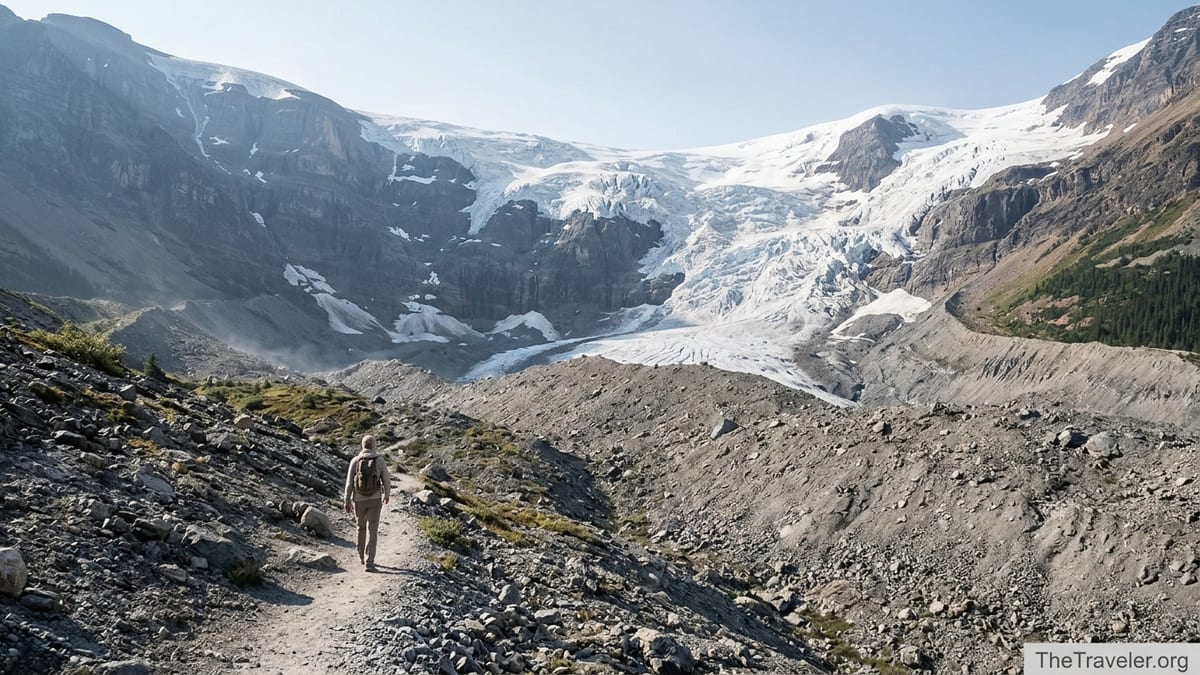
From Postcard View to Glacier Amphitheater
Most travelers first meet Victoria Glacier from the shoreline of Lake Louise. Standing outside the Fairmont Chateau Lake Louise, you see the glacier perfectly framed at the far end of the emerald lake, a classic Canadian Rockies postcard scene that draws thousands of visitors every day in summer. From here, the glacier feels distant and almost decorative, a white flourish high between Mount Victoria and Mount Lefroy.
It is only when you leave the paved lakeshore path and follow the Plain of Six Glaciers trail toward the head of the valley that the true dimensions begin to reveal themselves. The trail, about 13 to 14 kilometers return depending on how far you go beyond the teahouse, climbs steadily through forest and then out onto open moraine. As you gain height, the pretty postcard view transforms into a glacial amphitheater, with Victoria Glacier dropping toward you in broken seracs and blue crevasses while rock walls rise nearly a vertical kilometer above the valley floor.
By the time you reach the main viewpoint near the end of the maintained trail, you are standing at roughly 2,200 meters above sea level with the ice only a short distance away across a jumble of rubble and hidden ice beneath. The white wedge you saw from the hotel has become a living, moving river of ice, streaked with dark bands of rock and snow, its surface fractured into a chaotic maze that no photo from the lakeshore could have fully captured.
Many hikers describe the same realization here: that the photos they admired before arriving had flattened the landscape. In person, sound, scale, and the feeling of cold air spilling off the ice turn Victoria Glacier from a scenic backdrop into the dominant presence of the entire valley.
Why Photos Struggle to Capture Victoria Glacier’s Scale
Standing on the Plain of Six Glaciers, it quickly becomes obvious why pictures rarely do Victoria Glacier justice. For one thing, there are very few visual cues to help your brain interpret size. The glacier sits high on Mount Victoria, which rises to more than 3,400 meters, while cliffs and buttresses tower so steeply that it is hard to track where rock ends and ice begins. A telephoto image taken from the lakeshore compresses all of this into a neat frame, erasing the depth that overwhelms you in person.
When you are on the trail, you can pick out details that never appear in social media posts. In late summer, for instance, you might see blocks of ice the size of small houses hanging along broken icefall sections. Gravel ridges below you are actually moraines built from centuries of rock debris pushed forward by the glacier’s slow movement. You may hear sharp cracks echoing off the walls, followed seconds later by the distant roar of rockfall coming from somewhere along the glacier’s flanks, a reminder that this is not a frozen statue but an active system constantly reshaping the valley.
Depending on conditions, you might even see fine dust drifting in the air when a small serac collapses or a narrow avalanche pours down from the high snowfields. A long camera lens can zoom in on the broken ice, but it cannot convey how the sound vibrates in your chest, how the air temperature drops as katabatic winds roll down over you from the ice, or how small you feel on the moraine path with walls of rock and ice rising in every direction.
Even wide-angle landscape shots can mislead. From a distance, the Victoria Glacier often looks like a single smooth ramp, but when you are close you see that it is sliced into upper and lower sections, with visible fractures, thin snow-covered bridges, and a variety of subtle blues where light filters through compacted ice. The scale is such that what looks like a small ripple in the ice from Lake Louise can turn out to be a crevasse wide enough to swallow a bus.
The Hike That Turns a View into an Experience
Reaching the most impressive vantage points on Victoria Glacier means committing to time on the trail. The Plain of Six Glaciers route usually takes four to six hours return for most reasonably fit hikers, with a starting elevation of around 1,734 meters at Lake Louise and a climb of roughly 450 meters to the upper viewpoints. While it is considered a moderate hike in Banff terms, the transformation it offers is dramatic: you trade paved pathways and canoe rentals for rock, ice, and the distant clang of falling debris.
For many visitors, the break at the historic Plain of Six Glaciers Tea House is where the experience shifts. The teahouse, supplied by helicopter early in the season and by staff who hike in food and propane on their backs, sits on a rocky bench with commanding views of the Victoria, Lefroy, Aberdeen, Pope’s, and associated glaciers that give the trail its name. Grabbing a slice of cake and a pot of tea here is not just a novelty; it forces you to linger and really observe the glacier while your heart rate settles.
From the teahouse, the final stretch to the main glacier viewpoint adds about an hour round trip but is what turns a good hike into a great one. The trail narrows and crosses moraine slopes where steel cables in a few sections add security, though most people find it manageable in dry summer conditions. As you work higher onto the lateral moraine, the face of Victoria Glacier rises abruptly ahead and to your right, framed by the dark rock of Mount Victoria and Mount Lefroy. Many guided hikes from Lake Louise specifically aim for this point so first-time visitors can safely experience the full atmosphere of the glacier basin without technical mountaineering skills.
Along the way, you may pass volunteer rock walls and signage explaining how far the glacier has retreated over the past century. Looking back down the valley, Lake Louise appears small and distant, the famous hotel reduced to a tiny pale shape at the far end of the water. It is one of those rare hikes where every step physically changes your relationship to an iconic view you thought you already knew.
Moments That Make the Glacier Feel Immense
What most travelers remember from standing beneath Victoria Glacier is a collection of sensory snapshots rather than a single panoramic view. One hiker might recall the way their boots crunched over gravel and hidden ice, only later realizing that sections of the trail cross buried glacial ice covered by rock debris. Another might remember the moment a cool wind spilled down-valley and they instinctively pulled on a jacket, even though it had felt like summer on the lakeshore an hour earlier.
On busy July and August days, it is common to see groups from all over the world sharing the same reaction near the end of the trail. People grow quiet without being asked, phones lower, and conversations pause as they simply watch the glacier. Even children who rushed up the hill announcing that they “already saw it from the hotel” often stop short when they face the broken ice front and realize how big it really is. Parents point out the tiny dark specks of climbers moving high on Mount Victoria, which instantly recalibrates everyone’s sense of scale.
If you linger for 20 or 30 minutes, there is a good chance you will hear at least one rockfall or ice collapse echoing through the cirque, especially on warm afternoons in late summer. It may be just a small slide far across the valley, but the sound can be startlingly loud. That is when the glacier shifts in your mind from background scenery to something powerful, dynamic, and a little unpredictable. Even hikers who have done other glacier-view trails in the Rockies, such as Bow Glacier Falls along the Icefields Parkway or Wilcox Pass overlooking the Columbia Icefield, often comment that Victoria Glacier feels particularly close and vertical, as if it could spill over its rocky lip and rush down toward the plain at any moment.
For photographers, these moments are difficult to capture. Light conditions change quickly as clouds build over the peaks, and the best images often come from simply being patient. You might wait through flat midday light only to have the sun break through and strike the upper icefields, turning the fractured surface a luminous blue-white that pops against the dark limestone. That fleeting play of light and sound is exactly what no pre-trip photo gallery can provide in advance.
Planning a Visit: Seasons, Logistics, and Real-World Details
For most travelers, the most rewarding time to experience Victoria Glacier up close is between late June and late September, when the Plain of Six Glaciers trail is generally snow free and the teahouse is usually open. Early season hikers in June may still encounter snow patches and cooler temperatures near the upper viewpoint, while September brings chilly mornings and a good chance of frost, especially in the shade of the valley walls. In shoulder seasons, call or check local tourism information in Lake Louise to confirm current trail conditions.
Reaching the trailhead is straightforward but requires planning. Lake Louise parking fills very early in peak summer, sometimes before sunrise. Many visitors now rely on shuttle buses organized from the Lake Louise Park and Ride or from the village area. A family of four might spend the morning on the lake in a rented canoe and then dedicate the afternoon to hiking as far as the teahouse, while more serious hikers often start early and complete the entire loop that links Lake Agnes, the Big Beehive, and the Plain of Six Glaciers in a long full-day outing.
Expect mountain pricing at every turn. A simple tea and slice of chocolate cake at the Plain of Six Glaciers Tea House can cost more than a cafe visit in Calgary, reflecting the fact that food and fuel arrive by helicopter and on human backs rather than by road. In Lake Louise village, a modest hotel room in July can easily cost several hundred dollars per night, while campgrounds in the area need to be booked well in advance. Many budget-conscious visitors base themselves in nearby towns such as Canmore or Golden and make a long day trip to Lake Louise instead.
Guided experiences are common for travelers unfamiliar with mountain environments. Local guiding companies and the Fairmont hotel organize group hikes on the Plain of Six Glaciers, often including commentary on glaciology, local wildlife, and regional history. Joining such a hike can be especially helpful if you are traveling with children, have limited alpine experience, or simply prefer not to think about route finding, weather interpretations, or bear safety on your own.
Safety, Weather, and Respecting a Changing Glacier
Although the Plain of Six Glaciers trail does not require technical gear, it is still a true mountain hike, and the presence of Victoria Glacier creates its own microclimate. Temperatures near the ice can be significantly lower than at the hotel, and wind funneled down the valley can make a sunny day feel unexpectedly cold. Sturdy hiking shoes or boots, a warm layer, waterproof shell, hat, sunscreen, and at least one to two liters of water per person are basic essentials, even if it looks like a casual stroll from the lakeshore.
Rain showers are common in the Rockies in July and August, and late-afternoon thunderstorms can build quickly. Being high on a moraine ridge under darkening skies while thunder bounces around the peaks is a memorable but not ideal situation. Starting early in the morning helps you reach the upper viewpoints in calmer conditions and allows plenty of time for a relaxed return. Trekking poles can be helpful on loosier gravel sections, particularly if you have knee issues on descents.
Wildlife considerations are also part of the real-world experience. The Lake Louise area is prime habitat for black bears and grizzly bears, and it is not unusual for Parks Canada to impose group-size requirements or temporary restrictions on certain trails when bear activity is high. Carrying bear spray, hiking in a group, making noise on forested sections, and paying attention to signage at the trailhead are all part of being a responsible visitor.
Finally, it is important to remember that Victoria Glacier, like many in the Rockies, is retreating. Interpretation panels at viewpoints may show how far the ice extended only decades ago. From the Plain of Six Glaciers, you can often see barren, fresh rock that only recently emerged from under the ice. Staying off closed areas, respecting any ropes or warning signs near unstable moraine slopes, and resisting the temptation to scramble closer to the ice front help protect both you and this fragile landscape.
The Takeaway
Victoria Glacier may be one of the most photographed glaciers on the planet, yet it does not reveal its full character on a phone screen. The classic Lake Louise postcard view is beautiful, but it keeps you at a safe emotional distance, turning the glacier into a backdrop instead of a protagonist. Hiking the Plain of Six Glaciers changes that relationship. Step by step, the glacier grows from a white smudge at the end of the lake into an overwhelming presence that fills your senses with sound, cold, and scale.
In person, you notice details that never show up in your feed: the dull roar of invisible rockfalls, the way the valley wind suddenly turns icy, the fine dust that hangs in the air after a small slide, the faint crackling deep inside the ice itself. You feel how completely the glacier dominates the valley, how tiny the famous hotel looks when you glance back over your shoulder from the upper moraine.
For travelers willing to trade polished hotel views for a few hours on uneven trail, Victoria Glacier offers one of the most powerful reminders of why we travel in the first place. The journey is not just about collecting pretty pictures but about standing in landscapes that make you rethink your own sense of size, time, and permanence. No matter how many photos you have seen before you arrive, the real Victoria Glacier will almost certainly be bigger, louder, and far more alive than you imagined.
FAQ
Q1. Where exactly is Victoria Glacier and the Plain of Six Glaciers trail?
Victoria Glacier sits above Lake Louise in Banff National Park, Alberta, Canada. The Plain of Six Glaciers hiking trail begins at the lakeshore near the Fairmont Chateau Lake Louise and follows the north side of the lake into the valley beneath the glacier.
Q2. How difficult is the Plain of Six Glaciers hike to see Victoria Glacier up close?
The hike is generally rated moderate. Most visitors cover about 13 to 14 kilometers return with roughly 450 meters of elevation gain, taking four to six hours round trip depending on fitness, weather, and how far beyond the teahouse they go.
Q3. When is the best time of year to hike to Victoria Glacier?
The most reliable season is late June through late September, when the trail is usually clear of snow and the Plain of Six Glaciers Tea House is often open. Early June and October can be beautiful but may involve snow patches, cold temperatures, and occasional early-season or late-season storms.
Q4. Do I need special gear or a guide to visit Victoria Glacier?
You do not need technical climbing gear to hike the Plain of Six Glaciers trail, as it stays on established paths and does not go onto the glacier itself. Sturdy footwear, warm layers, rain protection, and water are essential. Hiring a local hiking guide is optional but useful if you are unfamiliar with mountain conditions or prefer added safety and context.
Q5. Can I walk on Victoria Glacier during my visit?
No, the Plain of Six Glaciers trail is designed to bring you to viewpoints near the glacier, not onto the ice. The glacier surface is heavily crevassed and unstable. Walking on it safely requires glacier travel skills, ropes, and specialized equipment, and is only done as part of technical mountaineering or guided glacier trips elsewhere in the Rockies.
Q6. How long does it take to reach the best viewpoint of Victoria Glacier?
Most hikers reach the Plain of Six Glaciers Tea House in about two to three hours from Lake Louise, then continue another 30 to 45 minutes up the moraine to the main glacier viewpoint. Allow time for breaks, photos, and a relaxed pace, especially if you are adjusting to altitude or hiking with children.
Q7. What should I pack for a day hike to Victoria Glacier?
Plan for quickly changing mountain weather. Bring sturdy hiking shoes or boots, a warm mid-layer, wind and rain jacket, sun hat, sunscreen, at least one to two liters of water, snacks or lunch, and optionally trekking poles. Bear spray is recommended in this region and should be carried where it is legal to do so.
Q8. Is the Plain of Six Glaciers trail suitable for children or less experienced hikers?
Many families with active children complete at least part of the trail, especially as far as the teahouse. The full hike to the upper viewpoints includes some steeper sections and loose gravel, so it is best for children and adults who are comfortable with several hours of steady walking and basic mountain terrain.
Q9. How crowded is the trail and can I still find quiet moments?
The Lake Louise area is very popular, and on summer weekends the Plain of Six Glaciers trail can be busy, particularly near the lake and teahouse. Starting early in the morning, visiting on weekdays, and lingering beyond the teahouse toward the upper viewpoints all increase your chances of finding quieter stretches and uncrowded glacier views.
Q10. Why does Victoria Glacier feel so much bigger in person than in photos?
Photos compress distance and often exclude the sounds, temperature changes, and vertical scale of the surrounding cliffs. In person, you can hear rockfall, feel cold air draining off the ice, see tiny climbers on faraway ridges, and sense how steeply the glacier drops into the valley. All of these details combine to make Victoria Glacier feel significantly larger and more powerful than it appears in images.