


For UK travellers planning a winter escape between December and February, the real question is not simply where the sun shines, but where it actually feels warm once you step off the plane. Within roughly five hours’ flying time of London there is a clear split between places that are pleasantly mild for outdoor sightseeing and those with a stronger chance of comfortable beach weather. Even in the subtropics, winter sunshine does not guarantee warm water or wind-free days on the sand, so choosing the right destination means looking carefully at air temperature, sea temperature, wind, rainfall, flight options and the true cost of the holiday, from luggage to resort taxes.
Get the latest updates straight to your inbox!
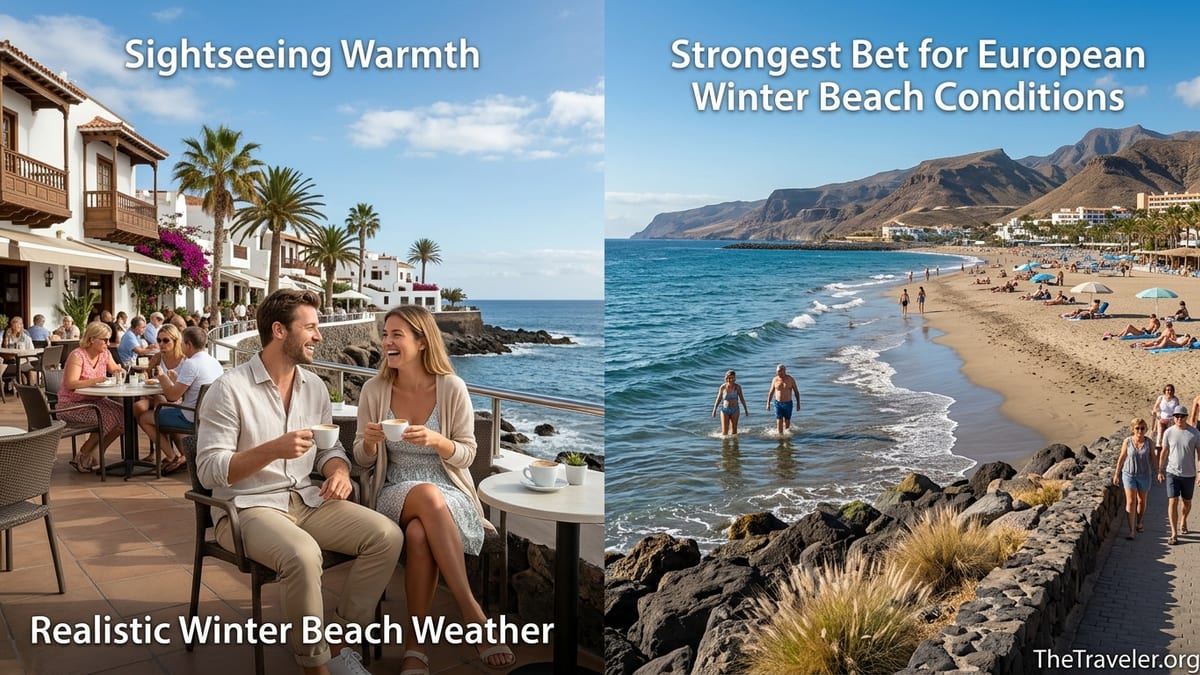
Sightseeing warmth vs realistic winter beach weather
From London, a five-hour flight radius in winter covers southern Spain, Malta, Cyprus, the Atlantic island of Madeira and the Moroccan coast, as well as the Canary Islands. Across this area, daytime temperatures in December, January and February often reach the mid to high teens Celsius, sometimes the low 20s, but only a handful of destinations combine mild air with seas that many people find comfortable for a proper swim. The critical distinction is between places that are warm enough for café terraces, city walks and hiking, and those where you can plausibly plan several relaxed beach days without a fleece.
The Canary Islands stand out among European options. Official climate normals from Spain’s AEMET, summarised by several independent weather guides, put average daytime highs in south Tenerife, south Gran Canaria, Lanzarote and Fuerteventura at roughly 21 to 23 degrees in December to February, with nights around 14 to 16 degrees. Sea temperatures around the archipelago hover near 19 to 20 degrees at this time of year, which many regular swimmers describe as fresh but manageable, especially on calm days. By contrast, sea temperatures off Málaga are closer to 15 to 16 degrees in midwinter, and around Cyprus they are typically in the mid to high teens, so you may paddle or take a quick dip but not linger in the water comfortably.
In North Africa, Marrakech and inland Morocco deliver some of the warmest daytime air temperatures within a short hop of London, with average winter highs close to 18 to 20 degrees and plenty of sunshine. Yet Marrakech has no beach and nights can fall close to single figures, so it works best for dry, sunny sightseeing rather than pool days. Coastal Agadir, further south, feels milder overall, with winter highs around 20 to 21 degrees and a broad Atlantic beach, though the ocean still feels brisk and evenings remain cool. Madeira and Malta sit closer to the Canary pattern in terms of air temperature but the sea generally runs cooler than the Canaries, and winter storms in the Atlantic can make the water feel rougher than raw numbers suggest.
Canary Islands: the strongest bet for European winter beach conditions
For travellers specifically chasing beach time, the Canary Islands are consistently the most reliable option within about four and a half hours of London. Climate data compiled from AEMET and published this autumn shows south Tenerife averaging around 22.8 degrees by day in December and 21.7 degrees in January, with similar figures for south Gran Canaria and slightly cooler numbers for Lanzarote and Fuerteventura. These are long-term averages, not promises, but they underline how unusual hard winter cold is at sea level. Sunshine still averages roughly six to seven hours a day across December to February for the main southern resorts, and rainfall amounts are modest compared with the Mediterranean coast.
Sea temperatures add another layer to the decision. Recent analyses of satellite sea-surface data put Canary waters at around 20 degrees in December, dipping towards 19 degrees by February. That is cooler than an English leisure centre pool but much warmer than the 15 to 16 degree winter seas off Andalucía or the 16 to 17 degree lows off Cyprus. Regular open-water swimmers tend to find it fine for 10 to 20 minute swims without a wetsuit. Casual swimmers used to 26 to 28 degree summer water might limit themselves to quick dips, so expectations matter. Winter trade winds can also roughen the Atlantic: Fuerteventura’s west coast in particular can be windy with strong surf, while sheltered south and southwest-facing beaches on Tenerife and Gran Canaria generally feel calmer.
Within each island, microclimates are significant. South Tenerife around Costa Adeje, Playa de las Américas and Los Cristianos is markedly sunnier and drier than Puerto de la Cruz in the north, where cloud and showers are more frequent in winter. Similar north-south contrasts exist between Maspalomas and the north of Gran Canaria, and between the leeward coasts of Lanzarote and its windier north. For a midwinter trip where beach time is a priority, south Tenerife, the Maspalomas area of Gran Canaria and the south or east coasts of Lanzarote and Fuerteventura are the most weather-favoured choices.
Madeira, Marrakech, Agadir, Málaga, Malta and Cyprus in winter
Madeira, lying north of the Canaries but still in the subtropical Atlantic, offers some of the most pleasant winter temperatures for outdoor activities within a four-hour flight. Climate normals from the Portuguese weather service for Funchal indicate average daytime highs of roughly 20 to 21 degrees from December through February and lows in the mid-teens. The sea is usually around 18 degrees in late winter. That combination is perfect for levada walks, botanical gardens and terrace dining on clear days, though the mountainous interior is far cooler and wetter, and Atlantic fronts can bring several days of heavy rain. Madeira is therefore better seen as a hiking and scenery destination than as a guaranteed winter beach holiday.
Marrakech sits inland at around 460 metres altitude and benefits from clear winter skies. Long-term figures collated by national meteorological services and academic studies point to average January highs close to the high teens, often reaching low 20s on sunny days, with more than 200 hours of sunshine a month. Nights, however, regularly drop below 10 degrees, so you will need warm layers once the sun goes down and many traditional riads have limited heating. Agadir, on Morocco’s Atlantic coast, is slightly milder and more maritime. Recent climate summaries cite January averages of about 20 degrees by day and lows around 9 to 10 degrees, with relatively low rainfall compared with the Mediterranean. The ocean is still cool and occasionally rough, but Agadir’s long south-facing bay offers more usable winter beach days than most European mainland resorts.
On the European mainland, Málaga and the wider Costa del Sol provide some of the warmest winter conditions within Spain. Official statistics show average daytime highs of roughly 17 to 18 degrees between December and February, with sea temperatures around 16 degrees in January. You can expect a mix of clear, bright days and occasional Atlantic fronts bringing several wet days a month. For many visitors this creates a sweet spot for café culture, exploring the old town and taking day trips to Granada or Ronda, rather than lying on the beach. Malta plots a similar course: winter highs typically sit in the mid-teens, nights hover just under 10 degrees, and the sea slips into the mid-teens. It is comfortable for sightseeing and exploring coastal paths around Valletta and Mdina, but the water is cool and wind can be strong.
Cyprus, sitting further east, is among the mildest parts of the Mediterranean in winter. Data for Paphos and Larnaca puts average January highs in the mid to high teens with lows around 8 to 9 degrees, and sea temperatures of roughly 17 degrees in February rising from around 19 to 20 degrees in December. The combination of softer light, citrus harvests and quieter resorts makes winter Cyprus attractive for walkers and history enthusiasts visiting sites like Paphos Archaeological Park or the Troodos villages. It is not, however, a guaranteed sunbathing and swimming destination in midwinter, and rain showers can cluster into a few unsettled weeks.
Flight times, London airports and seasonal routes
All of the destinations considered here are connected to London by direct flights that generally fall under the five-hour mark, though schedules differ by airport and season. British Airways lists a direct London to Tenerife South flight time of about 4 hours 30 minutes, with services operating from both Heathrow and Gatwick and additional frequencies from low-cost carriers out of Luton and Stansted. Aggregated flight search data this autumn shows typical non-stop departure times such as 08:00 from Gatwick, 06:05 from Stansted and 07:05 from Luton, with return sectors of a similar duration.
Madeira’s capital Funchal sits just under four hours from London. Current timetables show winter non-stop flights from Gatwick with British Airways and easyJet, and from Stansted with Ryanair, while Heathrow and London City generally require a connection. Marrakech is one of the closest warm winter destinations to London by air, with scheduled non-stop flights from Heathrow taking around 2 hours 40 to 2 hours 45 minutes according to current British Airways schedules. Additional low-cost routes run from Gatwick, Stansted and Luton, though some operate only on specific days of the week in winter.
Agadir, Málaga, Malta and Cyprus are all reachable in under five hours as well. Recent schedule data lists London to Agadir flight times around 3 hours 40 to just under 5 hours non-stop, with services from Gatwick on leisure airlines and from Stansted on low-cost carriers. London to Málaga usually comes in around 2 hours 45 to 3 hours, served daily in winter from all the major London airports including Heathrow, Gatwick, Stansted and Luton. Flights to Malta from London typically take 3 to 3 hours 20 minutes, while direct flights to Paphos or Larnaca in Cyprus are longer but still within the five-hour limit, usually in the region of 4 hours 30 to 4 hours 45 minutes.
Frequency matters if you are trying to build a flexible itinerary or a short break. Tenerife, Gran Canaria, Lanzarote, Málaga and Marrakech all see multiple weekly flights from at least one London airport through the winter months, which keeps fares more competitive. Agadir, Madeira, Malta and Cyprus sometimes have fewer weekly frequencies in deep winter, so prices can jump on popular departure days and choice of flight times is narrower.
Realistic winter weather: what historic data tells you (and what it does not)
Across all these destinations, official climate normals and recent analyses consistently quote similar caveats: averages are not guarantees. The 1991 to 2020 normals for south Tenerife, for example, suggest daytime highs around 21 to 23 degrees in midwinter with limited rain, yet particular years have delivered sequences of cool, cloudy days when Atlantic systems stall over the region. Lanzarote and Fuerteventura often score higher for sunshine hours than Tenerife or Gran Canaria in January, but their more exposed landscapes can mean windier conditions that make 21 degrees feel chillier on the beach than the thermometer suggests.
Sea temperatures are smoother and more predictable than air temperatures because the ocean changes slowly, but they still vary by 1 to 2 degrees between years. Around Funchal, long-term observations put February sea temperatures at around 18 degrees, yet recent winters have seen short-lived dips as Atlantic storms pass. Similarly, Cyprus’s February sea temperatures of around 17 degrees are averages; early February can be noticeably cooler than late in the month. For travellers, the sensible approach is to treat published figures as a guide to the general feel of the season rather than interpreting “21 degrees average” as a daily promise.
Rainfall patterns also differ sharply between destinations. The north coasts and highlands of Madeira see several times the winter rainfall of Funchal, so a week based in the capital might bring a mix of showers and bright spells, while road access to high levada trails could be affected by heavy rain in the interior. In Morocco, most winter months in Marrakech and Agadir pass with short, sharp showers if any, but occasional systems can bring a full day or more of rain. Málaga has its wettest period from November to January but still averages plenty of sunshine even in its rainiest month, although a single Atlantic front can cover several of your days if your timing is unlucky.
Holiday prices, packages and hidden extras
Winter sun pricing from London varies sharply between a quiet week in mid-January and the peak of UK school holidays. For example, recent price round-ups by UK holiday comparison sites in autumn 2026 list seven-night all-inclusive winter sun packages from London in late January 2027 starting from around the low to mid £400s per person for lower-rated hotels in the Canary Islands, rising to £600 to £800 per person for well-reviewed beachfront resorts. These figures typically include flights, check-in luggage and transfers but may not include local tourist taxes or charges for room safes, premium drinks and à la carte restaurants.
Madeira and Marrakech can look cheaper at first glance because many short breaks are sold as flight-plus-hotel bundles with breakfast only. Search snapshots in November 2026 show central riads in Marrakech from around £60 to £80 a night for two people in early January, with return Heathrow flights often available below £200 per person outside peak dates. However, you must then budget for airport transfers, city meals, excursions and tips, which means a four-night stay for a couple can easily land in the £700 to £1,000 bracket once everything is included. Similarly, a self-catering apartment in Funchal or Puerto de la Cruz may keep the headline price low but requires a realistic food and local transport budget, especially if you plan to explore by cable car or organised levada walk.
All-inclusive packages in the Canary Islands and Agadir can offer strong value for those who mainly want resort time, particularly when comparing like-for-like with eating out daily in Málaga, Malta or Madeira. That said, low advertised lead-in prices often apply to limited dates from specific London airports, to basic room types or to properties far from the main beaches. Some packages do not include checked luggage by default, and resort fees or eco-taxes collected on arrival are usually quoted only in the small print. Travellers who prefer flexible plans should also factor in the cost of car hire, which can be attractive in winter but sometimes requires additional insurance top-ups not reflected in the initial online quote.
Three example winter budgets: couple, family, sunshine seeker
For a budget-conscious couple targeting reliable winter sun, a realistic benchmark for a week in January 2027 in south Tenerife or Gran Canaria might be in the region of £450 to £650 per person, based on current package deal surveys. That would typically cover return flights from London with a checked bag, shared self-catering or bed and breakfast accommodation in a mid-range complex, shared airport transfers and basic resort taxes. Eating simply in local cafés and cooking some meals in the apartment might add another £250 to £350 per person for the week, including a few drinks and local buses, bringing the total to roughly £1,400 to £2,000 for two.
For a family travelling in UK February half-term, the school-holiday premium is significant. Recent analysis of February 2027 fares suggests that return flights alone from London to Tenerife for two adults and two children can reach around £900 in the most popular week, before accommodation. All-inclusive family packages for that same period, with flights, luggage, transfers and seven nights in a family room at a mainstream resort, are being marketed in late 2026 from about £600 to £800 per person. That implies a realistic total of £2,400 to £3,200 for a family of four, plus spending money and excursions. Booking outside school holidays, even by shifting dates a week earlier or later where term times allow, can reduce those figures materially.
For a solo traveller or pair whose overriding aim is winter sunshine rather than the beach, Marrakech offers a strong value contrast. A four-night mid-January break might combine return flights from Heathrow for roughly a low to mid three-figure sum per person with a comfortable riad at perhaps £70 to £120 per room per night and an allowance for meals and entrance fees. That could place the total somewhere between about £500 and £900 per person depending on comfort level and excursions, substantially below many Canary Islands packages while still delivering warm, dry days for sightseeing. A similar budget could also support a five to seven-night stay in Funchal in a mid-range hotel with breakfast, focusing on levada walks and town-based exploring rather than resort facilities.
Practicalities: school holidays, passports, entry rules and insurance
UK school holiday dates are one of the single biggest drivers of winter pricing. February half-term in England typically falls in the second or third week of February, and published 2027 fare comparisons already show substantial mark-ups on London flights to the Canaries, Morocco and mainland Spain during that week. Families with flexibility sometimes save hundreds of pounds by travelling in late January or in early March instead, or by choosing durations that start or end midweek where school policies permit. For child-free travellers, these high-demand weeks are best avoided unless fixed work leave dictates otherwise.
Entry requirements and passport validity rules are broadly straightforward but important. For Spain, Portugal, Malta and Cyprus, UK nationals travelling as tourists must ensure that their passport meets post-Brexit Schengen rules: it should be issued less than ten years before the date of entry and usually must have at least three months’ validity beyond the intended departure date. Stays for tourism are normally limited to 90 days in any 180-day period without a visa. For Morocco, current UK government advice confirms that British nationals visiting for tourism can enter visa free for short stays, provided they hold a valid passport; border control officers normally stamp passports on entry and exit and travellers have occasionally encountered difficulties when stamps were missing, so checking this on arrival is sensible.
In all cases, comprehensive travel insurance is highly advisable, particularly over the winter months when Atlantic storms can disrupt flights to and from island destinations. Policies should explicitly cover medical treatment, repatriation, cancellation or delay, and any planned activities such as hiking above 1,500 metres in Madeira or boat trips in the Canaries. Travellers heading to EU destinations may wish to carry a GHIC or valid EHIC card for access to state healthcare, but should treat this only as a supplement to proper insurance rather than a replacement.
Comparison snapshot and recommendations by travel style
Taking typical midwinter conditions as a guide, south Tenerife, south Gran Canaria, Lanzarote and Fuerteventura offer the best blend of mild air, usable sea temperatures and frequency of flights from London within roughly four and a half hours. Daytime highs commonly reach around 21 to 23 degrees, seas hover near 19 to 20 degrees, sunshine is relatively abundant and rainfall is modest. Madeira trades slightly cooler seas and more changeable weather for lush landscapes and excellent walking conditions around 18 to 20 degrees. Málaga, Malta and Cyprus deliver pleasant 15 to 18 degree days ideal for urban exploring and coastal walks but cooler water and a higher risk of rain. Marrakech stands out for the warmth of its sunshine and low rainfall, with air temperatures often in the high teens or low 20s under clear skies, but evenings are chilly and there is no beach; Agadir sits between the two, with a real oceanfront setting but cooler water and the possibility of breezy days.
If your priority is swimming, the Canary Islands give you the strongest chance of spending a meaningful amount of time in the sea or in unheated outdoor pools without shivering. For pure beach relaxation without much sightseeing, the south coasts of Tenerife and Gran Canaria and the more sheltered resort areas of Lanzarote and Fuerteventura are the most consistent choices, backed up by a wide choice of all-inclusive resorts that simplify budgeting. For hiking and coastal scenery, Madeira shines, with its levada network and clifftop paths, while winter Cyprus and the hills above Málaga also provide rewarding walking days when the weather cooperates.
Travellers more interested in cultural sightseeing and markets than in the beach will find Marrakech the standout option within this flight-time band, with atmospheric riads, souks and palaces under bright winter skies. Málaga, with its Picasso connections and growing museum quarter, plus easy day trips inland, is a strong alternative for those who prefer to stay within the EU. For short winter escapes of three to five nights, strong candidates are Marrakech and Málaga for culture, and Tenerife or Gran Canaria for a quick injection of light and warmth, thanks to the density of flights from London.
Weather contingency planning is prudent anywhere. In the Canaries, allow for one or two greyer or windier days by pencilling in inland drives, spa sessions or trips to attractions such as Tenerife’s Teide National Park or Gran Canaria’s old town. In Madeira, focus rainy days on Funchal’s cafés, covered market and museums, saving clear spells for levada walks. In Marrakech or Agadir, have indoor sights, hammam sessions or cookery classes in mind if a cooler day appears. By combining realistic expectations with a careful reading of climate data, flight options and total holiday costs, London travellers can pick a winter destination that matches not just their wish for sunshine but their tolerance for cool seas, breezes and the occasional rainy day.