


Night trains and Christmas markets sound like a perfect pairing, but in practice the romance comes with caveats. Sleeper services do not always stop beside the most photogenic squares, and many December itineraries require an extra early morning regional connection before you reach the stalls and mulled wine. For 2026 and 2027, however, a growing network of European night trains does make it realistically possible to wake up close to major markets in Vienna, Salzburg, Dresden, Berlin, Prague, Zurich and Basel if you plan carefully and understand what you are buying.
Get the latest updates straight to your inbox!
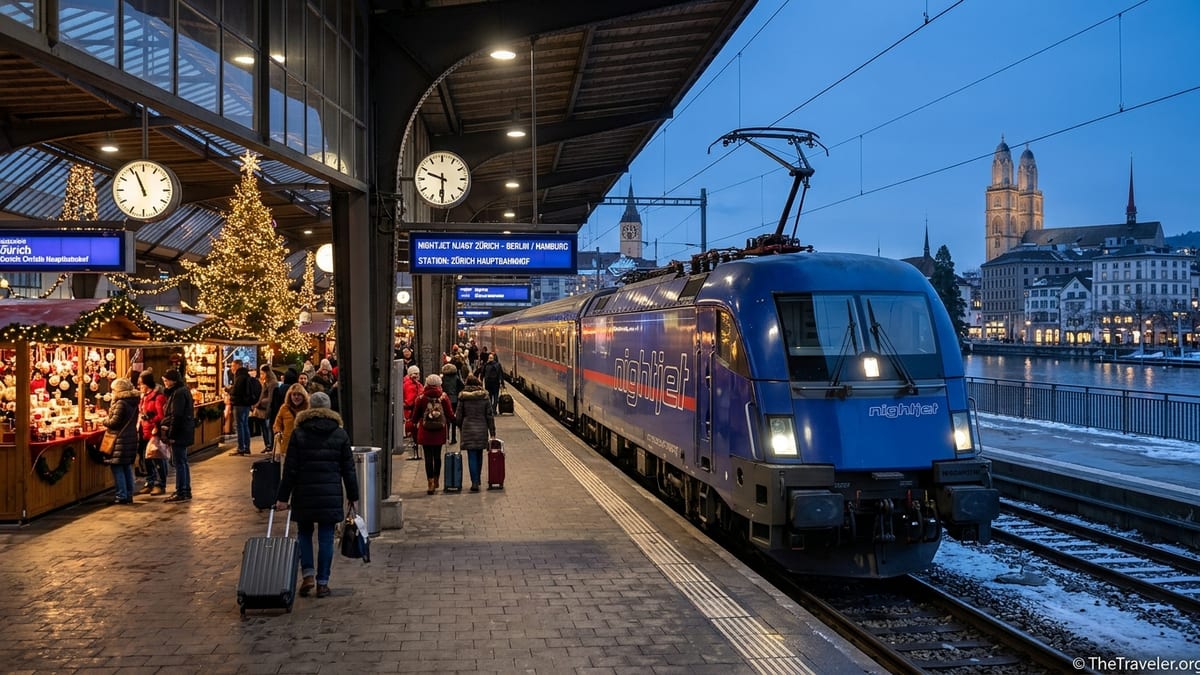
Where night trains actually go in 2026 and 2027
By late 2026 the core European sleeper operators for Christmas travel are ÖBB Nightjet, European Sleeper and several EuroNight services, with some seasonal routes run by partners such as RDC. ÖBB’s Nightjet network remains the backbone of Central European overnight travel, linking cities such as Vienna, Salzburg, Zurich, Basel, Hamburg, Berlin, Brussels and Amsterdam on year-round schedules, with additional seasonal services into ski regions and Italy. A Deutsche Bahn night services map for the 2026 timetable highlights Nightjet and EuroNight routes criss-crossing Germany, Austria, Switzerland, Italy and the Czech Republic, with regular overnight links relevant to Christmas markets between Amsterdam or Brussels and Vienna, between Hamburg or Berlin and Vienna, and between Zurich, Basel and Berlin.
European Sleeper, the cooperative based in Belgium and the Netherlands, is an important new player for 2026. Its original Brussels to Prague service via Amsterdam and Berlin has been extended to Dresden, and operates several nights per week, with typical timings that have you boarding in Brussels or Amsterdam in the evening and waking around Berlin after dawn before rolling along the Elbe to Dresden and Prague late morning. For winter 2026–2027 it is also scheduled to operate a Paris to Berlin service from Paris Nord via Belgium, plus a Brussels to Milan route that has been revised to run via Zurich because of construction work on the Simplon route. This Zurich leg is particularly useful for Christmas market travelers because it delivers you directly into the Swiss city’s Hauptbahnhof.
RDC has focused in recent years on seasonal and contract-operated services rather than a single branded winter route, and several open access and state rail EuroNight services complement Nightjet and European Sleeper. For example, there are overnight EuroNight trains linking Berlin with Vienna and Budapest, and services between Hamburg or Berlin and Zurich or Basel. The Hamburg and Berlin departures reach Switzerland around 7:30 to 9:00 in the morning, which works well for Basel and Zurich markets if you are comfortable arriving with your luggage and arranging storage before hotel check-in. What matters for planning is confirming that your chosen itinerary includes a genuine overnight segment with sleeping options, not simply a late-evening departure followed by a seat-only early-morning connection.
Looking into 2027, the main confirmed pattern is consolidation rather than dramatic expansion. ÖBB’s Nightjet network for the 2026 regular timetable is published with an indication that it continues into 2027 subject to construction-related changes, and European Sleeper signals that its Prague, Berlin and Milan routes are planned year-round with timetable tweaks rather than seasonal appearance. New or experimental routes may appear, but for trip-planning purposes to the 2027 Advent period it is safer to base itineraries on these established lines and adjust times once the final December timetables are released, usually around October.
Christmas market dates and why many close before New Year
Christmas markets are not aligned on dates, which matters intensely if you are booking a non-refundable sleeper months in advance. Vienna’s flagship Christkindlmarkt at Rathausplatz publishes its 2026 dates as 13 November to 26 December, with daily opening that includes the period up to and including Christmas. City tourism information confirms that other Viennese markets in Spittelberg or Belvedere typically end around 23 or 24 December, but the large Rathausplatz event continues through Christmas to capture both pre-Christmas shoppers and visitors staying over the holidays.
In contrast, the Basel Christmas market in 2026 runs from 26 November to 23 December on Münsterplatz and Barfüsserplatz. Official information from Basel tourism notes that on 23 December 2026 the market on Barfüsserplatz closes at 20:00 and the one on Münsterplatz at 18:00. There is no continuation on Christmas Eve or between Christmas and New Year; instead, Basel focuses on Advent and leaves the festive week itself to more low-key city events. That pattern is common in German-speaking Europe: the traditional idea is that markets are for Advent, and by 24 December people are expected to celebrate at home.
Dresden’s historic Striezelmarkt and other markets follow a similar Advent-focused model. Municipal documents for Dresden’s 2026 markets refer to retail rules and Sunday opening linked to the Striezelmarkt season, with the main market normally closing on 24 December around midday, and some associated markets ending as early as 23 December. Travelers booking an overnight train to arrive on, say, 24 or 25 December will often find that the “famous market” photos that inspired them no longer match reality on the ground, even though decorations remain.
Berlin and Zurich illustrate the variety. Major Berlin markets around Gendarmenmarkt and Alexanderplatz have in recent years extended at least part of their operations until 29 or 30 December, and some more commercial markets attached to malls have traded into early January. Zurich’s Christkindlimarkt inside the main station and its outdoor Weihnachtsdorf on Sechseläutenplatz traditionally run into the days just before Christmas, with some components staying open until 24 December but not generally beyond. For 2026 detailed Zurich dates are not yet fully published as of November 2026, but advance tourism material suggests a season from late November to around 23 or 24 December. Travelers targeting a between-Christmas-and-New-Year city break should therefore look at cities like Vienna, some Berlin markets or alpine resort events, and should not assume that any market automatically runs to 31 December.
How close the trains get: stations, transfers and walking distances
In several cities the night train station is comfortably close to the main Christmas markets, which makes car-free trips much easier. Vienna’s Nightjet and EuroNight services arrive at either Wien Hauptbahnhof or Wien Westbahnhof, depending on route. From Wien Hauptbahnhof it is approximately 10–15 minutes by U-Bahn to Rathausplatz, usually with one straightforward change, and from Westbahnhof around the same. Travellers comfortable with urban transport can be sipping punch on Rathausplatz less than 30 minutes after walking off the train, but there is no sleeper service that deposits you directly in front of the market itself.
Zurich and Basel are particularly convenient. Zurich’s principal night train arrivals from Germany, Austria and Italy all terminate at Zürich Hauptbahnhof. The indoor Christkindlimarkt is inside the station concourse, typically a short walk from long-distance platforms, so you can wander past stalls within minutes of arrival. The lakeside and Old Town markets are about 10–20 minutes on foot or a couple of tram stops from the station. Basel’s overnight trains from Germany and the north mostly arrive at Basel SBB, which is around a 10–15 minute tram ride or 20–25 minute walk from Barfüsserplatz and Münsterplatz, where the main Basel Christmas markets are held. Local transport operators and tourism boards often offer discounted transit to “Basel, Barfüsserplatz” specifically for market visitors, which underlines how integrated trains and trams are for this trip.
Berlin and Dresden require slightly more thought. European Sleeper and Nightjet trains serving Berlin generally stop at Berlin Hauptbahnhof and sometimes Berlin Gesundbrunnen. From Hauptbahnhof, trams and S-Bahn lines reach central markets at locations such as Alexanderplatz in 10–15 minutes, and more atmospheric squares like Gendarmenmarkt in a similar time once you factor in a short walk from Friedrichstrasse or Stadtmitte stations. Dresden’s night-train link is indirect; long-distance services generally bring you into Dresden Hauptbahnhof or Dresden Neustadt early in the morning, but the historic Striezelmarkt on Altmarkt is about a 15–20 minute walk or a brief tram ride. Here again, the sleeper does not stop beside the stalls, but the last leg is easy for travelers who pack light.
Prague illustrates the trade-off between overnight arrival and city-center markets. European Sleeper arrives into Praha hlavní nádraží, Prague’s main station, which sits just above the historic center. The Christmas market on Old Town Square and the smaller one on Wenceslas Square are within a 10–15 minute walk from the station if you are comfortable wheeling luggage over cobbles. There is also a small market at the station itself some years. However, if you are arriving around 9:30 or 10:00 in the morning, hotel check-in is unlikely before 14:00 or 15:00, and luggage storage at the station or a left-luggage service arranged through your accommodation becomes important to avoid dragging bags through crowded squares.
What you actually sleep in: seats, couchettes and sleepers
On most Nightjet and European Sleeper services relevant to Christmas markets you have three broad options: a reclining seat in a standard carriage, a shared couchette compartment, or a classic sleeping car with one to three beds per compartment. Seats are substantially cheaper but come with significant comfort trade-offs: you remain upright, the lights and announcements are more intrusive, and families or couples will find it much harder to arrive rested. For a short overnight hop such as Vienna to Zurich you might choose a seat to save money, but for a once-a-year Christmas market trip, most travelers find the extra cost of a couchette or sleeper worth it.
Couchettes are the workhorse option for budget travelers who still want a flat surface to lie on. In a typical Nightjet 6-berth couchette, you share with strangers unless you book an entire compartment, and you receive basic bedding and a light breakfast. Recent pricing examples on international sleepers show couchette supplements from around the low double digits of euros per person on top of a rail fare when bought through rail passes, or all-inclusive fares from about 50 to 80 euros per person for a 6-berth couchette on routes such as Brussels to Berlin or Prague on European Sleeper. For a 4-berth couchette the price climbs somewhat, but the extra space can make a big difference for families with children.
Sleeping cars offer more privacy and comfort. Nightjet and European Sleeper sell beds in compartments configured as up to three beds, with washbasins or private toilets and showers in some newer stock. Representative price information collected in autumn 2026 suggests that a bed in a 3-berth sleeper on a popular Nightjet route can cost in the region of around 100 euros and up per person when booked several months in advance, while a 2-berth sleeper or single-occupancy compartment can run from roughly 140 to 180 euros per person equivalent. On European Sleeper, public guides cite examples such as around 109 euros for a bed in a 3-bed sleeper and around 149 euros for a bed in a 2-bed sleeper between Brussels and Berlin or Prague, with dynamic pricing pushing costs higher on peak December weekends. These fares include accommodation for the night so they directly replace a hotel.
Families should pay particular attention to compartment configurations and minimum fares. Many operators allow entire couchette compartments to be reserved for exclusive family use at a capped total price, which can be attractive for two adults and two or three children, compared with buying four or five separate beds. In practical terms, this means a Berlin to Vienna Nightjet couchette for a family of four might cost roughly the same as two mid-range hotel rooms plus evening and morning local transport, but makes it possible to wake up already in Austria. However, availability of these family compartments is often sharply limited in December, and booking several months ahead is advisable, especially for Fridays and Saturdays.
Sample overnight itineraries and cost comparisons
To understand how overnight rail compares with flying, it helps to work through real-world examples. Consider a budget weekend from Brussels to Berlin’s Christmas markets using European Sleeper in a shared 6-berth couchette. Suppose you leave Brussels Midi on a Thursday evening in early December 2026, arriving at Berlin Hauptbahnhof early Friday morning, then return on Sunday night, arriving back in Brussels Monday morning ready for work. Sample public fare information in late 2026 suggests that a promotional return in a 6-berth couchette might be around 80 to 120 euros each way, so perhaps 160 to 240 euros total per person. This includes two nights of accommodation on the train. A low-cost flight might offer a base fare of 60 to 120 euros return if booked early, but once you add airport transfers at each end, possible baggage fees of perhaps 20 to 40 euros each way, and two or three hotel nights in Berlin at 80 to 150 euros per night, the total cash cost for the weekend can easily exceed the sleeper. The rail trip also gives you almost two full days on the ground with only one day off work.
A contrasting example is a couple from Amsterdam traveling to Vienna to visit the Rathausplatz market and nearby Advent events. They book a Nightjet private sleeper compartment for two on an Amsterdam to Vienna route that runs via Germany, departing early evening and arriving in Vienna the next morning. If they secure a mid-range fare of around 300 to 360 euros for the compartment in total, that amount effectively covers transport and one hotel night. A direct flight ticket for the same couple in mid-December might run 150 to 250 euros return each including baggage when booked in advance, and they will need at least one extra hotel night in Vienna because they lose usable time at airports. If their hotel costs 120 to 160 euros per night, the combined flight plus hotel price begins to converge with or exceed the sleeper, particularly if they value arriving in the city center and avoiding airport transport.
For multi-city journeys, overnight rail comes into its own but requires careful knitting together of timetables. Imagine a December itinerary that links Berlin’s markets with those in Prague and Vienna. One realistic sequence for 2026 could be to board European Sleeper in Brussels or Amsterdam to Berlin, spend one or two nights in a hotel in Berlin, then travel by day to Dresden and onward to Prague, and finally use a Nightjet or EuroNight train overnight from Prague or Dresden towards Vienna. Total travel time increases compared with point-to-point flights, but you string together several cities at relatively low marginal cost once you hold a rail pass or multi-sector ticket, and each overnight segment saves a hotel night.
When comparing costs, it is important to factor in subjective elements such as rest and inconvenience. Overnight trains can be noisy, and some travelers simply do not sleep well on board. A flight plus comfortable hotel might be better value for them even if the spreadsheet favors the sleeper. On the other hand, families with children who would need two hotel rooms, or couples keen on the romance of a private compartment, may find that the night train is both financially competitive and emotionally rewarding, especially on routes that deliver them directly into an atmospheric station such as Zurich or Vienna early in the morning.
Representative overnight routes for Christmas market trips
The following comparison describes several concrete night-train based Christmas market options for winter 2026–2027. The first is Brussels or Amsterdam to Berlin and Dresden on European Sleeper. Departures from Brussels Midi leave in the evening, with boarding also possible in Amsterdam later in the evening, and the train arrives in Berlin around dawn, continuing to Dresden and then Prague mid-morning. Travel time from Brussels to Berlin is around 15 to 16 hours end to end. A representative 6-berth couchette fare is around 80 to 120 euros, a 3-berth sleeper around 100 to 130 euros, and a 2-berth sleeper from the high 100s of euros per compartment on busy dates. From Berlin, a short onward regional train brings you to Dresden’s Striezelmarkt if you wish to detour for a day.
Second, there is an overnight connection from Hamburg or Berlin to Vienna operated as a Nightjet or EuroNight, running year-round. You might leave Hamburg after 20:00, pass Berlin later in the evening, and reach Vienna between roughly 7:00 and 9:00. This overnight brings you either to Wien Hauptbahnhof or a connected station, from where you reach the Rathausplatz Christkindlmarkt by U-Bahn in under 30 minutes. Seats, couchettes and sleepers are all offered, with entry-level couchette fares potentially starting around the 60 to 90 euro range per person if booked ahead, and sleepers costing more per person but still undercutting a hotel-and-flight combination on peak weekends when hotel prices surge.
Third, there is a north-south axis between Berlin and the Swiss cities of Basel and Zurich. Night trains from Berlin to Basel SBB and Zurich HB depart in the evening and arrive early morning with a travel time in the order of 11 to 12 hours. These services are usually branded as Nightjet or EuroNight and offer the standard seat, couchette and sleeper hierarchy. Because Zurich HB hosts one of its main Christmas markets directly inside the station concourse, and Basel’s tram-connected markets are under 20 minutes away, this axis is one of the most convenient for car-free market travelers looking for a Swiss experience. Representative sleeper prices may be similar to those on Berlin to Vienna, though precise figures for December 2026 depend on booking date and demand.
Finally, emerging routes for late 2026 and 2027 such as the European Sleeper Brussels to Milan service via Zurich create interesting combinations for those who want to pair markets in Brussels, Cologne, Basel and Zurich in a single journey. Construction on alpine corridors can alter routings, as happened when the planned Brussels to Milan line was adjusted to use the Gotthard route via Zurich, but the net result for Christmas travelers is sometimes positive because it creates more direct night connections to cities with major station-adjacent markets. As always, the key is verifying that the marketed service is running on your intended night and that you are booking a genuine sleep-capable train with couchette or sleeper options, not just a late TGV or InterCity.
Weather, delays, engineering work and booking risks
Winter 2026–2027 travel in Europe will be shaped not only by timetables but by weather and engineering work. Heavy snow, strong winds and freezing rain can all cause delays or diversions, especially in alpine regions and on busy German main lines. Rail operators typically build in some slack, but travelers on tight connections should expect occasional late arrivals. An overnight train that is one or two hours late can still be workable for a Christmas market trip, but if you have a fixed-time guided tour or restaurant booking on your arrival morning, it may be prudent to schedule it for later in the day.
Planned engineering works are another factor. On major rail corridors in Germany, Austria and Switzerland, weekend night trains occasionally run on altered routes or are replaced by buses for parts of the journey, which can dramatically reduce the appeal of an “overnight sleeper” experience. Timetable summaries for 2026 already carry disclaimers that construction-related deviations are possible, and these often become clearer a few months before travel. When booking in the spring for a December trip, monitor your reservation periodically and sign up for operator notifications so you are told if your sleeper becomes a seat-only service or is canceled.
Cancellation and change policies vary among operators and fare classes. Flexible Nightjet tickets may allow date changes for a fee or free cancellation up to a certain deadline, while promotional fares on both Nightjet and European Sleeper can be entirely non-refundable. In a world where strikes, extreme weather and public health issues can all disrupt transport, many travelers now choose slightly more expensive flexible fares for December trips, especially when combining night trains with non-refundable hotel or apartment bookings near Christmas markets.
Another practical risk is simple scarcity. Sleeper compartments on Friday and Saturday nights in early and mid-December are in high demand from both weekenders and longer-distance travelers heading to ski resorts or family gatherings. By autumn, availability in popular 2-berth sleepers on prime dates can be extremely thin. Budget-conscious travelers who are willing to sleep in a 6-berth couchette or even a reclining seat will have more options later in the year, but anyone wanting a private compartment for a couple or family is best advised to book as soon as the timetable for their desired date opens, often three to six months out depending on operator.
Which markets are best for car-free night-train travelers
When viewed specifically through the lens of overnight rail, some Christmas markets are significantly more convenient than others. Zurich scores highly, thanks to its central Hauptbahnhof, integrated local transport and large indoor Christkindlimarkt located directly in the station. Basel follows closely: night trains pull into Basel SBB, from where frequent trams flow to Barfüsserplatz and Münsterplatz, and dedicated event information promotes rail-and-tram combinations for market visits. Vienna is also strong, with Wien Hauptbahnhof well linked by U-Bahn and tram to Rathausplatz and other markets, and a cluster of other attractions such as the Belvedere and Schönbrunn markets reachable by straightforward public transport from the stations.
Berlin is moderately convenient. Although no night train arrives directly at a market square, Berlin Hauptbahnhof is just a couple of S-Bahn stops from Alexanderplatz and close to the U-Bahn network that serves most central markets. For car-free travelers, the principal question is not access but spread: Berlin’s markets are scattered across the city, from Charlottenburg to Gendarmenmarkt, so you will still spend time on trams and U-Bahn lines. Dresden is more compact once you arrive, but your access to a true night train is largely via European Sleeper or combinations of Nightjet and regional trains, so some itineraries involve an overnight to Berlin or Prague followed by a morning connection.
Prague sits somewhere in between. It is a superbly walkable city once you have reached the center, and Praha hlavní nádraží is close enough to Old Town and Wenceslas Square that reasonably fit visitors can walk to the main markets. However, Prague is not as thickly served by true overnight trains from western Europe as Vienna or Zurich. European Sleeper’s Brussels and Amsterdam service helps, but travelers from cities like Paris or London often need to change at Brussels, Amsterdam or Berlin, potentially adding complexity to a short break.
Some famous markets are, in 2026–2027, not especially practical for purely night-train based itineraries. Nuremberg’s Christkindlesmarkt, for example, is extremely well connected by day trains but does not currently benefit from a year-round international night sleeper that deposits visitors in the city at breakfast time. Similarly, smaller but much-hyped markets in towns or ski resorts may require last-leg regional or bus connections from a hub such as Munich, Innsbruck or Salzburg. Salzburg itself does enjoy good rail links and some Nightjet services, but many visitors still arrive by day from Munich or Vienna. Travelers whose absolute priority is to experience particular markets should therefore consider mixing overnight and daytime rail, rather than insisting on sleepers for every leg.
Booking timelines, budgets and who night trains suit best
For December 2026 and December 2027 Christmas market trips using night trains, a realistic booking timeline begins in the late spring or summer. Many Nightjet departures open for sale around three to six months before travel, although this can vary, and European Sleeper publishes its timetable months in advance with rolling booking windows. If you hope to travel on the first or second weekend of Advent, particularly in a private sleeper compartment for two or a family-only couchette, you should plan to book as soon as your date opens. Those with more flexibility on dates and accommodation type can afford to wait, but selection may be thin by October.
As for budgets, a weekend trip combining one night on a sleeper and one or two nights in a mid-range hotel in a city like Vienna, Berlin or Zurich might reasonably cost a solo traveler in the region of several hundred euros in total once you include rail, accommodation, local transport and market spending. A couple sharing a sleeper compartment will often find that their per-person transport-plus-accommodation cost is comparable to or slightly higher than economy flights plus a basic hotel, but substantially lower than flying business or staying in upper-tier hotels. Families can sometimes do significantly better on a per-person basis by filling an entire couchette compartment, particularly if they live close to a departure city such as Brussels, Amsterdam, Hamburg or Berlin.
Night trains are particularly well suited to travelers who value the journey itself. Couples often appreciate the privacy and novelty of a sleeper cabin that turns the trip into part of the holiday, with breakfast served in the compartment and a sense of old-fashioned romance. Budget travelers and students may opt for couchettes to save both time and the cost of a hostel bed, accepting a rougher night’s sleep in exchange. Families with children who enjoy trains can find that the overnight saves daytime stress and airport queuing, though parents should be realistic about sleep quality and pack snacks, games and earplugs.
By contrast, visitors whose top priority is maximizing rested daylight hours in a single destination, or who sleep poorly in motion, may be better off with an early-morning flight and a comfortable hotel near the Christmas market. Travelers with mobility challenges might also prefer direct flights to cities where airports are close to the center, though many night trains do offer accessible compartments. For everyone else, the sweet spot sits where a real sleeper service runs directly between your home region and a market city, such as Brussels or Amsterdam to Berlin and Prague, Hamburg or Berlin to Vienna, or Berlin to Basel and Zurich. In those cases, the night train is not only a charming alternative but often a rational, good-value way to reach Europe’s winter lights.