


Few cities blend art, landscape and history as seamlessly as Florence, and nowhere is that fusion more tangible than in its hillside gardens. For many visitors, the dilemma quickly becomes this: if you have limited time or energy, should you wander the monumental Boboli Gardens behind Palazzo Pitti, or climb to the quieter, view-filled slopes of Villa Bardini? Both promise classic Tuscan scenery and sweeping city vistas, but they deliver very different experiences. This comparison looks at how each garden feels on the ground so you can choose the one that will leave the stronger impression on your own Florence trip.
Get the latest updates straight to your inbox!
A Tale of Two Gardens: Scale, Atmosphere and First Impressions
Boboli Gardens and Villa Bardini sit on neighboring hills in the Oltrarno district, but your first steps into each space tell very different stories. Boboli is vast and formal, a 30-hectare park that once served as the private backyard of the Medici behind Palazzo Pitti. Paths radiate uphill in axes, sculptures punctuate the lawns, and the scale feels closer to a royal estate than a city park. Visitors typically enter from the courtyard of Palazzo Pitti and immediately confront the steep, amphitheater-like slope that signals how big a walk lies ahead.
Villa Bardini, by contrast, occupies just a few hectares on a steeper but more compact hillside above the Arno. You can enter from Via dei Bardi near the river or from the higher Costa San Giorgio entrance. The mood on arrival is usually quieter. Instead of a grand court, you step onto narrower paths edged with hydrangeas, fruit trees and tiled staircases. The garden feels more like a cultivated hillside villa than a state garden, which makes it especially appealing to travelers who prefer intimate corners over monumental avenues.
In practice, this difference in scale affects how visitors structure their day. Many travelers devote a full morning or afternoon to Boboli, sometimes pairing it with a visit to the Palatine Gallery inside Palazzo Pitti. Others slip into Villa Bardini for ninety minutes around golden hour to photograph the Duomo from the terraces. If you are someone who is energized by long walks, getting lost in side alleys and seeing a succession of grand views, Boboli tends to leave the deeper imprint. If you prefer one or two unforgettable vantage points and a more personal connection to the landscape, Bardini often wins.
Both gardens can be experienced on the same day, but the physical effort involved in climbing their hills means most visitors remember one of them far more vividly. That memory often correlates with whether they were looking for breadth or a concentrated burst of beauty.
History and Design: Medici Monumentality vs Villa Intimacy
The historical weight of Boboli Gardens is hard to overstate. Laid out from the mid-16th century for the Medici after they adopted Palazzo Pitti as their residence, Boboli became one of the archetypes of the Italian Renaissance garden. Its axial paths, terraced slopes and clipped greenery influenced princely gardens across Europe. When you stand in the amphitheater area behind the palace or walk along the Viottolone, the long tree-lined avenue leading toward the Isolotto basin, you are moving through a blueprint that later designers borrowed for centuries.
Boboli’s design language is overtly regal. The amphitheater once hosted court festivities, the Neptune Fountain crowns a broad terrace, and the coffeehouse pavilion on the hill above offers a decorative focal point. Statuary, grottoes and water features are integral to the layout, even if some details have softened over time. It feels like an open-air museum of aristocratic taste. UNESCO documentation on the Medici villas and gardens even describes Boboli as a key piece in understanding how the Medici shaped the Florentine landscape.
Villa Bardini’s story is more layered and personal. The hillside has hosted gardens since at least the Renaissance, but much of what visitors see now reflects the vision of the art dealer Stefano Bardini in the late 19th and early 20th centuries. He unified older properties, reshaped slopes into a dramatic baroque staircase, and framed views of Florence in a way that felt almost like composing paintings. Later restoration work preserved this structure while opening the garden to the public.
Design-wise, Bardini is more eclectic than Boboli. You move from a formal baroque stair to agricultural terraces planted with olives, then into a sinuous wisteria-covered pergola, and finally reach lawns near the villa with contemporary art exhibitions inside. The intellectual pleasure here is not in tracing a single grand design, but in seeing how an individual collector turned a hillside into an outdoor gallery of views, plants and sculpture. Travelers attuned to narrative and human-scale stories often find Bardini’s history easier to connect with than Boboli’s dynastic grandeur.
Views, Photography and That “Wow” Moment
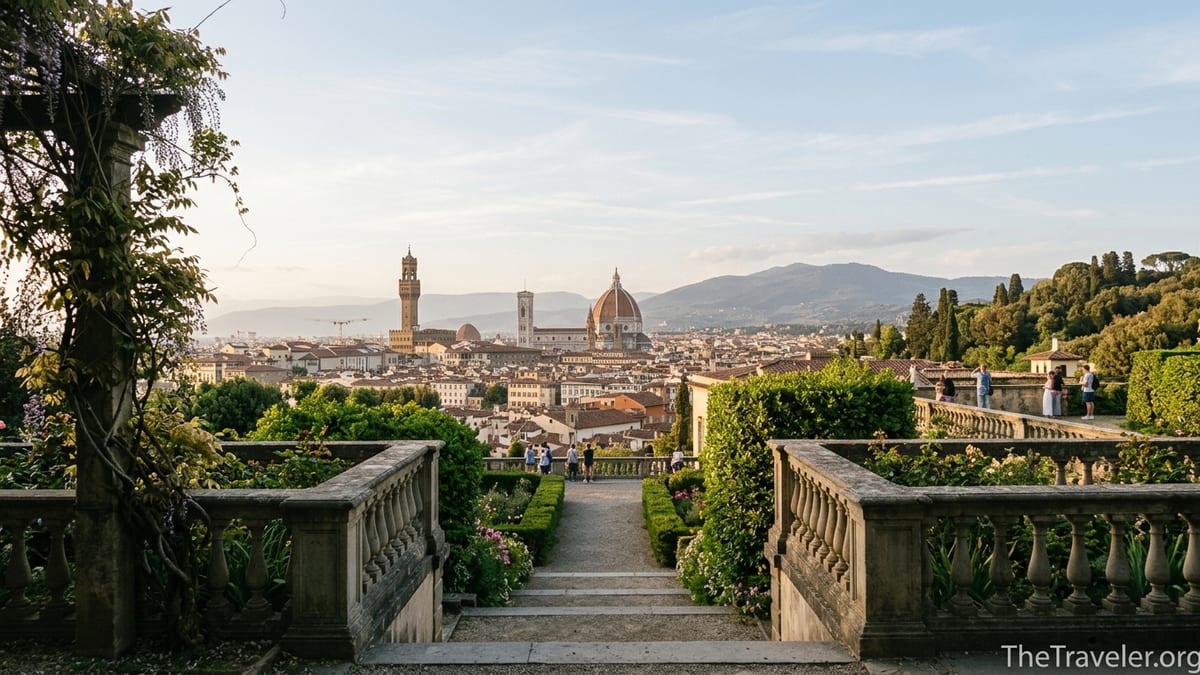
For many travelers, the garden that leaves the stronger impression is the one that delivers a single unforgettable view. On that front, Villa Bardini has a clear advantage. The baroque staircase and the panoramic terrace near the cafe offer head-on vistas of Florence’s skyline: the Duomo, Palazzo Vecchio’s tower and the river framed by cypress and terracotta rooftops. On clear late afternoons, the light falls diagonally across the city, giving your photos the kind of depth that usually comes from professional editing.
Bardini’s wisteria pergola, in bloom for a brief window in April and early May, has become a seasonal star attraction. Local outlets report that, for a couple of weeks, the hillside transforms into a tunnel of violet flowers leading your eye straight toward the city below. Standing under those hanging clusters with Brunelleschi’s dome visible at the end of the path can feel almost surreal, and it is one of the reasons Bardini repeatedly appears in springtime photo spreads. Outside the bloom, the pergola still frames compelling compositions, but the emotional impact is greatest in those few weeks.
Boboli’s views are broader and more dispersed. From the Knight’s Garden near the Kaffeehaus, you can look across the city to the Duomo and beyond to the hills of Fiesole. The Isolotto basin offers long perspectives lined with statues and clipped hedges, and from some higher paths you glimpse the Tuscan countryside rather than just the urban core. Yet these panoramas are not always framed as perfectly as Bardini’s frontal skyline shots. The reward is a sense of immersion; you feel perched in the hilly landscape surrounding Florence rather than positioned at a single scenic overlook.
If your priority is highly photogenic, easily recognizable images for social media or a personal photo book, Villa Bardini often wins. A single late-afternoon visit can yield several gallery-worthy shots with the city as a backdrop. Boboli, by contrast, rewards patient wandering and a taste for more subtle compositions: a statue half-hidden in greenery, sunlight cutting across gravel alleys, a slice of the dome at the end of a long path. Travelers who enjoy photography as a slower practice often cite Boboli as more satisfying, while those seeking a standout postcard moment gravitate toward Bardini.
Crowds, Practicalities and How Each Garden Feels in Peak Season
The crowd dynamics of the two gardens influence how memorable they feel. Boboli is firmly on the main tourist circuit. In high season from late spring to early autumn, the entry area behind Palazzo Pitti can see steady lines, and core axes such as the central amphitheater and Viottolone fill with tour groups. There is so much space that you can still find quieter corners, but you may share many of the signature viewpoints with dozens of other visitors.
Villa Bardini tends to be calmer. Its entrance on Via dei Bardi sits a short uphill walk from Ponte Vecchio yet draws fewer first-time visitors. Even when there is a queue during peak wisteria bloom, the overall number of people inside is usually far lower than at Boboli. This relative tranquility allows moments like sitting on a bench along the baroque stair or lingering at the terrace cafe without feeling rushed. For travelers overwhelmed by Florence’s museum crowds, this hush can be what sticks in memory long after the trip.
From a practical standpoint, both gardens operate with seasonal hours. Boboli usually opens from around 8:15 in the morning, with closing times shifting from late afternoon in winter to early evening in summer, and last entry about one hour before closing. Villa Bardini typically opens later in the morning and closes around early evening, with special evening openings announced for some summer Thursdays. Because schedules can shift from year to year, it is wise to confirm exact hours a few days before you visit, especially if you are targeting sunset or the wisteria season.
Tickets are another consideration. A standard Boboli Gardens ticket is generally in the range of 10 euros, with reduced and free categories for certain age groups and residents. Villa Bardini entry is usually around that same range for a full-price ticket. In some periods, combined tickets have been offered that cover Boboli, Bardini and Palazzo Pitti’s museums within a set time window, though availability and terms change. Travelers on a tighter budget might choose just one garden and a public viewpoint such as Piazzale Michelangelo for free city panoramas, reserving paid garden time for the experience that best matches their interests.
Gardening, Plant Life and Seasonal Highlights
Travelers who care about horticulture and seasonal color will notice another contrast between the two gardens. Boboli, shaped primarily as a formal Renaissance and Baroque landscape, emphasizes structure over flamboyant flower beds. You will see laurel and box hedges, tall cypresses, stands of pines, and lawns punctuated by statues and fountains. There are seasonal plantings and more intimate areas such as the Camellia Garden and the Kaffeehaus terraces, but the overall effect is architectural greenery rather than a riot of blooms.
Villa Bardini, on the other hand, leans into seasonal spectacle. The hillside includes agricultural terraces with olive trees, hydrangea plantings, fruit trees and that famous wisteria pergola. In late spring, hydrangeas and roses add color to the baroque staircase, and in summer the shade along upper paths makes it a pleasant retreat from the heat radiating off Florence’s stone streets. Because the garden is smaller, these botanical highlights feel more concentrated; you notice each shift in season as you climb.
The timing of your trip can tip the balance in favor of one garden. A visit to Bardini in mid to late April, when local news and social channels begin announcing the wisteria’s peak, can easily become a core memory of Florence. By comparison, Boboli feels more consistent across the year. Its evergreen framework and sculptural focus give it presence even on cool, overcast days in late autumn, when Bardini’s floral displays are more subdued.
For many visitors, the lasting impression comes from how a garden aligned or contrasted with the rest of their Florence experience. If you spend days absorbed in Renaissance painting and sculpture, Boboli’s continuity with that world can feel deeply satisfying. If you need a softer, more romantic counterpoint to dense museum visits, Bardini’s layered flowers and fruit trees against the skyline may resonate more.
Accessibility, Effort and Who Each Garden Suits Best
Both gardens are built on steep hills, and this physical reality significantly shapes the visitor experience. Boboli’s slopes are long but generally gradual, with broad gravel avenues and many side paths. Travelers who are comfortable walking several kilometers with ups and downs will find plenty of routes. Benches and flatter terraces near fountains and lawns offer chances to rest. For those with mobility challenges, however, the combination of gradients and uneven surfaces can be tiring, and planning a shorter loop around the lower sections may be advisable.
Villa Bardini’s climbs are steeper but shorter. The baroque staircase in particular is a sustained ascent, although you can pause at landings framed by balustrades and planted borders. Visitors who start at the higher Costa San Giorgio entrance can stroll mostly downhill through the garden toward the river, which is often easier for those with knee or hip concerns. Because Bardini is more compact, it can be explored meaningfully in an hour or so, making it a good choice for travelers with limited stamina who still want impressive views.
In terms of logistics, both gardens are reachable on foot from central Florence. Boboli sits directly behind Palazzo Pitti, about a 10 to 15 minute walk from Ponte Vecchio. Villa Bardini’s lower gate on Via dei Bardi lies a similar distance along the river before you begin climbing. Public transport options are limited in the immediate vicinity, so comfortable walking shoes are essential for either visit. On hot summer days, starting early in the morning for Boboli or saving Bardini for the slightly cooler late afternoon can make the physical effort more manageable.
Ultimately, the garden that leaves the bigger impression is usually the one that fits your energy level. Travelers who relish long exploratory walks and want to sink into a landscape for half a day often come away speaking most enthusiastically about Boboli. Those who want maximum beauty for modest effort, or who are balancing their day with other major sights, usually remember Bardini more vividly.
So Which Garden Leaves a Bigger Impression?
When travelers recount their time in Florence, patterns emerge in how they talk about these two gardens. People who value history and breadth often say that Boboli felt like stepping inside a living chapter of Renaissance landscape design. They recall wandering for hours, stumbling across sculpture-filled clearings or shaded side alleys, and sensing the power and taste of the Medici embedded in the terrain. For them, Boboli’s vastness is precisely what makes it unforgettable.
By contrast, visitors who speak most warmly of Villa Bardini typically emphasize one or two crystalline moments: emerging onto the terrace just as the sun set behind the hills, sitting under the wisteria canopy with Florence spread out below, or sipping a coffee at the panoramic cafe while the city hummed in miniature beneath their feet. The combination of manageable size, strong focal points and seasonal blooms produces concentrated memories that feel almost cinematic, even though the atmosphere on site is relaxed and unhurried.
If you only have time or budget for one garden, your choice should follow your instincts. Choose Boboli if you are drawn to grand historical spaces, can devote at least half a day, and like the idea of an outdoor museum of sculptures, fountains and formal avenues. Choose Villa Bardini if views and atmosphere matter most, you prefer quieter environments, or you are visiting in spring and want a chance to see the wisteria at its peak.
For travelers with a full day in the Oltrarno, the most memorable option is often to combine both. Starting in Boboli in the morning, making your way gradually uphill and then exiting near Forte Belvedere, you can continue across to Bardini’s upper entrance and descend through its terraces toward the river. The contrast between the two spaces sharpens your sense of Florence’s layered relationship with its hills. Many who follow this route later say that it was the day when the city’s geography and history finally clicked into place.
The Takeaway
Boboli Gardens and Villa Bardini are not rivals in any strict sense. They are more like two chapters in a single story about how Florence has looked out at itself from its surrounding slopes. Boboli offers the chapter on power, dynasty and the birth of formal garden design; Bardini supplies the chapter on intimate views, private vision and the romance of seasonal flowers.
Which one leaves a bigger impression depends partly on what you need from Florence at the moment you climb those hills. If you want to feel the weight of centuries and stretch your legs in a landscape that feels worthy of a capital, Boboli may lodge deeper in your memory. If you are seeking a quieter, more personal encounter with the city’s skyline and a concentrated burst of beauty, Villa Bardini often becomes the place you find yourself recommending to friends years later.
In the end, either garden can be the setting for your most lingering memory of Florence: a quiet bench with the dome in view, the sound of gravel underfoot, the smell of cypress and wisteria in the air, and the sense that the city below is both close enough to touch and far enough away to let you breathe.
FAQ
Q1. If I can visit only one garden in Florence, should I choose Boboli or Villa Bardini?
For a first visit, choose Boboli if you want a grand, historically important garden and have half a day to explore. Choose Villa Bardini if you prefer quieter surroundings, big views in a compact space, or are visiting in spring and hope to see the wisteria in bloom.
Q2. How much time should I plan for each garden?
Most visitors spend at least two to three hours in Boboli Gardens, and longer if paired with Palazzo Pitti. Villa Bardini can be enjoyed in about one to one and a half hours, though photographers and garden enthusiasts may want more time to linger on the terraces.
Q3. Are the views really better from Villa Bardini than from Boboli?
The views are different rather than simply better. Villa Bardini offers more direct, postcard-style panoramas of the Florence skyline from its staircase and terrace. Boboli provides wider, more varied vistas that often include the surrounding hills and countryside as well as glimpses of the city.
Q4. Is it worth visiting Boboli Gardens if I am not especially interested in history?
Yes, provided you enjoy walking and being outdoors. Even without focusing on the Medici story, Boboli offers long shaded paths, lawns for resting, fountains and sculptures that many people appreciate simply as a beautiful, expansive park.
Q5. When is the best time of year to visit Villa Bardini?
Villa Bardini is attractive year-round, but it is particularly memorable in spring when the wisteria pergola blooms, usually in April, and when hydrangeas and other flowers begin to color the terraces in late spring and early summer.
Q6. Are tickets for Boboli Gardens and Villa Bardini ever combined?
At various times there have been combined tickets covering Boboli, Villa Bardini and sometimes nearby museums, but the exact offers change. It is advisable to check current ticket options shortly before your trip and decide whether a combined ticket suits your plans.
Q7. Which garden is easier to manage for visitors with limited mobility?
Both gardens are built on hills and involve slopes, steps and some uneven paths. Boboli has broader, more gradual avenues, while Bardini is steeper but more compact. Visitors with limited mobility often find it helpful to focus on selected areas rather than attempting to see everything in either garden.
Q8. Can I bring children, and which garden do families usually enjoy more?
Families visit and enjoy both gardens. Boboli’s size, lawns and varied corners give children space to roam, though distances can be tiring. Bardini’s shorter routes and dramatic staircase may suit families with younger children who have limited stamina but still enjoy viewpoints and open spaces.
Q9. Is it necessary to buy tickets in advance?
Buying tickets ahead can be useful for Boboli Gardens, especially in the busiest months, to avoid queueing at the ticket office and to secure a preferred time. Villa Bardini is often less congested, but checking current guidance and deciding based on your travel dates is a sensible approach.
Q10. What should I wear and bring when visiting these gardens?
Comfortable walking shoes are essential for both gardens due to slopes and gravel paths. In warm weather, bring water, a hat and sunscreen, as some sections are exposed. A light layer is helpful in cooler months, and a camera or smartphone is worthwhile if you plan to capture the views.