


Boboli Gardens behind Florence’s Pitti Palace can feel either like a quiet open-air museum or an overrun sightseeing checklist, depending almost entirely on when you go. For photographers and travelers who care about both light and breathing room, timing your visit is just as important as buying the right ticket. Here is how to plan your visit for better photos, smaller crowds, and a more relaxed experience in one of Italy’s most historic gardens.
Get the latest updates straight to your inbox!
Understanding Boboli’s Hours, Seasons, and Daily Rhythm
Boboli Gardens operate on a clear pattern that shapes everything from crowd levels to the quality of your photos. The garden is open daily, with seasonal variations: in winter months it typically opens around 8:15 a.m. and closes mid-afternoon, while in late spring and summer closing can be as late as early evening. Last entry is usually about one hour before closing, which matters for anyone trying to squeeze in golden hour shots. The garden may close entirely on a few major holidays or shorten hours during storms or exceptional heat, so always double-check opening times shortly before your visit.
Florence’s tourism calendar is heavy on peaks. The busiest periods for Boboli are broadly April through early November, with especially dense crowds from late May to early October and again around Easter. August remains busy despite heat, because many international visitors treat Florence as a fixed stop on Italy itineraries. True low season is short, mostly in mid to late November and parts of January and early February, when tour groups thin out and you can often photograph key viewpoints with nobody in your frame.
Within a typical day, Boboli is quietest in the first hour after opening and again in the last hour before closing. Midday, between about 11 a.m. and 3 p.m., sees the highest concentration of visitors, especially on weekends and when cruise excursions or big coach tours are in town. If you aim to photograph iconic spots such as the amphitheater behind Pitti Palace or the Cypress Avenue, build your route so you reach them in those quieter windows rather than at midday.
Weather also shapes your experience. Summer heat can be intense, and by early afternoon wide gravel paths become glaringly bright, which is difficult for photography and draining for visitors. In cooler seasons, low sun angles and softer light persist for more of the day, so even late morning can be usable for photography. Planning around both the seasonal calendar and the daily rhythm gives you a much better starting point than simply picking a random afternoon ticket slot.
Best Months for Photography and Fewer People
For most travelers, the sweet spot for Boboli Gardens is the shoulder season: late March to early May and late September to early November. In these windows, Florence is still popular, but you are less likely to face solid lines of people on the main alleys. Early spring brings fresh green growth and clear air after winter rains. You might, for example, shoot the view from the Kaffeehaus terrace in early April and capture snow-dusted Apennines in the distance with a soft blue sky and relatively few other visitors lingering near the balustrade.
Late September and October are also excellent, especially for photographers. The afternoon light warms the stonework of Pitti Palace and the statues, and the cypresses and oaks begin to shift towards autumnal tones. Visiting on a weekday in early October, you may find that the long axis from the amphitheater up to the Neptune Fountain has intermittent clusters of visitors rather than a constant flow, making it easier to wait a few seconds for a cleaner composition.
Winter has its own appeal for those who prioritize emptiness over lush greenery. In January and early February, the garden’s architecture dominates: terraces, staircases, and sightlines stand out clearly without dense foliage. If you visit on a bright but cold weekday morning, you may be able to photograph the Isolotto basin or the Viottolone almost alone, with bare tree branches creating graphic lines against the sky. The trade-off is shorter opening hours and the possibility of gray days or rain, so flexibility in your schedule helps.
High summer, especially late June through August, offers long opening hours and guaranteed leaves on the trees, but at a price: intense heat and crowds. If this is when you must visit, focus on very early morning entries or the final hour of the day to make the most of the season without letting the worst of the crowds and brightness ruin your shots.
Best Time of Day for Light, Shadows, and Classic Viewpoints
The orientation of Boboli Gardens gives different parts of the park distinct personalities at different times of day. In the hour after opening, soft, low-angle light reaches the amphitheater and the slope behind Pitti Palace from the east, which works well for wide shots with gentle shadows. At this time, you can often stand in the center of the amphitheater, frame Pitti Palace rising above the grass, and include only a few scattered visitors, especially on weekdays.
By late morning, sunlight can become harsher, especially in late spring and summer, flattening details on statues and washing out gravel paths. If you are shooting then, use side light and backlight deliberately. For example, walking down towards the Isolotto, you can shoot back toward the palace with the sun just off to your side, using tree trunks and hedges to control flare. This period is better for detail shots of fountains, carvings, and textures rather than broad panoramas.
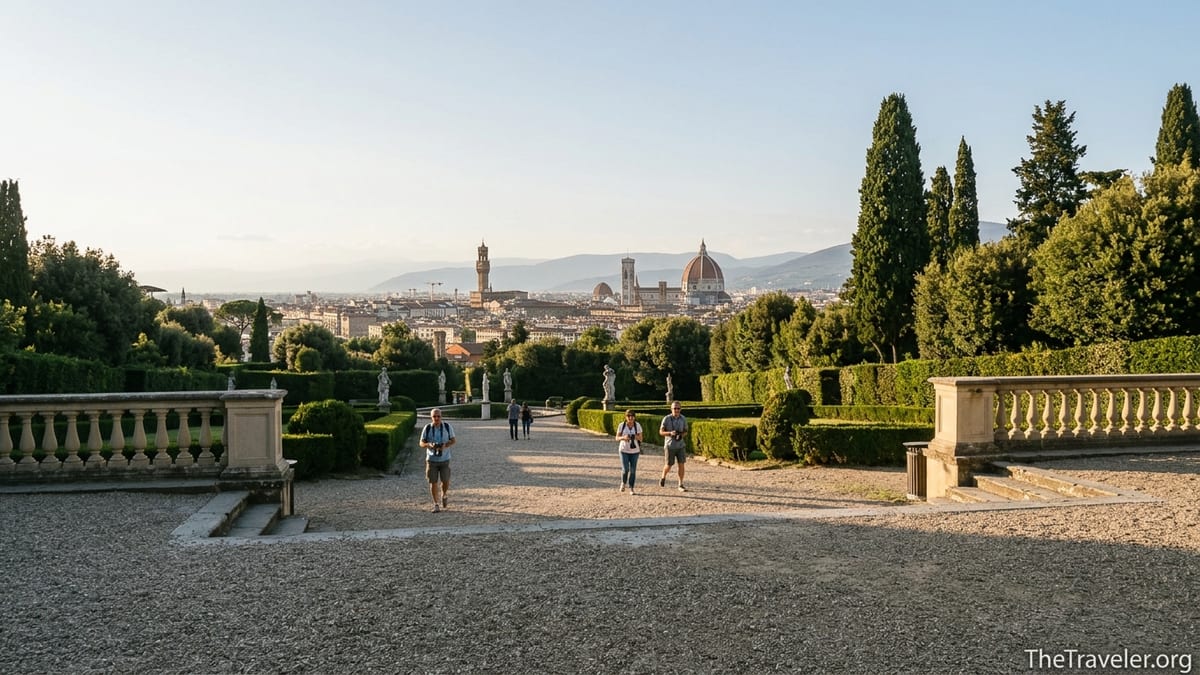
Afternoons and early evenings often offer the best balance of usable light and access to the higher terraces. As the sun lowers in the west, warm light rakes across the garden slopes, giving depth to the cypress alleys and emphasizing relief on sculptures. The terrace near the Kaffeehaus or the area around the Knight’s Garden can be particularly photogenic in the final 60 to 90 minutes before closing. From there, you can capture Florence’s skyline, with the Duomo and Palazzo Vecchio emerging over terracotta roofs, under a soft golden glow.
If your priority is views over the city rather than details inside the garden, plan your visit so that you reach the highest viewpoints in that late-afternoon window. For example, in October with a 6:30 p.m. closing time, entering around 3:30 p.m. gives you time to wander up through the main alleys and still be in position for warm, directional light on the skyline. In midwinter, when closing may be closer to 4:30 p.m., you will need to enter within an hour or so of opening to get similarly low, warm light.
Weekdays vs Weekends and How to Dodge Tour Groups
Day of the week affects your experience almost as much as time of day. Saturdays and Sundays, plus Italian public holidays, attract local families along with international tourists. On a sunny Sunday in May, for example, the area near the amphitheater and the main central axis can feel continuously busy from late morning onward, and you may have to wait longer between groups for clean frames.
On weekdays, especially Tuesday through Thursday, the flow tends to be more gradual, with fewer spikes. Many international visitors still follow similar routines, often entering the gardens mid to late morning after visiting the Uffizi or the Duomo area. If you schedule Boboli first thing in the morning and leave indoor museums for midday, you effectively invert that pattern. A common strategy is to reserve a mid-afternoon Uffizi timeslot and use the garden’s opening hour that same morning for photos.
Group tours, including those combining Pitti Palace and Boboli, typically adhere to fixed paths and tight timing. You will often see them cluster near the palace façade, the amphitheater, and key fountains, then move on together. When you notice one or two large groups entering an area you wanted to photograph, it can be faster to pivot and explore a lateral alley or secondary terrace, then circle back once they have gone. The garden’s size works to your advantage; even on busy days, sections such as the more distant lawns or the wooded slopes can remain comparatively quiet.
If your schedule is rigid and you must visit on a weekend, lean heavily on the earliest entry slot you can book and avoid the midday peak. Consider planning a coffee near Santo Spirito afterward, then using the afternoon for indoor visits where crowd density is less damaging to your photos.
Tickets, Timing Tricks, and Combining Boboli With Pitti Palace
Ticketing for Boboli Gardens is managed together with Pitti Palace and the Uffizi. In 2026, a combined ticket that covers Pitti Palace and Boboli Gardens is commonly priced in the low to mid-twenties in euros when bought through official channels, with slightly higher prices for advance purchase compared with same-day tickets. There are seasonal variations and occasional passes that bundle Uffizi, Pitti, and Boboli across multiple days, which can be a good value if you plan a deeper dive into Florence’s museums.
For photographers, the key is using your ticket time to control when you enter the garden. If you buy a combined Pitti and Boboli ticket with a morning entry window, you might walk through selected palace rooms quickly, then move straight into the garden while the light is still soft. Alternatively, on a hot day, you might reverse it: enter the gardens at opening, use the first hour for photos, then retreat inside the palace as the heat and crowds build outside.
Keep in mind that re-entry is generally not allowed. Once you exit the garden, you cannot usually come back later in the day on the same ticket. That means you should plan your photo session as a continuous route rather than expecting to pop out for lunch and return for golden hour. A practical solution is to eat beforehand and carry water and a light snack, then reward yourself with an early dinner in the Oltrarno once you exit at closing.
On very busy days, buying tickets in advance can save you from queuing in direct sun near Pitti Palace’s entrance. You can typically purchase tickets online through the official channels or on-site at designated ticket offices in Florence. Even when pre-booking, choose your time slot with light and crowds in mind rather than treating it as a simple availability question.
Seasonal Weather, What to Wear, and Gear Tips for Photographers
Florence’s climate directly shapes how comfortable you will feel carrying equipment through Boboli Gardens and how long you can realistically keep shooting. In July and August, midday temperatures can climb high enough that the broad, exposed alleys become uncomfortable, especially on the long climb up to the Knight’s Garden. In this period, early morning and late afternoon are not just better for photos but also for your health. A light, breathable outfit, a hat, and a refillable water bottle are more important than bringing every lens you own.
In spring and autumn, conditions are more forgiving, but passing showers are common. A compact rain cover for your camera and a lightweight waterproof jacket will let you keep shooting during brief drizzle, when statues, leaves, and gravel paths take on richer tones and reflections. For instance, shooting the Isolotto after a shower, you might capture subtle reflections of statues in the water with subdued, contrast-friendly light.
Footwear matters more here than in many city gardens. Boboli’s slopes, steps, and gravel paths can be tiring, particularly if you are repeatedly doubling back to revisit favorite viewpoints in changing light. Wear supportive walking shoes rather than sandals that slip on loose gravel. This is especially important in winter, when paths can be damp and occasionally muddy, and in autumn when fallen leaves can be slick on staircases.
For gear, a mid-range zoom on an interchangeable-lens camera, such as a 24–70 mm equivalent, will cover most scenes from wide amphitheater shots to tighter details of sculptures. A smartphone with a good main lens can also perform well, especially in good light. Tripods are generally discouraged or restricted in many Italian heritage sites without special permission, so plan to shoot handheld at higher ISO if necessary. A polarizing filter can help manage glare on water features and deepen skies, particularly on clear days around midday when you cannot avoid brighter light.
Suggested Photography Routes for Different Types of Visitors
If you have only an hour and want classic views with minimal backtracking, enter from Pitti Palace and move straight to the amphitheater to shoot the palace façade from the grass. Then walk up the central axis towards the Neptune Fountain, pausing to shoot back down towards the palace as the view opens up. Continue up to the Knight’s Garden or the terrace near the Kaffeehaus for panoramic Florence skyline shots, then loop back along one of the parallel paths to pick up quieter corners for detail shots before you exit.
For a half-day visit focused on photography, you can afford a more meandering route that follows the light rather than a strict checklist of sights. Start at opening, exploring the main central axis first while it is still relatively empty. As more visitors arrive, drift towards the less-trafficked side paths and wooded areas, seeking oblique angles on famous features. Later, as afternoon light improves, climb back toward the upper terraces for broad city views and finish at one of the major viewpoints just before closing, when crowds thin again.
Travelers combining Boboli with Pitti Palace in a single day might split the day into clear blocks. A workable plan in May, for example, is to book a late-morning or midday palace entry, visit a first indoor section during the brightest, harshest light, then step into the gardens mid-afternoon as shadows lengthen. This way, your indoor time coincides with the least flattering light for outdoor photography, and your garden time overlaps with the golden part of the day.
Families or casual visitors who still care about photos but not in a technical sense can take a simpler approach: aim for a weekday visit, arrive either early or in the last two hours before closing, and concentrate on three or four areas rather than racing around the entire complex. Even a smartphone will capture excellent results if you patiently wait a few seconds for people to pass through your frame and use hedges, archways, and staircases as natural framing elements.
The Takeaway
Boboli Gardens can be either a serene backdrop for thoughtful photography or a rushed detour between headline museums. The difference rarely comes down to equipment or professional skill. It is primarily about timing. Choose shoulder-season months if possible, favor weekdays over weekends, and build your entry around the first or last hour of the day. Within the garden, think in terms of light and flow: visit the busiest central features early, retreat to side paths during midday, and climb to the high terraces when the sun lowers and the city glows.
By coordinating your ticket time with Florence’s broader rhythms and giving yourself space to wander, you turn a simple garden visit into a layered photographic session. Whether you are carrying a full-frame camera with a zoom lens or simply your phone, Boboli rewards those who move slowly, pay attention to the changing light, and let the crowds ebb away before pressing the shutter.
FAQ
Q1. What is the best month to visit Boboli Gardens for photography?
April, May, late September, and October usually offer the best combination of softer light, milder temperatures, and manageable crowds for most photographers.
Q2. What time of day is least crowded at Boboli Gardens?
The first hour after opening and the last hour before closing are typically the quietest, especially on weekdays outside of peak summer and major holidays.
Q3. Are there specific days I should avoid visiting Boboli Gardens?
Try to avoid sunny Saturdays, Sundays, and Italian public holidays in late spring and summer, when both locals and tourists pack the main paths and terraces.
Q4. Can I leave Boboli Gardens and come back later with the same ticket?
In general, no. Once you exit the garden area you usually cannot re-enter on the same ticket, so plan your route and photography session as one continuous visit.
Q5. Is it worth visiting Boboli Gardens in winter?
Yes, if you value fewer people and strong architectural lines over lush greenery. You will likely find quieter paths but must accept shorter hours and cooler, changeable weather.
Q6. Do I need a professional camera to get good photos in Boboli Gardens?
No. A modern smartphone or simple mirrorless camera is enough. Thoughtful timing for light and crowds matters far more than owning advanced gear.
Q7. How long should I allow for a photo-focused visit to Boboli Gardens?
Plan at least two hours for a relaxed photography session. If you want to explore more remote corners or wait out crowds at key spots, three to four hours is ideal.
Q8. Can I use a tripod inside Boboli Gardens?
Tripods are often restricted or require permission in Italian heritage sites. Expect to shoot handheld and check on-site regulations with staff if in doubt before setting up any equipment.
Q9. Is there shade in Boboli Gardens during hot summer days?
Yes. While many main alleys are exposed, there are wooded sections and side paths with shade. Use these to break up your walk, especially in July and August.
Q10. Can I visit Pitti Palace and Boboli Gardens on the same ticket?
Often yes. Combined tickets covering Pitti Palace and Boboli Gardens are commonly available, so you can plan your day to move between indoor galleries and the outdoor gardens efficiently.