


On a map of Central Europe, Bratislava looks like a simple detour: a compact capital on the Danube, less than an hour from Vienna and a short train ride from Budapest. On the ground, it feels very different from its grand neighbors. A medieval hilltop castle, a walkable Old Town, riverfront promenades and relatively low prices make Bratislava a tempting weekend break. The key question for many travelers planning 2027 trips is whether it deserves an overnight stay or is better as a day trip from Vienna. This guide uses current prices and real travel logistics to help you decide.
Get the latest updates straight to your inbox!
Bratislava in context: how it compares to Vienna and Budapest
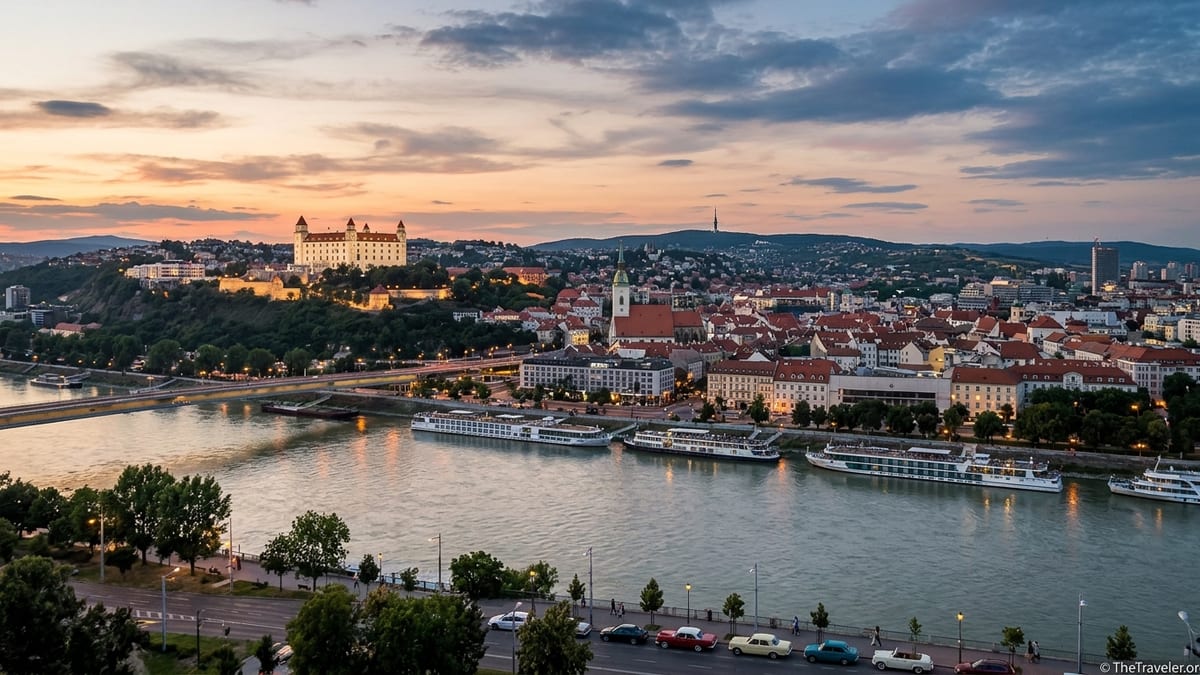
Bratislava sits directly on the Danube, with the Old Town rising in layers from the riverside up to Bratislava Castle. The historic core is small enough that most first-time visitors can cross it on foot in 15 minutes, in contrast with the much larger historic centers of Vienna and Budapest. The streets between the Main Square, Michael’s Gate and St. Martin’s Cathedral form a tight knot of cafes, wine bars and small museums that feel closer to a lived-in town than a showpiece imperial capital.
Prices remain noticeably lower than in Vienna. In 2026, centrally located three-star hotels in Bratislava commonly sell weekend nights for about 80 to 120 euros for a double room, while similar properties in Vienna often start closer to 130 to 180 euros. Everyday costs track that same pattern: a sit-down cappuccino in Bratislava Old Town might be 2.50 to 3 euros, while in Vienna’s central districts it can easily reach 4 euros or more. Budapest can still feel cheaper for some items, especially budget accommodation and street food, but Bratislava holds an advantage in simple point-to-point transit costs for short stays.
Atmospherically, Vienna offers wide boulevards, polished museums and grand palaces; Budapest stretches along the river with monumental architecture and intense nightlife. Bratislava is quieter and more intimate. Instead of dozens of blockbuster sights, it offers a handful of major landmarks surrounded by pleasant streets, river walks and local food. That means it can feel fully “seen” in a focused day trip, yet staying overnight lets you enjoy evening streets after most day-trippers have left and explore slower experiences, such as wine bars and Danube walks, that do not fit into a rushed schedule.
Because it is so compact, Bratislava rewards unhurried wandering more than box-ticking. The main risk for a weekend visit is repetition: visiting too many similar museums, churches or panoramic viewpoints can feel redundant in just two days. Planning with a clear sense of which attractions to enter and which to admire from outside keeps a short stay balanced and good value.
What is worth seeing inside vs outside
Bratislava Castle dominates the skyline and is the natural anchor for any visit. The castle courtyards and terraces are free to enter and provide the classic views across the Danube, Petržalka housing blocks and on clear days even to Austria. Inside, the castle houses the Slovak National Museum’s Historical Museum. As of 2026, a standard adult ticket listed through the official Bratislava Card price list is around 14 euros. For many visitors on a weekend trip, it is enough to enjoy the exterior, gardens and views, especially if you are already planning to visit more extensive history museums in Vienna or Budapest.
In the Old Town, Michael’s Gate, St. Martin’s Cathedral, the Main Square and the Old Town Hall cluster within a few minutes’ walk. St. Martin’s Cathedral, historically the coronation church of Hungarian kings, is worth a short visit inside for its Gothic interior and atmosphere, and the suggested donation or small entry fee is modest. The Old Town Hall houses the Bratislava City Museum, which includes historic interiors and a tower view; the ticket price is generally under 10 euros. This can be good value if you are interested in local history and urban development, but casual visitors may find that the external facades and tower square provide most of the visual impact.
The so‑called Blue Church, officially the Church of St. Elizabeth, sits just east of the Old Town. Its unusual pale blue facade and art nouveau details make it a memorable photo stop and a pleasant short interior visit when it is open between services. There is usually no formal ticket, although donations are encouraged. By contrast, many smaller churches around the Old Town offer similar interiors and can feel repetitive; most visitors gain little from going inside each one over a short weekend.
Museums require stricter choices. Bratislava offers galleries, the Slovak National Gallery complex by the river, and specialized collections. For a two-day trip, entering two or at most three indoor attractions beyond churches and viewpoints is usually enough to avoid museum fatigue. Attractions like the Slovak National Gallery or the Nedbalka Gallery (a compact modern art space) are more rewarding than multiple small, narrow-focus museums. In a short visit, it generally makes sense to prioritize one strong art or history stop and skip minor museums that repeat similar themes.
A realistic two-day Bratislava itinerary
Day one works well as a structured overview of the center. In the morning, start at the Danube promenade near the Old Town and walk up past the Slovak National Theatre’s modern riverside building toward the historic center. From there, follow the streets to the Main Square, Old Town Hall and St. Martin’s Cathedral, taking time for a coffee break on a side street to avoid the priciest tourist terraces. Spend an hour exploring the cathedral interior and Old Town lanes, including spotting the whimsical bronze statues that dot the streets.
By midday, continue uphill to Bratislava Castle via quiet residential streets or the formal castle approach. Allow time to explore the free courtyards and panoramic walls. If you choose to buy tickets for the castle museum, plan at least 90 minutes; otherwise, simply enjoying the grounds and views can take about an hour. Head back down for a late lunch in the Old Town, trying a traditional restaurant that serves local dishes such as bryndzové halušky, a plate of potato dumplings with tangy sheep’s cheese and bacon that typically costs around 9 to 12 euros in central locations.
In the late afternoon, walk to the Blue Church and loop back through the streets behind the historic Slovak National Theatre building on Hviezdoslav Square. As evening falls, the square’s trees are often illuminated, and the atmosphere is quieter than during the day. Consider a glass of Slovak white wine or frankovka red at a wine bar just off the square, where a glass often starts around 3 to 4.50 euros. Dinner in a midrange bistro, including a main course and non-alcoholic drink, usually runs about 15 to 20 euros per person.
Day two allows for either deeper exploration or an excursion. If staying in the city, use the morning for a museum visit such as the Slovak National Gallery on the riverfront, where adult admission has recently been around 9 to 10 euros, or for climbing the tower at the Old Town Hall for another perspective on the city. Lunch can focus on lighter fare in a modern cafe, where a soup and sandwich combination might cost 8 to 12 euros. The afternoon is ideal for a longer Danube walk, heading west along the river or crossing one of the bridges to look back at the Old Town silhouette. Evening is the time to explore Bratislava’s relatively low-key nightlife, from casual craft beer spots to cocktail bars, mostly clustered within the Old Town grid.
Devín Castle: when the side trip is worth it
Devín Castle stands at the confluence of the Danube and Morava rivers, about 10 kilometers from central Bratislava. It offers dramatic river views, crumbling medieval walls and a more rural atmosphere than the city center. For many visitors it is the single most rewarding side trip if you have more than one day in Bratislava and the weather is cooperative. The site is largely outdoors, so clear days between late spring and early autumn provide the best experience.
Reaching Devín by public transport is straightforward. City bus number 29 runs from the stop near the Nový most area on the river side of Old Town out to Devín. Travel time is about 20 to 25 minutes, and a standard 30-minute integrated public transport ticket within Bratislava typically costs a little over 1 euro, while a 60-minute ticket is under 2 euros. Tickets can be bought at machines or, on many vehicles, by tapping a contactless bank card at marked validators; however, local advice suggests taking care with the contactless system and making sure the purchase is confirmed, as inspectors are strict about correct validation.
The walk from the Devín bus stop up to the castle gate is a modest uphill gradient on a paved path and then through the site itself on mixed surfaces, including some uneven stone and dirt paths. For travelers with average fitness, the climb is not strenuous, but visitors with mobility issues may find it challenging. From the lower courtyards to the highest accessible viewpoint, you can expect multiple sets of steps and moderate walking effort. Admission for adults has been roughly in the mid single-digit euro range in recent seasons, with higher prices during special events.
Choosing Devín over staying entirely in the city shifts the feel of a weekend. The castle offers a stronger sense of landscape history and the former Iron Curtain frontier than anything within the Old Town. If you only have one full day based in Bratislava after travel time, trying to combine Devín, the castle hill, Old Town interiors and multiple museums can feel rushed. For a two-night stay, one half day at Devín and one and a half days in the city are usually enough to cover major highlights without fatigue.
Food, drink and realistic 2027 prices
Food is a strong argument for spending at least one evening in Bratislava. Traditional Slovak cooking features hearty dishes built around potatoes, cabbage, pork and sheep’s cheese. In the Old Town and nearby streets, a main course of bryndzové halušky, roasted pork with dumplings and cabbage, or schnitzel-style meat with potato salad usually costs between 9 and 14 euros in 2026 pricing. Lunch menus outside the most touristy squares often offer smaller portions and a soup or side for 7 to 10 euros.
Local pastries and sweets are easy to incorporate into walking days. Small bakeries and cafe chains around the center sell items such as koláč, strudel or filled sweet buns for 1.50 to 3 euros. Coffee culture has modernized; speciality cafes in the Old Town and around the bus and train stations roast their own beans and sell espresso drinks for roughly 2 to 3.50 euros. Tipping around 10 percent is common in sit-down restaurants, usually by rounding up or adding a small extra amount in cash.
Wine and beer are central to evening plans. Slovakia produces notable white wines from regions like the Little Carpathians north of Bratislava, and many bars pour these by the glass. A 0.1 liter glass of decent local wine in a central wine bar can be around 3 to 4 euros, while a 0.5 liter beer in a pub usually runs between 2.50 and 4 euros depending on the venue. Craft beer bars with rotating taps may charge a bit more for imported or strong styles, while neighborhood pubs outside the Old Town are cheaper.
Travelers focused on value can save by eating one main meal each day as a menu of the day at local restaurants and filling other gaps with bakery items or supermarket snacks. Larger supermarkets a short walk from the center sell picnic supplies at similar or slightly lower prices than in neighboring Austria, including bottled water for under 1 euro, fresh bread, cheese and fruit. With moderate choices, a visitor can comfortably plan around 30 to 40 euros per person per day for food and drink without feeling restricted, a figure that rises with more frequent wine bar visits or fine dining.
Where to stay: Old Town, station area or riverside
Accommodation choices in Bratislava divide broadly into three convenient areas: the Old Town itself, the surroundings of Bratislava hlavná stanica (main railway station), and newer riverside developments south of the historic center. Each balances price, atmosphere and noise differently, which matters on a short stay.
Staying within or just at the edge of the Old Town maximizes convenience. You can step out directly into pedestrian lanes, reach the Main Square or St. Martin’s Cathedral within minutes, and walk back to your room between sights. In 2026, a solid midrange double in this area tends to cost around 100 to 150 euros per night on weekends, with smaller pensions sometimes under 90 euros outside peak season. The trade-off is noise: streets near popular bars can be lively late into weekend nights, and older buildings sometimes have less effective soundproofing or air conditioning, making open windows and street noise more of an issue in summer.
Near Bratislava hlavná stanica, roughly 15 to 20 minutes’ walk or a short tram ride from the Old Town, hotels can be slightly cheaper and often cater more to business travelers. Room rates for similar quality may be 10 to 20 percent lower than those directly in the Old Town, sometimes around 80 to 110 euros for a good three-star or four-star room. The area is less charming but functional, with easier early departures for trains toward Vienna and the rest of Slovakia. The main drawback is the less attractive immediate surroundings and the need to factor in a short commute to and from the historic core.
Riverside developments across the Danube, particularly in Petržalka and newer mixed-use districts on the northern bank, offer modern high-rise hotels and apartments. These often provide larger rooms, river views and secure parking, appealing to drivers and families. Prices sit between Old Town and station-area levels, commonly in the 100 to 160 euro range for a midrange room, with higher prices for upscale riverfront properties. Walking time to the Old Town can be 15 to 25 minutes depending on the specific address, though frequent buses and trams help shorten the trip. Noise levels from nightlife are usually lower than in the Old Town but there may be traffic noise along main roads.
Getting there: Vienna, Budapest and Bratislava Airport
Bratislava’s position on the rail and road network makes it easy to fold into multi-city trips. From Vienna, the standard rail journey runs between Wien Hauptbahnhof or Wien Hbf and Bratislava hlavná stanica or the secondary Bratislava-Petržalka station. Journey times are often about one hour. Recent examples of advance-purchase day-return fares from Austrian and Slovak railway operators have been roughly 20 to 25 euros, sometimes including free use of Bratislava city public transport for a limited period. Given seasonal track works, it is wise in 2027 to check whether your train arrives at the main or Petržalka station and to allow extra time for transfers.
Buses between Vienna and Bratislava run frequently, often more than once per hour at busy times, operated by companies such as FlixBus and Slovak lines. They depart from Vienna’s main bus hubs like Erdberg or the international bus terminal near Stadion and arrive at Bratislava’s main bus station east of the center or sometimes at bus stops closer to the Old Town. Journey times range from about 60 to 75 minutes and typical one-way fares purchased in advance in 2026 have been in the 6 to 12 euro range depending on timing and demand. Buses usually provide luggage space under the coach, but at peak times space can be tight, so arriving early for boarding is prudent.
Seasonal boats provide a more scenic but costlier connection. The Twin City Liner high-speed catamaran runs between central Vienna near Schwedenplatz and Bratislava’s Old Town riverfront during a season that typically starts in late March and continues into early November. Recent information for the 2026 timetable shows one-way adult fares broadly in the mid 30 to high 30 euro range, plus a separate fuel surcharge of about 3 euros per ticket, with crossing times around 75 minutes downstream and slightly longer upstream. Seats are reserved, luggage is carried on board and boarding normally starts around 30 minutes before departure. As water levels and schedules vary, travelers planning 2027 sailings should check updated timetables closer to travel.
Vienna Airport and Budapest are both gateways. Vienna International Airport connects to Bratislava by direct bus services that run in roughly 45 to 60 minutes for around 8 to 15 euros one way, depending on carrier and booking conditions. Travelers coming from Budapest can use direct rail links that usually take two and a half to three hours, with competitive fares if bought in advance, or long-distance buses that often take a similar time. Bratislava Airport itself sits a few kilometers from the center and is linked by regular city buses whose tickets fall under the standard public transport tariff, meaning passengers can reach the Old Town for little more than 1 euro if they validate the correct time-based ticket.
Moving around: public transport, walking and driving
Once in Bratislava, most central sightseeing is on foot. From the main railway station, trams and buses take visitors to the edge of the Old Town in around 10 minutes using standard city tickets. As of late 2026, single-journey tickets valid for up to 30 minutes of travel within the core Bratislava zones cost a little over 1 euro, while 60-minute tickets are under 2 euros, and 24-hour and 72-hour tickets offer better value for frequent riders. Tickets can be purchased at machines, selected kiosks and through contactless payment on many vehicles, though visitors should study the instructions carefully to avoid misunderstandings with inspectors.
The city’s integrated transport system offers limited-time travelcards and the Bratislava Card tourist pass, which combines unlimited public transport with free or discounted entry to attractions such as Bratislava Castle. According to the official 2026 price leaflet, the card effectively reduces the castle’s listed 14 euro admission to zero for cardholders, which can be worthwhile if you are planning multiple paid museum visits. However, independent travelers who only intend to pay for one or two attractions and otherwise walk may find that simple time-based tickets or occasional single fares remain cheaper overall.
Driving in central Bratislava is often more trouble than it is worth. Street parking in and around the Old Town is tightly regulated, with paid zones, resident permits and active enforcement. Public garages on the edge of the center and hotel parking facilities can charge daily rates that quickly erode any savings from self-driving compared with coming by train or bus. For those arriving by car, it is generally practical to choose a hotel with clear parking policies in advance, preferably across the river or a short walk from the Old Town, and then rely on walking and public transport during the stay.
Accessibility on historic streets is mixed. Main routes through the Old Town squares and along the Danube promenade are relatively flat and paved, but side alleys often have cobblestones, steps and narrow sidewalks. Visitors using wheelchairs or strollers will find the riverfront paths, larger squares and modern shopping streets more straightforward than the steepest lanes to Bratislava Castle or some sections of Devín Castle, where uneven terrain can be limiting. Planning routes that use gentler approaches and checking hotel elevator access in advance improves comfort for travelers with mobility needs.
Costs, seasons and who should stay overnight
To put numbers on a two-night visit, consider three spending levels for 2027 using recent prices as a guide. A budget traveler sharing a twin room outside the Old Town for around 70 euros per night, eating mainly at bakeries and inexpensive restaurants for about 25 to 30 euros per day, buying a 72-hour transport ticket for roughly the cost of ten single rides, and paying entry to one or two attractions could expect a weekend total near 180 to 230 euros per person, not including intercity travel. A midrange couple staying in a central three-star hotel at about 120 euros per night, dining in midrange restaurants with wine for roughly 45 to 55 euros per person per day and entering a few paid sights might see a two-night cost closer to 250 to 350 euros per person.
Travelers seeking higher comfort, staying in a four-star riverfront hotel at 160 to 220 euros per night, including daily full restaurant meals, several drinks in wine bars or cocktail bars, boat travel in at least one direction from Vienna and a handful of museum admissions could easily spend 400 to 600 euros per person over two nights, depending on intercity tickets. In all scenarios, accommodation costs are shared between room occupants, while food, attractions and public transport are per-person expenses. These figures may move with inflation by 2027, so treating them as indicative ranges rather than fixed prices is sensible.
Season affects value and atmosphere significantly. In summer, especially at weekends, the Old Town can feel crowded with tour groups and river-cruise passengers during the day, but evenings are lively and outdoor terraces are in full swing. Winter brings shorter daylight, sometimes with dusk settling before 4:30 p.m., and some attractions or river services reducing hours or pausing operations. On the positive side, December Christmas markets around the Main Square and Hviezdoslav Square add atmosphere and make overnight stays more appealing, as you can enjoy them after Vienna day-trippers have returned.
Nightlife in Bratislava tends to be concentrated and relatively modest in scale compared with Budapest’s ruin bars or Vienna’s club scene. There are bars and a few clubs that draw students and visitors, but the center rarely feels overwhelming. Sunday can be quiet, with some shops closed or operating reduced hours, although cafes and many restaurants stay open. Visitors should not assume every attraction is open seven days a week or that shoulder-season evenings offer the same schedule as peak summer; checking opening hours for castle interiors, museums and Devín Castle in advance prevents disappointment.
Direct comparison: Bratislava, Vienna and Budapest
For trip planning, it helps to compare the three neighbors along a few clear lines. Accommodation prices in Bratislava are usually lower than Vienna’s and somewhat higher than Budapest’s at the budget end, though midrange hotel deals can bring Bratislava closer to Budapest levels outside major events. Attraction variety is where Bratislava lags: Vienna offers a deep roster of world-class museums and palaces, while Budapest combines major thermal baths, historic sites and extensive neighborhoods. Bratislava’s list is shorter and better suited to one or two intensive sightseeing days.
Transport convenience tilts toward Bratislava for compactness. Within the city, walking covers much of what visitors want to see, and short tram or bus rides fill in the rest at low cost. Vienna’s network is far larger and efficient but requires more time to cross, while Budapest’s distances are greater and some steep hills and bridges extend transfer times. For intercity travel, all three cities are well linked, yet Bratislava gains points by being both its own destination and an easy day-trip option from Vienna.
In terms of suitable trip length, Vienna comfortably supports four or more full days without repetition for most travelers, and Budapest often rewards three to four days plus additional time for day trips. Bratislava on its own is ideal for a focused one or two full days, or a two-night stay with one partial day on arrival or departure. Devín Castle or longer Danube walks stretch this by another half day, but most first-time visitors will feel that three full days in Bratislava alone is more than they need unless they have a special interest in local culture or plan multiple slow cafe days.
Taking all factors together, Bratislava shines when combined with other destinations. For travelers spending several nights in Vienna, adding a single day trip to Bratislava is enough to see the Old Town, castle exteriors, Blue Church and riverfront. Choosing to stay overnight makes sense if you want quieter evenings, to visit Devín, or to enjoy Bratislava’s food and wine without watching the clock for a return train or boat.
Common mistakes and final recommendations
Several recurring missteps can reduce the value of a Bratislava weekend. One is underestimating transfers: arriving at Vienna Airport and assuming a direct, frequent train to Bratislava, when in reality you must usually change in Vienna and total travel time is more like 1.5 to 2 hours. Another is assuming that every attraction opens daily and late into the evening. In reality, some museums close on Mondays or have reduced winter hours, and Devín Castle’s full access season is concentrated in warmer months, with limited facilities outside that window.
Public transport misunderstandings are another pitfall. Visitors sometimes board trams or buses assuming that contactless card tap validators work the same way as metro gates in other countries, then discover during inspections that they did not complete the transaction correctly. To avoid fines, buy paper or app tickets in advance when possible, read instructions before tapping, and always check that the machine prints or displays confirmation. Drivers should avoid trying to park spontaneously on narrow Old Town streets, where resident zones and towing are active and fines can erase savings from budget accommodation.
For first-time visitors deciding between a day trip from Vienna and a weekend stay, a simple rule of thumb applies. If your main goal is to sample Bratislava’s Old Town, tick off the main landmarks and add another capital to your list, a long day trip by train or bus is sufficient, especially in summer when daylight is long. If you prefer quieter evenings than central Vienna, want to explore Devín Castle, enjoy unhurried meals and get a feel for the city after day-trippers leave, then two nights in Bratislava offer good value without overstaying.
Bratislava suits budget-conscious couples and solo travelers looking for a manageable, less crowded base in Central Europe. Prices allow for comfortable midrange stays without the premium of Vienna’s center, and the city’s walkability reduces everyday transport costs. For travelers who prioritize breadth of museums or intense nightlife, Vienna or Budapest will still dominate the itinerary, with Bratislava as a rewarding side trip. For those seeking a gentler rhythm, Danube views, and hearty food at reasonable prices, giving Bratislava at least one overnight in 2027 is a sound choice rather than a compromise.