


More news on this day
Travelers across Brazil are facing mounting disruption as LATAM, Azul and British Airways routes linking major hubs such as São Paulo, Brasília, Campinas and Rio de Janeiro with Porto Alegre, Belo Horizonte, London, Buenos Aires and Ribeirão Preto experience waves of cancellations and short-notice schedule changes.
Get the latest news straight to your inbox!
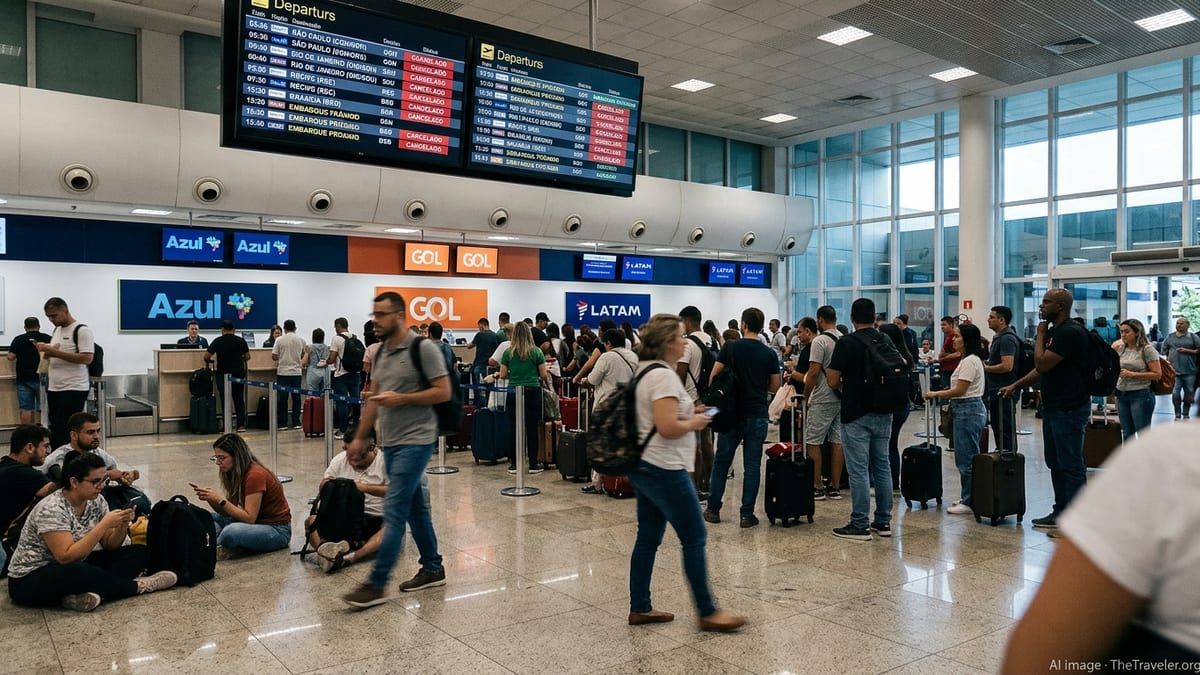
Operational Strains Converge on Key Brazilian Hubs
Publicly available flight-tracking data for late May 2026 shows an unusually high number of altered or canceled services touching Porto Alegre, a critical aviation gateway for southern Brazil. Routes between Porto Alegre and São Paulo’s Guarulhos airport, normally dense with departures from LATAM and Azul, have seen multiple services removed from departure boards or re-timed within hours of departure, leaving connections in disarray.
The pattern is particularly visible on codeshare flights marketed by British Airways but operated by LATAM on domestic sectors such as Porto Alegre to São Paulo. Several of these services appear on schedules under dual flight numbers, and when the operating LATAM flight is disrupted, the British Airways coded service effectively disappears for affected passengers.
These irregularities are compounding congestion at São Paulo, Rio de Janeiro, Brasília and Campinas, which together handle the bulk of Brazil’s long haul and regional traffic. With LATAM and Azul both using these airports as central nodes, cancellations on a single Porto Alegre or Belo Horizonte rotation can reverberate across onward connections to Argentina, Europe and other parts of Brazil.
Industry data and airline communications in recent weeks also highlight the lingering effects of aircraft reallocation, maintenance backlogs and sporadic airspace or weather constraints in southern Brazil. Each factor on its own is common in airline operations, but their convergence in the same period is amplifying the scale of disruption.
Domestic Links to Porto Alegre and Belo Horizonte Under Pressure
Domestic connections from São Paulo, Brasília, Campinas and Rio de Janeiro to Porto Alegre and Belo Horizonte have been among the hardest hit, according to real time route trackers and timetable comparison sites. Flights marketed under the LATAM brand, still using the TAM callsign, show a series of recent cancellations on Porto Alegre rotations that were scheduled to feed onward services to Belo Horizonte and Buenos Aires.
Azul, which has built an extensive domestic network linking mid sized cities such as Ribeirão Preto with larger hubs, is also adjusting Porto Alegre services. Booking engines and schedule displays for the coming weeks show trimmed frequencies and time changes on certain Ribeirão Preto to Porto Alegre combinations, suggesting that demand and fleet availability are being recalibrated in near real time.
In Belo Horizonte, irregular operations are creating bottlenecks for travelers relying on connections from São Paulo and Brasília. LATAM and Azul both use the Confins airport as a strategic node, and reduced reliability on feeder flights from the southeast corridor is complicating itineraries that combine Belo Horizonte with secondary Brazilian destinations.
Travel search platforms tracking Porto Alegre and Belo Horizonte routes indicate that while some cancellations are isolated to individual flights, others are part of broader pattern adjustments, with entire departure windows cut or consolidated into fewer, fuller services.
International Itineraries to London and Buenos Aires Disrupted
The domestic turbulence is spilling over into international itineraries, particularly those involving London and Buenos Aires. Long haul services from São Paulo and Rio de Janeiro to London, marketed by both British Airways and LATAM, depend heavily on punctual domestic feed from cities like Porto Alegre, Belo Horizonte and Campinas. When those feeder legs are canceled or heavily delayed, passengers miss onward transatlantic departures, triggering complex rebookings.
Published timetables show British Airways codes on a number of LATAM operated domestic flights within Brazil, such as Porto Alegre to São Paulo and connections feeding São Paulo to London Heathrow. If a domestic flight is removed from the schedule, the British Airways marketed segment is also lost, and travelers may not see an immediate alternative on the same day, especially during busy travel periods.
On the southern cone corridor, LATAM’s operations between Porto Alegre and Buenos Aires are also coming under strain. Flight status tools tracking services around 24 and 25 May 2026 show late running and cancellations on at least one Porto Alegre to Buenos Aires rotation, which in turn affects passengers connecting in the Argentine capital onto other South American or European carriers.
For travelers booked on multi segment journeys that include both Brazilian domestic sectors and international legs to London or Buenos Aires, the current pattern means a higher risk of misaligned connections and extended layovers, particularly where minimum connection times are tight.
Travelers Face Changing Options and Limited Spare Capacity
One of the most significant challenges for passengers caught in the current wave of cancellations is the limited spare capacity on alternative flights. Publicly visible seat maps and schedule comparison tools suggest that many LATAM and Azul departures from São Paulo and Rio de Janeiro to Porto Alegre, Belo Horizonte and Campinas are already operating near capacity, leaving few open seats when earlier services are removed.
In practice, travelers whose flights are canceled are being pushed onto later departures, often several hours or even a day later, depending on demand and available aircraft. Combined with the code share structure that places British Airways flight numbers on LATAM operated Brazilian segments, this can turn a domestic cancellation into a missed long haul connection with no same day alternative.
Reports from passenger forums and social media highlight a mix of outcomes. Some travelers manage to secure rebookings on rival carriers or alternate routings through other Brazilian hubs, while others report overnight delays and the need to reroute entirely via different countries to maintain onward connections.
For those flying from secondary cities such as Ribeirão Preto, the loss of one or two key connections to Porto Alegre or Campinas can essentially remove same day options to reach long haul flights, forcing reconsideration of itineraries and, in some cases, trip postponements.
Airlines Adjust Networks Amid Shifting Demand
The disruption is taking place against a backdrop of broader network adjustments by Brazilian and international carriers in 2026. Azul has recently detailed refinements to its domestic footprint in regulatory filings, indicating a focus on strengthening connectivity between northeastern Brazil and core hubs in São Paulo and Rio de Janeiro. That shift coincides with trimmed frequencies in certain southern markets, including Porto Alegre and Belo Horizonte, which may explain part of the current reduction in available seats.
LATAM, operating in Brazil under the former TAM brand codes, continues to balance domestic obligations with a growing long haul portfolio from São Paulo and Rio de Janeiro to Europe and North America. Schedule planners appear to be prioritizing trunk routes and high yielding international services, which can result in rapid changes to thinner domestic spokes when aircraft availability tightens.
British Airways is also undergoing a strategic review of parts of its long haul network in 2026, according to industry analysis and previously published planning documents. While London services to Brazil remain an important link, the airline is making broader adjustments to frequencies and aircraft deployment, which can filter down into how its codeshare relationships function in practice on domestic Brazilian sectors.
For now, publicly accessible data suggests that the pattern of cancellations and schedule changes affecting São Paulo, Brasília, Campinas and Rio de Janeiro routes to Porto Alegre, Belo Horizonte, London, Buenos Aires and Ribeirão Preto is likely to continue intermittently, especially during peak travel days. Travelers are being advised by consumer groups and travel industry commentators to monitor itineraries closely, allow extra time for connections and remain prepared for rapid changes as airlines fine tune their networks.