


Brisbane has rapidly grown into a major cruise gateway for Australia and the South Pacific, with the Brisbane International Cruise Terminal at Pinkenba now handling many of the region’s largest ships. If you are flying into Brisbane Airport to board a cruise, getting the transfer right can mean the difference between a relaxed sailaway and a stressful race against the clock. This guide explains the best ways to travel from Brisbane Airport to the Brisbane International Cruise Terminal, what they really cost, how long they take, and when it is worth staying overnight before you sail.
Get the latest updates straight to your inbox!
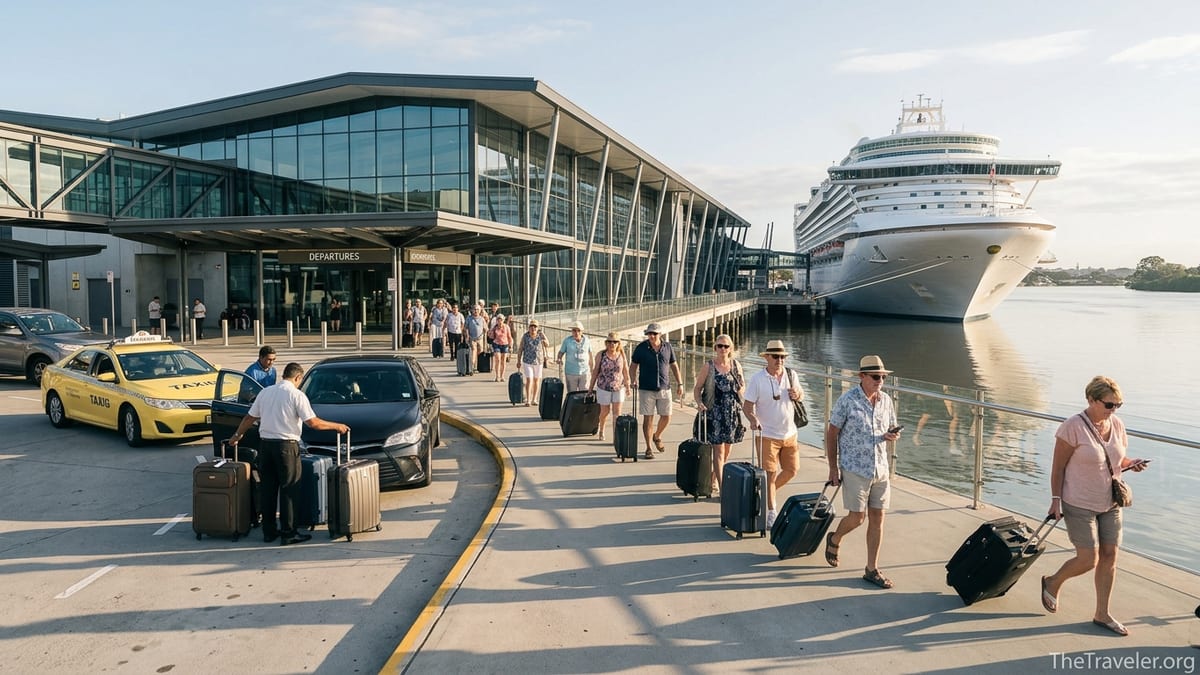
Understanding the Journey from Airport to Cruise Terminal
The Brisbane International Cruise Terminal (BICT) sits at Luggage Point in Pinkenba, on the northern bank of the Brisbane River, about 12 kilometres from Brisbane Airport. In good traffic the drive usually takes 15 to 20 minutes. That short distance is good news for cruise passengers, because it means transfers are simpler and generally cheaper than in cities where ports sit far from the airport.
The port operator notes that the cruise terminal is not currently served by regular public transport. You cannot simply step out of the terminal and onto a public bus or train that goes directly to BICT. Instead, passengers rely on taxis, rideshare services such as Uber, prebooked private transfers or self-drive and parking at the terminal. Knowing this in advance helps you avoid wasting time trying to piece together public transport options that are not designed for cruise-day schedules.
The terminal itself only opens on days when a ship is in port, and ships typically stagger passenger arrival and check-in times. Most cruise lines encourage guests to arrive within a set window, often late morning to early afternoon. When planning flights, allow generous time to clear immigration and customs at Brisbane Airport, collect luggage, and then travel to the terminal. For long-haul flights from North America or Europe, many experienced cruisers choose to arrive at least one day earlier to build in a safety buffer.
Because both the airport and the cruise terminal sit close to major arterials such as the Gateway Motorway, congestion is usually manageable. That said, early weekday mornings can be busy with commuter traffic, and weekends with multiple cruise ships can see short queues for taxis and rideshare. Checking your ship’s boarding time and matching that to when locals are travelling to work or events will help you decide how early to leave the airport.
Taxi Transfers: Fast and Simple from the Airport
For most cruise passengers, a taxi from Brisbane Airport to the Brisbane International Cruise Terminal is the most straightforward option. Taxi ranks at both the Domestic and International terminals are directly outside arrivals. You simply follow the signs to “Taxis,” join the queue, and wait to be allocated a car. Rank marshals are usually on duty when flights arrive, helping to direct passengers and manage any lines.
Recent fare estimators suggest that a standard taxi for the roughly 12 kilometre trip typically costs in the range of about 30 to 40 Australian dollars in normal daytime conditions, including the airport surcharge that applies to all taxi departures from Brisbane Airport. Some local passengers have reported paying a little over 25 dollars for very short hops from the airport to nearby hotels and around 60 to 70 dollars to the central business district, which makes a 30 to 40 dollar range to the cruise terminal realistic for most journeys. Night-time, weekend and public holiday surcharges, traffic delays, and toll routes can nudge the fare higher.
One advantage of taxis is that you do not need to worry about app connectivity, mobile roaming or prebooking. They are especially convenient for older travellers, those with mobility challenges, or anyone carrying outsized luggage such as full-size suitcases, garment bags or golf clubs. Brisbane’s main taxi companies run fleets that usually include a mix of sedans, station wagons and people movers. If you have three or four large suitcases, mention this to the rank marshal so they can put you in a wagon or maxi taxi with a bigger boot.
It is sensible to have some Australian dollars on hand in case you encounter a card terminal issue, but most Brisbane taxis accept major credit and debit cards as standard. If you are using a corporate cabcharge or similar voucher card, have it ready before you reach the front of the rank, particularly at busy times when drivers are trying to load quickly. As with any airport in the world, keep an eye on the meter and confirm that the driver understands your destination is the “Brisbane International Cruise Terminal at Pinkenba,” not the older Portside cruise wharf closer to the city.
Uber and Rideshare: Flexible and Often Good Value
Rideshare services, especially Uber, are widely used in Brisbane and are a popular choice for cruise passengers who are comfortable with app-based bookings. Brisbane Airport has dedicated rideshare pick-up zones at both terminals; after clearing customs or baggage claim, you follow the signs for rideshare or Uber, which typically involve a short walk to a designated pick-up area on the upper or lower roadways depending on the terminal layout.
Price estimates for an UberX between Brisbane Airport and the central city frequently fall in the 30 to 40 dollar range, which aligns closely with the distance to the cruise terminal. In practice, many travellers report that UberX or similar services end up similar in price to taxis for this particular trip, though they can sometimes be slightly cheaper outside peak periods or when special promotions run. Surge pricing during peak times or major events can push rideshare fares higher than taxis, so it is worth checking both your app estimate and the posted taxi fare information at the airport before deciding.
Using Uber from the airport to the cruise terminal can be especially helpful for couples or small groups. For example, a family of four might request an UberXL or similar large vehicle and still pay only modestly more than a two-passenger ride, often under 60 dollars in normal conditions. Prebooking features in rideshare apps allow you to schedule pick-up times, although some Brisbane locals note that very early morning prebooked rides can occasionally attract cancellations as drivers juggle demand. It is always wise to have a fallback plan such as the taxi rank if your prebooked rideshare does not appear on time.
One factor to budget for is waiting time at the airport pick-up zone. Brisbane Airport applies its own access fees and wait-time calculations for rideshare cars entering the pick-up areas, and parts of those charges may be passed on to passengers. While these are not extreme, they can add a few dollars to your final bill. When possible, request your car only after you have collected your luggage and are close to the pick-up point so the driver is not left circulating or waiting with the meter running.
Private Transfers and Cruise-Specific Shuttles
Prebooked private transfers are ideal for larger groups, travellers seeking a smoother door-to-door experience, or anyone worried about tight timing on embarkation day. Several Brisbane-based operators focus specifically on cruise transfers to the Brisbane International Cruise Terminal. Services like Drive Me 2, My Private Transfers and similar companies offer sedans, luxury SUVs and larger vans that can comfortably handle multiple passengers and large amounts of luggage.
For example, a private transfer company might quote a fixed price for a Mercedes van that carries six to eight passengers plus luggage from Brisbane Airport to BICT. While the total price could be in the 100 to 150 dollar range depending on vehicle type and time of day, that cost split among a family group or multiple cabins travelling together can work out comparable to, or even cheaper than, taking separate taxis. High-end options, including Teslas or chauffeured European sedans, are also available and popular with honeymooners or guests celebrating special occasions on board.
Many private transfer firms monitor flight arrival times and adjust pick-ups when aircraft are delayed. A typical arrangement involves the driver waiting at the meeting point just outside customs with a sign, assisting with luggage trolleys, and escorting passengers to a nearby parking or set-down area. For older travellers or anyone with mobility issues, that hands-on service can be worth the extra cost. It also removes the need to navigate airport roads or explain directions to a driver unfamiliar with the new cruise terminal.
Some cruise lines operating from Brisbane arrange their own shuttle buses between Brisbane Airport and the cruise terminal, particularly for large turnarounds when thousands of passengers disembark and re-embark on the same day. These ship-organised transfers are typically sold as optional add-ons when you book your cruise or flight package. Pricing is often per person rather than per vehicle, and can be comparatively high for solo travellers, but many passengers appreciate the perceived security of a cruise line managed coach that knows exactly where the ship is berthed and is in direct contact with port staff.
Self-Drive, Parking and Free Shuttle Connections
If you live within driving distance of Brisbane or plan to hire a car on arrival, self-driving to the Brisbane International Cruise Terminal is another practical option. The port sits off Cruise Terminal Drive at Luggage Point, reached via major roads such as the Gateway Motorway. Once you near the terminal, signage directs you toward short-term drop-off areas and multi-day parking zones.
Onsite parking at BICT is managed by a commercial parking operator with both prepaid and limited drive-up options. Car Parks 1 and 2 are typically prepaid only, while Car Park 3 has some drive-up capacity along with hourly rates for drop-offs and pick-ups. For a seven- to ten-day cruise, parking charges can add substantially to the overall cost of your holiday, so many Queensland locals compare the price of long-term port parking with alternatives such as leaving the car at a private parking facility near the airport or using a suburban park-and-ride linked with a taxi to the terminal.
One additional wrinkle worth knowing is that, on some cruise days, a free shuttle bus service has operated between near-airport parking or retail precincts and the Brisbane International Cruise Terminal for passengers and staff. These shuttles typically run to locations around the airport and shopping outlets such as the discount factory outlet precinct near the terminals, giving another way to bridge the gap between public transport routes and the cruise wharf. However, shuttles and schedules can change, and they may be restricted to specific cruise lines or parking arrangements, so it is important to confirm details with your cruise line or parking provider in the weeks before your trip rather than relying on older information.
For most fly-in cruise passengers, self-drive is less attractive because one-way rental fees and the hassle of returning a car close to the port outweigh the benefits. The exception might be travellers planning a broader Queensland road trip before or after their cruise. In that case, one sensible strategy is to complete the road trip first, drop the rental vehicle at Brisbane Airport, spend a night at an airport or city hotel, and then transfer by taxi or Uber to the cruise terminal the following morning.
Luggage, Accessibility and How Much Time to Allow
Managing luggage smoothly between plane and ship is one of the most important parts of planning your transfer. The road to the Brisbane International Cruise Terminal is relatively direct, so your bags will not experience rough handling in transit. The main considerations are how far you need to wheel them and whether your chosen vehicle has enough space for everyone’s suitcases and carry-on items.
If you are travelling as a couple with two medium to large suitcases and two carry-ons, almost any standard taxi or UberX sedan will be sufficient. Families of four or more, or groups bringing bulky gear such as mobility scooters, folding wheelchairs or sports equipment, should look for an UberXL or similar rideshare, request a maxi taxi at the airport rank, or book a private van in advance. It is far easier to pay a little extra for a larger vehicle than to risk having bags crammed into unsafe positions or needing two cars at the last minute.
The Brisbane International Cruise Terminal itself was designed with accessibility in mind, with flat or ramped access points and designated accessible parking bays close to the entrance. Still, the walk from drop-off point or car park to the check-in area can feel long for passengers with reduced mobility, especially in Queensland’s summer heat. If you need wheelchair assistance, request it through your cruise line well before departure. Taxis and private transfer companies can also arrange vehicles capable of storing collapsible wheelchairs or, in some cases, specially adapted vehicles.
Timing your transfer is always a balancing act. For domestic flights within Australia, many travellers are comfortable booking flights that land about four hours before their assigned cruise check-in time, which generally leaves enough room for moderate delays, baggage collection and the 20-minute drive to the terminal. For international flights, or during storm-prone seasons, it is prudent to allow much more. A growing number of Australian and overseas passengers now choose to arrive in Brisbane at least one calendar day before sailing, spending the night at an airport hotel or in the city so that even substantial flight disruptions will not risk missing the ship.
Should You Stay Overnight Before Your Cruise?
Whether to stay overnight in Brisbane before your cruise depends on how far you are flying, the time of year and your personal appetite for risk. Travellers coming from Sydney, Melbourne or other Australian east-coast cities on early morning flights sometimes arrive and board the ship on the same day without difficulty. However, for long-haul passengers from North America, Asia or Europe, same-day sailing after a long flight can be exhausting and exposes you to greater risk of delay-related problems.
Staying overnight near Brisbane Airport can be a smart compromise. Hotels clustered around the airport precinct, including properties near the domestic terminal and around the nearby retail and business districts, usually offer free or low-cost shuttles from the terminals. A typical pattern for international arrivals is landing in the evening, transferring by hotel shuttle for a one-night stay, sleeping off some of the jet lag, then taking a short taxi or Uber ride to the cruise terminal the following morning. At local taxi and rideshare rates, that morning transfer typically costs a fraction of a ship-organised coach transfer.
Another option is to stay in Brisbane’s riverside neighbourhoods, such as the central business district, South Bank or New Farm. This lets you enjoy a full day or two exploring the city’s river walks, galleries, restaurants and bars before sailing. Taxi and Uber journeys from these central areas to BICT generally take about 25 to 30 minutes in normal traffic, costing somewhat more than a direct airport-to-terminal run but still manageable. Many cruise passengers treat this as a mini city break, arriving two nights ahead to allow for long-haul recovery and sightseeing.
If you do decide to arrive on the morning of your cruise, avoid cutting it fine. A schedule such as landing in Brisbane at 9:00 am for a 3:00 pm all-aboard time might look comfortable on paper, but delays in immigration queues, bags arriving late on the belt, or unexpected traffic around the port can erode that margin quickly. It is especially risky in peak holiday seasons, when both flights and cruise departures are heavily booked and alternatives are limited if things go wrong.
Choosing the Right Transfer for Different Types of Cruisers
Different transfer options suit different styles of traveller. Solo cruisers and couples who pack light often lean toward UberX or standard taxis, focusing on simplicity and cost. For example, a couple arriving on a midmorning domestic flight might walk straight from baggage claim to the taxi rank, hop in a cab and arrive at the cruise terminal less than 40 minutes after landing, with a fare in the 30 to 40 dollar range. That ease of movement can be particularly welcome on shorter three- or four-night cruises where time in port is already limited.
Families with children may prefer the predictability of a prebooked private van or a ship-organised shuttle, even if it costs a little more per person. Having a confirmed pick-up, a driver who expects car seats or booster cushions, and a dedicated vehicle large enough for strollers, suitcases and backpacks can reduce stress on embarkation morning. Splitting a prebooked van between two related families is a common tactic; if the total cost for a van is, say, 140 dollars and it carries eight passengers, the per-person rate is competitive with many bus transfers.
Groups travelling together for events such as weddings at sea, corporate incentives or club trips often choose dedicated coaches or mini-buses arranged through local operators. The benefit here is not just cost efficiency but also group cohesion. Everyone meets at a designated point in the airport arrivals hall or at a city hotel, loads luggage into a single vehicle, and arrives at the ship together. Event organisers also appreciate having one point of contact for any last-minute schedule adjustments if flights change.
For luxury cruisers or those with limited mobility, a chauffeured transfer in a high-end sedan or SUV can be money well spent. These services often include meet-and-greet in the arrivals hall, assistance at the baggage carousel and coordination with port staff. While the total cost can be substantially higher than a taxi, the extra comfort and reduced physical strain can transform a potentially tiring travel day into a smooth start to your holiday.
The Takeaway
Getting from Brisbane Airport to the Brisbane International Cruise Terminal is, by global cruise standards, a relatively short and simple journey. With a drive of roughly 15 to 20 minutes under normal conditions and clear road connections, the key decisions for passengers are less about distance and more about comfort, cost and risk tolerance. Because the terminal is not directly served by public transport, cruise passengers should plan on using taxis, Uber and other rideshare services, or prebooked private transfers.
As a rough guide, budget around 30 to 40 Australian dollars for a standard taxi or UberX from the airport to the cruise terminal in typical daytime traffic, more in peak periods, at night or for larger vehicles. For families and groups, private vans and cruise-specific shuttles can deliver better value per person and a smoother logistics experience. Whatever option you choose, allow generous time for airport processes, especially if flying long haul or during busy seasons, and strongly consider arriving at least one day before sailing if you are coming from far away.
Above all, remember that embarkation day is the start of your holiday. Investing a little thought into how you will move between plane and ship, factoring in luggage, mobility needs and your personal sense of comfort, helps ensure that the first hours of your cruise are relaxed rather than rushed. With realistic expectations on timing and cost, and a clear plan tailored to your travel style, the transfer from Brisbane Airport to the cruise terminal can be a straightforward bridge between sky and sea.
FAQ
Q1. How long does it take to get from Brisbane Airport to the Brisbane International Cruise Terminal?
In normal traffic the drive takes about 15 to 20 minutes, as the terminal is roughly 12 kilometres from Brisbane Airport along major arterial roads.
Q2. How much should I expect to pay for a taxi from the airport to the cruise terminal?
A standard taxi fare from Brisbane Airport to the Brisbane International Cruise Terminal typically falls in the approximate range of 30 to 40 Australian dollars in daytime conditions.
Q3. Is Uber cheaper than a taxi for this trip?
UberX and similar rideshare services often price in a similar range to taxis for this distance, sometimes slightly cheaper, but surge pricing at busy times can make them more expensive.
Q4. Can I take public transport from Brisbane Airport to the cruise terminal?
There is currently no direct public transport to the Brisbane International Cruise Terminal, so cruise passengers generally need to use taxis, rideshare or private transfers.
Q5. Should I arrive in Brisbane the day before my cruise?
If you are flying long haul or during busy seasons, arriving at least one day before sailing is strongly recommended to reduce the risk of flight delays causing you to miss the ship.
Q6. Are there hotel shuttles that go directly to the cruise terminal?
Most airport hotels run shuttles between their properties and the airport terminals rather than to BICT itself, so you usually connect by taxi or rideshare on embarkation morning.
Q7. Do cruise lines offer their own transfers from Brisbane Airport?
Many cruise lines do sell coach transfers between Brisbane Airport and the cruise terminal, often at a per-person rate; these can be convenient but are not always the cheapest option.
Q8. What is the best option for families with a lot of luggage?
Families with multiple suitcases and strollers often find a prebooked private van, maxi taxi or UberXL best, as these vehicles provide more space and predictable pricing.
Q9. Is the Brisbane International Cruise Terminal accessible for passengers with mobility issues?
The terminal was built with accessibility in mind, including ramped access and nearby accessible parking, but passengers needing wheelchairs should arrange assistance in advance through their cruise line.
Q10. How early should I leave the airport on embarkation day?
For domestic flights landing the same day, aim to be at the airport at least four hours before your check-in window; for international flights, or in peak seasons, consider arriving the previous day.