


More news on this day
A British Airways Airbus A320 operating flight BA1458 from London Heathrow to Edinburgh declared an emergency approach and landed safely at Edinburgh Airport after the co-pilot reportedly required urgent medical attention, according to aviation tracking data and specialist aviation coverage.
Get the latest news straight to your inbox!
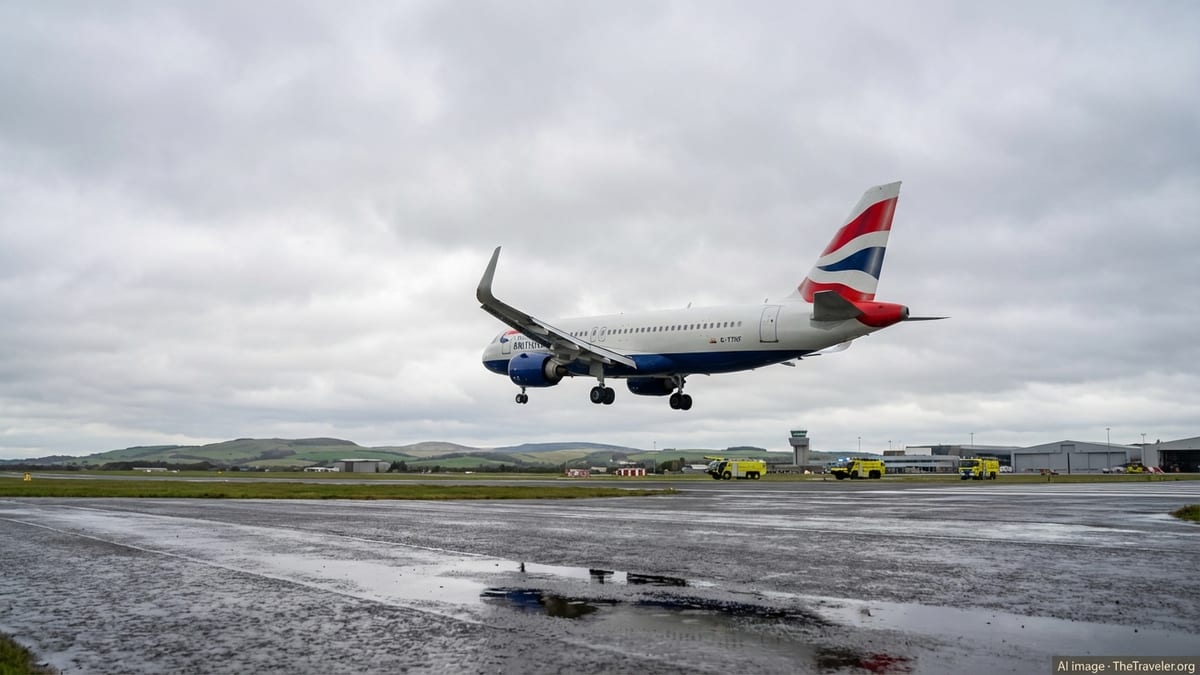
Incident on British Airways Flight BA1458
Flight BA1458 departed London Heathrow on the afternoon of 11 May 2026, bound for Edinburgh, on a routine short-haul service frequently used by business and leisure travellers between the two capitals. Publicly available flight-tracking information indicates that the Airbus A320, registered G-EUYW, took off at around 16:54 British Summer Time and climbed to a cruising altitude of approximately 34,000 feet for the journey north.
Reports from aviation news outlets state that the flight was proceeding normally until late in the cruise when a medical issue reportedly affected the co-pilot. The nature of the condition has not been disclosed in detail in public reporting, but coverage indicates that the situation was serious enough for the flight crew to request priority handling on approach to Edinburgh.
Data from tracking services show that the aircraft subsequently declared an emergency as it prepared to descend into Edinburgh, using a standard transponder code that signals the need for urgent assistance. The decision allowed air traffic controllers to give the aircraft priority routing so that it could land as soon as practicable.
The jet continued to Edinburgh rather than diverting to an alternate airport, reflecting assessments that the aircraft remained fully controllable and that the fastest access to medical support would be on the ground at its planned destination. The approach and landing were completed without technical complications, and the aircraft touched down safely in the early evening.
Safe Landing and Response at Edinburgh Airport
According to publicly available information, the emergency declaration meant that emergency and medical teams were placed on heightened readiness at Edinburgh Airport ahead of the aircraft’s arrival. This is standard practice whenever a flight signals a medical or operational emergency, ensuring that assistance is immediately available after landing.
Following touchdown, the aircraft taxied to a stand under its own power. Passengers were able to disembark normally after the situation was stabilised, and there have been no reports of injuries among those on board apart from the affected crew member. Available coverage suggests that the co-pilot was transferred for medical assessment shortly after arrival.
Operations at Edinburgh appear to have continued with only limited disruption. Flight-movement data show no prolonged ground stoppages or diversions linked directly to BA1458, indicating that the airport’s contingency procedures handled the incident within normal capacity. Subsequent London services to and from Edinburgh on British Airways have continued to operate, underlining that the issue was contained to this single rotation.
The aircraft involved, an Airbus A320 widely used across European networks, is reported to have remained on the ground for checks and scheduling adjustments following the event. This is consistent with standard airline practice after any flight that has required an emergency declaration, even when the underlying cause is medical rather than technical.
Medical Emergencies in the Air and Crew Procedures
This latest incident highlights how airlines manage medical issues affecting flight crew as well as passengers. Commercial aircraft are operated by at least two pilots, and procedures are in place for one pilot to take full control if the other becomes incapacitated. Training for such scenarios is embedded in regular simulator sessions and operational checks.
In this case, publicly available aviation reporting indicates that the captain continued the flight to Edinburgh while coordinating with ground services and ensuring that the unwell co-pilot received prompt care on landing. Industry practice in such situations focuses on balancing the medical needs of the individual involved with the safest and quickest way to get the aircraft on the ground.
Medical events on board are among the more common reasons for unscheduled diversions or emergency declarations in commercial aviation. Analysts note that many such incidents are resolved without further consequence, but emergency procedures are designed to err on the side of caution so that crews have immediate access to air traffic priority whenever they deem it necessary.
Aviation observers point out that the safe outcome on BA1458 is in line with broader trends in commercial flying, where established protocols, crew training and coordination with ground teams typically ensure that in-flight medical situations are managed with minimal risk to passengers.
Impact for Passengers and the Route Between London and Edinburgh
The London Heathrow to Edinburgh route is one of the busiest domestic corridors in the United Kingdom, with multiple British Airways services scheduled each day. Flight BA1458 is a regular afternoon departure that often serves connecting passengers from long-haul arrivals as well as travellers originating in London.
Travel reports suggest that passengers on BA1458 experienced an arrival that felt more urgent than usual because of the emergency handling, but the absence of significant onward disruption indicates that the situation remained under control. Scheduled services on the city pair, including other British Airways flights tracked on subsequent days, continue to operate normally.
For travellers, the incident serves as a reminder that even when a flight is described as an emergency landing, it can still involve a routine touchdown on a standard runway with no visible signs of distress. The term in this context primarily reflects the priority given by air traffic control and the readiness of emergency services, rather than a dramatic or technically hazardous approach.
Industry commentators note that the swift and uneventful conclusion to the flight is likely to limit long-term impact on traveller confidence along the route. With no indication of a mechanical fault, the episode is being viewed as a medical situation handled through well-rehearsed procedures rather than a reflection of any wider issue with the aircraft type or airline operations.
Ongoing Review and Operational Context
Following any event involving an emergency declaration, airlines typically undertake internal reviews to examine crew decision-making, communication and timelines. While the focus in this case appears to be on a sudden health issue affecting a member of the flight deck, such reviews often look broadly at how all aspects of the response unfolded, including coordination with airport services.
Publicly available information at this stage does not indicate any broader safety concern linked to the aircraft or the route. The Airbus A320 family has a long service record across Europe, and medical-related emergencies such as the one reported on BA1458 are treated as isolated operational events rather than technical warnings.
For Edinburgh Airport, the incident fits within an established framework for handling priority arrivals. Large commercial airports maintain regular training for scenarios that range from in-flight medical issues to technical emergencies, ensuring that fire, rescue and medical teams can be activated quickly whenever a flight signals distress.
As British Airways continues its dense schedule between London and Scottish destinations, the BA1458 episode is likely to be remembered primarily as an example of established emergency procedures functioning as designed, with a safe landing, prompt medical attention for the affected crew member and only limited disruption for passengers and operations.