


More news on this day
A fresh wave of flight cancellations involving Flybondi and American Airlines has disrupted travel across Argentina, affecting connections to Bariloche, Iguazú Falls and New York JFK and stranding passengers at Buenos Aires’ Ezeiza and Jorge Newbery airports.
Get the latest news straight to your inbox!
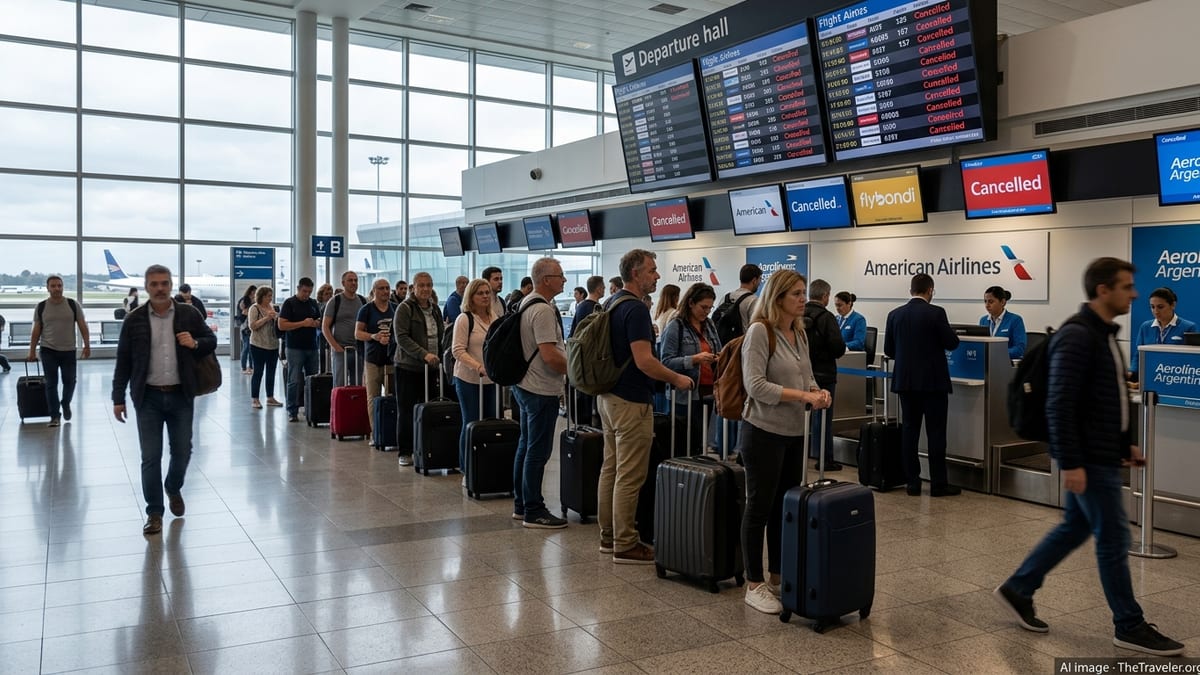
Five Cancellations Hit Domestic and International Links
Published coverage and live flight-tracking data indicate that at least five flights operated by Flybondi and American Airlines were cancelled within a short window, interrupting both domestic tourism routes and long-haul services. The affected operations include Flybondi services linking Buenos Aires with major leisure destinations such as San Carlos de Bariloche and Puerto Iguazú, as well as an American Airlines service on the New York JFK corridor from Ezeiza International Airport.
Flybondi cancellations were registered on services connecting Bariloche and Iguazú Falls with Buenos Aires, including flights routed through Ezeiza and Aeroparque Jorge Newbery. These routes are central for travelers heading to Patagonia’s lake district and to the country’s northeast, where Iguazú National Park is a flagship attraction for both domestic and international visitors.
At the same time, an American Airlines flight on the Buenos Aires to New York JFK route was listed as cancelled, disrupting transcontinental travel plans for passengers connecting between North and South America. Publicly available schedules show that Ezeiza functions as the primary hub for long-haul operations, meaning even a single cancelled widebody flight can ripple across multiple onward itineraries.
Although the precise causes cited vary by airline and individual service, publicly accessible information attributes several of the cancellations to operational reasons, a broad term that can encompass crew availability, aircraft rotation issues and knock-on effects from earlier delays.
Holidaymakers to Bariloche and Iguazú Face Sudden Plan Changes
The disruption has been particularly acute for leisure travelers bound for San Carlos de Bariloche and Iguazú Falls, two of Argentina’s most in-demand destinations. Bariloche, served by Teniente Luis Candelaria International Airport, is a year-round draw for lake tourism, trekking and winter sports, while flights into Puerto Iguazú provide one of the main gateways to Iguazú National Park and its UNESCO-listed waterfalls.
Domestic low-cost services have become the preferred option for many Argentines and international visitors looking to keep costs down on multi-stop itineraries. Flybondi, which operates Boeing 737-800 aircraft across a network anchored in Buenos Aires, plays a prominent role on both Bariloche and Iguazú routes. When a small carrier experiences multiple cancellations within a limited time frame, the availability of immediate rebooking options can be constrained, especially during peak travel dates.
Reports from passenger tracking platforms and social media posts describe travelers facing last-minute notifications of cancellation, often within 24 hours of departure. For those with prepaid hotel bookings in Bariloche or Iguazú, or onward international connections, the absence of same-day alternatives can translate into significant additional costs for accommodation, transfers and reissued tickets.
Travel forums and user-generated reviews have increasingly highlighted a pattern of sudden schedule changes on certain domestic services in Argentina. In this context, the latest cluster of cancellations has reinforced calls from affected travelers for greater transparency around the reasons for disruptions and clearer communication on available remedies.
Pressure Grows on Buenos Aires’ Dual-Airport System
The cancellations once again place a spotlight on the complexity of Buenos Aires’ dual-airport system, which splits domestic and many regional operations at Aeroparque Jorge Newbery and most long-haul services at Ezeiza International Airport. While this configuration increases capacity for the metropolitan region, it also introduces additional risk when delays or cancellations occur on key feeder routes.
Flybondi bases part of its fleet at both Aeroparque and Ezeiza, operating a web of domestic routes that feed traffic into Buenos Aires. When a flight such as a Bariloche to Ezeiza service is cancelled, passengers with same-day international departures from Ezeiza can lose onward connections, especially to North America and Europe. For those booked on American Airlines or other long-haul carriers, a missed departure from Ezeiza often implies rebooking into limited remaining inventory.
Aeroparque itself is a crucial node, handling a high volume of domestic flights to and from cities such as Bariloche and Puerto Iguazú. Any operational strain on low-cost operators at Aeroparque can create a ripple effect, as passengers scramble to transfer between the two Buenos Aires airports or seek replacement flights on competing airlines. The current episode adds to a broader pattern in which localized operational issues quickly become national travel disruptions.
Recent statistics published by aviation data portals and local outlets show that cancellations and delays have periodically spiked in Argentina over the last year, driven by a combination of staffing disputes, congestion, and the tight utilization of narrow-body fleets. The latest five-flight disruption involving Flybondi and American Airlines fits into this broader context of a system operating with limited slack.
Flybondi’s Reliability Under Scrutiny Amid Wider Network Issues
The renewed cancellations have further sharpened scrutiny on Flybondi’s reliability metrics. Public data from previous months highlighted periods in which the carrier registered elevated rates of cancellations compared with competitors on certain domestic routes. Local media coverage earlier in the year documented episodes in which large numbers of Flybondi passengers were left seeking last-minute alternatives after concentrated waves of suspensions.
Industry observers note that ultra-low-cost models rely on dense aircraft utilization, with minimal turnaround times and limited backup capacity. In practice, that means unscheduled maintenance, weather-related diversions or disruptions at a single hub can cascade rapidly through the network. When several services on high-demand routes like Bariloche and Iguazú are cancelled within the same operational window, the airline can struggle to offer near-term re-accommodation, particularly if load factors are already high.
American Airlines, by contrast, operates fewer daily frequencies to and from Argentina but uses larger aircraft. As a result, the cancellation of a single New York JFK service can affect hundreds of passengers at once, including those who have already completed domestic segments on other carriers. In such cases, travelers holding split tickets on Flybondi domestically and American internationally may find themselves navigating separate customer-service channels while trying to salvage complex itineraries.
Publicly available industry commentary suggests that these kinds of disruptions will continue to test coordination between low-cost carriers and full-service airlines that share passenger flows without formal interline agreements. For travelers, the practical implication is a heightened need to build additional buffer time into connections between domestic and long-haul flights in and out of Buenos Aires.
What Stranded Passengers Are Being Offered
In the wake of the latest cancellations, the remedies available to affected passengers largely depend on each airline’s policies and the type of ticket purchased. Flybondi’s published guidance typically provides options such as free date changes within a defined window, vouchers, or refunds when flights are cancelled for operational reasons. However, travelers frequently report that rebooking into the next available service can mean significant delays when seats are already scarce.
American Airlines, in line with its global policies, generally offers rebooking on subsequent flights on its own metal or, where agreements exist, on partner airlines, subject to seat availability. For New York-bound travelers departing from Ezeiza, this may entail overnight stays in Buenos Aires or rerouting via other U.S. or regional hubs before reaching JFK.
Consumer advocates in Argentina have consistently urged passengers to document all expenses arising from cancellations, including accommodation, meals and ground transport between airports, in order to pursue compensation where local regulations or carrier policies allow. While the specific legal framework varies depending on whether a flight is domestic or international, public information on previous disputes suggests that keeping detailed records can be decisive in securing partial reimbursements.
For now, the five-flight disruption involving Flybondi and American Airlines serves as another reminder of the fragility of key air links connecting Argentina’s most visited destinations and its primary international gateway. With peak travel seasons to Bariloche and Iguazú on the horizon, how airlines manage reliability and recovery from cancellations at Ezeiza and Aeroparque will remain a central concern for both local travelers and international visitors planning complex itineraries across the region.