


By the time I reached Ramsey Cascades, my legs were done in the best possible way. The kind of bone-deep fatigue that only comes after hours of climbing stone steps slick with mist, weaving around roots the size of railroad ties, and pushing through a tunnel of old-growth forest toward the tallest accessible waterfall in Great Smoky Mountains National Park. If you are picturing a gentle stroll to a scenic overlook, reset your expectations now. Ramsey Cascades is a serious day hike, and that is exactly what makes finally standing at the base of its thundering 100-foot drop feel so unforgettable.
Get the latest updates straight to your inbox!
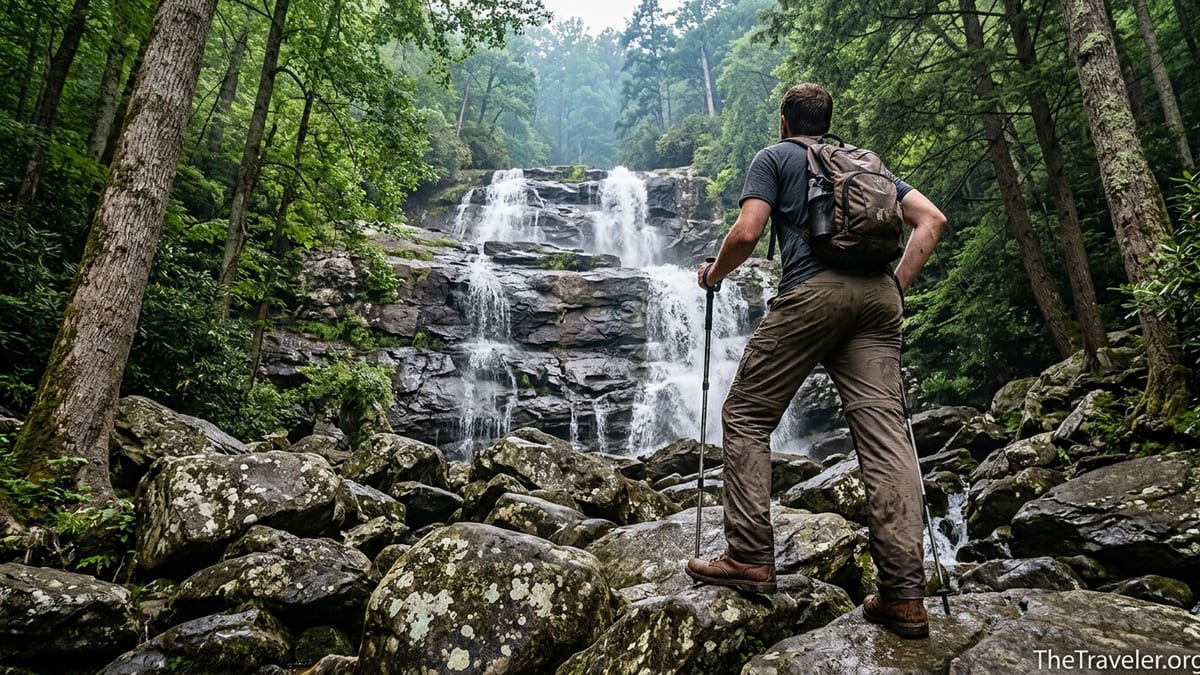
Meeting Ramsey Cascades: A Waterfall You Truly Earn
Ramsey Cascades is an 8 mile out and back trail in the Greenbrier section of Great Smoky Mountains National Park, near Gatlinburg, Tennessee. Official park materials describe it as a relatively challenging hike through lush cove hardwood forest to the tallest waterfall in the park that is reachable by trail. In plain language, that means you will climb roughly 2,000 to 2,500 feet over four miles of increasingly rough terrain before you ever see water plunging over rock.
The numbers only tell part of the story. Parking at the Greenbrier trailhead, you are already off the main tourist loop. You drive in on a narrow paved and gravel road that follows the Middle Prong of the Little Pigeon River, passing picnic pullouts and anglers in waders. From March through November, you also need to factor in the park’s parking tag system: most visitors purchase a 5 dollar per day tag from a kiosk or visitor center and display it in the windshield before leaving the car, an extra but necessary step so you can linger at the falls without worrying about a ticket.
From the first steps on the old road bed, the trail feels deceptively friendly. It wanders gently uphill beside Ramsey Prong, past moss coated rocks and the remains of early 20th century logging operations that once stripped these slopes. That early ease is why so many visitors underestimate Ramsey Cascades. Reviews on travel and booking sites from 2025 and 2026 tell the same story: hikers who thought they were signing up for another Smokies waterfall stroll like Laurel Falls or Grotto Falls quickly realized this is a different category altogether.
What has changed recently is the quality of the path itself. Between 2022 and late 2024, Great Smoky Mountains National Park and the nonprofit Friends of the Smokies completed a intensive trail rehabilitation project here. They rebuilt failing log bridges, repaired eroded sections, installed rock steps, and removed many of the worst trip hazards. The work did not make Ramsey Cascades easy, but it did make it safer and more sustainable, meaning the punishment your legs feel at the end now comes more from elevation and distance than from fighting ankle deep ruts.
The Long Climb: How the Trail Really Feels Underfoot
The defining feature of the Ramsey Cascades hike is its steady, relentless climb. Over the first mile and a half, you gain elevation gradually along a wide, sometimes rocky former road. Many families with small children walk this lower section for a taste of the old growth forest and river views before turning back, which is a smart choice for anyone not ready to commit to the full 8 miles.
Around the halfway mark, everything tightens. The route narrows to a traditional single track, curling higher above Ramsey Prong. You start to encounter extended stretches of stone staircases, root lattices, and boulder steps. Trail runners who log the route on fitness apps often record average paces dropping from 20 to 30 minutes per mile on easier Smokies routes to 35 minutes or more here on the final push, especially if the rocks are wet. On a typical spring Saturday, you can watch the gradient assert itself in real time as conversations fade and hikers fall quiet, heads down, one foot in front of the other.
One visitor review from late 2025 described the last mile as feeling like “a natural stair machine,” and that is not far off. You might cover that final stretch in 45 minutes if you are fit and moving steadily, or in over an hour and a half if you stop frequently to catch your breath or negotiate slick boulders. Either way, this is where you truly earn the view. For hikers used to milder Tennessee day walks, such as the flat Riverwalk in downtown Chattanooga or the moderate climb to Alum Cave Bluffs on Mount Le Conte, the cumulative strain on knees and calves here can be surprising.
By the time you cross the last rock hop stream crossing and hear the roar of the waterfall around a bend, the fatigue feels almost ceremonial. Legs burned on the ascent make that first glimpse of cascading water through the trees feel like the resolution of a story your body has been telling for hours.
Why Your Legs Feel Destroyed at the Top
When travelers say their legs were “completely done” at Ramsey Cascades, they are usually feeling the combination of three factors: elevation gain, terrain, and time on feet. Roughly 2,000 plus vertical feet over four miles means you are gaining about 500 feet per mile. For comparison, popular roadside waterfall walks in the park can gain less than 200 feet per mile, while more serious summit hikes like Rainbow Falls to Mount Le Conte gain around 700 to 800 feet per mile. Ramsey Cascades sits in that demanding middle ground where the grade is never technical enough to feel like a climb, but almost never flat enough to let your muscles fully recover.
The terrain multiplies that effort. Even after recent repairs, large portions of the upper trail are armored with uneven stone. Every step requires your ankles, knees, and hips to stabilize, especially when wet leaves or a recent rain have slicked the rock. Hikers who often train on gym treadmills or city staircases miss this sideways, twisting work until they are halfway down and their stabilizer muscles are quivering.
Time is the final ingredient. For most day hikers, a realistic round trip time is 5 to 7 hours, including breaks. Fit trail runners have logged out and back times of around 3 hours, but that is not a target most visitors should chase. If you leave the trailhead at 9 a.m., you may not be back at the car until mid afternoon. That extended workload, especially if you are carrying a daypack with 2 or 3 liters of water, lunch, and layers, adds up. By the time you are snapping photos at the falls, the walk back still ahead of you, your quads may already feel like they have finished for the day.
Travelers often compare the fatigue of Ramsey Cascades to a full day exploring an urban European city. Imagine walking from morning until evening on cobblestones in Prague or Lisbon, climbing cathedral steps and steep alleys. The step count may be similar, but at Ramsey Cascades you are also dealing with altitude, humidity, and continuous climbing. That is why planning and pacing matter far more here than on short scenic drives or roadside viewpoints.
Planning Your Day: Timing, Seasons, and Current Conditions
Given the effort involved, timing your Ramsey Cascades hike is crucial. On typical spring and fall days, many Gatlinburg visitors leave their accommodations around 7:30 or 8:00 a.m., stop briefly at a gas station or bakery for coffee and breakfast, then drive the 30 to 45 minutes into the Greenbrier area. That makes it easy to be at the trailhead between 8:30 and 9:00 a.m., which is early enough to secure parking and enjoy cooler temperatures on the climb.
From late March through November, a 5 dollar per day parking tag is required for most vehicles in Great Smoky Mountains National Park, with longer term options available for frequent visitors. In practice, that means factoring in a detour to a visitor center or buying a tag in advance, rather than arriving at the trailhead and realizing you are not compliant. The Greenbrier road itself can close temporarily after heavy rains or winter storms, so it is worth checking the park’s official conditions page the night before or morning of your hike, especially in shoulder seasons.
Seasonally, spring and early summer are prime times to experience the lushness of the Ramsey Cascades drainage, with wildflowers brightening the understory and water levels typically robust. Summer brings thicker foliage and higher humidity; the shade of old growth hemlock and tulip poplar forests helps, but midday temperatures can still climb toward 80 degrees Fahrenheit, and the rocks stay slick. Autumn offers cooler air and color in the canopy, but the days grow shorter, making early starts even more important. Winter hikes are possible for experienced visitors with proper traction and layers, yet ice on the last rock steps can turn the upper section into a technical challenge beyond what casual tourists may want.
Recent years have also seen intermittent weekday closures for trail work. While the major rehabilitation wrapped up in 2024, crews occasionally return for maintenance, similar to ongoing projects on other popular Smokies routes like Bullhead Trail. Before you commit a vacation day, always confirm whether Ramsey Cascades is open on your planned date so you do not arrive to find weekday barricades at the trailhead.
What to Pack So You Still Enjoy the Last Mile
The difference between arriving at Ramsey Cascades exhausted but exhilarated and arriving depleted and anxious about the return can come down to something as simple as footwear, water, and snacks. At a minimum, you will want broken in hiking shoes or boots with good traction. Trail runners with grippy soles also work well if you are used to them, but casual sneakers with flat, worn tread struggle on the roots and stone steps. In TripAdvisor reviews from 2024 and 2025, hikers who regretted their footwear almost always mentioned smooth soled shoes that slipped repeatedly on wet rock.
Water is non negotiable. For a 5 to 7 hour outing, many day hikers carry between 2 and 3 liters per person in a hydration bladder or multiple reusable bottles. There is enticing water flowing near the trail for much of the route, but it is not treated, and relying on refilling without a proper filter is not recommended. On humid days in July or August, even 3 liters per person can feel barely adequate, especially if you tend to sweat heavily.
Food and layers may sound less critical on a summer day, but they heavily influence your energy and comfort. Simple, calorie dense snacks such as nut mixes, energy bars, jerky, and fresh fruit travel well and encourage you to take short, regular breaks. Even in warm months, a lightweight rain jacket or wind shell can make a difference at the falls, where cool spray and shade lower the apparent temperature. Travelers who hike in quick drying shirts and socks rather than cotton also recover more comfortably once they stop moving at the top.
Lastly, do not underestimate small supportive items. Trekking poles can dramatically reduce the pounding on your knees during the descent, especially in the final mile when fatigue amplifies missteps. A compact first aid kit with blister plasters, ibuprofen, and a bandage or two weighs almost nothing and can turn a potential early exit into a manageable inconvenience.
Trail Etiquette and Safety at the Falls
For all the physical effort it demands, Ramsey Cascades is at heart a waterfall hike, and that means the focal point is a powerful, unpredictable natural feature. When you step out onto the jumbled boulder field at the base of the falls, you will likely see spray drifting on the breeze, moss glistening on the rocks, and fellow hikers scattered along the edges taking photos and eating lunch. It can be tempting, especially in warm weather, to scramble closer for that perfect selfie or to climb up the lower rock ledges and feel the water directly. Park rangers strongly discourage this, and with good reason.
Over the decades, multiple serious accidents and at least three fatalities have occurred at Ramsey Cascades involving people climbing on slick rock or entering the plunge pool. Even on seemingly calm days, the combination of algae, mist, and uneven surfaces turns the boulders into a natural skating rink. A slip here means not just bruises, but the possibility of tumbling into shallow, fast moving water with limited ways to self arrest. The safest and most responsible choice is to admire the falls from stable rocks and obvious, well used viewing spots.
Basic trail etiquette also goes a long way toward keeping the experience enjoyable for everyone. Uphill hikers have the right of way, since stopping and restarting on a steep grade is harder than pausing on a descent. If you are part of a large group, stepping aside at narrower sections to let others pass can prevent congestion. On busy weekends, voices carry, and a single loud conversation can ripple down the line of hikers behind you; keeping noise to a conversational level preserves the sense of wildness that so many people come here to find.
Wildlife awareness matters as well. Black bears are present throughout the Smokies, including the Greenbrier area, though encounters on this specific trail are not guaranteed. Carrying out all food waste, giving any wildlife you see ample space, and storing snacks securely in your pack during breaks all reduce the risk of creating problem situations where animals begin to associate hikers with easy calories.
Alternatives and Recovery: When to Turn Back and What to Do After
There is no shame in deciding that your legs have done enough before the final push to Ramsey Cascades. In fact, one of the most common mistakes first time visitors make is refusing to turn around when their bodies or the weather are clearly signaling that it is time. Because the trail follows Ramsey Prong for much of its length, there are several scenic spots with river views, mossy boulders, and small cascades that make satisfying turnaround points a mile or two in. Families with younger children often choose one of these areas for a picnic before heading back, turning the outing into a half day adventure rather than a forced march.
If you genuinely want a less demanding waterfall experience in the same park, you might compare Ramsey Cascades with Porters Creek Trail, also in the Greenbrier area. Porters Creek offers historic homestead ruins, spring wildflowers, and a smaller falls on a route that many hikers describe as moderate instead of strenuous. Elsewhere in the park, Grotto Falls and the now temporarily closed Laurel Falls provide paved or well graded paths to water features with far less elevation gain, though they can be much more crowded during peak seasons.
Assuming you do complete the full 8 miles, plan some recovery into your itinerary. After hours of hiking, most travelers welcome a late lunch or early dinner in nearby communities like Gatlinburg or Pigeon Forge, where casual restaurants serve everything from barbecue plates in the 15 to 20 dollar range to pancake stacks at long running breakfast spots. Hydrating with water or an electrolyte drink before reaching for celebratory craft beer or cocktails helps your body repair muscles rather than deepening fatigue. Many visitors also schedule a lighter day after Ramsey Cascades, opting for scenic drives like Newfound Gap Road or Cades Cove Loop rather than immediately stacking another strenuous hike.
If you are staying in a cabin or vacation rental with a hot tub or soaking tub, a 15 to 20 minute soak followed by gentle stretching can relieve tight calves and quads. Simple self care like this means that when you look back on Ramsey Cascades, you remember it as a challenging highlight of your trip rather than the hike that left your legs so sore you could barely climb the stairs to your rental loft.
The Takeaway
By the time most hikers reach Ramsey Cascades, their legs are indeed done. But that exhaustion carries a sense of earned accomplishment that lingers long after the lactic acid fades. Rather than a roadside stop you can check off between outlet mall runs and dinner shows, this trail asks for your full attention, your morning, and a significant share of your physical energy. In return, it gives you the sound of water hammering down a hundred foot staircase of rock, the sight of old growth giants arching overhead, and the knowledge that you followed a path into a corner of the Smokies where cars cannot go.
If you approach Ramsey Cascades with realistic expectations, proper gear, and a flexible attitude, the moment you finally step onto the boulders at the base of the falls will feel less like defeat and more like arrival. Yes, your legs will complain, and yes, the descent will still be waiting for you. Yet that is precisely why this hike stands out in memory when easier trails blur together. It is a reminder that some of the richest travel experiences require effort, and that the stories you tell later often begin with a simple truth: by the time I reached Ramsey Cascades, my legs were completely done, and it was absolutely worth it.
FAQ
Q1. How long does it take to hike Ramsey Cascades round trip?
Most visitors should plan on 5 to 7 hours for the 8 mile out and back hike, including rest stops, photos, and a break at the waterfall.
Q2. How difficult is the Ramsey Cascades trail compared with other Smokies hikes?
The trail is considered strenuous due to its 2,000 plus feet of elevation gain, rocky terrain, and length, making it more demanding than popular paved waterfall walks.
Q3. Do I need a permit or reservation to hike Ramsey Cascades?
You do not need a trail specific permit, but from March through November you do need a paid parking tag displayed in your vehicle while parked in the area.
Q4. What is the best time of year to hike Ramsey Cascades?
Spring and fall are generally ideal, offering cooler temperatures and either wildflowers or fall color, though the trail can be hiked year round with proper preparation.
Q5. Is Ramsey Cascades suitable for children or beginner hikers?
The lower portion can work for families, but the full hike is long and strenuous; many beginners and younger children do better turning around after a mile or two.
Q6. Can I swim or climb on the rocks at Ramsey Cascades?
Swimming and rock scrambling near the falls are strongly discouraged because slick boulders and strong currents have led to serious accidents and fatalities in the past.
Q7. Are dogs allowed on the Ramsey Cascades trail?
No, dogs are not permitted on most Smokies hiking trails, including Ramsey Cascades, though they are allowed in campgrounds and along certain roads.
Q8. What should I bring for the hike?
Plan on sturdy hiking footwear, 2 to 3 liters of water per person, snacks or lunch, a light rain layer, basic first aid, and optionally trekking poles for the descent.
Q9. Is the trail crowded?
Ramsey Cascades is popular but less congested than short roadside walks; expect steady but manageable traffic on weekends and lighter crowds on early weekday mornings.
Q10. How do I check if the trail is open before my trip?
Trail and road status can change with weather and maintenance, so check the official Great Smoky Mountains National Park conditions page close to your hiking date.