


Ramsey Cascades is one of those hikes that sparks debate in Great Smoky Mountains National Park. At roughly 8 miles round trip, with more than 2,000 feet of elevation gain, the trail asks a serious commitment for a single destination: the tallest waterfall in the park. For some travelers it becomes the highlight of their Smokies trip. For others, it feels like too much toil for too little variety. If you are weighing whether to devote a full day to one waterfall, this guide breaks down exactly what you get for the effort, who the hike is really for, and when another Smokies waterfall might make more sense.
Get the latest updates straight to your inbox!
What Exactly Is Ramsey Cascades?
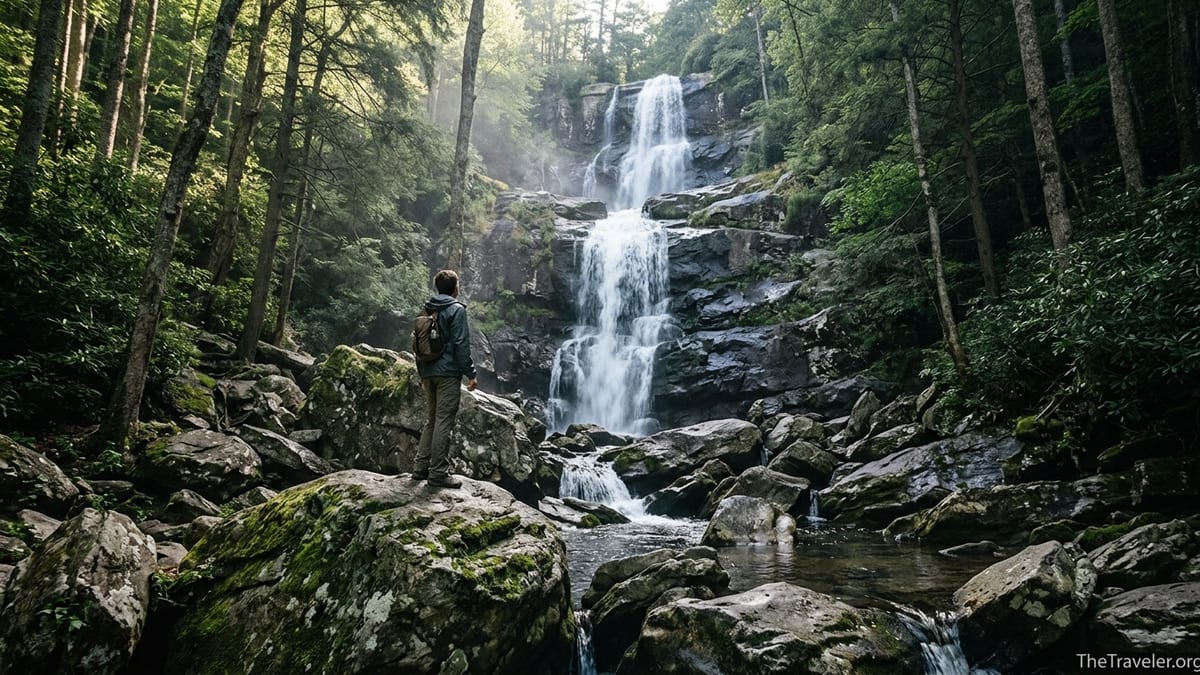
Ramsey Cascades is a multi-tiered waterfall tucked into the remote Greenbrier section of Great Smoky Mountains National Park, on the Tennessee side east of Gatlinburg. The falls drop about 100 to 105 feet in a series of stair-stepped ledges, fanning out into a broad, white curtain that crashes into a boulder-filled pool at the base. According to the National Park Service, it is the tallest waterfall that is reachable by maintained trail anywhere in the park, which is a major part of its appeal.
The only way to reach the falls is the Ramsey Cascades Trail, a roughly 8 mile out-and-back route that begins at the end of Ramsey Prong Road in the Greenbrier area. The first section follows an old road along the Middle Prong of the Little Pigeon River before narrowing into a classic Smokies footpath that climbs steadily through dense forest beside the Ramsey Prong. That combination of length, elevation gain and rough footing is why most guidebooks and apps rate it as strenuous, even though there are no ropes or scrambling in the technical sense.
This is not a loop and there are no alternate viewpoints of the waterfall. If you commit to Ramsey Cascades, you are committing to this single destination and the out-and-back experience of the stream, forest and climb along the way. That reality sits at the core of the question: is one waterfall worth a full day and a hard push, especially if you only have a few days in the Smokies?
Complicating the decision further, Ramsey Cascades lies at the end of a narrow mountain road and a small trailhead parking area. On busy weekends in spring and fall, travelers often find the lot full and end up parking along the gravel road, adding extra walking before they even reach the trail. Crowd pressure and access quirks make it even more important to know whether this particular hike actually fits your goals.
Trail Facts: Distance, Difficulty and Time Commitment
On paper, Ramsey Cascades looks straightforward: around 8 miles round trip with about 2,200 to 2,500 feet of elevation gain, depending on which mapping source you consult. In practical hiking terms, you are looking at a continuous climb from about 2,000 feet above sea level at the trailhead to over 4,000 feet near the falls. The grade is never vertical, but the final mile steepens noticeably and includes rock steps, roots, and short boulder scrambles that demand good balance.
Most park visitors who are in average shape should plan for 5 to 7 hours on the trail, including a reasonable break at the waterfall. Fit day hikers who are accustomed to mountain trails sometimes complete the round trip in about 4 hours of moving time, while families with young teens or photographers who stop frequently can easily turn it into a full 7 or 8 hour outing. If you are visiting in summer, that means starting no later than mid-morning to avoid hiking out in the dark.
Unlike some destination hikes in the Smokies, there is no simple shortcut or partial version that still delivers a big view. You can certainly walk the first mile or so along the old roadbed for an easy stroll by the river, but you will not see the falls unless you commit to the full four miles each way. The commitment is similar to doing Alum Cave to the summit ridge of Mount Le Conte or Rainbow Falls followed by the continuing climb toward Le Conte, but focused entirely on water rather than high-elevation vistas.
Conditions can also affect the perceived difficulty. After rain, the Ramsey Prong runs louder and the cascades are more dramatic, but the trail’s rocky sections become slick and the final boulders by the falls can be treacherous. In summer, humidity in the cove forest makes the climb feel hotter than the air temperature. In winter, ice on shaded rocks can turn even moderate steps into serious hazards. If you decide Ramsey Cascades is worth it, treat the difficulty rating as real, not as a line in a brochure.
The Experience Along the Way: More Than “Just One Waterfall”
If you judge Ramsey Cascades only by the number of named viewpoints, the hike might seem like a poor trade. But the route itself is part of the reward. Much of the trail follows rushing mountain water, first beside the broad Middle Prong of the Little Pigeon River and later along the narrower Ramsey Prong. Travelers routinely mention that they spend long stretches listening to the constant sound of water, crossing log bridges and watching small rapids and side cascades that never make it onto maps.
One of the signature features of this hike is its old-growth forest. The upper part of the Ramsey Cascades Trail passes through a pocket of big trees that escaped the heavy logging that transformed much of the Smokies before the national park was established. Here you can walk among tulip poplars, basswood and hemlock trees that are several hundred years old and tower well over 100 feet. Several trail descriptions note individual trunks that may be 7 or 8 feet in diameter, something most visitors have never seen in the eastern United States.
Because the trail consistently follows water, small details change dramatically with the season and weather. In April and early May, wildflowers such as trillium and foamflower carpet the forest floor, and the streams typically run high with snowmelt and spring rain. In mid-summer, ferns unfurl beneath a dense green canopy, providing shade but also trapping humidity. By October, the hardwoods in Greenbrier flame into reds and golds that reflect off the water, making even the quieter stretches feel like a destination in themselves. Many hikers report stopping constantly to take photos of the river long before they ever reach the main cascade.
In that sense, the “one waterfall” framing can be misleading. While the big payoff is indeed a single named falls at the turnaround point, the day’s experience also includes several miles of classic Smokies river scenery, four or more log bridge crossings and some of the most impressive old-growth forest remaining in the park. For travelers who value immersion in a particular landscape over checking multiple sights off a list, Ramsey Cascades delivers far more than a single photo stop.
The Payoff: What It Feels Like at the Falls
After the final half mile of steeper, rockier trail, Ramsey Cascades reveals itself suddenly, pouring down a dark rock face into a rocky amphitheater. On days with moderate flow, the water spreads into multiple silky ribbons that fan over ledges, with moss and small shrubs clinging to cracks in the cliffs. After heavy rain, the cascades merge into a thundering sheet, throwing up mist that can leave your clothes damp within minutes if you stand close to the pool.
The immediate foreground is a jumble of large boulders, many the size of small cars, tumbled into the creekbed. Reaching the best viewing spots typically requires careful stepping from rock to rock. The National Park Service explicitly warns visitors not to climb higher up the rocks or attempt to access the top of the falls, because previous accidents and fatalities have resulted from slips here. Even staying low, though, you can find comfortable perches with direct, dramatic views of the entire waterfall.
In a practical sense, the viewing area is not large, which affects how the finale feels on a busy day. On crowded weekends or during peak fall color, dozens of hikers may be sharing the same boulder field, taking turns at prime photo spots and finding limited picnic space near the water. On weekday mornings or during shoulder seasons, by contrast, you might share the scene with only a handful of people. Many travelers describe lingering for 30 to 45 minutes, eating lunch, and simply watching the water, letting their legs recover before the long walk down.
Is this payoff “worth it” compared to other waterfalls in the park? That depends on what you value. The falls are genuinely tall by Smokies standards, and the amphitheater setting framed by old-growth trees feels wild and remote. You will not find a paved path, boardwalk railing or roadside turnoff here. If your measure of value is a sense of having earned your view and finding something that feels less packaged than popular roadside stops, Ramsey Cascades scores high.
How It Compares to Other Smokies Waterfall Hikes
To decide whether Ramsey Cascades is worth the effort, it helps to compare it with other well-known waterfall hikes in Great Smoky Mountains National Park. Take Laurel Falls, for example, one of the park’s most famous cascades. Laurel Falls requires only about 2.6 miles round trip on a mostly paved path and is often busy with strollers and casual walkers. The waterfall itself is pretty and photogenic, but the surrounding experience feels more like an urban walkway than a backcountry hike. If you are looking for an easy win with limited time or mobility, Laurel Falls excels, but it does not offer the sense of remoteness that Ramsey Cascades does.
Abrams Falls near Cades Cove is another classic comparison. That trail runs about 5 miles round trip on a dirt path with roughly 600 feet of total elevation gain. The falls are shorter, about 20 feet high, but they drop into a wide pool that draws swimmers in warmer months, despite park safety warnings about currents. For travelers staying on the western side of the park or prioritizing a moderate waterfall hike that pairs well with a scenic drive through Cades Cove, Abrams Falls may be a more efficient choice than trekking all the way to Greenbrier for Ramsey Cascades.
Closer in difficulty, Rainbow Falls and Grotto Falls share some DNA with Ramsey Cascades. Rainbow Falls is a roughly 5.4 mile round trip with about 1,500 feet of elevation gain to reach a 80-foot waterfall, and the trail continues higher toward Mount Le Conte. Grotto Falls, on the other hand, is a roughly 2.6 mile round trip with about 600 feet of gain, delivering the fun novelty of walking behind the waterfall. Travelers who want a harder hike with a tall waterfall but slightly less time commitment might lean toward Rainbow Falls. Those who want an easier family-friendly cascade might prioritize Grotto Falls.
When you place Ramsey Cascades among this set, its niche becomes clearer. It is one of the most challenging waterfall hikes in the Smokies in terms of both length and total elevation gain, and it offers more of a wilderness feel than the short, heavily trafficked waterfall walks. If you only have two or three days in the park and want a sampler of drives, overlooks and lighter trails, it might feel like an overinvestment. If you are staying for a week, or you are building your trip around one signature hike, Ramsey Cascades compares favorably as a “big day out” that still ends at water rather than a summit.
Who Will Find Ramsey Cascades Worth the Effort?
Personality and priorities matter as much as fitness when evaluating this hike. Travelers who tend to enjoy Ramsey Cascades the most usually fall into a few clear categories. The first group is intermediate to advanced hikers who already love spending full days on the trail. If you are comfortable with hikes like a 10 mile loop in Shenandoah National Park or a 7 mile climb in the Rockies at moderate altitude, Ramsey Cascades will feel like a solid but manageable effort. These hikers often care less about how many named viewpoints they reach and more about the quality of the forest, water and solitude along the way.
The second group includes nature enthusiasts who specifically want to experience old-growth forest and mountain streams. For them, the value of Ramsey Cascades lies not only in the final waterfall but also in being surrounded by intact, centuries-old hardwood trees and constant water features. Birders, wildflower lovers and photographers often fall into this camp, trading the broad panoramas of a summit trail for the layered textures of trunks, moss and rushing water at close range.
A third group is travelers planning repeat visits to the Smokies. If this is your second or third trip, and you have already driven Newfound Gap, stopped at Clingmans Dome and walked shorter waterfall trails, Ramsey Cascades can be a satisfying progression. It gives you a way to “level up” your hiking without stepping into technical terrain or backcountry overnights. In this context, dedicating a full day to one standout waterfall feels less like a sacrifice and more like a reward.
On the other hand, certain travelers are less likely to find the hike worth it. Visitors with limited time who want to experience as many different areas of the park as possible will likely be better served by two or three shorter hikes than by a single long push to Ramsey Cascades. Families with young children, people with knee or balance issues and anyone uncomfortable with steep, rocky terrain may find the final mile especially taxing. For them, a moderate waterfall hike such as Porters Creek to Fern Branch Falls, Grotto Falls or Abrams Falls may deliver more joy per hour.
Recent Conditions, Safety and Planning Considerations
As of mid-2026, prospective hikers should pay close attention to current conditions and temporary closures before driving toward the Greenbrier area. In recent years, Ramsey Cascades Trail has seen weekday closures for trail rehabilitation under the park’s Trails Forever program, as crews rebuilt footlog bridges and improved eroded sections. More recently, rangers have at times closed Ramsey Prong Road or the trail itself due to aggressive black bear activity near the falls and along the upper trail. These closures can change on short notice based on wildlife behavior and safety concerns.
The National Park Service posts updates about trail and road status on its conditions page and through park information channels. Because Ramsey Cascades sits at the end of a dead-end road, discovering a closure at the gate can mean backtracking 30 to 45 minutes to reach alternative hikes. Smart travelers check conditions the evening before and again the morning of their planned hike, especially in spring, when storm damage, flooding or bear activity are more common.
On the trail, the main safety issues are steep drop-offs near the creek, slick rocks, and potential encounters with wildlife. Several incidents in past years have involved visitors leaving the maintained path at the falls, climbing higher on wet boulders or swimming near the plunge pool, only to slip and fall. The park’s guidance is clear: admire the falls from stable rocks, avoid climbing around the cascades, and keep a safe distance from swift water, especially after storms. Black bears are common throughout the Smokies, and hikers should carry bear spray if they are comfortable using it, store food securely, and give any bear ample space.
In practical planning terms, approach Ramsey Cascades as you would any serious mountain day hike. That means sturdy footwear, at least 2 liters of water per person in warm weather, snacks or lunch, a light rain jacket, and layers even in summer, since the upper canyon can feel cooler and damper than the trailhead. Many visitors based in Gatlinburg or Pigeon Forge plan an early breakfast, drive about 45 minutes to an hour to the Greenbrier entrance, and aim to be on the trail by 8:30 or 9 a.m., returning to town for an early dinner.
Is It Worth It for Your Trip? A Decision Framework
So, is Ramsey Cascades worth the effort for one waterfall? The honest answer is that it depends on your goals for this particular Smokies visit. If you want a signature challenge that blends a demanding hike with a remote-feeling destination, and you have at least one full day to spare, Ramsey Cascades often justifies its reputation. Many travelers who take it on report that it becomes the most memorable single outing of their trip, precisely because they invested real sweat to reach something that still feels wild and relatively untouched.
If, however, you are piecing together a first-time visit of only two or three days, your priorities might skew differently. In that scenario, the opportunity cost of devoting nearly an entire day to one waterfall is high. You might instead stack a morning visit to Clingmans Dome with an afternoon walk to Laurel Falls, then another day with a drive around Cades Cove and a moderate hike to Abrams Falls or Grotto Falls. Those combinations expose you to high ridges, broad vistas, historical cabins and multiple waterfalls, all with less physical strain.
A helpful self-check before committing to Ramsey Cascades is to reflect on how you felt during past hikes of similar length and difficulty. If an 8 to 10 mile mountain hike with 2,000 feet of gain has left you satisfied and pleasantly tired in the past, this trail will likely feel like a highlight. If similar efforts have felt like slogs you endured only for the bragging rights, you may want to reserve your energy for a different Smokies experience. In either case, clarity about your expectations is the key to avoiding disappointment.
Ultimately, the value of Ramsey Cascades lies in its focus. It does not try to be a scenic drive, a historical tour and a summit all at once. It asks you to trade breadth for depth, to spend a whole day getting to know one valley, one river and one waterfall. For travelers who resonate with that style of exploration, the answer to whether it is worth it is often a resounding yes.
The Takeaway
Ramsey Cascades is not the right choice for every Great Smoky Mountains itinerary. The trail is long, consistently uphill, and at times rugged, and the destination is, in literal terms, a single waterfall at the end of a dead-end valley. Yet that simplicity is also its strength. The hike offers the tallest accessible waterfall in the park, some of its finest old-growth forest, and miles of intimate river scenery with far fewer roadside distractions than the park’s most popular stops.
If you are an active hiker seeking one big, rewarding challenge, have checked current conditions, and understand that the journey itself is a major part of the appeal, Ramsey Cascades is likely to feel worth every step. If your priorities lean toward easy access, variety in a short time, or family-friendly strolling, the Smokies offer many alternative waterfalls that may fit your trip better. Framed honestly and chosen intentionally, Ramsey Cascades can either be the centerpiece of a memorable mountain day or a hike you wisely leave for a future visit when its particular rewards match your goals.
FAQ
Q1. How long does it take to hike Ramsey Cascades round trip?
Most visitors should plan 5 to 7 hours for the full 8 mile round trip, including breaks at the waterfall. Very fit hikers may complete it in about 4 hours of moving time.
Q2. Is Ramsey Cascades too difficult for beginners?
The trail is rated strenuous due to its length, elevation gain and rocky sections, so it is not ideal for first-time hikers. Confident beginners who are active, start early and pace themselves sometimes do it successfully, but many will be happier starting with shorter waterfall hikes.
Q3. What is the best time of year to hike to Ramsey Cascades?
Spring and fall are generally the most rewarding. Spring offers strong water flow and wildflowers, while fall brings cooler temperatures and colorful foliage. Summer can be hot and humid, and winter introduces ice hazards, though experienced hikers may enjoy the quiet.
Q4. Are dogs allowed on the Ramsey Cascades Trail?
No, dogs are not allowed on most trails in Great Smoky Mountains National Park, including Ramsey Cascades. Pets are limited to campgrounds, picnic areas and certain paved roads and walking paths.
Q5. Do I need any special gear for this hike?
Sturdy hiking shoes or boots with good traction are strongly recommended, along with at least 2 liters of water per person in warm weather, snacks or lunch, and a light rain jacket. Trekking poles can help on steep, rocky sections, especially on the descent.
Q6. Can I swim at the base of Ramsey Cascades?
Swimming is strongly discouraged. The pool and rocks around the falls can be extremely slippery, and there have been serious accidents and fatalities from slips and strong currents. It is safest to enjoy the waterfall from stable rocks at a distance.
Q7. How crowded does the trail get?
On peak-season weekends, the small trailhead parking lot often fills by mid-morning and the falls area can feel busy. Weekdays, early starts and shoulder-season visits typically mean fewer people, especially beyond the first mile.
Q8. Is the road to the trailhead suitable for all vehicles?
Ramsey Prong Road is a narrow paved and gravel road that most standard passenger cars can handle in normal conditions. It can feel tight when passing oncoming traffic, and after storms there may be debris or temporary closures, so drive slowly and check conditions.
Q9. Are there bathrooms or water sources at the trailhead?
There are usually basic restroom facilities near the Greenbrier area, but services are limited and there is no potable water at the trailhead. Plan to use facilities before arriving and bring all the water you will need for the hike.
Q10. What are some good alternatives if Ramsey Cascades is closed or too difficult?
If the trail is closed or feels too strenuous, consider moderate waterfall hikes such as Porters Creek to Fern Branch Falls, Grotto Falls, Laurel Falls, or Abrams Falls. These offer rewarding cascades with shorter distances or less elevation gain than Ramsey Cascades.