


On paper, the Ramsey Cascades Trail in Great Smoky Mountains National Park sounds straightforward: roughly 8 miles round trip to the tallest waterfall in the park, tucked into the lush Greenbrier section on the Tennessee side. In reality, this out and back route routinely surprises even experienced Smokies hikers with its relentless climb, technical footing, and sheer remoteness. If you have ever cruised up Alum Cave or powered to Chimney Tops and wondered why locals speak about Ramsey Cascades with a different kind of respect, spending a day on this trail quickly answers that question.
Get the latest updates straight to your inbox!
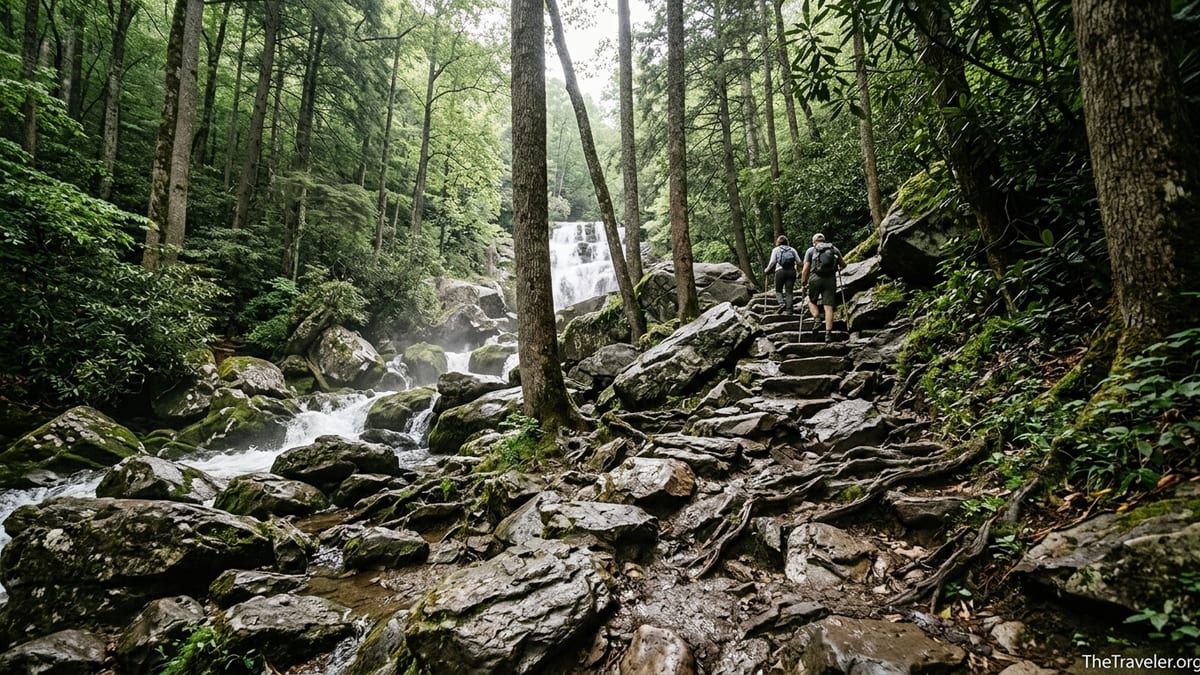
A Trail That Feels Tough Long Before the Waterfall Reward
Ramsey Cascades is an 8 mile round trip hike with more than 2,000 feet of elevation gain, climbing steadily from the Greenbrier trailhead along an old roadbed before narrowing into rugged singletrack. While numbers like 2,200 to 2,500 feet of gain spread over 4 miles might sound manageable to seasoned hikers, the way that elevation is packed into uneven, rocky segments is what makes the trail feel far more punishing than the stats alone suggest. Many visitors who comfortably finish Rainbow Falls or Alum Cave are surprised by how drained they feel on Ramsey’s final mile.
The trail plays psychological tricks from the start. The first mile and a half lulls you along a relatively wide former jeep road that parallels rushing Ramsey Prong, with broad, gentle grades. It feels like a casual warm-up, and hikers often push harder than they should here. Once the track narrows, though, the character changes quickly. Rocks crowd the tread, roots cross at tricky angles, and the climb ramps up sharply. By the time you reach the final, steep approach to the 100-foot cascade, many strong hikers find themselves taking frequent breathers between boulder steps.
Real-world hiking reports back this up. On popular travel forums and recent reviews, fit visitors who regularly tackle 10 mile days in the Smokies mention taking five to seven hours to complete Ramsey Cascades, compared with three to four hours on moderate trails of similar distance. They describe legs “feeling like jelly” long before reaching the falls, and a descent that is just as demanding as the climb because of the constant need to watch every foot placement.
Even experienced backpackers find the combination of distance and terrain deceptive. If you are used to Western switchbacked trails with smooth dirt tread, Ramsey’s mix of stone, mud, and awkward rock steps can feel far slower. A hiker who expects a 2 mile per hour pace may find themselves averaging closer to one mile per hour in the upper half, stretching what looked like a medium day into a genuine all-day push.
Relentless Elevation Gain and Technical Footing
What truly distinguishes Ramsey Cascades from many other Smokies waterfall hikes is how rarely the trail gives you a break. After the gentle opening stretch, the climb becomes persistent. Short flat spots exist, but they are brief pauses at creek crossings or small clearings before the grade tilts upward again. This lack of recovery sections is mentally fatiguing, even for strong hikers accustomed to elevation.
The surface itself is as tiring as the incline. Above the old roadbed, much of the route picks its way over angular stones and exposed tree roots. In wet or humid conditions, which are common in this temperate rainforest, those surfaces turn slick. The National Park Service and partner groups have spent years installing log steps, rock stairs, and rebuilding washed-out sections, greatly improving the safety of the route. Yet the very improvements highlight how steep and eroded this mountainside wants to be. Long stair runs, uneven step heights, and narrow rock corridors demand focus from every muscle in your legs and ankles.
For example, near the final half mile, hikers must negotiate a series of stone steps wedged into the hillside alongside Ramsey Prong. In spring when flows run high, spray from the river leaves this stonework damp and mossy. Trekking poles help, but there is no avoiding the constant micro-adjustments to stay upright, especially on the way down when fatigue has set in. Even hikers who breeze up the switchbacks of Trillium Gap or Sugarland Mountain often find Ramsey more exhausting simply because the footing requires so much attention.
Compare Ramsey Cascades with other popular waterfall hikes nearby. Laurel Falls uses paved segments and carefully graded paths to reach its scenic plunge. Grotto Falls is steeper but relatively short, and its tread is more forgiving. Ramsey, by contrast, stays stubbornly wild. It climbs through boulder fields, squeezes between lichen-covered trunks, and forces you to step over and around obstacles for hours rather than minutes. The result is a hike that feels more like a backcountry route, even though it is a day hike from Gatlinburg.
Stream Crossings, Slick Rock, and Real Objective Hazards
In addition to constant climbing, Ramsey Cascades presents objective hazards that require mountain sense, not just fitness. The trail crosses or closely parallels lively branches of Ramsey Prong for much of its upper half. During or after heavy rain, these streams swell quickly, turning routine rock hops into serious water crossings. Local guides and experienced hikers frequently advise turning around if you arrive after a major storm and find water lapping over normally dry stepping stones.
Even in dry conditions, sections of the trail are naturally slick. Mossy boulders, wet roots, and shaded rock faces seldom receive strong sunlight, so they stay damp throughout the day. Close to the falls, where mist hangs in the air, everything from the viewing rocks to the surrounding tree trunks can feel like they have been lightly coated in oil. Park rangers regularly warn visitors not to climb on the rocks around the base of the falls; over the years numerous rescues have involved people who slipped while trying to get closer for a photo.
Wildlife is another factor that adds seriousness to the hike. The Greenbrier area is quality black bear habitat, and recent temporary closures of Ramsey Prong Road and the trail due to bear activity reinforce that this is not a city park path. Even seasoned Smokies hikers who know bear etiquette still need to be prepared to change plans on short notice, carry bear spray if they are comfortable with it, and store food properly at the trailhead and on the hike. Encountering a feeding bear on a narrow section of the trail can mean retreating and losing hard-won elevation.
Finally, the remoteness of Ramsey Cascades increases the consequences of mistakes. Cell service is inconsistent to nonexistent for most carriers along the upper trail. Rescue teams must travel the same rocky tread you do, often carrying heavy gear. A broken ankle on a loose rock can turn into an hours-long evacuation involving multiple rescuers, with the injured hiker exposed to cool, damp forest air. Even highly experienced hikers who normally take calculated risks on shorter, more accessible routes often dial back their risk tolerance here because they recognize how long help would take to reach them.
Remote Greenbrier Access and Logistical Challenges
Getting to Ramsey Cascades begins with a drive into the Greenbrier section of Great Smoky Mountains National Park, northeast of Gatlinburg along U.S. 321. Unlike the heavily trafficked Sugarlands Visitor Center corridor, Greenbrier feels tucked away. The access road narrows to gravel, and visitors pass a ranger station, picnic areas, and several side trailheads before reaching the small parking area at Ramsey Cascades. For drivers used to wide, paved national park roads, this approach alone sets a more remote tone.
Recent years have underscored how fragile this access can be. Flooding has washed out sections of Greenbrier Road, and major rehabilitation work on the trail meant periodic weekday closures. More recently, seasonal bear activity has at times required temporary shutdowns of both Ramsey Prong Road and the trail. For travelers planning a Smokies hiking vacation, this means that Ramsey Cascades cannot always be treated as a plug-and-play option. Checking the latest park alerts right before your trip and having a backup plan, such as Porters Creek Trail or Brushy Mountain from other trailheads, is essential.
Parking is another real-world constraint that makes the hike feel more committing. The trailhead lot is small and fills quickly on spring and fall weekends. When that happens, drivers must turn around and park along the road shoulders in designated spots, adding an extra quarter mile or more of walking each way. This may not sound like much, but on a route where many hikers already underestimate the time and energy required, that extra half mile can be the difference between finishing confidently and limping back in darkness.
All these logistical details combine to make Ramsey Cascades the kind of hike that rewards advance planning. Experienced hikers who routinely throw a daypack in the car and improvise their route in the Newfound Gap area often find that Ramsey demands a stricter schedule: an early morning start from Gatlinburg or Pigeon Forge, a firm turn-around time set on the map, and a careful eye on afternoon thunderstorms that can swell creeks and drench the rocky tread.
An Old-Growth Cathedral That Lures You Deeper
If Ramsey Cascades is demanding, it is also deeply seductive. The upper Greenbrier valley holds some of the park’s finest remaining old-growth forest, with tulip poplars and hemlocks that tower above the understory. As the trail leaves the old roadbed and climbs toward the falls, hikers enter a world of massive trunks, moss-draped boulders, and filtered green light that feels far removed from parkway overlooks and busy visitor centers.
These surroundings are part of what makes the trail psychologically tricky even for seasoned hikers. It is easy to keep pushing “just a bit farther” when every switchback reveals another cluster of giant trees or another scramble beside the cascading creek. You might tell yourself you will reassess at the next bend, only to find an even more beautiful stretch of forest that nudges you farther up-valley. Before long, you have committed to the full climb and are too invested to turn around, even if the day is wearing on and thunderstorms are building over Mount Guyot.
The waterfall itself is a powerful motivator. Ramsey Cascades is widely regarded as one of the most impressive falls in the entire park, dropping around 100 feet over a stair-stepped rock face. Photographs in guidebooks and social media feeds show a classic Smokies scene: white water streaming over dark stone, framed by rhododendron and hardwoods. For experienced hikers, that kind of iconic endpoint can trigger a summit mentality where reaching the falls feels mandatory, even if aches, weather, or slower-than-expected progress suggest turning back.
This emotional pull can lead even practiced mountain travelers to break their own rules about turnaround times, snack and water breaks, or how long they are willing to push on uncertain footing. The very beauty that makes Ramsey Cascades special is the same beauty that coaxes tired legs up the last, steep, rock-strewn quarter mile when perhaps they should instead be heading down.
Why Experienced Smokies Hikers Still Get Surprised
Many visitors tackle Ramsey Cascades only after building a Smokies resume of marquee hikes: Alum Cave to the bluffs, Charlies Bunion from Newfound Gap, Chimney Tops, Rainbow Falls, and parts of the Appalachian Trail. Each offers its own challenge, but they also share traits that can lull strong hikers into complacency: well-signed trailheads near main roads, heavy traffic that provides a sense of security, and terrain that, while occasionally steep, is generally predictable.
Ramsey Cascades breaks that pattern. It is not isolated wilderness, yet it has a backcountry feel that is rare so close to Gatlinburg. The trail is less crowded than the park’s famous ridge routes, the forest feels wilder, and the creek crossings and rock steps demand constant engagement. Hikers used to trading stories about how fast they completed Alum Cave or how many viewpoints they bagged in one day often find themselves oddly quiet after a full Ramsey outing, reflecting more on slippery rocks and narrow ledges than on Instagram-ready vistas.
Conditioning is another reason this trail surprises people. Many Smokies hikes train you to expect straightforward elevation: a strong, sustained climb early, then a long descent. Ramsey’s more mixed profile, with its alternating ramps and rocky benches, taxes different muscles. Your calves burn on steep pitches, your stabilizers work overtime on off-camber rocks, and your quads take a beating on the descent. Runners who easily jog the lower Oconaluftee River Trail or even add trail miles at Cades Cove often discover that their usual endurance does not translate perfectly to Ramsey’s chunky upper miles.
Finally, the timing catches people off guard. An experienced party might plan for a six mile hike to take three hours, assuming rest stops and photo breaks. Apply that same logic to Ramsey Cascades without adjusting for terrain, and you arrive back at the car an hour or more later than expected. That matters in winter when daylight is short, in summer when afternoon storms build quickly, and in shoulder seasons when overnight temperatures can drop sharply. Seasoned hikers are not immune to those factors; if anything, they are more prone to assuming they can “make up time” on the way down, only to find that the rocky descent is just as slow.
How to Prepare If You Think You Are Ready
For hikers who already have Smokies experience and still want to take on Ramsey Cascades, thoughtful preparation makes the difference between a punishing slog and a challenging but rewarding day. The practical steps look simple on paper: start early, bring extra water and calories, pack a light but complete rain layer, and wear real hiking footwear with grippy soles instead of casual sneakers. In practice, every one of those choices matters more on this trail than on many others in the park.
Starting early from nearby bases like downtown Gatlinburg or the cabins dotted along East Parkway does more than help you secure a parking spot. It buys you cooler temperatures for the steep lower miles and a buffer of daylight in case your pace is slower than expected. Many experienced hikers aim to leave the trailhead by 8 a.m., which, in peak season, can make the difference between hiking through quiet forest and navigating crowded, fatigue-fueled bottlenecks on the rocky stair sections later in the day.
Gear-wise, trekking poles are almost a secret weapon here. Even hikers who rarely use poles elsewhere often swear by them on Ramsey Cascades for taking pressure off knees during the descent and providing stability on slime-slick stones near the creek. A small first-aid kit with blister treatment, tape, and a compression bandage is not overkill given the number of awkward steps and ankle-twisting rocks. Extra snacks, such as energy bars or nut mixes purchased in Gatlinburg shops, can help keep energy levels steady during the long, continuous effort.
Perhaps most importantly, experienced hikers should mentally reframe Ramsey Cascades as a serious objective, not a casual waterfall stroll. That means setting a firm turnaround time regardless of whether you have reached the falls, discussing bear and weather contingencies with your group beforehand, and being honest about how everyone feels at key decision points. In a landscape as beautiful as Greenbrier’s old-growth valley, the instinct to keep pushing is strong. Respecting the trail enough to call it a day early if conditions deteriorate is the hallmark of a truly seasoned hiker.
The Takeaway
Ramsey Cascades has all the ingredients of a classic Smokies outing: a roaring mountain creek, lush old-growth forest, and a spectacular waterfall payoff. Yet it is the less photogenic elements that define the experience for most hikers: relentless elevation gain, slick and uneven footing, narrow tread above fast water, bear activity, and real remoteness once you leave the gravel road behind. These factors do not disappear because you have logged miles on Alum Cave or the Appalachian Trail; if anything, they stand out more sharply by comparison.
Far from being a reason to avoid the trail, Ramsey’s difficulty is part of what makes it so memorable. When approached with humility, preparation, and a willingness to turn back when conditions warrant, it offers one of the most rewarding day hikes in Great Smoky Mountains National Park. The cascade itself is unforgettable, but so is the feeling of stepping back onto the gravel road at day’s end, legs tired and respect for this deceptively tough trail renewed.
FAQ
Q1. How long does it take to hike Ramsey Cascades for an experienced hiker?
Most experienced hikers should plan on 5 to 7 hours round trip, including breaks, photographs, and a careful descent over the rocky upper sections.
Q2. Is Ramsey Cascades harder than popular hikes like Alum Cave or Rainbow Falls?
Many hikers find Ramsey Cascades more demanding because of its combination of elevation gain, rough footing, and remoteness, even if they have completed Alum Cave or Rainbow Falls comfortably.
Q3. What is the best season to hike Ramsey Cascades?
Late spring and fall are often ideal, with cooler temperatures and flowing water. Summer heat and humidity make the climb more taxing, while winter can bring ice and shorter daylight.
Q4. Do I need special gear beyond normal day-hiking equipment?
In addition to standard day-hiking gear, sturdy footwear with good traction and trekking poles are strongly recommended because of slick rocks, roots, and steep stair sections.
Q5. Are there recent closures or restrictions I should know about?
Flood damage repairs, trail rehabilitation, and seasonal bear activity have all led to temporary closures in recent years, so it is important to check current park alerts just before your hike.
Q6. Is the trail suitable for children or less experienced hikers?
The length, elevation gain, and technical terrain make Ramsey Cascades a poor choice for young children or casual hikers. Families often opt for shorter waterfall hikes instead.
Q7. How early should I start the hike?
Leaving the trailhead by mid-morning, around 8 a.m., is wise. This allows a generous daylight window and improves your chances of finding a parking spot at the small trailhead lot.
Q8. Can I swim or climb on the rocks at the base of the falls?
No. The rocks around the base are extremely slick, and climbing or scrambling near the falls has led to injuries and rescues. Staying on the designated viewing area is safest.
Q9. How bad are the stream crossings?
In normal conditions, crossings are usually manageable on rocks or small footbridges, but after heavy rain the water can rise quickly and may make the upper crossings unsafe for the day.
Q10. What makes Ramsey Cascades rewarding despite the challenge?
The combination of towering old-growth trees, the wild feel of the Greenbrier valley, and the dramatic multi-tier waterfall at the end creates a sense of immersion and accomplishment that many hikers rank among their best Smokies experiences.