


Planning a weekend escape from Madrid to western Spain usually comes down to a choice between Cáceres and Salamanca. Cáceres seduces with one of Europe’s best preserved medieval cores, a UNESCO World Heritage old town and a quieter Extremaduran feel. Salamanca dazzles with golden sandstone university buildings, lively plazas and a large student population that keeps bars and cafés buzzing late into the night. This guide compares the two in practical, decision-focused detail so you can pick the city that fits your style, timing and budget.
Get the latest updates straight to your inbox!
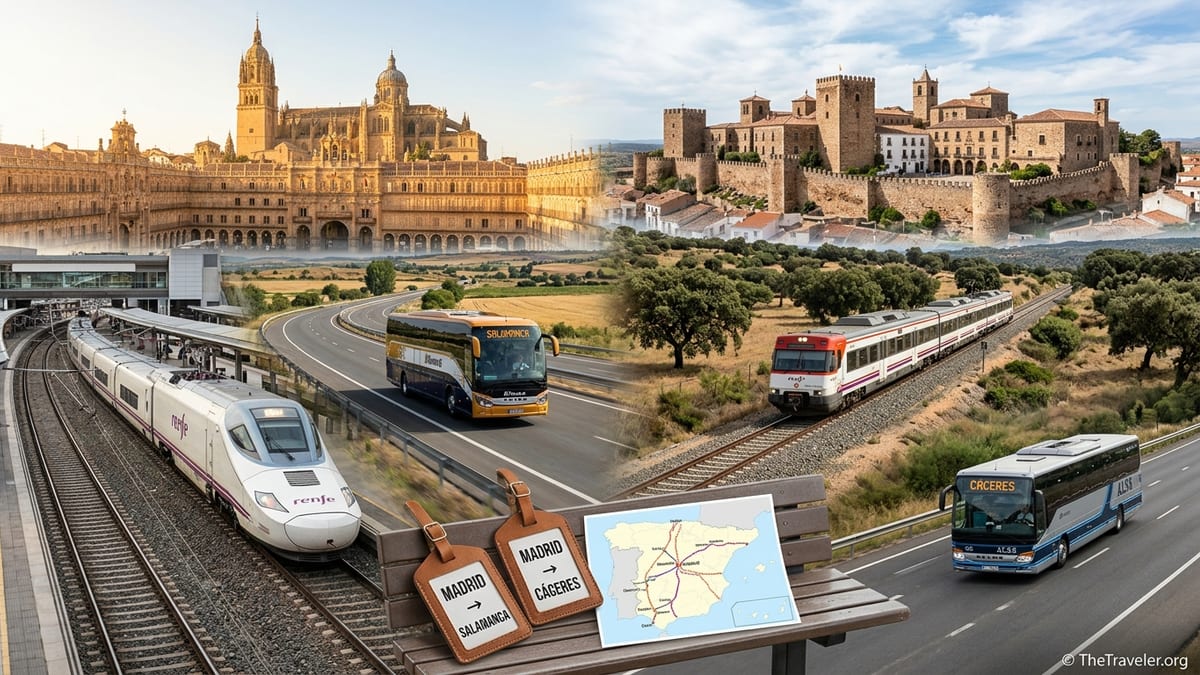
Getting There from Madrid: Trains, Buses and Arrival Logistics
From Madrid, Salamanca is easier and faster to reach than Cáceres. Renfe operates Media Distancia and Alvia services from Madrid Chamartín station to Salamanca, generally taking around 1 hour 40 minutes to 2 hours 30 minutes depending on the train type and intermediate stops. Recent schedules show several direct departures per day, with advance purchase fares on regional Media Distancia services advertised from around 18 to 20 euros one way in second class when booked early. Same-day or flexible fares can be noticeably higher, so checking prices as soon as tickets open, usually a few weeks ahead, is wise.
Madrid to Cáceres services are slower and a bit less frequent. Renfe runs a mix of Media Distancia, Regional and at least one Alvia service on the Madrid–Extremadura corridor, currently departing mainly from Madrid Puerta de Atocha–Almudena Grandes and sometimes from Madrid Chamartín depending on the train. Recent timetables and aggregators show about six trains a day, with journey times typically between 3 hours 20 minutes and around 3 hours 45 minutes and direct services available on most days. Advance fares on regional services can appear from roughly 13 to 20 euros one way, with Alvia and last-minute prices higher. Because schedules can change and strikes occur, travelers should verify times close to travel dates using Renfe’s official channels.
Long-distance buses provide alternatives. For Salamanca, Monbus now runs the Madrid–Salamanca route that was once operated by Avanza, with services departing both from central Madrid bus terminals and, on some runs, directly from Barajas Airport terminals. Travel times vary around 2 hours 30 minutes to 3 hours depending on traffic and stops. For Cáceres, long-distance buses serve the Madrid–Extremadura corridor from Estación Sur de Autobuses, usually taking about 4 hours. Bus tickets often cost between 15 and 30 euros one way, and can be useful if trains are affected by strikes or sold out.
Arrival logistics slightly favor Salamanca. Salamanca’s rail station lies about 20 to 25 minutes on foot from Plaza Mayor, or roughly 10 minutes by urban bus or taxi. The walk is straightforward, mostly along city streets with cafés and shops. Cáceres station, on the other hand, sits a little farther from its Plaza Mayor, roughly 25 to 30 minutes on foot. Many visitors opt for a short taxi ride or local bus, especially with luggage, since the historic center rises on a hill above the modern city. If you want the most time-efficient, low-effort weekend out of Madrid, Salamanca has the edge for transport convenience.
First Impressions: Old Stones, Squares and Atmosphere
Cáceres’s calling card is its remarkably intact medieval and Renaissance walled city. Step through the Arco de la Estrella from the spacious Plaza Mayor and you are inside a compact maze of cobbled lanes, stone towers and noble palaces that has earned UNESCO World Heritage status. Much of the upper town is almost free of commercial signage and modern traffic, especially in the evenings, so wandering can feel like walking onto a historical film set. It is generally quieter than most Spanish old towns, reinforcing the sense of time travel and Extremadura’s slower pace.
Salamanca impresses in a different way. The historic center is larger, livelier and bathed in the warm glow of Villamayor sandstone that gives the whole city a golden hue, especially around sunset. Its Plaza Mayor, framed by baroque arcades and packed with terraces, functions as the city’s living room and rarely feels empty. University buildings spread around the old town create a constant flow of students, giving the city an intellectual and youthful energy that contrasts with Cáceres’s more contemplative feel. Street musicians, language students and locals heading between lectures add to the buzz.
For travelers seeking a romantic medieval escape with fewer crowds and a strong sense of preservation, Cáceres offers a more intimate atmosphere. For those who prefer a classic Spanish city break filled with café culture, street life and academic heritage, Salamanca’s first impression will likely be more compelling. Your reaction on arrival may be the single biggest factor in deciding between the two.
Iconic Architecture and Museums: What You Actually See and Visit
Cáceres’s architectural highlights cluster around its upper town. From Plaza Mayor, the Arco de la Estrella leads into a tangle of stone streets lined with towers and palaces such as the Palacio de los Golfines de Abajo, Palacio de las Veletas and Casa de los Becerra. Several towers can be climbed in season, typically for modest admission fees in the range of a few euros per person. The historic Jewish quarter, with its narrow, less monumental lanes, lies slightly downhill from the main palaces and rewards unhurried strolls. Many historic buildings now house small museums, exhibition spaces or cultural centers, with opening hours often closing for a mid-afternoon break and reduced times on Mondays; checking the local tourism office’s current schedule is recommended.
Museums in Cáceres tend to be small-scale and focused. The Cáceres Museum, housed partly in the former Palacio de las Veletas, covers archaeology and ethnography and is one of the main cultural stops in the old town. Entry has historically been free or low cost for EU nationals, with small fees for others, though policies can change, so visitors should verify prices just before visiting. Contemporary art spaces, including those linked to nearby private foundations, offer rotating exhibitions. Guided walking tours of the old town in Spanish and English run most days, typically lasting 1.5 to 2 hours and costing around 10 to 15 euros per person, giving helpful context on the noble families and defensive architecture that shaped the city.
Salamanca’s icons are more numerous and varied. The twin cathedrals, known together as the Old and New Cathedrals, dominate the skyline. Combined entry tickets usually cover interior visits and may include access to towers or upper galleries for elevated views over rooftops and the Tormes River. In recent years, standard adult admission to the cathedral complex has been around 6 to 10 euros, with optional tower climbs priced slightly higher; prices and opening times can shift with liturgical events and maintenance, so confirming the latest information is essential. Nearby, the famous university façade on Patio de Escuelas draws crowds hunting for the carved frog good-luck symbol, while Casa de las Conchas, decorated with hundreds of carved stone shells, now houses a public library and is generally free to visit.
Salamanca also offers more museum variety. The university’s historical buildings contain collections related to academic life, while other sites range from art and history museums to smaller thematic spaces. Many offer multilingual audio guides or captions. Guided tours in English and Spanish, including university-focused walks, run frequently on weekends and tend to cost slightly more than in Cáceres, often starting around 15 euros per person, but they cover more sites over a larger area. For travelers who prize architectural diversity and museum choice, Salamanca emerges as the stronger option.
Food, Cafés, Nightlife and After-Dark Feel
Both cities deliver solid regional food, though the character differs. In Cáceres, menus highlight Extremaduran products: acorn-fed Iberian ham and pork, Torta del Casar cheese, migas and hearty stews. Around Plaza Mayor and the streets climbing into the old town, many bars offer raciones and tapas. A coffee on one of the main square terraces often runs around 1.50 to 2 euros, while a glass of house wine might cost 2 to 3 euros. Simple set lunches at traditional restaurants can fall in the 12 to 18 euro range per person, including a starter, main, dessert and drink. Vegetarian and international options exist but remain more limited than in larger cities, which can influence choices for some travelers.
Salamanca’s food scene is broader, thanks in large part to the student population and year-round tourism. Classic Castilian-Leonese dishes such as hornazo pastry, chorizo, roasted meats and hearty soups anchor many menus, but you will also find burger bars, Asian restaurants, vegetarian cafés and contemporary tapas spots. Around Plaza Mayor and the nearby streets, espresso or café con leche on a terrace usually costs roughly similar to Madrid’s mid-range prices, which can feel slightly higher than in Cáceres. Fixed-price menus and lunch deals are easy to find, with many casual places offering weekday lunch formulas from about 12 to 20 euros. Supermarkets and take-away counters selling empanadas, bocadillos and salads give budget travelers more flexibility than in Cáceres.
After dark, the difference between the cities becomes more pronounced. Cáceres’s old town grows atmospheric but generally quiet at night. Bars cluster mainly around Plaza Mayor and a few side streets; you can find a handful of cocktail spots and wine bars, but the overall vibe leans toward relaxed drinks rather than high-energy nightlife. Streets within the walled city can feel almost empty on some nights outside local festivals, which many visitors love but some find too subdued.
Salamanca, by contrast, lives late. The area around Plaza Mayor and streets such as Calle Van Dyck and the old university quarter fill with students and visitors moving between tapas bars, pubs and clubs. On Thursday, Friday and Saturday, you can expect busy sidewalks into the early morning hours, with drinks promotions and a noticeable party atmosphere. This makes Salamanca the clear choice for travelers who want nightlife and people-watching. Those seeking quiet evenings, early nights and peaceful strolls may prefer Cáceres’s more low-key ambiance.
Day Trips and Nature: Where You Can Realistically Go
Cáceres works well as a base for exploring Extremadura’s landscapes and historic small towns, although going car-free imposes some limits. The nearby hilltown of Trujillo, with its castle and plaza lined by palaces, lies roughly 45 minutes away by car. Public buses connect Cáceres and Trujillo, but departures are not extremely frequent, especially on weekends, so anyone relying on them should confirm current timetables well in advance and plan for fixed return times. Guided day tours by minibus are sometimes available through local agencies, pairing Trujillo with short stops in surrounding countryside.
Monfragüe National Park, one of Spain’s prime birdwatching and Mediterranean forest reserves, lies within reach of Cáceres but is much easier with a car or organized excursion. The park’s core viewpoints sit a significant distance from train and bus stops, and there is no dense internal public transport network. Certain guided nature tours run from Cáceres on selected days, picking up participants in the city and providing transport and guiding for hikes or birdwatching. Visitors who prioritize nature, raptor spotting and quiet landscapes will find Cáceres the stronger gateway if they are comfortable hiring a car for at least one day or joining a paid tour.
From Salamanca, day trips skew more toward historic towns and villages than pure nature, though attractive landscapes are nearby. Trains and buses link Salamanca with cities like Zamora and Ávila, both known for Romanesque churches or city walls, making independent car-free excursions feasible. Services between Salamanca and smaller villages in the Sierra de Francia exist but may be sparse, so many visitors who want to reach beauty spots such as La Alberca, Mogarraz or Miranda del Castañar either rent a car for the day or join organized tours. Travel times from Salamanca to these mountain villages by car are generally around 1.5 to 2 hours each way.
In practical terms, car-free travelers looking for straightforward day trips will find Salamanca’s rail and bus connections to other heritage towns slightly easier to use. Travelers open to renting a car or booking specific nature tours gain more distinctive options from Cáceres, particularly if birdlife and national-park scenery are important components of their trip.
Where to Sleep: Central Hotels, Events and Price Patterns
Both cities offer accommodations near their main squares, but availability and prices behave differently. Around Cáceres’s Plaza Mayor and within a short walk uphill into the old town, you will find a handful of small hotels, guesthouses and a few boutique properties set in renovated historic buildings. Prices for a double room in shoulder season often fall in a broad range starting near 60 to 80 euros per night for modest but central two or three-star hotels, rising to over 120 euros in high-season weekends, local festival periods or for more atmospheric boutique stays inside medieval palaces. Because the accommodation stock in the historic core is relatively limited, rooms can sell out on popular holiday weekends.
Salamanca’s center has a much wider spread of lodging. Around Plaza Mayor and the streets radiating toward the cathedrals and the river, you can choose from simple pensiones, modern chain hotels and historic properties in old buildings. In off-peak periods, double rooms in well-located three-star hotels sometimes appear from roughly 70 to 100 euros per night, while more characterful or higher-category hotels near Plaza Mayor and the university often range from 120 to 200 euros on busy weekends. University events, exam periods and national holidays can all affect rates and availability, so booking early for spring and autumn weekends is advisable.
In both cities, staying within or just beside the historic center pays dividends, reducing reliance on taxis and maximizing time on foot. In Cáceres this usually means a hotel on Plaza Mayor itself or up in the walled town. In Salamanca it means lodging within a short walk of Plaza Mayor, the cathedrals or the university buildings. Travelers on a tight budget may find it slightly easier to locate low-cost hostels and budget hotels in Salamanca’s central area than in Cáceres, simply because the market is larger.
Two-Day Itineraries and Sample Budgets
For a budget-minded couple spending two days and two nights in Cáceres, a realistic itinerary could start with an early morning train from Madrid on day one, arriving by late morning. After checking into a modest central hotel near Plaza Mayor, you could spend your first afternoon exploring Plaza Mayor, crossing under the Arco de la Estrella and wandering the main palaces and towers of the old town, perhaps joining a guided evening walking tour. Day two might focus on a half-day trip to nearby Trujillo by bus or organized minivan, followed by a relaxed evening of tapas and a stroll through the illuminated upper town. On day three you could enjoy a final coffee on Plaza Mayor before a midday or afternoon train back to Madrid.
In budget terms, such a Cáceres weekend for two might include around 80 to 140 euros total for return train tickets, depending on how early you book and which services you choose, about 120 to 200 euros for two nights in a simple but central hotel, and perhaps 140 to 200 euros for meals over two and a half days if you emphasize menus del día and casual tapas. Adding a guided walking tour and a modest excursion to Trujillo or a short nature outing near Cáceres could contribute another 60 to 120 euros for two, depending on the operator. Overall, a frugal but comfortable couple might spend somewhere from the mid 400s to low 600s of euros in total for the weekend excluding personal shopping.
For a midrange couple in Salamanca, a two-day plan might start with a mid-morning train from Madrid to arrive around lunchtime. After checking into a well-located hotel near Plaza Mayor, you could devote afternoon one to the plaza, Casa de las Conchas and the university façade, then enjoy drinks under the arcades and a tapas crawl. Day two could focus on the Old and New Cathedrals, including a tower climb if conditions and schedules allow, followed by a university-focused guided tour and time on the Roman Bridge for river views. Nightlife options range from quiet wine bars to lively student pubs. On day three you might fit in a quick visit to a smaller museum or a last coffee before an afternoon train back to Madrid.
Costs for such a Salamanca weekend for two might include around 60 to 180 euros for return train tickets, depending on advance purchase and train type, roughly 200 to 350 euros for two nights in a good central hotel, and perhaps 180 to 260 euros for meals if you mix menus del día with some restaurant dinners and late-night drinks. Cathedral and museum entries, plus at least one guided tour, could add another 60 to 120 euros. This places a typical midrange Salamanca weekend for two somewhere in the broad band from the mid 500s to around 900 euros, again excluding shopping. Actual totals will vary with travel dates, chosen hotels and how enthusiastically you eat and drink out.
Weather, Seasons, Accessibility and Crowds
Climate can tip the balance between Cáceres and Salamanca. Extremadura, where Cáceres sits, is known for hot summers, with daytime temperatures regularly climbing high in July and August. Exploring Cáceres’s stone lanes under intense midday sun can be demanding, so in the hottest months many visitors plan early-morning and evening sightseeing, retreating indoors during siesta hours. Spring and autumn usually bring more comfortable conditions, with warm days, cooler nights and less crowding. Winter in Cáceres is generally mild compared with many northern European cities, though cold snaps and rain do occur.
Salamanca, in Castile and León, tends to be colder in winter, with frosty mornings and sometimes foggy or damp conditions around the river. Buildings of solid stone hold the chill, so layers and proper outerwear are important for trips from late autumn through early spring. Summers can be hot as well, though the higher altitude moderates extremes somewhat compared with parts of Extremadura. Shoulder seasons of late spring and early autumn often offer pleasant temperatures and abundant outdoor café life, but also draw more visitors.
In terms of crowds, Salamanca receives more tourists overall and has a large resident student population, so its central streets and plazas feel busy most of the year, especially during university terms and holiday weekends. Special events, graduations and festivals can further swell numbers. Cáceres sees surges during major local festivities and on some weekends, but between events the old town often feels calm. This makes Cáceres appealing to travelers who prefer quieter lanes and fewer queues at attractions.
Accessibility is mixed in both cities. The historic cores are paved with cobbles and include slopes and stairs. Salamanca’s main routes between Plaza Mayor, the university and the cathedrals are relatively broad and better lit, which can help those with limited mobility, though gradients still exist. Cáceres’s upper town features more irregular paving and steeper sections, which can challenge travelers with mobility issues. Those who need step-free access should research specific hotels and check for adapted routes and accessible entrances at key monuments ahead of time.
Verdict: Which City Wins for Your Style of Trip?
Seen through a decision-focused lens, different travelers will land on different winners. For architecture, Salamanca offers more variety, with its twin cathedrals, grand Plaza Mayor, university complex, Casa de las Conchas and the Roman Bridge all within easy walking distance. Cáceres, however, arguably wins for coherent historic atmosphere, thanks to its exceptionally preserved medieval and Renaissance core and the powerful sensation of wandering through a living museum after dark.
For nightlife and evening buzz, Salamanca clearly comes out ahead. Its student population, dense bar scene and active squares create a late-night environment that Cáceres simply does not match. Cáceres instead excels at a relaxed, contemplative atmosphere: quiet streets after dinner, views over the tiled roofs from old towers and unhurried drinks on Plaza Mayor. Those wanting a peaceful, romantic weekend will likely feel more at home there.
When it comes to museum and attraction variety, Salamanca again has the edge, especially if you enjoy church interiors, academic history and a range of curated collections. For nature excursions, Cáceres is the stronger gateway, particularly if you will rent a car or join organized tours to Monfragüe National Park or combine the city with Trujillo and other Extremaduran towns. For car-free day trips to other historic centers, Salamanca’s rail and bus network is marginally more convenient.
Finally, for pure transport convenience from Madrid, Salamanca is the winner. It is closer, faster to reach by train and generally offers more daily departures, making it ideal for short weekends or flexible last-minute escapes. Cáceres takes longer to reach and requires a bit more planning, but rewards that effort with one of Spain’s most atmospheric medieval centers and a quieter slice of western Spain. If your priority is nightlife and a dense set of monuments, choose Salamanca. If you value calm streets, immersive old-town wandering and access to national-park landscapes, Cáceres may be the more rewarding choice for your weekend.