


Cai Be Floating Market has long been one of the most evocative names in Vietnam’s Mekong Delta, a place where boats once packed the Tien River from bank to bank and trade began under the stars. Today it is changing quickly, shaped by highways, tourism and shifting local livelihoods.
If you are planning a visit, it is worth understanding what the market is now, not just what it used to be. This guide walks you through exactly what you will actually see on the water and around Cai Be, so you can arrive with realistic expectations and still appreciate the quieter, more intimate river life that remains.
Where You Are Really Going: Setting & Current Reality
Cai Be Floating Market sits on a broad curve of the Tien River, in Tien Giang Province, roughly two hours by road from Ho Chi Minh City followed by a short boat ride. Historically, this was one of the major wholesale hubs of the Mekong Delta, a meeting point for traders from three provinces who bought and sold fruit and vegetables directly from boats. Many accounts still describe Cai Be as an enormous, frenetic market with hundreds of craft jostling for space.
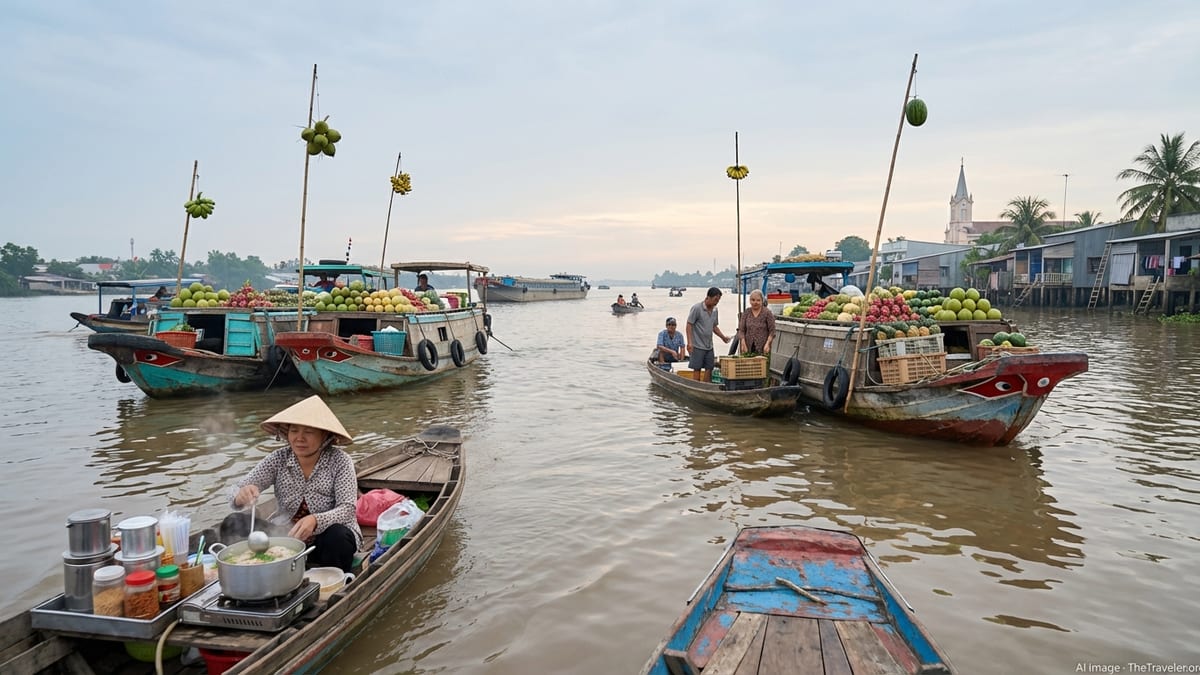
In practice, the picture today is more modest. New bridges, upgraded roads and modern wholesale depots have shifted much of the serious trading onto land. Local tourism and travel operators increasingly describe Cai Be as a mix of smaller-scale floating trade and riverside markets rather than a single massive cluster of boats. You are unlikely to find the river completely jammed with wooden hulls; instead, you will see scattered trading boats, sampans serving breakfast, and long-distance barges sliding past, framed by stilt houses and riverfront orchards.
This does not mean Cai Be is no longer worth visiting. It is still one of the most accessible windows into waterborne life for travelers using Ho Chi Minh City as a base. But it has shifted from a pure, working wholesale market to a softer blend of commerce and tourism. The experience is less about buying sacks of fruit and more about watching local rhythms, sampling food on the water and combining a short market visit with time in nearby canals and villages.
The Rhythm of the River: What You’ll See at Different Hours
The character of Cai Be changes dramatically over the course of the day, and the time your boat pulls up to the dock will shape your impression more than almost anything else. For a sense of the market as a functioning trading point, first light is still the key. Boats begin to gather from around 3 am. By about 5 am the river typically feels most alive, with wholesale buyers completing their rounds and smaller retail boats moving between them.
Arriving between 5 am and 7 am, you are likely to see a loose cluster of medium-sized wooden boats, each piled with fruit or vegetables, moored in midstream or along the banks. Some will be conducting real sales to other Vietnamese buyers; others will be more oriented toward serving breakfast and drinks to visitors. The light is gentle, the temperatures are manageable and the colors of piled pomelos, dragon fruit and pineapples stand out sharply against the muted brown of the river.
By about 8 am, activity tapers off noticeably. Many of the biggest trading boats will have finished their work and moved on, and the river traffic becomes more about regular transport: schoolchildren in small boats heading to class, families traveling between hamlets, and fishermen maneuvering along the banks. If you come in late morning expecting a dense, hectic market, you may be disappointed. Instead, you will see a slower, more everyday river scene, with just a scattering of vendors still selling drinks or snacks from sampans.
Late afternoon, from around 4 pm, can bring a different kind of charm. The main trading is over, but the riverside villages and orchards glow in the low sun, and the water is quieter. Some tours time their Cai Be visit for this hour to focus less on commerce and more on scenery: children swimming near stilt houses, families cooking on open verandas, and farmers loading small boats with produce for the next day’s early run to land-based markets.
Boats, Poles and Fruit Pyramids: How the Market Works
One of the first details you will notice on the water is a forest of tall bamboo poles rising from the decks of trading boats. At the top of each pole hangs a small sample of whatever the boat is selling: a cluster of bananas, a single pumpkin, a garland of onions. This simple signal system is known locally as a “cay beo.” It predates modern signage and helps buyers spot the right boat from a distance without shouting across the water.
On the decks themselves, goods are usually stacked in neat pyramids or rows. You might see one boat carrying nothing but green coconuts, another devoted entirely to watermelons, and a third stacked high with cabbages. Bargaining tends to be pragmatic rather than theatrical. Buyers, often in smaller wooden boats, pull alongside, inspect the produce and negotiate by the crate or basket. Local wholesalers still treat Cai Be as a collection point for fruit from nearby orchards that will move onwards to city markets.
Around these core trading boats, you will find smaller sampans that serve as the market’s “services sector.” These boats weave between moored hulls selling hot coffee, iced tea, noodle soups and sticky rice. Their owners know many of the traders by name and will pull up alongside for brief exchanges that double as breakfast and social catch-up. As a visitor, your tour boat may flag down one of these floating kitchens so you can buy a bowl of noodles or a cup of strong Vietnamese coffee from your seat.
Because Cai Be has become popular with day tours, there is also a layer of visitor-oriented services. Some boats now carry pre-cut fruit portions rather than whole sacks, drinks in cans or bottles, simple snacks and occasionally souvenirs. Compared with land markets, the selection is limited, but it reflects the blend of local needs and traveler demand that defines the market’s modern identity.
Beyond the Postcard: How Cai Be Is Changing
Any honest explanation of Cai Be today has to acknowledge how much the market has evolved. For decades, floating markets existed because rivers were the most practical roads. Barges could move tons of fruit faster and more cheaply by water than over muddy tracks. As Vietnam’s economy modernized, bridges rose over the Mekong’s branches, roads were paved and trucking companies assumed much of the wholesale trade.
That shift has inevitably thinned out the river traffic. Some long-time traders have moved their businesses to land-based depots, where deals can be struck without the costs of maintaining a boat home. Younger generations are less likely to choose a life entirely on the water, preferring jobs in nearby towns or the booming cities upriver. Where families once lived year-round on their trading boats, many now split their time between shore and river.
At the same time, tourism has become a significant part of Cai Be’s economy. Travel agencies in Ho Chi Minh City promote floating market day trips, and many local boat operators have pivoted from hauling produce to carrying visitors. As a result, certain scenes you encounter will be shaped for the camera: a vendor calling out cheerfully as your tour sampan draws alongside, a carefully displayed basket of fruit positioned where you can easily photograph it, or a tasting of coconut candy arranged at a family-run workshop along the canals.
For travelers, this does not have to diminish the experience, but it does change what “authentic” means. Instead of expecting to step into a purely working wholesale market untouched by tourism, it is more realistic to see Cai Be as a living place adapting to new realities. Genuine trade still occurs, but so does a conscious effort to engage visitors. The atmosphere is less raw and more curated than older accounts might suggest, but it remains a valuable way to glimpse how river life is evolving in the Mekong Delta.
What You’ll Actually Do on a Cai Be Visit
Most travelers reach Cai Be as part of an organized excursion from Ho Chi Minh City or Can Tho, though it is also possible to arrange your own boat at the local wharf. Whichever route you choose, your time on the water typically follows a loosely similar pattern, blending market viewing with smaller side trips through the surrounding waterways and villages.
First, you board a motorized wooden boat at a pier on the Tien River. The boat is usually covered, with open sides to catch the breeze and allow for photos. As you head toward the market area, you pass under the gaze of a large riverside Catholic church, rows of stilt houses, and smaller cargo vessels ferrying sand, rice or building materials along the river. The view is less about a single landmark and more about a continuous stream of local activity.
Once you near the core market zone, the captain will slow to a crawl so you can take in the trading boats, their “cay beo” poles and the smaller breakfast sampans. Your boat may pull alongside one or two vendors so you can buy fruit or juice, or simply to allow you a closer look at life on board. Expect conversations to be a mix of simple English, Vietnamese and gestures, often smoothed by the presence of a local guide who can translate basic exchanges.
Afterward, many tours leave the main river and turn into a network of narrow canals that thread through orchards and small hamlets. Here you are likely to stop at family-run workshops producing items such as coconut candy, rice paper, puffed rice cakes or traditional sweets. These stops can feel commercial, but they also reveal how households diversify their income beyond farming and market trading. Some itineraries include a short ride in smaller, hand-rowed sampans along particularly narrow, shaded channels, offering a more intimate, slower-paced look at daily life.
The Details: Food, Sights and Sensory Impressions
For many visitors, the most vivid memories of Cai Be are of taste and sound as much as sight. Breakfast on the water might be a plastic bowl of hu tieu or banh canh, noodle soups built on clear or slightly cloudy broths, studded with pork, seafood or fish balls, and topped with herbs. The cook ladles broth from a pot balanced on a small charcoal or gas stove set up directly on the sampan’s deck. Balancing your soup as the boat rocks gently takes a bit of practice, but it is part of the charm.
Coffee is another essential note in the market’s soundtrack. Vendors prepare it the traditional Vietnamese way, relying on strong robusta beans and condensed milk. You might sip it hot from a small plastic cup or over ice if the morning is already warming up. All the while, the ambient soundscape fills in: the slap of waves against wooden hulls, the putter of small engines, distant laughter, the occasional rooster crowing from a boat roof, and snatches of conversation carried over the water.
Visually, Cai Be offers a quieter palette than some travelers expect, but the details are rich. Look for the way families adapt their boats into floating homes, with hammocks slung under tarps, potted plants near the bow, laundry lines stretched between poles and small shrines tucked near the steering wheel. Notice the layers of paint on hulls, the way names and registration numbers are scrawled across sterns, and the painted eyes on bows that, in local belief, help boats navigate safely.
Along the riverbanks, stilt houses and low-slung workshops speak to a life oriented toward the water. Wooden ladders run from back doors down to mooring posts, boats are pulled half ashore for repairs, and small gardens cling to the thin fringe of earth between house and river. The combination of coconut palms, tangled vines and the wide, moving water creates an atmosphere that feels far removed from the traffic and towers of Ho Chi Minh City, even though the city lies only a few hours away.
Making the Most of Your Visit: Practical Expectations
To align what you see with what you hope for, it helps to set a few practical expectations in advance. First, understand that Cai Be no longer resembles the massive, densely packed floating markets of past decades. If your goal is to witness a large-scale, working wholesale market, you may want to combine Cai Be with other destinations in the Mekong Delta that still attract bigger fleets of boats. If, instead, you are interested in a gentler introduction to river life that fits comfortably into a day or overnight trip from Ho Chi Minh City, Cai Be remains a solid choice.
Second, timing matters. For the fullest sense of market activity, plan your boat ride to coincide with the early morning hours, aiming to be on the water by around 5 or 6 am. That usually means an overnight stay near Cai Be or a very early departure from Ho Chi Minh City. If you cannot manage that schedule and instead visit later in the morning or afternoon, frame your expectations around scenery, quiet canals and small workshops rather than a bustling market scene.
Third, think of the experience as broader than the floating market alone. The value of a Cai Be trip often lies in the combination of activities: drifting past trading boats at dawn, gliding through shaded side canals, walking short stretches of village paths, tasting local sweets and fruits, and watching how families work multiple jobs to adapt to a changing economy. Seen this way, the floating market is a focal point, but not the entire story.
Finally, keep a flexible mindset on the water. Conditions change with the season, the day of the week and even local events. There may be mornings when more boats gather, and others when the market feels thin. Your guide and boat operator will usually adjust the route to make the most of whatever is happening on the river that day, whether that means lingering longer at the remaining trading cluster or spending extra time along especially atmospheric canals.
The Takeaway
Cai Be Floating Market is no longer the crowded, purely functional wholesale hub that older travel tales describe, but it remains a revealing lens on the Mekong Delta’s transformation. You will likely see a modest but evocative cluster of trading boats displaying their goods on bamboo poles, sampans serving breakfast and coffee, and the quiet choreography of families who still depend on the river.
Rather than judging Cai Be against an idealized image of what floating markets “should” look like, it is more rewarding to treat your visit as a chance to witness change in real time. You are stepping into a community that is adapting to better roads, new jobs and increasing numbers of visitors, while still holding on to key pieces of river culture. If you come early, stay observant and embrace both the market and its surroundings, Cai Be will give you not just colorful photographs but a more nuanced understanding of how life on the waters of the Mekong is evolving.
FAQ
Q1. Is Cai Be Floating Market still active or has it closed?
Cai Be is still active, but on a smaller and more mixed scale than in the past. You will see a limited number of trading boats and service sampans rather than a vast, tightly packed fleet. The market has shifted some of its activity onto land and toward tourism, yet genuine river-based trade still takes place in the early morning hours.
Q2. What is the best time of day to visit Cai Be Floating Market?
The most rewarding time is between about 5 am and 7 am, when trading activity is most visible, temperatures are cooler and the light is soft. Boats start to gather from around 3 am, and by 8 am much of the market’s energy has faded. Late afternoon offers pleasant scenery but far less active commerce.
Q3. What will I actually see on the water during a visit?
You can expect to see medium-sized wooden trading boats displaying fruit or vegetables on tall bamboo poles, smaller sampans selling breakfast and drinks, and everyday river traffic such as family boats and cargo barges. Along the banks you will pass stilt houses, small workshops and orchards that reveal how closely local life is tied to the river.
Q4. Can I buy food and drink at the market, and is it safe?
Yes, food is a central part of the experience. Floating kitchens serve noodle soups, sticky rice, snacks, fresh fruit and strong Vietnamese coffee directly from their boats. Hygiene standards are basic but generally acceptable for travelers accustomed to street food. Choose busy vendors, eat hot dishes and drink sealed bottled water or beverages prepared in front of you if you are cautious.
Q5. How long should I budget for a typical Cai Be Floating Market tour?
A standard boat trip around Cai Be and nearby canals usually lasts from two to five hours, depending on how many stops are included. If you are traveling from Ho Chi Minh City as a day trip, expect the entire excursion, including road travel, to take most of the day. Staying overnight nearby allows you to reach the market earlier with less rush.
Q6. Will the market feel very touristy?
Elements of Cai Be are definitely shaped by tourism, especially set-piece stops at family workshops and some boats that focus on selling snacks and drinks to visitors. At the same time, there is still genuine local trade and everyday river life happening around you. If you arrive early and pay attention to the interactions between Vietnamese buyers and sellers, you will see both sides of this mix.
Q7. What should I wear and bring for a visit to Cai Be?
Light, breathable clothing, a hat, sunscreen and insect repellent are all useful in the Mekong’s heat and humidity. Early mornings can feel slightly cool on the water, so a light layer is helpful. Comfortable sandals or shoes with good grip are recommended for getting on and off boats and walking short distances in villages. Bringing small denominations of cash makes it easier to buy snacks and drinks from vendors.
Q8. Is it suitable for children or people who get seasick?
The river is generally calm, and boats move slowly, so many families visit with children without problems. However, if you are very prone to motion sickness, the gentle rocking combined with heat and strong smells might be uncomfortable. Sitting near the center of the boat, facing forward and keeping your eyes on the horizon can help, as can bringing any motion sickness remedies you normally use.
Q9. How does Cai Be compare to other floating markets in the Mekong Delta?
Cai Be is one of the most accessible markets from Ho Chi Minh City and combines a modest amount of floating trade with scenic canals and village visits. Some other markets deeper in the delta may host more boats and feel more intensely focused on wholesale trade but are harder to reach on a short trip. If convenience and a gentler, introductory experience are your priorities, Cai Be works well.
Q10. Can I visit Cai Be Floating Market independently, or do I need a tour?
You can do both. Many travelers book a tour from Ho Chi Minh City or nearby towns, which includes transport and a set route on the river. If you prefer flexibility, you can travel to Cai Be on your own and hire a boat and optional local guide at the pier. Going independently requires more negotiation and planning, but it allows you to tailor the length and focus of your time on the water.