


More news on this day
Saudi Arabia has become the latest Middle Eastern state to confront mounting trade and air travel disruption as the protracted closure and militarization of the Strait of Hormuz, combined with rolling airspace restrictions, continue to ripple through routes linking the Gulf to Canada, the United States, Germany, the United Kingdom, France, and Spain.
Get the latest news straight to your inbox!
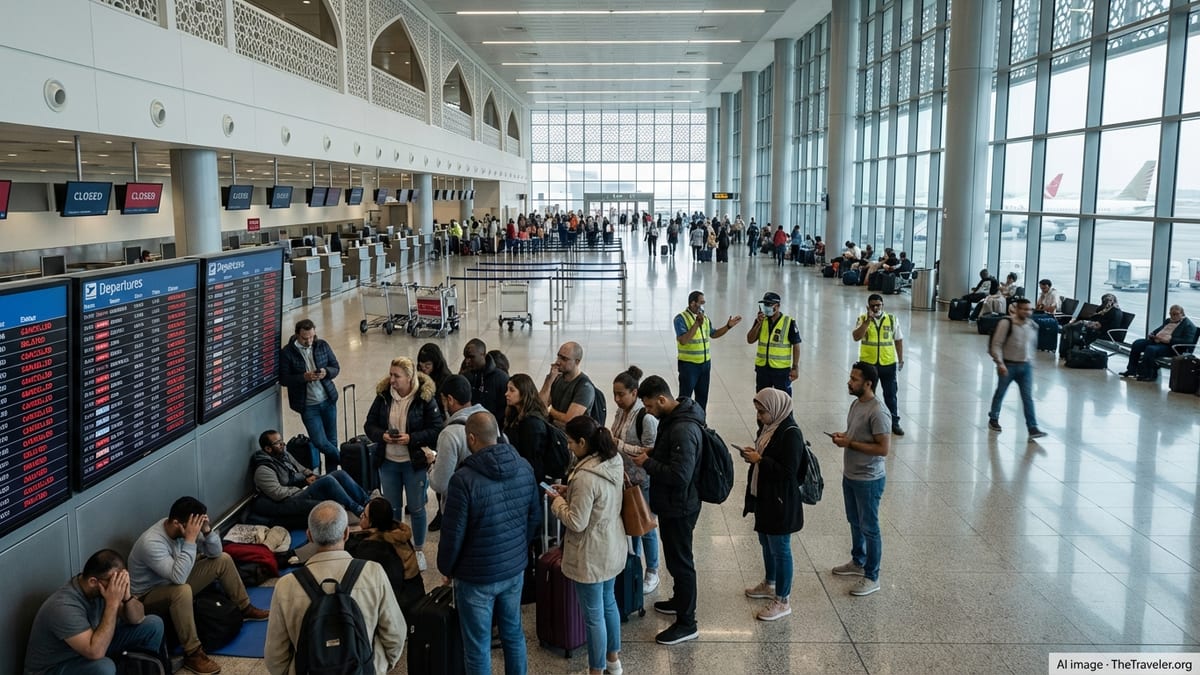
Regional Crisis Spills Into Saudi Skies
Saudi Arabia is increasingly entangled in the wider fallout from the 2026 Strait of Hormuz crisis, which has sharply curtailed commercial shipping and heightened military risk across the Gulf. As the conflict in and around Iran has intensified, publicly available airline notices, port advisories, and industry analyses indicate that carriers in Saudi Arabia, Jordan, Qatar, Bahrain, Egypt, Iraq, and Oman are all navigating a volatile operating environment, with knock-on effects for long haul travel to North America and Europe.
Earlier regional advisories described widespread closures or restrictions affecting portions of Gulf airspace as governments and aviation regulators sought to keep civil traffic clear of missile, drone, and naval activity. Although exact measures vary by country and are being updated frequently, the net effect has been to constrict the main corridors that airlines traditionally use to connect Gulf hubs with major cities in Canada, the United States, Germany, the United Kingdom, France, and Spain.
Saudi operators had already been adjusting schedules and routings in response to the conflict, but the sustained nature of the Hormuz shutdown and the end to predictable overflight patterns are now feeding through into more visible disruption. Passengers transiting through Riyadh and Jeddah, particularly on itineraries involving multiple stops in the region, are encountering longer journeys, last minute rebookings, and, in some cases, cancellations when aircraft and crews are not where timetables expect them to be.
For Saudi Arabia, which has invested heavily in becoming a global aviation hub, the timing is particularly sensitive. The country’s strategy relies on reliable, high frequency links between Gulf airports and major markets such as Toronto, Montreal, New York, Los Angeles, London, Frankfurt, Paris, and Madrid. Each new layer of airspace constraint adds cost and complexity to that model.
Airspace Restrictions Force Lengthy Detours to Europe and North America
The most immediate impact of the crisis for travelers is in the sky. With parts of airspace over and around Iran and the Strait of Hormuz deemed unsafe for civilian traffic, airlines serving Saudi Arabia and neighboring states are being forced to redesign flight paths to Europe and North America, often at short notice. According to published flight tracking data and airline schedule changes, some carriers are routing further south over the Arabian Sea or further north via Iraq and Turkey when feasible, adding significant distance and fuel burn.
These detours are particularly relevant for services from Saudi Arabia, Qatar, Bahrain, and the United Arab Emirates that historically used relatively direct tracks between the Gulf and Western Europe. A Riyadh to London or Doha to Frankfurt flight that once followed efficient great circle routes now may need to loop around restricted regions, extending flying time and narrowing the margin for tight connections to onward transatlantic services bound for Canada and the United States.
The turbulence is not confined to point to point links. Gulf carriers play an outsized role in connecting Europe and North America with destinations across Asia and Africa via hubs such as Riyadh, Doha, Manama, and Muscat. When those hubs are ringed by uncertain airspace, knock-on effects reach passengers traveling to and from cities as far afield as Vancouver, Chicago, Munich, Manchester, Lyon, and Barcelona. Industry observers note that some travelers are rebooking via alternative hubs in Turkey or further west in Europe to avoid the most affected corridors.
Fuel and insurance costs are also rising for airlines operating in and near the Gulf, compounding the pressure to rationalize schedules. Publicly available industry briefings suggest that carriers are trimming marginal frequencies, upgauging aircraft on core routes, or temporarily suspending certain services in order to conserve capacity for the most commercially critical links to markets such as Canada, the United States, Germany, the United Kingdom, France, and Spain.
Blockade of Hormuz Chokes Trade and Cargo Flows
Beyond passenger flights, the effective blockade and militarization of the Strait of Hormuz since late February has severely disrupted maritime trade patterns. Shipping data and international news coverage describe hundreds of commercial vessels delayed, diverted, or idled as Iran reasserted control over the chokepoint and the United States responded with a naval blockade of Iranian ports, creating a layered system of restrictions that has dramatically reduced traffic through one of the world’s busiest energy and container corridors.
For Saudi Arabia and its neighbors, the squeeze at Hormuz is filtering into air logistics. With ocean freight subject to long delays and higher insurance premiums, time sensitive goods that would normally move by sea, such as critical components, pharmaceuticals, and high value manufactured products, are increasingly being shifted to air cargo where possible. However, the same airspace constraints that hinder passenger operations also complicate cargo routings, particularly on freighter services linking Gulf airports with European gateways like Frankfurt, Paris, and London and North American hubs in the United States and Canada.
Reports from shipping and supply chain analysts indicate that major carriers and forwarders are reconfiguring their networks, rerouting some flows via Red Sea and East African ports and using overland connections through Saudi Arabia, Jordan, and Egypt to reach Mediterranean export points. While these workarounds help maintain some level of continuity, they often add days to transit times and raise costs for shippers sending goods to markets such as Germany, France, Spain, and the broader European Union.
The United Nations and other multilateral bodies have recently drawn attention to the implications of the Hormuz blockade for vulnerable import dependent economies, particularly in relation to energy, grain, and fertilizer flows. Although Saudi Arabia and other Gulf producers retain some alternative export options via the Red Sea and internal pipelines, the overall tightening of supply and logistical uncertainty is contributing to global price volatility that ultimately feeds through to consumers in Europe and North America.
Gulf and European Carriers Scramble to Protect Key Routes
Faced with overlapping airspace restrictions and maritime disruption, airlines in Saudi Arabia, Jordan, Qatar, Bahrain, Egypt, Iraq, and Oman, along with their European counterparts, are focusing on preserving commercially and strategically vital links. Publicly available schedule filings and booking data show an emphasis on maintaining core frequencies between Gulf hubs and primary destinations such as London Heathrow, Paris Charles de Gaulle, Frankfurt, Munich, Madrid, and major Canadian and United States gateways, even if that means sacrificing capacity on secondary routes.
Some European carriers have reduced or temporarily paused operations to certain Gulf destinations viewed as higher risk or operationally challenging, instead consolidating traffic through a smaller number of hubs where security coordination and contingency planning are more developed. This dynamic has elevated the role of major Saudi and Qatari airports as transfer points, even as they grapple with their own constraints and rerouting challenges.
The interdependence between Gulf and European networks means that decisions made in Riyadh, Doha, or Muscat can have immediate consequences for travelers in Berlin, Manchester, Boston, or Toronto. When a Gulf route is downgraded from daily to a few times per week, or shifted to a different time of day to accommodate new airspace windows, passengers on both ends of the route must adjust connections and, in some cases, postpone or cancel trips. Travel agents and online booking platforms are reporting increased demand for flexible tickets and alternative routings that avoid the most congested or unpredictable segments.
Industry analysts caution that even if there are tentative diplomatic steps toward easing tensions in and around the Strait of Hormuz, air travel and cargo patterns will not revert to pre crisis norms immediately. Restoring confidence among airlines, insurers, crews, and passengers will require a sustained period of stability, clear deconfliction mechanisms in contested airspace, and a credible roadmap for reopening maritime lanes without the constant threat of disruption.
Longer-Term Questions for Saudi Arabia’s Hub Ambitions
The current crisis is sharpening questions about the long term resilience of Saudi Arabia’s aviation and logistics strategy. The kingdom has invested billions of dollars in new airports, national carriers, and free zones designed to position Riyadh and Jeddah as global crossroads linking Asia, Europe, Africa, and the Americas. Those plans assume that key arteries through the Gulf, including airspace over and around the Strait of Hormuz and maritime channels in the Arabian Gulf and Red Sea, will remain reliably open.
In the short term, Saudi authorities and aviation stakeholders are focused on day to day crisis management: ensuring safety, rerouting flights, supporting stranded passengers, and coordinating with neighboring countries that face similar constraints. However, the prolonged closure of Hormuz and the end to the predictable operating environment that prevailed for much of the past decade are likely to prompt a deeper reassessment of risk across the region’s air and sea networks.
Some regional planners and think tank commentators are already highlighting the strategic importance of diversifying both air and trade corridors. This could mean accelerating investment in alternative overland routes linking the Gulf to the Mediterranean via Saudi Arabia, Jordan, and Egypt, as well as strengthening connections through the Red Sea and the Arabian Sea that are less directly exposed to flashpoints near Hormuz. For air travel, it may translate into more resilient network design, with built in redundancy for routes to major markets in Canada, the United States, Germany, the United Kingdom, France, and Spain.
For travelers and businesses in those destination countries, the immediate experience is one of uncertainty, longer journeys, and higher costs. Over time, however, the adjustments now being forced on Saudi Arabia and its neighbors could reshape global aviation and trade patterns, altering which hubs dominate flows between East and West and how exposed international supply chains are to any single chokepoint.