


More news on this day
Travellers moving through Calgary International Airport are facing renewed disruption as Air Canada and Porter adjust schedules and cancel selected flights to Toronto, Montreal and Vancouver, creating knock-on delays across Canada’s busiest domestic corridors.
Get the latest news straight to your inbox!
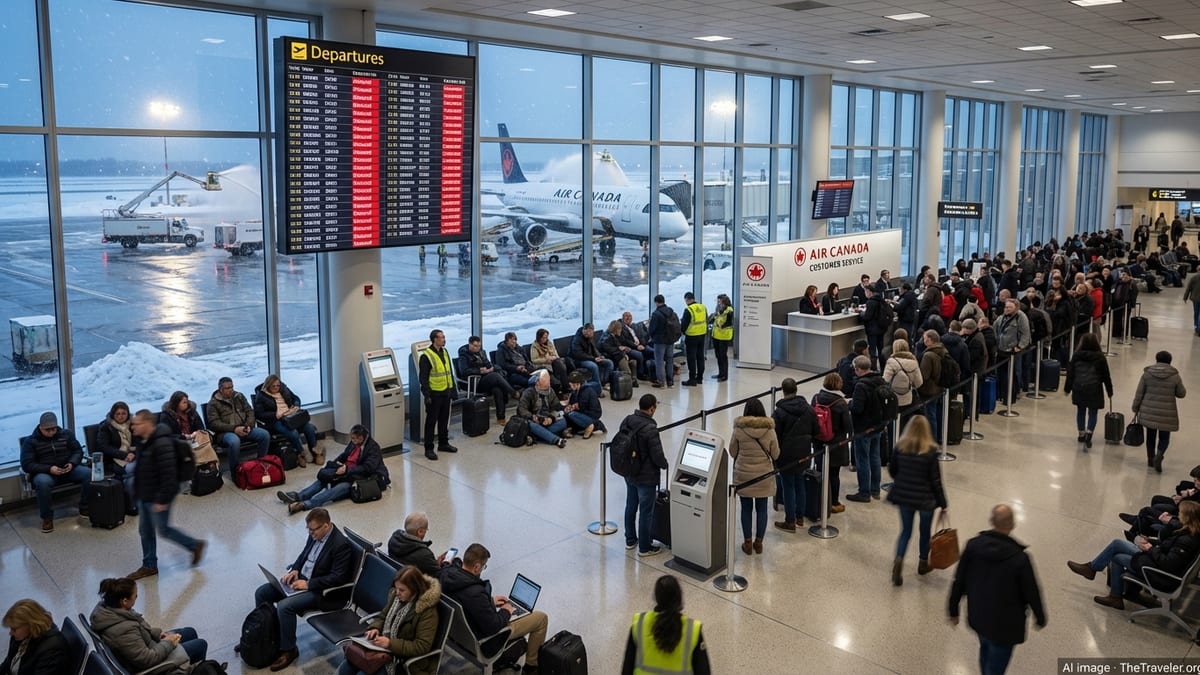
Cancellations Target Connections to Major Canadian Hubs
Recent schedule changes and same day cancellations at Calgary International Airport have affected a number of departures linking Alberta’s largest city with Toronto Pearson, Montreal Trudeau and Vancouver, according to live flight tracking data and airline schedule information. These three destinations function as primary national hubs, and disruption on these routes tends to ripple across domestic and transborder networks.
Air Canada has been selectively cancelling or consolidating services on its Calgary to Toronto and Calgary to Montreal routes, alongside delays affecting remaining flights. Publicly available trackers show multiple services operating outside their planned times, with some flights scrubbed entirely and others rebooked onto later departures. The pattern is adding uncertainty for passengers relying on tight connections from those hubs to eastern Canada, the United States and Europe.
Porter, which has been expanding its western network from Calgary with links to Toronto and Vancouver, has also seen cancellations folded into its revised schedules. Previous industry data highlighted that the carrier has already been under scrutiny for a higher than average cancellation rate at Calgary compared with some eastern bases, and the latest adjustments are drawing fresh attention from travellers monitoring the airline’s reliability during its growth phase.
The combined effect is that Calgary’s role as a connecting point between western Canada and the country’s largest hub airports is under pressure, with reduced frequencies or lost departures narrowing options for same day travel on certain dates.
Operational Pressures Behind the Latest Wave of Disruptions
Publicly available information points to a mix of operational and commercial pressures behind the current pattern of cancellations in and out of Calgary. Previous documentation on Air Canada’s network decisions has underlined the impact of high fuel costs and route economics on thinner domestic services, particularly where airlines are also wrestling with crew availability and aircraft utilization constraints.
In several recent cases, weather has also played a complicating role across the national network, affecting on time performance even when skies appear clear at a specific airport. Canadian carriers have been managing storms and low visibility events that may be occurring hundreds of kilometres away, triggering ground holds, aircraft rotation issues and crew duty time limits that can cascade into cancellations on otherwise unaffected routes.
For Porter, its rapid growth strategy and move into larger jets on longer routes has coincided with a period of generally higher disruption across the industry. Aviation data cited in earlier coverage of the airline’s western expansion showed comparatively elevated cancellation rates at multiple hubs, including Calgary, as the carrier worked to balance ambitious scheduling, new markets and limited spare capacity. The latest Calgary cancellations appear to fit into this wider pattern of adjustment.
Industry commentary also suggests that carriers are more proactively trimming individual flights that are projected to operate with low load factors, particularly on overlapping hub routes where passengers can be consolidated onto alternative departures. While such moves can improve airline economics, they often translate into last minute headaches for affected travellers.
Impact on Travellers and Knock On Effects Across Canada
For passengers, the most immediate consequence of the disrupted operations out of Calgary is the loss of predictability on some of the country’s busiest business and leisure corridors. Reduced frequencies or same day cancellations to Toronto, Montreal and Vancouver increase the likelihood of missed onward connections and overnight stays, especially for those booked on separate tickets or tight itineraries.
Reports from recent disruption events at other Canadian airports, including Ottawa and Toronto, indicate that widespread cancellations at a single hub can quickly spill over into other cities as aircraft and crews become out of position. When Calgary departures are cancelled, travellers may find that alternative options via nearby hubs are already heavily booked or subject to their own delays, limiting rerouting possibilities.
The concentration of cancellations among Air Canada and Porter flights is particularly significant for travellers who depend on loyalty programs, specific fare classes or corporate travel policies that restrict them to certain carriers. With fewer same day alternatives available on the same airline from Calgary to major hubs, some passengers are being forced to accept longer routings or travel on different days.
Beyond individual itineraries, repeated disruptions on core domestic routes can influence longer term travel decisions. Business travellers may increasingly build in buffer days or opt for early morning departures to allow for same day recovery options, while leisure travellers may shift bookings toward competing carriers or airports that appear to offer more stable schedules during peak disruption periods.
Calgary’s Strategic Role and Limited Room for Error
Calgary International Airport functions as a key western gateway, with published statistics showing heavy traffic flows to Toronto, Vancouver and Montreal. For airlines, maintaining reliable links between these hubs is essential for feeding long haul services and sustaining competitive timetables across Canada’s vast geography.
When multiple carriers simultaneously adjust or cancel Calgary flights to these cities, the network impact extends well beyond Alberta. Passengers travelling from smaller western communities who connect in Calgary to reach eastern Canada or international destinations face a heightened risk of dislocation if their Calgary link fails. In some cases, there are limited alternatives by air within the same day, particularly for those starting their journey in secondary markets with only one or two daily departures.
The latest disruptions also highlight how dependent Canadian air travel remains on a small number of central hubs. Toronto Pearson and Montreal Trudeau continue to carry much of the country’s connecting traffic, while Vancouver anchors key transpacific routes. Interruptions to Calgary’s connectivity with any of these airports reduce redundancy in the system and can leave travellers with few options during times of stress.
Observers note that while Calgary retains strong schedules overall, even modest cuts or tactical cancellations on its highest demand routes can be felt quickly by frequent flyers. In a market where travel demand has rebounded but capacity growth is constrained, airlines have only limited flexibility to add backup flights when things go wrong.
What Travellers Through Calgary Should Expect in the Near Term
Based on recent patterns in Canada’s airline operations, travellers using Calgary to reach Toronto, Montreal or Vancouver should be prepared for continued pockets of disruption in the near term. Airlines are still fine tuning post pandemic schedules while coping with cost pressures, staffing challenges and periodic weather related constraints, any of which can trigger further cancellations or extended delays.
Publicly available guidance from consumer advocates suggests that passengers monitor their flights closely in the 24 to 48 hours before departure, as airlines are increasingly making late schedule adjustments rather than publishing large cuts far in advance. Same day text or app notifications have become common when flights are consolidated, and Calgary based travellers have reported that rebooking options are more limited later in the day as remaining services fill up.
For those with essential same day connections in Toronto, Montreal or Vancouver, travel planners recommend considering earlier departures from Calgary where possible, allowing time to recover from a missed flight. Travellers with flexible schedules may find value in avoiding peak disruption windows, particularly around major weather systems or holiday periods when airlines have less slack in their networks.
While Calgary continues to serve as one of the country’s most connected airports, the recent cancellations by Air Canada and Porter on routes to key hubs underline how quickly that connectivity can be strained. Until airlines stabilize their schedules and restore additional buffer capacity, passengers using these corridors should anticipate a higher than usual level of uncertainty and plan their journeys accordingly.