


More news on this day
London has become the latest major hub caught in a widening web of reroutes and schedule cuts as Canada’s increasingly strict conflict-zone risk rules squeeze flights that would normally cross airspace over the United Arab Emirates, Iran, Iraq, Israel, Lebanon, Syria, Yemen, Palestine and Qatar, prompting wholesale diversions via cities such as Frankfurt, Istanbul, Baku, Almaty, Singapore and Delhi and amplifying pressure on already fragile airline insurance arrangements.
Get the latest news straight to your inbox!
Risk-Based Rules Shut Key Corridors For Canadian Flights
Canada’s conflict-zone framework, refined in the wake of the downing of Ukraine International Airlines flight PS752 in 2020, places the onus on Transport Canada to flag foreign airspace where civilian overflights are considered too dangerous. Publicly available advisories show that Canadian operators are now strongly warned against entering or are heavily restricted in large parts of the Tehran, Baghdad, Tel Aviv, Beirut and Damascus flight information regions, as well as segments of Yemeni airspace, because of the risk from military activity and anti-aviation weaponry.
Inventory documents indicate that for Iran, Canadian carriers are advised not to enter national airspace at all, while operations over Iraq are subject to minimum-altitude thresholds and enhanced risk assessments. Guidance covering Israel, Lebanon and Yemen stresses potential exposure to missiles and other conflict-related hazards, effectively making direct routings from Canada to or across these territories difficult to insure and operationally unattractive.
These restrictions may not constitute an outright legal ban on every crossing, but aviation risk manuals and government circulars make clear that Canadian-registered airlines are expected to treat the affected flight regions as high risk. The result is a de facto shutdown of many traditional great-circle paths between Canada and destinations in the Gulf, the Levant and parts of South and Central Asia, redirecting traffic flows thousands of kilometres north or south.
Industry analyses suggest that parallel guidance from European and US regulators, together with airspace measures introduced by Middle Eastern states themselves, has reinforced the pattern. In practice, Canada’s approach fits into a wider global shift toward conservative overflight planning where any ambiguity about conflict intensity, control of airspace, or notification procedures can close an entire corridor overnight.
London Joins A Growing List Of Pressure-Point Hubs
With direct routings over the most contested parts of the Middle East treated as off-limits for many operators, airlines have leaned more heavily on a string of secondary waypoints. Frankfurt, Istanbul, Baku, Almaty, Singapore and Delhi have taken on expanded roles as pivot points linking North America and Europe with South Asia, Central Asia and Australasia. London, which already ranks as one of the world’s busiest long-haul crossroads, is now increasingly drawn into the same pattern.
Schedules loaded for the current season show additional Canada connections into London feeding onward services to South and Southeast Asia that previously would have routed more directly across Iranian or Iraqi airspace. Comparable trends are reported into Frankfurt and Istanbul, where European and Asian carriers are stitching together multi-leg itineraries designed to stay clear of the most sensitive conflict zones while still preserving connectivity between Canada and markets in the Gulf and beyond.
In the Caucasus and Central Asia, Baku and Almaty have seen a growing number of east–west overflights and passenger transfers as airlines thread a narrow gap between Russian restrictions to the north and Middle Eastern conflict advisories to the south. Singapore and Delhi, meanwhile, have become preferred staging posts for journeys that link Canada and Europe with Australasia or Southeast Asia via southern Indian Ocean or South Asian routes, avoiding the traditional Gulf super-connector model.
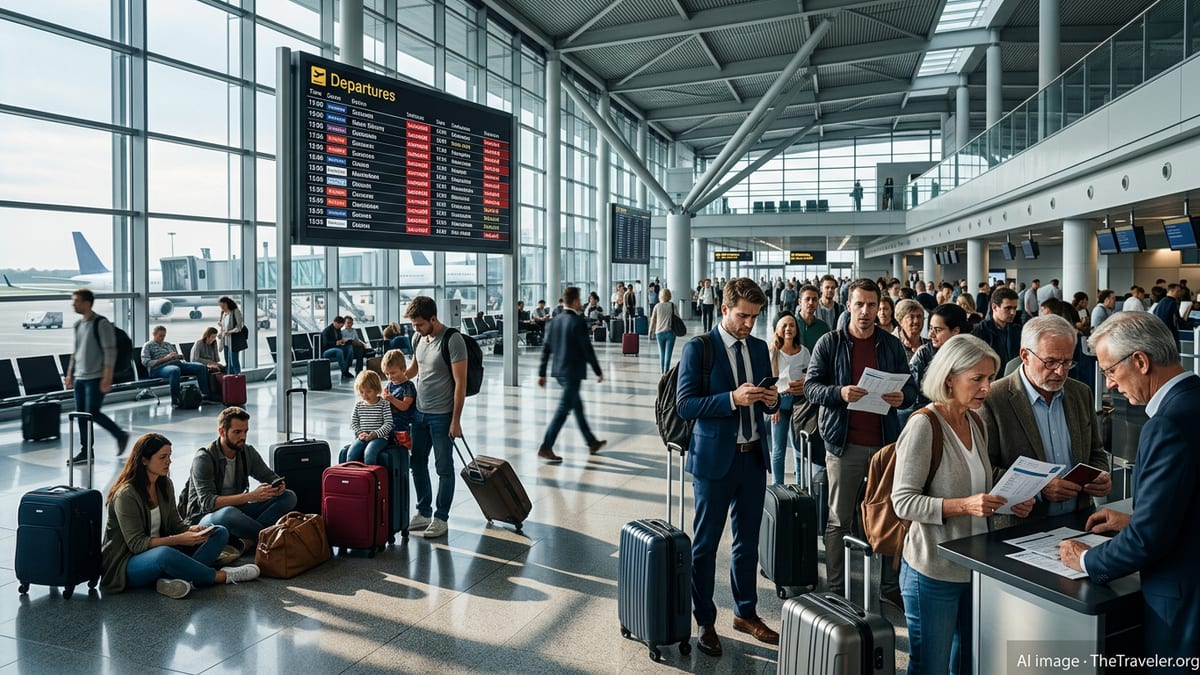
For travellers, this means London and its peer hubs are increasingly where disruption is most visible. Longer connections, tighter banks of departure times and stretched airport infrastructure create more points of failure in an environment where even minor airspace changes reverberate across already crowded transatlantic and intra-European networks.
Operational Fallout: Longer Flights, Cancellations And Congestion
Rerouting around banned or heavily constrained airspace adds significant distance and complexity to Canada-linked itineraries. Aviation risk consultancies estimate that a Europe to Southeast Asia flight that formerly passed over Iran can burn several extra tonnes of fuel when forced to detour via Central Asia or the southern Arabian Peninsula. For Canadian and European carriers, similar detours on services that would otherwise make use of Middle Eastern corridors drive up costs sharply.
Higher fuel burn is only part of the operational equation. Flight time extensions of 30 to 90 minutes push aircraft and crews against duty-time limits and maintenance windows, reducing schedule resilience and increasing the likelihood of rolling delays or last-minute cancellations. Reports from airline operations centers describe a near-constant need to refile flight plans as military developments or new advisories shift the boundaries of acceptable routing in the region.
Ripple effects are now apparent across North Atlantic and intra-European traffic. When a long-haul aircraft faces a late arrival into London, Frankfurt or Istanbul because of an unplanned detour around a newly classified risk zone, its downline departure to Canada may be delayed or swapped to a smaller aircraft. In peak travel periods, this can strand passengers far from their final destination or force overnight stays while airlines reconstruct their rotations.
Canadian airports are also experiencing indirect congestion when large numbers of disrupted passengers are rebooked onto limited remaining services that still offer compliant routings. Travel forums and social media posts from recent months highlight cases where travellers returning from the Middle East or South Asia via Europe have endured extended layovers or multiple rebookings as carriers worked around cascading schedule changes.
Insurance Pressures Drive Route Choices And Capacity Cuts
Behind the visible disruptions sits a quieter but critical shift in aviation insurance. War risk underwriters have increased premiums sharply for operations touching the Middle East since the current cycle of conflict escalated, and industry bulletins note that flying through or near airspace over Iran, Iraq, Israel, Lebanon, Syria, Yemen and adjacent areas can trigger substantial additional charges per sector.
Specialist brokers report that many policies are now written with stricter named-risk clauses. Airlines must obtain specific underwriter approval for each flight that penetrates designated risk zones, or else accept exclusions that leave them uncovered for conflict-related incidents. For Canadian carriers already constrained by domestic advisories, the combination of regulatory pressure and insurance cost makes any residual direct operation through these airspaces hard to justify.
Carriers based in or near the affected states face a different but related challenge. Even when they retain the option to use certain portions of their home-region airspace, insurers may limit the volume or geography of covered flights, leading to tactical capacity reductions, changes in aircraft type, or shifts of long-haul traffic onto alternative city pairs. Publicly available financial updates from some regional airlines reference route cancellations or downgauging tied at least in part to higher insurance and fuel outlays linked to conflict.
The squeeze is not confined to passenger airlines. Cargo operators, which often operate overnight and use more varied routings, are seeing dedicated war risk surcharges applied to freight moving through or around the Middle East. Industry conference papers in 2026 highlight that this is prompting some shippers and logistics firms to reconsider routings via Europe and Central Asia rather than the Gulf, a trend that further concentrates traffic over hubs like London, Frankfurt and Baku.
What Travellers From Canada Need To Watch Now
For Canadian passengers, the most immediate impact of these overlapping restrictions is on reliability rather than personal safety. Global aviation bodies and independent safety analysts consistently emphasize that airlines and regulators design reroutes precisely to keep civil traffic clear of active conflict. The risk to individuals on compliant scheduled services remains statistically low, but the probability of prolonged disruptions on journeys touching the Middle East or nearby regions has increased materially.
Consumer guidance from government agencies and travel insurers stresses the importance of reading policy documents closely, as many standard products exclude losses linked directly or indirectly to war, civil unrest or government-imposed airspace closures. In practice, when a Canadian or European carrier cancels or reroutes flights because of prohibited airspace, the airline is generally responsible for care and rebooking obligations, while insurers may treat the event as an excluded peril.
Travel advisory portals now encourage Canada-based travellers connecting to or across London, Frankfurt, Istanbul, Baku, Almaty, Singapore or Delhi on itineraries involving the Middle East to allow extra time for connections and to monitor flight status frequently in the days before departure. Some risk specialists recommend booking through-tickets on a single carrier or alliance where possible, to simplify rebooking in the event of sudden route changes or cancellations driven by evolving conflict-zone assessments.
With geopolitical tensions showing few signs of rapid resolution, analysts expect Canada’s risk-based airspace restrictions to remain a defining factor in network planning for at least the medium term. That points to a sustained role for London and its fellow hubs as critical junctions in a fragmented global route map, and to continued uncertainty for passengers whose journeys rely on corridors shadowed by conflict.