


If you are planning an East Coast trip to the United States, chances are Washington, D.C. and New York City are both on your radar. They sit roughly four hours apart by train, share the same broad Atlantic climate, and appear together on countless bucket lists. Yet on the ground they feel very different. One is a low-rise capital of museums, monuments, and policy talk. The other is a vertical sprawl of neon, neighborhoods, and nonstop hustle. This guide breaks down how each city actually feels to visit, what typical days look like, and what kinds of travelers tend to thrive in D.C. versus New York, so you can choose the destination that fits your travel style best.
Get the latest updates straight to your inbox!
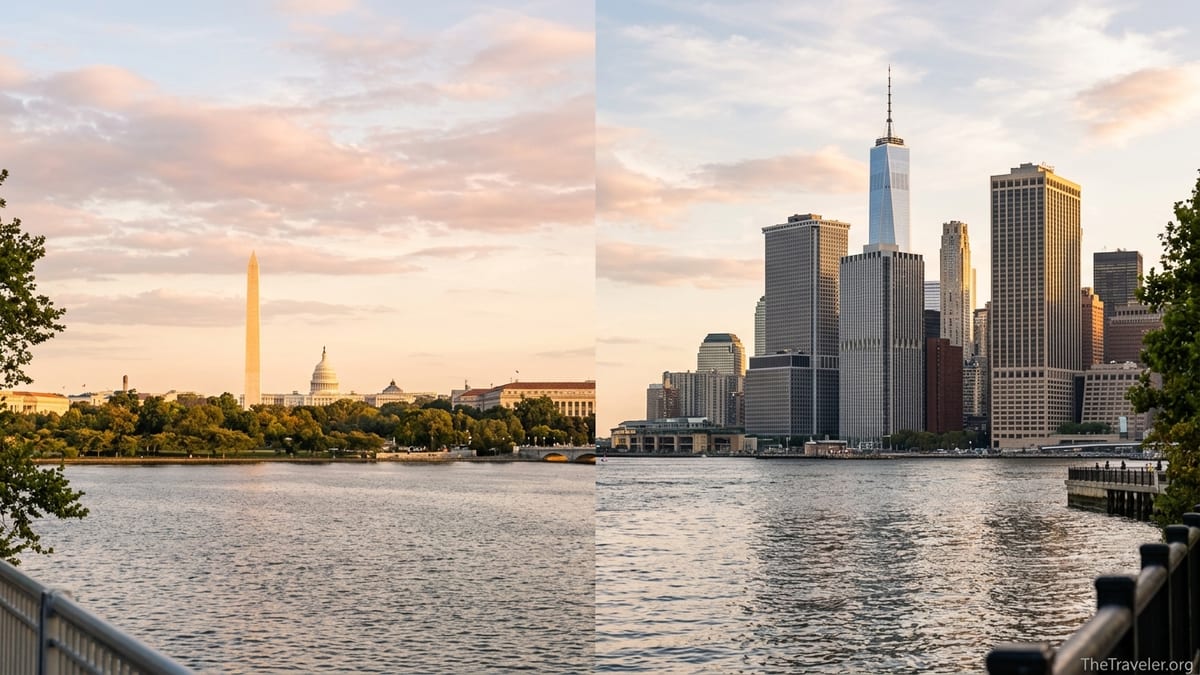
Overall Vibe: Measured Capital vs. High-Energy Metropolis
Washington, D.C. often surprises first-time visitors with how calm it feels for a national capital. Height limits on buildings keep the skyline low, so even in central areas like the National Mall you see wide avenues, long sightlines, and plenty of sky. Around the Capitol and Smithsonian museums, traffic noise is softened by lawns and reflecting pools, and it is common to hear birds over the hum of the city. Even in peak bloom during the National Cherry Blossom Festival in late March or early April, the primary feeling is still open space and big monuments, rather than crowd crush.
New York City, by contrast, is as vertical and dense as its reputation suggests. Stand at the corner of 42nd Street and Eighth Avenue at rush hour and you are surrounded by LED billboards, honking taxis, food carts steaming on the sidewalk, and a crowd flowing in every direction. Even quieter neighborhoods like the West Village or Carroll Gardens have a constant hum of delivery trucks, people walking dogs, strollers, and bike couriers. If you are energized by that level of sensory input and love the feeling that anything might happen around the next corner, New York will suit you.
The pace of life follows the architecture. In D.C., office workers pour out of federal buildings at 5 or 6 p.m., and by 9:30 many downtown streets are relatively subdued outside of a few dining pockets like Penn Quarter or 14th Street. In New York, restaurants in Midtown and Lower Manhattan may still be seating late-night diners at 10:30 or 11, and bars in neighborhoods like the Lower East Side or Williamsburg can stay busy until the early hours. Night owls and people who like to stack multiple evening activities in one night usually find more options in New York.
Neither energy level is objectively better, but they create very different travel experiences. A Saturday in D.C. might mean a quiet morning in a Smithsonian gallery, lunch from a food truck on the Mall, and a nighttime monument walk with relatively few people. A Saturday in New York might involve squeezing into a standing-room-only bagel shop, waiting for a table at a popular brunch place, and weaving through crowds in Times Square before catching a late Broadway show.
What You Actually See and Do in Each City
Washington, D.C. is one of the most museum- and monument-dense cities in the world, and many of its top attractions cost nothing to enter. The Smithsonian network includes the National Museum of American History, the National Museum of Natural History, the National Air and Space Museum, the National Museum of African American History and Culture, and several art museums, all with free admission. On a typical D.C. day, you might spend your morning with the Wright brothers’ plane and Apollo spacecraft at Air and Space, walk ten minutes to see the original Star-Spangled Banner at American History, and then cross the Mall for an afternoon among dinosaur fossils, all without paying individual ticket fees.
Monuments and memorials form the other backbone of a D.C. itinerary. The Lincoln Memorial, Washington Monument, World War II Memorial, Martin Luther King Jr. Memorial, and Jefferson Memorial are strung around the Tidal Basin and Reflecting Pool in a way that rewards walking. Many visitors plan an evening circuit when the monuments are illuminated and the air is cooler, which can be especially dramatic in summer. Add in a Capitol tour, a timed but free visit to the Library of Congress, or a pre-booked White House tour arranged through your embassy or member of Congress, and a three-day visit can feel packed with civic landmarks.
New York City’s attractions skew more toward neighborhoods, viewpoints, and iconic cityscapes than formal monuments. Visitors often start with Times Square, Top of the Rock or the Empire State Building for skyline views, and a walk across the Brooklyn Bridge. Museum lovers have excellent options, but most come with ticket prices. The Metropolitan Museum of Art, the Museum of Modern Art, and the American Museum of Natural History typically charge in the range of about 25 to 35 dollars for standard adult admission, so a day of museum hopping can quickly add up for a family. Many of them do, however, offer limited pay-what-you-wish or free hours, usually in the late afternoon or on specific days, which budget travelers can plan around.
New York also specializes in experiences D.C. cannot quite match, like seeing a Broadway or Off-Broadway show, catching late-night stand-up comedy in Greenwich Village, or visiting trend-setting galleries in Chelsea. A traveler with a food or nightlife focus may find more variety in a single New York neighborhood than in an entire D.C. quadrant, from Michelin-starred dining in Midtown to Taiwanese-American natural wine bars on the Lower East Side and no-frills dollar-slice pizza stands on nearly every block.
Costs on the Ground: Sightseeing, Transport, and Daily Budget
When you compare everyday travel costs, Washington, D.C. and New York City are closer than many expect in terms of hotels and dining, though they diverge sharply on sightseeing expenses. Mid-range hotel rates in central neighborhoods for both cities often sit in the mid to high hundreds of dollars per night, depending on season and demand, with prices spiking when Congress is in session in D.C. or during major events in New York, such as New Year’s Eve or large conventions. At the lower end, simple chain hotels or well-rated budget properties in D.C. areas like NoMa or Crystal City may be slightly cheaper than similar options in Manhattan, while New York’s best-value options are often in Outer Borough neighborhoods like Long Island City in Queens or Downtown Brooklyn with fast subway access.
Sightseeing is where D.C. can offer significant savings. Because the major Smithsonian museums and most monuments do not charge admission, a family of four can spend several days exploring marquee attractions without buying separate day passes. In New York, visiting two or three major paid attractions in one day, such as a museum, an observatory deck, and a harbor cruise past the Statue of Liberty, can easily run into low three figures in tickets alone for a group. City passes and bundled ticket products exist in New York, and they can soften costs if you plan to hit many paid sights in a short time, but they still represent a notable line in the budget.
Transit costs also differ in structure and feel. In Washington, the Metrorail system uses distance- and time-based fares. Typical trips within the core can cost roughly 2 to 4 dollars off-peak and more at rush hour, with a higher maximum for long distances. Many visitors also rely on the DC Circulator bus, which connects major areas like Georgetown, the National Mall, and Union Station for around 1 dollar per ride, making it one of the best values in the city. In New York, the subway and local buses now use a flat fare system for nearly all rides, which as of 2026 is about 3 dollars per trip when you tap in with the OMNY contactless system. That flat fare feels high for very short journeys but becomes good value for long cross-borough rides that might cover 30 or 40 minutes underground.
Food pricing between the cities is more similar than different at the casual level. In D.C., a quick lunch near the Mall might mean a 10 to 15 dollar salad or a 12 dollar sandwich from a food truck or fast-casual chain, and a sit-down dinner at a popular 14th Street bistro can easily reach 30 to 40 dollars per person before drinks. In New York, grabbing a classic bagel with cream cheese in Midtown might run 3 to 6 dollars, while a slice of pizza typically starts around 1.50 to 4 dollars depending on neighborhood and style. At the sit-down level, neighborhood Italian in Brooklyn or a buzzy spot in the East Village is likely to have entree prices similar to central D.C. One key difference: New York’s sheer density of options makes it easier to calibrate your spending up or down by choosing a particular block or neighborhood.
Neighborhood Feel: Where You Stay and Wander
In Washington, D.C., tourist days tend to orbit the National Mall, but evening and dining often pull visitors into neighborhoods that feel distinct from the federal core. Dupont Circle has embassies, row houses, and a lively but not overwhelming dining scene, with independent bookstores and small galleries tucked on side streets. Logan Circle and the 14th Street corridor offer fashionable restaurants, small design shops, and rooftop bars that appeal to a young professional crowd. Georgetown, with its cobblestone streets and waterfront, feels more historic and upscale, with boutique shopping and a mix of student life from Georgetown University.
If you prefer a residential, less touristy base, D.C.’s Capitol Hill and Eastern Market areas are particularly attractive. A typical day there might start with coffee from a neighborhood shop, a stroll through the Eastern Market food hall to sample local produce and breakfast sandwiches, and then a ten-minute Metro ride to the museums. In the evening you can walk back through quiet, tree-lined streets past row houses lit from within, which suits travelers who like city energy during the day but a calmer, almost small-town feeling at night.
New York offers a broader spectrum of neighborhood personalities. Staying in Midtown Manhattan puts you a short walk or subway ride from Times Square, Broadway theaters, and major attractions, but the streets are often crowded with office workers and tourists, and dining skews toward chain restaurants and expense-account spots. Down in Lower Manhattan, neighborhoods like Soho, Tribeca, and the Lower East Side have more intimate streetscapes of cast-iron buildings, fire escapes, and graffiti, with boutiques and late-night bars that cater to both locals and visitors.
Across the East River, Brooklyn and Queens broaden the palette even further. Williamsburg and Greenpoint attract creative travelers with independent music venues, third-wave coffee, and waterfront parks that look back toward the Manhattan skyline. Astoria and Long Island City in Queens offer a mix of immigrant food cultures, local bakeries, and fast subway connections to Manhattan at prices that are often lower than central hotels. If your travel style centers on exploring diverse neighborhoods on foot, ducking into record shops, vintage stores, and tiny family-run eateries well away from postcard sights, New York will give you more ground to cover than you can possibly finish in one trip.
Getting Around: Practical Transit Experience
Both cities rely on robust public transit, but the experience of using those systems feels quite different. Washington’s Metro has a simpler color-coded map and, in many cases, straightforward station layouts. Popular visitor stops like Smithsonian, Metro Center, and Gallery Place are clearly signed, and platforms tend to be wide with distinctive vaulted ceilings. Trains do not run 24 hours, and late-night frequencies can thin out, but for a typical sightseeing schedule the system covers most needs, especially now that contactless payment is widely accepted at faregates. On weekends, the fare structure is generally flatter and cheaper, which can be helpful for families moving between museums and their hotel.
New York’s subway is one of the largest and oldest in the world, and visitors feel that complexity immediately. Multiple lines can share tracks, station names often repeat in different boroughs, and some entrances only go in one direction, so it is common for first-timers to find themselves on an express train that suddenly skips their intended stop. Yet once you learn basic patterns, the system becomes extremely powerful. Trains run 24 hours in most of the network, service frequency can be high even late at night on key lines, and you can ride from upper Manhattan to deep Brooklyn on a single flat-fare swipe. OMNY’s tap-to-pay system has reduced friction, allowing you to simply tap a contactless card or phone on entry without worrying about buying a separate transit card.
Above ground, D.C. is generally easier for casual walking between major sights because the tourist core is compact and logically laid out. You can start at the U.S. Capitol, walk the National Mall westward past museum facades, and finish at the Lincoln Memorial in a single long day without ever using a vehicle, stopping only for food trucks and photo breaks. New York’s attractions are more spread out. You might walk all over Central Park in the morning, but then you will likely need a subway ride to reach the Brooklyn waterfront or a crosstown bus to get from the Upper East Side to the theater district in time for an evening curtain.
Ride-hailing and taxis are abundant in both cities, though patterns differ. In D.C., using a car service to cross town can be relatively affordable, especially at off-peak times, and street traffic is more manageable outside rush hours. In New York, yellow cabs and app-based rides are omnipresent, but congestion can turn a simple Midtown trip into a long, meter-running crawl. Many locals will tell you that in Manhattan, the subway is usually faster and more predictable than a cab for anything beyond a few blocks.
Best For: Families, First-Timers, Foodies, and Culture Seekers
If you are traveling with children, Washington, D.C. has several built-in advantages. Free museum admission reduces stress when attention spans are short, because you can spend an hour in a gallery and leave without feeling the need to “get your money’s worth.” Institutions like the National Air and Space Museum, the National Museum of Natural History, and the National Zoo tend to be naturally engaging to kids, with large-scale exhibits and interactive elements. The open spaces of the National Mall also give younger travelers room to run between activities, and strollers are common everywhere.
For first-time international visitors who want an accessible introduction to the United States, D.C. offers clear narratives about the country’s history and institutions. Standing in the rotunda of the Capitol after a guided tour, seeing original founding documents at the National Archives, and then visiting civil rights-related memorials in the same day creates a coherent, if selective, story about American democracy. The city’s scale and transit network are approachable enough that even travelers unused to large cities can feel comfortable navigating after a day or two.
New York, on the other hand, excels for travelers whose main goals are food, nightlife, and urban culture. The city’s dining scene is famously international. You can have Yemeni coffee and honeycomb bread in one Brooklyn neighborhood for breakfast, hand-pulled noodles in Manhattan’s Chinatown for lunch, and Oaxacan tacos in Queens for dinner, all without repeating a cuisine. Music fans can build trips around seeing jazz in Harlem, indie bands in Brooklyn, and classical concerts at Lincoln Center. Shoppers will find more variety in neighborhoods like Soho and Nolita than anywhere in D.C., from flagship fashion brands to tiny designer studios.
New York is also the better fit for theater lovers. A classic night might include pre-show drinks in Hell’s Kitchen, a Broadway musical or serious drama, and a late dinner at a Midtown brasserie. Off-Broadway and Off-Off-Broadway productions in the East Village, as well as comedy clubs in Greenwich Village, cater to both experimental tastes and budget-conscious visitors, with ticket prices generally lower than the biggest Broadway blockbusters. Travelers who want a sense of “this is what life in a global megacity feels like” will find New York unmatched on the East Coast.
Seasonality, Safety, and Trip Logistics
Both Washington, D.C. and New York experience four distinct seasons, and your tolerance for heat, humidity, and cold may nudge you toward one city or influence your timing. Summers in both places can be hot and muggy, with outdoor sightseeing around the monuments or through Central Park requiring frequent water and shade breaks. In D.C., much of your time can be indoors in air-conditioned museums, making summer still workable despite the humidity. New York’s summer street life, including outdoor dining and rooftop bars, has its own appeal, but subway platforms can feel particularly warm and crowded.
Spring and fall are widely considered the best times to visit both cities, with mild temperatures and more comfortable walking conditions. D.C.’s cherry blossoms around the Tidal Basin become a major draw in early spring, while New York’s fall foliage in Central Park and along brownstone-lined streets in Brooklyn creates classic cityscapes. Winter in either destination can bring cold winds and occasional snow, but both cities remain very much open, and savvy travelers can benefit from lower hotel rates outside major holiday periods.
Safety perceptions are an important factor for many visitors. Tourist-heavy areas in both D.C. and New York are generally well policed and see large numbers of people at most hours. In recent years, both cities have experienced public discussions about crime statistics and quality of life, but for travelers who stick to central neighborhoods, use common sense precautions like not flashing valuables, and avoid deserted areas late at night, the overall experience tends to feel comparable. In D.C., the zones around the National Mall, Smithsonian museums, and major downtown hotels are among the most heavily monitored spaces in the region. In New York, areas like Midtown, Lower Manhattan, and major transit hubs stay busy late, which many visitors find reassuring.
Logistically, both cities are well connected to domestic and international flights. D.C. offers the convenience of Reagan National Airport, which is just across the river and directly on the Metro, along with Dulles International, now linked by the Silver Line, for longer-haul and international routes. New York spreads air traffic across JFK and LaGuardia, as well as Newark in nearby New Jersey. Transit options from these airports into Manhattan range from dedicated trains to city buses and ride-hailing cars, with travel times that can vary significantly with traffic. If you are nervous about complex airport transfers, D.C.’s direct rail links from both major airports into the urban core may feel simpler.
The Takeaway
Choosing between Washington, D.C. and New York City is less about which is “better” and more about what kind of trip you want. If your ideal vacation centers on museums, monuments, history, and a manageable level of urban bustle, D.C. is likely to fit your style. Free Smithsonian museums, the walkable layout of the National Mall, and the calm of residential neighborhoods like Capitol Hill allow for days that feel full but not frantic, especially for families or travelers who prefer clear structure.
If, instead, you picture your East Coast journey as a plunge into dense city life with late-night dinners, global food, live performances, and endless neighborhood exploration, New York City is the stronger match. Its cost of living is undeniable, but the return is access to an unmatched range of experiences, from experimental theater to hidden cocktail bars and street food that reflects almost every cuisine on the planet.
Many travelers ultimately solve the dilemma by visiting both, taking a northeast corridor train between the two cities in roughly four hours and giving each destination at least three days. If that is not feasible, use your own energy level and interests as your guide. Ask whether you are more excited by seeing the Capitol dome and reflecting on history at the Lincoln Memorial, or by standing under neon billboards in Times Square on your way to a late show. Your answer to that question will point you clearly toward the East Coast destination that fits your travel style best.
FAQ
Q1. Which city is cheaper for first-time visitors, Washington, D.C. or New York City?
For most travelers, Washington, D.C. works out a bit cheaper because so many headline attractions, especially the Smithsonian museums and monuments, have no admission fees. New York’s hotels and meals can be priced similarly to D.C., but the number of paid attractions, from observation decks to major museums, tends to push daily budgets higher.
Q2. Is Washington, D.C. or New York City better for families with kids?
Families often find Washington, D.C. easier, thanks to free, kid-friendly museums like the National Air and Space Museum and the National Museum of Natural History, plus open green spaces around the National Mall. New York also works for families, especially with parks and shows, but the crowds, stair-heavy subway, and higher ticket prices can make days more tiring and expensive with young children.
Q3. Which city has better public transportation for visitors?
New York’s subway runs 24 hours and reaches far more neighborhoods, which is a huge advantage if you want to explore widely and stay out late. Washington’s Metro is cleaner and simpler to understand, with straightforward color-coded lines and easy access to key sights, but it does not run all night and serves a smaller footprint. Casual visitors who mainly stay near central attractions may find D.C. easier, while adventurous urban travelers benefit more from New York’s network.
Q4. If I only have three days, should I choose D.C. or New York?
With three days, Washington, D.C. lets you see a satisfying cross-section of museums and monuments at a relaxed pace, making it ideal if you like structure and history. New York can also be done in three days, but you will have to prioritize tightly, for example combining one day around Midtown and Times Square, one day in Lower Manhattan, and one day in Brooklyn or Central Park. Your choice should depend on whether you prefer a curated, educational trip or a fast-paced sampler of big-city life.
Q5. Which city offers better food options for travelers?
New York City offers more variety and depth, from fine dining and Michelin-starred restaurants to neighborhood bakeries, food trucks, and late-night street food reflecting dozens of cultures. Washington, D.C. has an increasingly strong restaurant scene, with standout Ethiopian, Korean, and Southern-inspired spots, but the sheer scale of options in New York means food-focused travelers usually get more mileage from a trip there.
Q6. Is it realistic to visit both Washington, D.C. and New York City in one trip?
Yes, many visitors combine the two cities in a single itinerary by taking an intercity train that covers the distance in about four hours. A common pattern is to spend three to four days in New York for urban intensity and then two to three days in D.C. for museums and monuments, or vice versa. The key is to avoid overloading each day so the train transfer feels like a pleasant shift, not an exhausting obligation.
Q7. Which city feels safer for tourists?
Tourist-heavy areas in both Washington, D.C. and New York City are generally considered safe when you use normal urban common sense, such as staying aware of your belongings, avoiding deserted areas late at night, and using official transit or licensed taxis. In D.C., zones around the National Mall and central museums are heavily monitored. In New York, Midtown, Lower Manhattan, and popular neighborhood corridors tend to stay busy late, which many visitors find reassuring.
Q8. How do the seasons affect which city is better to visit?
Spring and fall work well for both destinations, with mild temperatures and comfortable walking conditions. If you are drawn to cherry blossoms and do not mind some crowds, late March or early April in Washington, D.C. is hard to beat. If you dream of crisp air, golden leaves, and brownstone stoops, a fall trip to New York, especially in October, can be ideal. Winters can be cold in both, and summers humid, but indoor attractions keep both cities viable year-round.
Q9. Which city is better for nightlife and cultural events?
New York City clearly has the edge in nightlife and the sheer volume of cultural events, from Broadway and Off-Broadway theater to live music, late-night comedy, and bar scenes in multiple boroughs. Washington, D.C. does have respected theaters, concert venues, and a growing bar and restaurant culture, but it cannot match New York’s density and late-night hours. Travelers who measure trips by shows seen and venues explored will usually prefer New York.
Q10. I prefer quieter streets and a slower pace. Which city should I choose?
If you value quieter evenings, wide sidewalks, and a sense of order more than towering skylines and constant noise, Washington, D.C. is likely the better fit. You can still tap into city energy around 14th Street, Georgetown, and other dining zones, but you will also find calm residential neighborhoods and open green spaces steps away. New York offers pockets of calm, especially in certain Brooklyn and Manhattan neighborhoods, but the city’s default mode is busy, which some travelers find overwhelming.