


If you only have one precious hiking day in Shenandoah National Park, the choice often comes down to two heavyweights: Hawksbill Mountain, the park’s highest peak, and Old Rag Mountain, its most talked-about challenge. Both deliver big Blue Ridge views, but the experiences are dramatically different. Here is how they compare in the real world so you can decide which hike actually deserves your time.
Get the latest updates straight to your inbox!
Hawksbill and Old Rag at a Glance
Hawksbill Mountain and Old Rag Mountain sit roughly an hour apart by car within Virginia’s Shenandoah National Park, but they cater to very different hikers. Hawksbill tops out at about 4,050 feet, making it the highest point in the park. Typical summit routes here are between 1.7 and 2.9 miles round trip, labeled moderate in difficulty, and often completed in one to two hours. Old Rag, by contrast, reaches a lower summit at around 3,284 feet, yet feels far more serious. The classic loop is roughly 8.5 to 9 miles with a lengthy rock scramble, commonly taking 6 to 8 hours for average hikers.
On the ground, that means Hawksbill feels like a classic, brisk mountain walk from Skyline Drive: a steep but straightforward trail that families with school-age kids, casual hikers, and time-pressed road trippers can tackle between overlooks. Old Rag is an all-day event. You park outside the main Skyline Drive corridor, follow forested trail to the base of the mountain, then weave and squeeze your way up huge granite boulders using hands and feet. Many hikers treat it as a single major objective for a Shenandoah trip, building an entire weekend around it.
In terms of crowds and reputation, Old Rag is widely considered one of the marquee scrambles on the East Coast, drawing visitors from as far as Boston and Atlanta who come specifically for this hike. Timed-entry tickets exist precisely because of its popularity. Hawksbill, although frequently busy in summer and foliage season, feels more like a classic Skyline Drive stop: popular, yet still relatively accessible even on a short visit to the park.
Both hikes require paying the Shenandoah entrance fee or using a national parks pass. For many travelers, especially first-time park visitors who want a taste of the Blue Ridge without a sufferfest, Hawksbill is the easier value proposition. For fit hikers who relish a challenge and do not mind logistics, Old Rag often ends up being the highlight of the trip.
Trail Experience: Easy Access vs All-Day Adventure
On Hawksbill, the experience begins right off Skyline Drive at Hawksbill Gap or the nearby upper parking area. From the Lower Hawksbill trailhead at milepost 45.5, the 1.7-mile round trip gains about 700 feet of elevation. That ascent is noticeable, especially if you are not used to hills, but the path is well graded and free of technical obstacles. Most hikers reach the summit in 40 to 50 minutes, even with photo breaks, and the descent is straightforward. Many visitors pair Hawksbill with nearby stops like Dark Hollow Falls or a meal at Big Meadows Lodge on the same day.
Old Rag demands more commitment. The main loop from the Old Rag parking area near Nethers involves a steady forest climb before you reach the rock scramble section, which can last for one to two hours depending on pace and congestion. Expect narrow gaps where you must remove a daypack to squeeze through, ledges that require boosting yourself up with both hands, and sections where you effectively boulder-hop across exposed rock. Even hikers familiar with moderate trails on the Appalachian Trail often find Old Rag significantly more strenuous and time consuming than expected.
A typical Old Rag day might look like this: leave your hotel or cabin in Luray or Madison at 6 a.m., arrive at the parking area around 7 a.m., start hiking by 7:30, spend the late morning negotiating the scramble and enjoying the summit, then trudge the long fire road descent back to your car by mid-afternoon. Tack on another hour or more of driving to get back to Skyline Drive lodges or gateway towns and the hike can easily absorb the entire day.
By comparison, you can often slot Hawksbill into a morning or late-afternoon window between scenic drives, winery visits, or other hikes. For instance, travelers staying at Skyland or Big Meadows frequently hike Stony Man in the morning, have lunch at the lodge, then knock out Hawksbill in the late afternoon when the light softens over the Shenandoah Valley.
Views and Scenery: Panoramas vs Immersive Scramble
Hawksbill’s appeal is its big, immediate payoff. From the stone observation platform at the summit, you get a sweeping 360-degree panorama across the Shenandoah Valley on one side and the rolling Piedmont on the other. On a clear October afternoon you might see layers of orange and red hardwood forest fading into blue ridgelines, with distant farm fields patchworked below. Because the hike is short, many visitors linger on the summit with picnic snacks, watching hawks ride thermals along the ridge or clouds casting shadows over Timber Hollow’s dramatic drop.
Old Rag’s scenery is more immersive and adventurous. The scramble section threads through house-sized granite blocks, narrow chutes, and exposed slabs that feel unlike anything else in the park. You will often find hikers pausing not only for photos but also to watch others figure out a particularly tricky move, almost like an informal climbing gym. As you gain the upper ridge, views open steadily, giving repeated glimpses of the Virginia Piedmont spilling away from the mountain in all directions.
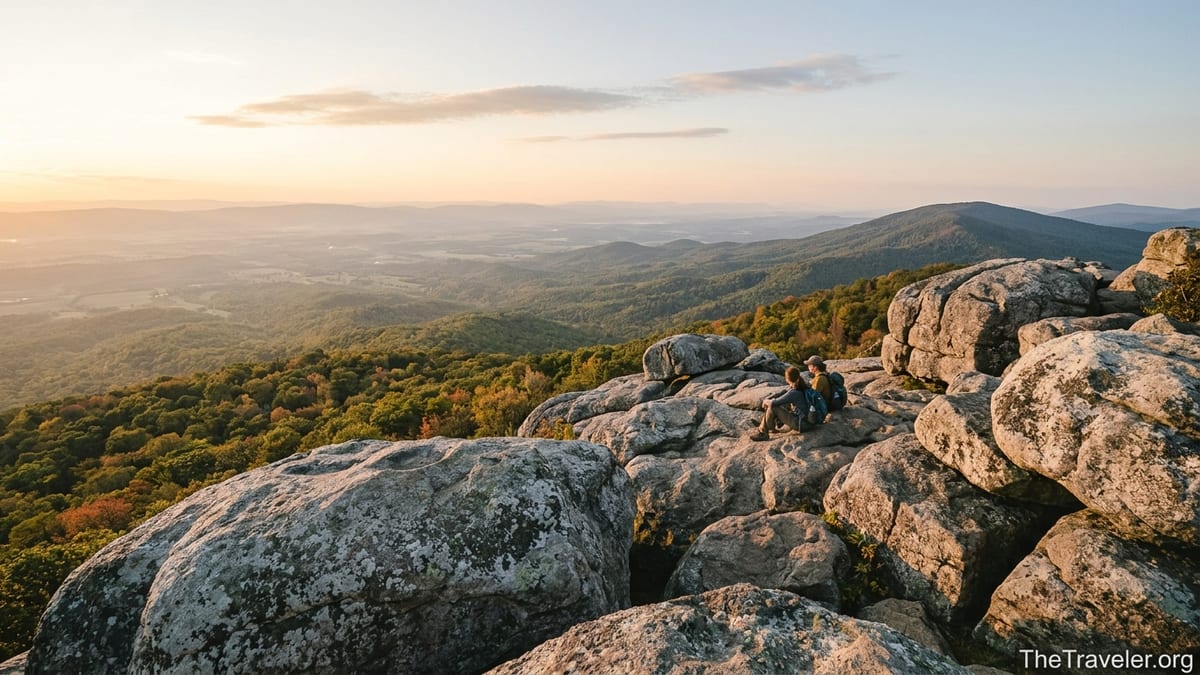
The summit plateau of Old Rag is broad and dotted with rounded boulders that invite exploration. On a less crowded weekday, you can pick a quiet spot away from the main cluster, lie back on warm rock, and watch vultures circle below you. In hazy midsummer weather the vistas can be softer than the crisp autumn views from Hawksbill, but the feeling of being perched on a huge granite dome, with drop-offs on several sides, is undeniably dramatic.
If you mainly want a postcard-style overlook that children, older relatives, or less-fit friends can enjoy, Hawksbill almost always delivers, especially at sunrise or sunset. If you want the journey itself to feel like an adventure, with puzzles to solve and obstacles to overcome, Old Rag’s rock playground wins every time.
Logistics, Permits, and Crowds
From a planning standpoint, Hawksbill is simple. You drive Skyline Drive to Hawksbill Gap, park in one of the lots, and go. There are no special permits beyond your park entry, and you can decide on the day whether you feel like tackling the summit. In busy autumn weekends parking can fill by late morning, but spaces typically turn over regularly. For travelers staying at Skyline Drive lodges, Hawksbill is often less than a 20-minute drive away, making it easy to time around meals and weather windows.
Old Rag requires more forethought. From March through November, the National Park Service has a daily quota system that requires each hiker to purchase a separate day-use ticket for Old Rag in addition to the standard park entrance pass. Tickets are inexpensive, but they do sell out on peak Saturdays, long weekends, and foliage season. You must either print or download the ticket beforehand; there is no guarantee of cell service at the parking area. This added step means spontaneous last-minute decisions to hike Old Rag are risky in high season.
Crowds also feel different. Both Hawksbill and Old Rag can be busy, but delays on Hawksbill are usually confined to a few congested switchbacks or the summit platform during peak hours. On Old Rag, the rock scramble creates natural chokepoints. It is not unusual on a sunny Saturday to wait several minutes at individual obstacles as people figure out where to place hands and feet. This can turn a 6-hour hike into an 8-hour one, especially for groups with varying comfort levels around heights.
For many travelers, this raises a key question: how much of your limited vacation time do you want to spend in a queue in the woods. If you visit on a weekday in late April or early November, Old Rag can feel much more relaxed, and the timed-entry system has improved conditions compared with pre-permit days. If your dates are locked to a busy leaf-peeping weekend, Hawksbill may provide a better ratio of effort to enjoyment.
Difficulty, Safety, and Who Each Hike Suits Best
Hawksbill is categorized as a moderate hike primarily due to its elevation gain and steep sections, not technical difficulty. The trail is well marked, and while roots and rocks are common, you rarely need to use your hands to move forward. For a reasonably active traveler who can comfortably walk several city miles in a day, Hawksbill is challenging but achievable. Families regularly bring children aged seven or eight and up, provided they take breaks and carry snacks and water.
Old Rag is in a different category. The loop is long, the elevation gain substantial, and the rock scramble demands full-body effort. Hikers with knee issues, limited upper-body strength, or fear of heights often struggle through the scramble or retreat before finishing. The park’s search-and-rescue teams frequently respond to accidents here, ranging from twisted ankles on wet rock to more serious falls. If you are used to relatively flat greenway walks at home, jumping straight to Old Rag as your first mountain hike is a recipe for frustration.
Safety considerations are also more complex on Old Rag. Afternoon thunderstorms are common in late spring and summer, and the summit ridge is highly exposed. Being caught on smooth granite in a sudden downpour can turn fun scrambling into a slippery hazard. Many experienced hikers specifically start Old Rag at dawn so they reach the summit before midday storms develop, bringing headlamps for early light and extra layers for cooler morning temperatures.
In short, Hawksbill is a smart choice for mixed-ability groups, first-time Shenandoah visitors, and travelers who want great views without risking an overreach. Old Rag is best for fit, sure-footed hikers comfortable with heights and willing to treat the day like a true mountain adventure, complete with early start, weather awareness, and backup plans.
Time, Season, and Itinerary Fit
Your travel schedule may decide the winner before you do. If you are driving Skyline Drive for a single day and staying in a gateway town like Front Royal or Waynesboro, you can realistically add Hawksbill into your route without reshuffling much. Many visitors from Washington, D.C. drive in for a fall Saturday, stop at a few overlooks, hike Hawksbill, have a late lunch at a lodge or picnic area, then head home the same evening.
Old Rag works better when you can dedicate at least one full day and ideally stay nearby. Lodging options in Madison, Sperryville, and Luray make early starts less punishing, but you still need to factor in parking, bathroom stops, and ticket checks. Travelers planning a long weekend often pair Old Rag one day with a Skyline Drive day the next, using the second day for shorter hikes like Stony Man, Bearfence, or Dark Hollow Falls to give tired legs a break.
Season also matters. Hawksbill is hikeable year-round, though winter can bring ice and strong winds on the summit. On cold but clear January days, you might have the observation platform nearly to yourself, with unobstructed views thanks to leafless trees. Old Rag in winter is more serious; ice on the scramble can be treacherous, and many hikers wisely avoid the route until snow and ice melt. Spring and fall are prime seasons for both, though spring’s wet rock and fall’s popularity can complicate Old Rag more than Hawksbill.
If your trip dates fall in July or August, consider daytime heat. Hawksbill’s short distance and forest shade make it manageable for early morning or early evening outings, even on hot days. Old Rag’s long, exposed scramble sections can be exhausting in humid midday heat. In that case, a dawn start or postponing Old Rag to a cooler season is often the safer play.
Costs, Gear, and Practical Details
From a budget perspective, both hikes start with the same baseline: Shenandoah’s entrance fee, which can be covered by a 7-day vehicle pass or an annual national parks pass. On top of that, Old Rag requires a per-person day-use ticket during much of the year, which is relatively inexpensive but nonrefundable for bad weather or last-minute changes. For a couple or family of four, that can add up to the cost of a casual dinner in nearby Luray or Madison, so it is worth treating the reservation seriously.
Gear needs are modest for Hawksbill. Sturdy walking shoes or light hiking shoes, one to two liters of water per person depending on season, and a light jacket are usually sufficient. Trail runners in shorts and T-shirts with a small daypack are a common sight on clear summer days. Because the hike can be done in about an hour and a half, many visitors do not bother with specialized packs or trekking poles unless they already own them.
Old Rag, however, rewards more thoughtful preparation. Most hikers carry at least two to three liters of water, high-energy snacks or a packed lunch, a small first-aid kit, and layers for changing summit conditions. Footwear with good grip is essential; slick, worn-out sneakers can make the scramble unnervingly slippery. Many hikers leave trekking poles in their car or collapse them into their packs for the scramble section, since they can get in the way when squeezing through tight gaps.
Transportation logistics differ as well. Hawksbill’s trailheads sit directly on Skyline Drive, so any itinerary that includes the drive will naturally bring you within a few minutes of the hike. Old Rag’s parking area lies off the eastern foothills, accessible via country roads that can feel slow after a long day on the trail. If you are combining both hikes in one trip, some travelers choose to tackle Old Rag first from a foothill base, then move up to a Skyline Drive lodge and hike Hawksbill later in the stay.
The Takeaway
So which hike deserves your time: Hawksbill or Old Rag. If your priority is a high-impact view with low logistical friction, Hawksbill is the clear winner. It delivers the highest point in Shenandoah, a sweeping panorama, and a classic Blue Ridge experience in a compact, accessible package that fits easily into almost any itinerary. Families, first-time visitors, and travelers unsure of their fitness level will almost always walk away satisfied.
If you crave a challenge and can dedicate a full day, Old Rag is difficult to beat. The combination of rock scrambling, expansive granite summit, and sense of earned achievement makes it one of the standout hikes not just in Shenandoah but on the entire East Coast. The required ticket system, long duration, and technical sections are real hurdles, but for many hikers, they are part of the appeal.
For those with several days in the park, the best answer might be “both”: Old Rag as the marquee adventure and Hawksbill as a more relaxed counterpart, perhaps at sunrise or sunset. For a single-day visitor or mixed-ability group, Hawksbill’s balance of effort, safety, and reward often makes it the smarter choice. Ultimately, the hike that deserves your time is the one that matches your fitness, comfort with exposure, and the kind of memories you want to bring home from Shenandoah’s ridgelines.
FAQ
Q1. Is Hawksbill or Old Rag better for first-time visitors to Shenandoah National Park. Hawksbill is usually better for first-timers, especially if you are unsure about your fitness. It offers top-tier views with a relatively short, non-technical hike that fits easily into a day of driving Skyline Drive and exploring overlooks.
Q2. Do I need a special permit to hike Old Rag Mountain. For most of the main hiking season, you need a separate day-use ticket for Old Rag in addition to the standard park entrance fee. These tickets are date-specific and can sell out on busy weekends, so it is important to secure them in advance.
Q3. How long does it take to hike Hawksbill compared with Old Rag. Most hikers complete Hawksbill’s common routes in about one to two hours, including time at the summit. Old Rag typically takes between six and eight hours for the full loop, depending on your pace, crowding in the rock scramble, and how long you linger on the summit.
Q4. Which hike is safer for children or older adults. Hawksbill is generally the safer choice for children and older adults because it avoids the exposed rock scrambling and long duration of Old Rag. While the trail is steep in places, it remains a standard dirt and rock path where you rarely need your hands to progress.
Q5. Can I hike Old Rag in bad weather or during winter. It is possible but not recommended for most visitors. Wet or icy rock on Old Rag’s scramble section can be extremely slippery and dangerous, and winter conditions can increase the risk of hypothermia and falls. In poor weather, Hawksbill or other less technical trails are usually better options.
Q6. Is it realistic to hike both Hawksbill and Old Rag on the same day. For most travelers, hiking both in a single day is overly ambitious. Old Rag alone can take most of the daylight hours, and adding Hawksbill would mean rushing both experiences and driving significant distances between trailheads. It is usually better to dedicate one day to Old Rag and another to Hawksbill and nearby shorter hikes.
Q7. What kind of footwear do I need for each hike. For Hawksbill, sturdy walking shoes or light hiking shoes with good tread are generally enough. For Old Rag, dedicated hiking shoes or boots with strong grip are strongly recommended, as you will be climbing over smooth granite surfaces where traction matters.
Q8. How do crowds compare between Hawksbill and Old Rag. Both can be busy, but crowds affect the experience differently. On Hawksbill you may see full parking lots and a busy summit, yet you can usually move at your own pace. On Old Rag, the rock scramble creates bottlenecks, so you may have to wait in line at certain obstacles, especially on sunny weekends in spring and fall.
Q9. Which hike offers better sunrise or sunset views. Both hikes can be beautiful at golden hour, but Hawksbill is more practical for sunrise or sunset because of its short distance and direct access from Skyline Drive. Old Rag’s length and rock scrambling make hiking it in the dark risky for most visitors, so early morning or late evening attempts require extra experience and preparation.
Q10. If I am afraid of heights, which hike should I choose. Hawksbill is the better choice if you are uneasy with heights. While the summit is high and open, the trail itself does not involve exposed scrambling or narrow ledges. Old Rag’s scramble includes several airy spots where you may need to maneuver close to drop-offs, which can be intimidating for anyone uncomfortable with exposure.