


More news on this day
Palma de Mallorca will remain capped at three cruise ships per day but cut peak summer capacity from 2027 under a renewed deal between the Balearic government, Palma City Council and major cruise lines, making one of Europe’s busiest cruise hubs a test case for crowd and resource management in the western Mediterranean.
Get the latest news straight to your inbox!
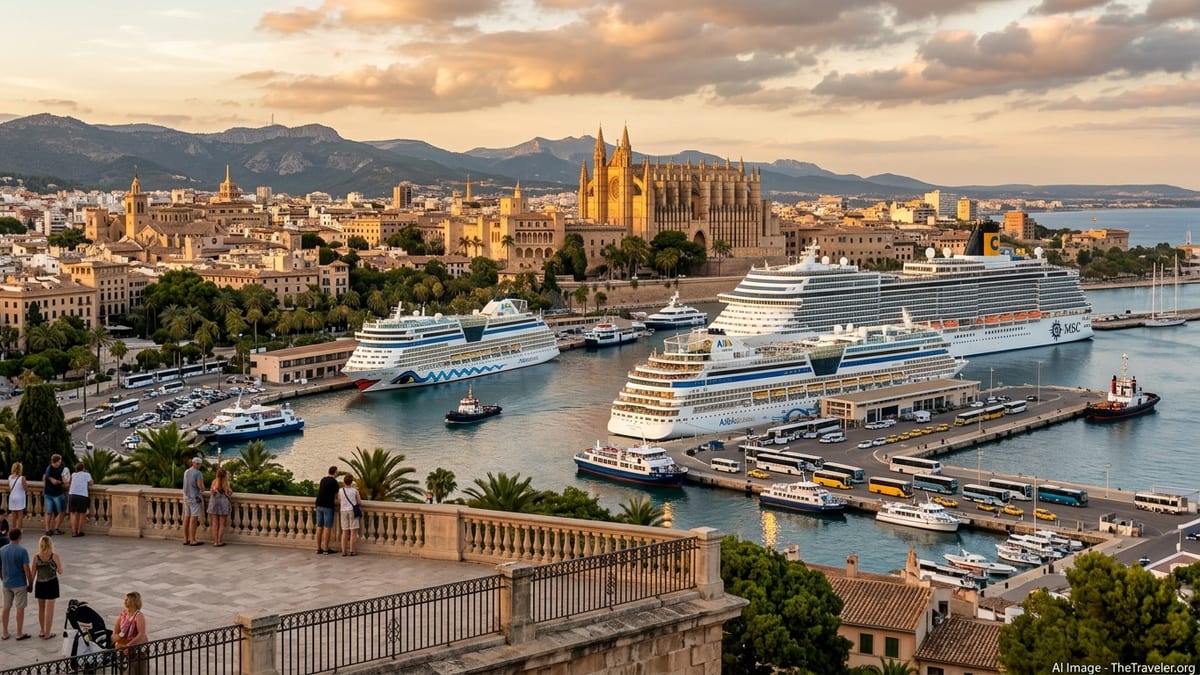
What the new Palma cruise limits actually do
The new memorandum of understanding, signed in early 2026 by the Balearic Islands government, Palma City Council and the Cruise Lines International Association with around 20 global brands, formalises rules for 2027 to 2031. It keeps the existing ceiling of three cruise ships per day in Palma, with a maximum of one mega‑ship over 5,000 lower berths in port at any given time.
On capacity, the agreement tightens an earlier framework. For most of the year, the port will continue to work with an average ceiling of 8,500 lower berths per day. From June to September in 2027, 2028 and 2029, that average cap will fall to 7,500 lower berths per day, down from the current 8,500, with a return to 8,500 in peak months expected in 2030 and 2031 unless the deal is amended.
The limit is framed as an average based on ship capacity, not a hard daily headcount of passengers actually disembarking. In practice, this means individual days in high season can still see more than 7,500 berths in port, but weekly schedules must be planned so that the overall average for the June to September period stays within the agreed threshold.
Weekly caps, drought conditions and cleaner ships
In addition to the daily framework, the memorandum sets a weekly cap that translates to roughly the same 7,500 daily‑average berth ceiling in peak months. Local officials have stressed that this technical weekly limit is what governs deployment decisions by cruise lines, although the detailed wording is complex and focuses on total capacity scheduled into each week rather than simple ship counts.
The agreement also adds resource and environmental conditions. One notable clause states that if Palma is placed under a formal drought emergency, signatory cruise lines will not take on freshwater in port during that period. The pact references continued work on emissions reductions and gives scheduling priority to ships that can plug into shore power or meet higher environmental standards once the necessary infrastructure is in place.
The list of signatories runs across the mainstream cruise market and into premium and luxury brands. Companies including Aida Cruises, MSC Cruises, Costa Cruises, Royal Caribbean, Norwegian Cruise Line, Princess, Carnival, TUI brands and several others have accepted the caps, giving the Balearic authorities direct leverage over much of the western Mediterranean cruise fleet serving Spain.
How the cap fits Palma’s recent cruise numbers
According to data compiled from the Balearic Ports Authority, the Port of Palma handled around 1.84 million cruise passengers in 2024, still below its pre‑pandemic peak but close enough that local officials describe volumes as largely recovered. Across the wider Balearic ports system, cruise traffic has been rising, even as Palma’s ship and passenger totals have been held in check by the earlier three‑ship cap.
Authorities have signalled that they expect slightly fewer cruise passengers in Palma in 2026 than in 2025 despite strong demand and a record‑setting year for Spanish cruise traffic overall. That outlook reflects the combination of slot limits in Palma, deployment choices by cruise lines and some redistribution of traffic to other ports in the islands and on the mainland.
Because the new 7,500‑berth limit only takes effect from summer 2027 and works on weekly averages, travellers should not assume that current daily visitor numbers have already been cut to that level. For 2026 and much of 2027, schedules are still governed by the previous, higher effective ceiling, and any visible change in peak‑season crowds is likely to be gradual rather than abrupt.
What this means for western Mediterranean cruise itineraries
The combination of a three‑ship cap and lower peak‑season averages is already influencing how lines design western Mediterranean routes featuring Palma. Capacity that cannot fit into Palma’s June to September quotas is being pushed into shoulder months, shifted to other Balearic ports such as Ibiza or Maó, or rerouted to alternative Spanish calls including Málaga, Valencia and occasionally smaller mainland ports.
For travellers, that can translate into more spring and autumn options using Palma as a base port, and slightly fewer of the very high‑density summer days when four or five large ships would previously have been in port together. On capped days when three large ships are scheduled, shore‑excursion demand inside Palma’s historic centre can still be intense, but competing excursions that spread passengers across the island are expected to play a bigger role in managing flows.
Palma’s approach sits alongside other city‑specific measures in Europe, such as Venice’s long‑running ban on large cruise vessels in the historic centre and Barcelona’s move to concentrate ships at dedicated terminals further from downtown. However, the Balearic government’s deal stands out for combining explicit daily and weekly capacity averages, resource‑use triggers and an agreed framework that runs to at least 2029 for its tightest summer limits.
Planning a cruise that calls in Palma from 2027
The memorandum’s provisions on daily and weekly caps between 2027 and 2029 are now factored into deployment tools used by CLIA members, but published schedules remain subject to change as lines fine‑tune capacity across Spain. Travellers considering western Mediterranean itineraries for those years should expect Palma calls to be more concentrated on certain days and seasons, with some lines marketing alternative Balearic or mainland calls where Palma no longer fits the weekly quota.
Because the new limits are based on lower berths rather than passenger headcounts, the practical feel of a port day will still depend on how many guests disembark, the mix of excursion options and how ports and municipalities continue to adjust transport and crowd‑management plans. Local authorities have said they will monitor the agreement’s impact and review whether to maintain or adjust the 7,500‑berth summer average after 2029.
Before booking, travellers who are sensitive to crowding may want to compare call dates within an itinerary and look for spring or autumn departures, when Palma can still handle 8,500 daily berths on average and overall visitor pressure is lower. Closer to departure, it remains worth checking for any updated guidance from cruise lines or local authorities if drought alerts or environmental measures temporarily change how ships operate in Palma’s port.