


More news on this day
A December 2024 collision between a river cruise ship and the lock at St. Aldegund on Germany’s Moselle River forced a multi-day closure, rerouted Christmas-market sailings and renewed scrutiny of how resilient the country’s booming river-cruise network is when single-chamber locks fail, even as officials stress that injuries were limited and no lives were lost.
Get the latest news straight to your inbox!
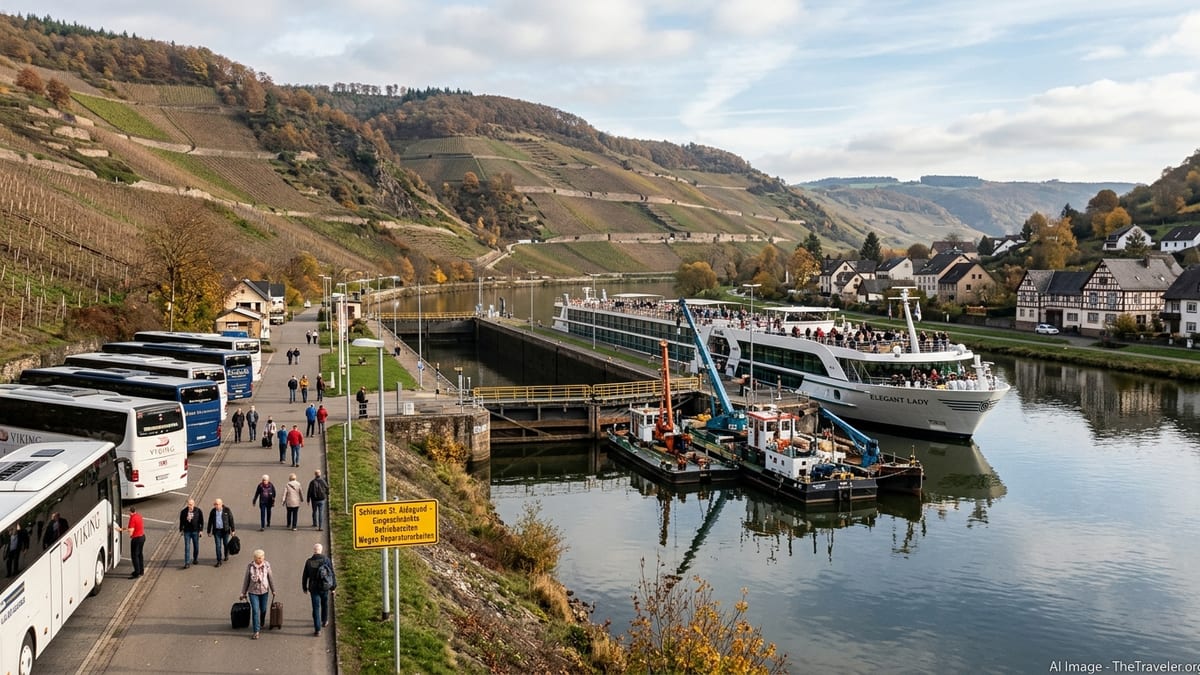
What happened at St. Aldegund’s Moselle lock
On 10 December 2024, the river cruise ship Elegant Lady struck the ship lock gate at the St. Aldegund barrage on the Moselle at river kilometer 78.4 in Rhineland-Palatinate. German cruise and shipping outlets report that the vessel hit the lock gate while entering the chamber, causing significant structural damage to the lower gate of the single large-ship lock.
According to German boating and cruise media summaries of local authority statements, three passengers on Elegant Lady were reported injured, with one person taken to hospital, and no fatalities. The accident damaged the only chamber for commercial traffic at St. Aldegund, immediately halting regular navigation for cargo and most passenger ships in that section. A small separate boat lock remained technically available but is designed for much smaller craft and not for typical 110- to 135-meter river cruise vessels.
The Waterways and Shipping Authority (WSA) Mosel-Saar-Lahn set up a crisis unit and initially suspended through traffic at St. Aldegund while engineers assessed the damage and options for temporary operation. Authorities emphasized that the damaged lock gate at St. Aldegund, while serious, was less severely compromised than the one destroyed days earlier in a separate cargo-ship crash at the single-chamber Müden lock downstream, which had already limited Moselle capacity heading into the Christmas season.
How long the Moselle closure lasted and which stretches were hit
Official notices from Germany’s waterway authorities show that after the 10 December accident, the lock at St. Aldegund was closed to normal operations for several days while inspections and emergency repairs were prepared. In the first phase, traffic between roughly Cochem and Zell was effectively interrupted for large commercial and cruise ships, as vessels could not pass through the damaged chamber in either direction under standard procedures.
Within days, the WSA began carefully controlled “Notschleusungen,” or emergency lock transits, at St. Aldegund once engineers determined the damaged gate could be operated under strict conditions. These early emergency passages prioritized cargo vessels needing to exit the upper Moselle system toward Koblenz and the Rhine, with each transit taking significantly longer than the typical 20 to 30 minutes for a standard locking cycle. River cruise companies, which require firm itinerary timing, largely treated the section as effectively closed for the peak of the Christmas-market period, even as limited freight traffic restarted.
Regular, fully scheduled lock operations at St. Aldegund did not resume immediately; instead, the section moved gradually from full closure to restricted emergency use, then back toward normal timetables following repair work and safety checks. This disruption came on top of the earlier December 2024 Müden lock accident, which had already interrupted through traffic on the German Moselle and required an intensive emergency-sluicing program before normal operations could resume in February 2025, highlighting how vulnerable single-chamber stretches of the river can be when a gate is knocked out of service.
Christmas-market cruises forced to reroute
The St. Aldegund incident occurred in the middle of the 2024 Christmas-market cruising season, when Moselle itineraries featuring Cochem and other small wine towns are commonly paired with Rhine sailings. Cruise-focused outlet reporting at the time detailed how several major river cruise brands adjusted December 2024 itineraries, often at short notice, to account for the damaged lock and associated Moselle restrictions.
Cruise Critic reported that lines including Viking, AmaWaterways, A-ROSA and Avalon Waterways modified festive sailings that were due to transit the affected section. For example, some Rhine–Moselle combination cruises dropped calls on the Moselle altogether, remaining instead on the Rhine and substituting ports such as Rüdesheim or Mainz in place of Cochem and nearby Moselle villages. Other itineraries kept Moselle overnights but handled the closed section by busing guests around St. Aldegund and Müden, with passengers rejoining their ship on the other side of the damaged locks.
Viking confirmed that selected December 2024 Christmas-market itineraries required mid-cruise adjustments because vessels could not reliably transit the affected Moselle locks. According to the company’s statements at the time, some sailings involved ship swaps, where guests were transferred by coach between two Viking vessels positioned on opposite sides of the closure so that the overall route length and most Rhine port visits could be preserved. AmaWaterways, Avalon and A-ROSA likewise advised booked guests that Moselle calls were subject to change and, in some cases, replaced with extra time in larger Rhine cities such as Koblenz, which remained accessible despite the localized lock damage.
What German authorities say about causes, safety and next steps
German federal and regional authorities have treated the St. Aldegund collision as part of a broader review of lock resilience on the Moselle following the more severe December 2024 cargo-ship crash at Müden. Public documents and parliamentary briefings describe the Müden incident as the more structurally damaging event, but officials also highlight the Elegant Lady collision as a second serious incident within months that again exposed the lack of backup capacity at several single-chamber barrages.
The Federal Ministry for Digital and Transport and the General Directorate for Waterways and Shipping have stated that emergency lock procedures, including controlled Notschleusungen, were key to restoring at least partial traffic at St. Aldegund while repairs proceeded. They have also reiterated long-standing plans to add second large-ship chambers at several Moselle locks that still rely on only one main chamber, including St. Aldegund, though timelines depend on broader federal infrastructure budgeting and are not yet fixed for all sites.
As of November 2026, German waterway statistics and industry data continue to show strong demand for river cruising on the Rhine and Moselle, with no official indication of a systemic safety crisis or a statistically proven increase in accidents specifically involving German river cruise ships. The Federal Bureau of Maritime Casualty Investigation has listed the December 2024 Moselle incidents within its inland navigation caseload, but detailed final reports on the root causes and any recommended changes for bridge teams and lock operations have either not yet been published in full or remain summarized only in technical German-language notices. For travelers, the practical takeaway is that while the Elegant Lady crash caused injuries and days of disruption, lock-related incidents of this kind remain rare relative to the total volume of traffic, and operators have now rehearsed contingency measures such as ship swaps, emergency lock passages and substitute port calls that can be activated again if a single-chamber lock fails during a future holiday season.