


More news on this day
Final 2025 traffic figures from Airports Council International and Heathrow’s own reports confirm London Heathrow as Europe’s busiest passenger hub with 84.5 million travelers last year, underpinning expectations that it will remain one of the world’s most crowded airports through the winter 2026–2027 travel season.
Get the latest news straight to your inbox!
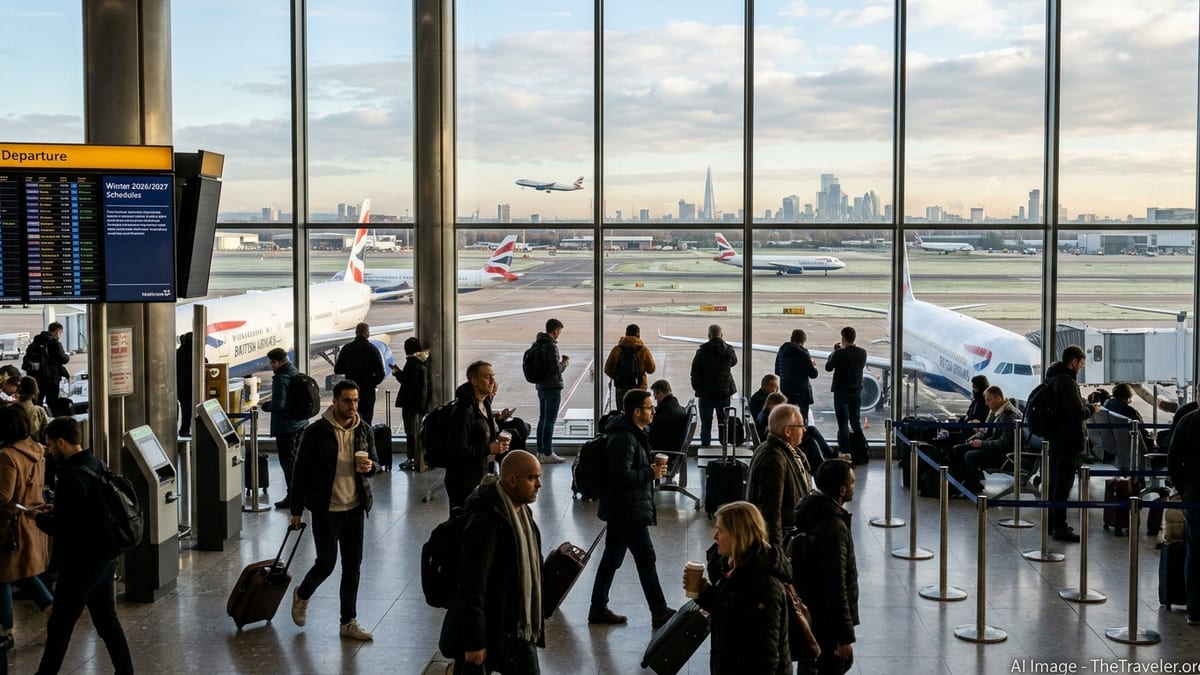
Heathrow’s 2025 lead and what it means for winter 2026–2027
According to ACI Europe’s full-year 2025 traffic report, London Heathrow handled 84.48 million passengers in 2025, narrowly ahead of Istanbul Airport’s 84.44 million and retaining its position as Europe’s busiest airport by passenger volume. That total was up about 0.7 percent on 2024 despite tight capacity limits at the airport.
Heathrow’s own 2025 results, covering the 12 months to 31 December 2025, describe last year as its busiest on record, with around 84.5 million passengers and a record seat count of more than 105 million. The operator also notes that it remained Europe’s busiest hub airport and ranked within the global top tier by total passengers on Airports Council International’s finalized 2025 tables.
ACI World’s 2025 global rankings, released in July 2026, confirm that Hartsfield–Jackson Atlanta remains the world’s busiest airport by total passengers, followed by Dubai International and Tokyo Haneda. Heathrow sits a little lower in the global top ten on total passengers but is second worldwide for international passengers, behind Dubai, reinforcing its role as one of the main global transfer points and a consistently high-volume hub.
Low seasonality keeps Heathrow busy even in winter
For travelers, the crucial detail is not just the annual total but how much traffic drops in the off season. UK Civil Aviation Authority data and Heathrow statistics show that the gap between Heathrow’s busiest and quietest periods is comparatively modest by UK standards, with roughly a one-quarter difference between peak summer and the slowest winter months in recent years.
Heathrow’s own reporting for 2025 highlights that every summer month exceeded 7 million passengers, with August above 8 million, but winter volumes still remained high as airlines focused on using larger, fuller aircraft rather than dramatically cutting frequencies. That pattern reflects the airport’s slot-constrained status, where carriers typically protect their allocated slots year round instead of withdrawing large blocks of winter capacity.
This relatively low seasonal swing means that although summer remains the absolute peak, winter 2026–2027 is still expected to be very busy at Heathrow. The expectation is based on the latest confirmed structural data on traffic, slot holdings and aircraft gauge, not on any published winter 2026–2027 forecast from regulators or airport authorities.
How Heathrow compares with other major hubs
The same ACI datasets and airport reports point to a tight cluster of very large hubs likely to remain crowded through the coming winter. Istanbul finished 2025 only about 40,000 passengers behind Heathrow, with strong year-on-year growth of around 5.5 percent, while Amsterdam Schiphol, Paris Charles de Gaulle and Frankfurt all remained well within Europe’s top tier by passenger traffic.
Globally, Atlanta keeps the overall passenger crown, while Dubai International remains first for international passengers and within the top three worldwide by total volume. These airports, along with Tokyo Haneda and several major Asia-Pacific hubs, continue to operate at very high annual traffic levels, but their mix of domestic and international traffic and their seasonality profiles differ from Heathrow’s heavily international, slot-limited operation.
For travelers connecting through Europe in winter 2026–2027, the practical takeaway is that Heathrow, Istanbul, Paris Charles de Gaulle and Amsterdam Schiphol are all likely to feel busy at key bank times, with Heathrow retaining an edge in long-haul connectivity and frequency, especially to North America. The projection is grounded in the confirmed 2025 rankings and network structures rather than any new, winter-specific traffic forecast.
What “most crowded” means for passengers
High rankings translate on the ground into sustained passenger volumes, particularly at morning and evening peaks, plus tight slot conditions that can limit last-minute seat availability on popular routes. At a hub like Heathrow, this can mean longer security and border queues at busy times, more competition for space in seating areas and lounges, and heavier pressure on baggage and ground transport systems during peak banks.
Crowded does not automatically mean chaotic. Eurocontrol’s 2025 network operations report shows that Heathrow’s departure and arrival punctuality actually improved compared with 2024, with roughly seven in ten departures and more than three quarters of arrivals counted as on time across the year. For winter travelers, that suggests that despite heavy traffic, operational performance has recently been moving in the right direction.
Major Heathrow carriers, including British Airways, continued to schedule robust winter 2024–2025 long-haul and European programs, with capacity focused on high-demand business and leisure markets. While those past schedules cannot be projected directly onto winter 2026–2027, they illustrate how airlines have recently chosen to sustain substantial winter activity at Heathrow rather than dramatically pulling back.
Planning a winter journey through Heathrow and other hubs
Because no authority has yet published specific rankings for the busiest airports in winter 2026–2027, travelers should treat Heathrow’s status as a “most crowded” hub as a data-based expectation drawn from its confirmed 2025 performance, international ranking and low seasonality. Similar logic applies to other large hubs such as Istanbul, Dubai, Amsterdam and Paris Charles de Gaulle, which all appear in the upper tiers of the latest ACI rankings.
Anyone booking connecting itineraries for winter should pay close attention to minimum connection times at these big hubs and consider allowing extra buffer at known peak times. Given tight slot conditions at Heathrow in particular, same-day rebooking options can be more limited when disruption occurs, especially on long-haul services that already operate near daily capacity.
Before travel, passengers should recheck updated schedules, any announced winter capacity changes from their chosen airline and the latest airport guidance on security and arrival times. As new statistics for 2026 become available, and as airlines finalize their winter 2026–2027 timetables, those figures will provide the next hard test of whether Heathrow and its peer hubs have maintained their current positions at the very top of the global traffic rankings.