


Renting a car at Cape Town International Airport is one of the most practical ways to explore South Africa’s celebrated Garden Route and Cape Winelands. With the N2 highway and R300 interchange just minutes from the terminal, you can land, collect your keys and be en route to Stellenbosch or Mossel Bay in under an hour. Understanding how airport rentals, insurance, deposits and local driving conditions work will help you choose the right vehicle, avoid surprises at the desk and feel confident on the road.
Get the latest updates straight to your inbox!
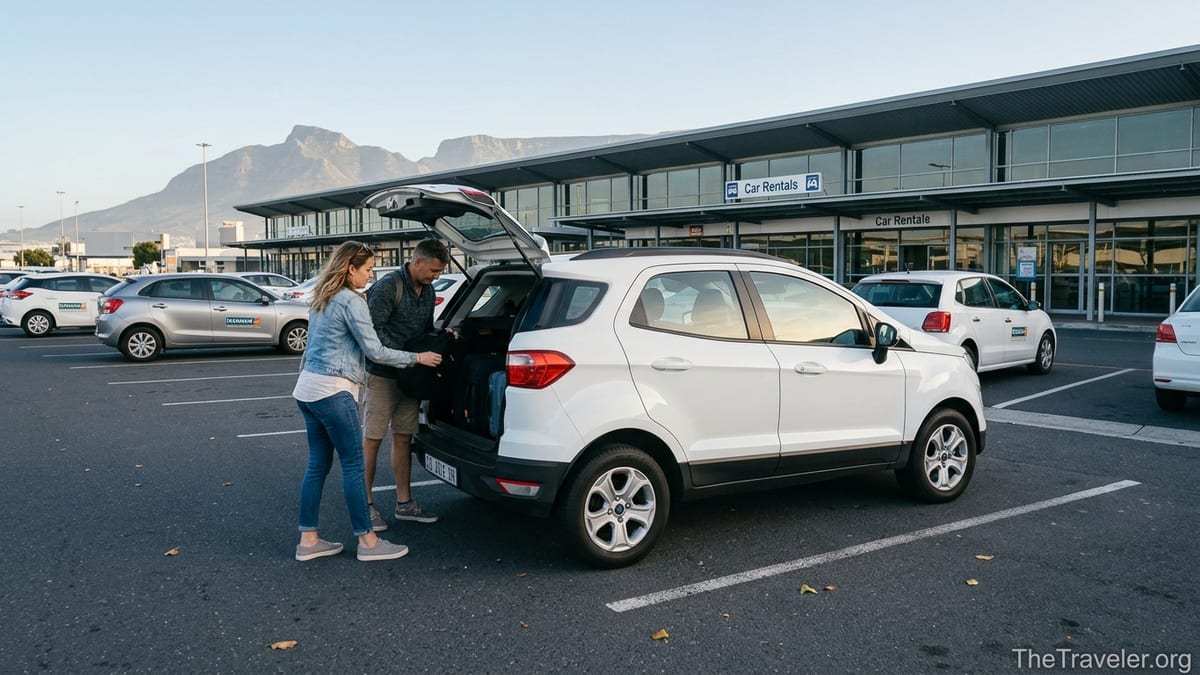
How Cape Town Airport car rentals work in practice
Cape Town International Airport has a dedicated car rental precinct just beyond the main terminal building, reached via short covered walkways or subways from arrivals. Inside you will find the major international brands such as Avis, Budget, Europcar, Hertz, SIXT and Enterprise, alongside South African agencies like Tempest and First Car Rental. All operate from a shared multilevel car rental building, which is clearly signposted from baggage claim and again on the access roads as “Car Rental Returns.”
In normal daytime conditions, you can walk from the arrivals hall to the rental desks in about five minutes. After signing your contract, you typically take a lift or ramp down to clearly marked bays where vehicles are parked by company name and bay number. Returns are just as simple: you follow “Car Rental Returns” signs on Airport Approach Road, enter the same building and a staff member scans the car back in while you wait for the final invoice.
Opening hours vary by company, but the big brands usually staff their desks from early morning to late evening to match the main domestic and international flights. For example, a long-haul arrival around 10:00 often lands to find several counters open and a short queue, while late-night arrivals closer to midnight may see only one or two staff on duty and a longer wait. During South African school holidays and December peak season, pre-booking and keeping your confirmation number handy at the desk can significantly speed things up.
On-airport agencies are usually more expensive than off-airport providers that shuttle you to nearby depots, but they save time and are far better suited to itineraries where you drive straight out toward the Garden Route or winelands and return just before an outbound flight. For short Cape Town city stays without a road trip, some travelers choose to collect later from downtown depots instead of the airport.
What you should expect to pay: rates, deposits and fuel
Daily rental rates at Cape Town Airport vary widely by season and car class. A small manual hatchback from a well-known brand can start around the equivalent of a modest budget hotel room per day in low season, while a mid-size automatic SUV in December can cost two to three times as much. Prices generally include unlimited kilometres on airport rentals, but some budget categories still come with capped mileage, so it is essential to check if you plan to drive the full Garden Route to Knysna or Plettenberg Bay.
Security deposits are a key consideration. It is common for agencies to pre-authorise a few thousand rand on your credit card to cover fuel and potential damage, on top of holding an excess amount linked to your insurance choice. If you opt for a basic collision and theft waiver with a higher excess, the hold can be substantial relative to your holiday budget. Some local rate sheets show excess liabilities on a standard waiver running into tens of thousands of rand for a typical sedan, which can be reduced to a much smaller or even nil excess by paying for “super” or “all-inclusive” cover at the counter.
Most airport rentals operate on a “full-to-full” fuel policy. You receive the car with a full tank and must return it full, usually at a petrol station just before the airport turnoff. There are service stations on the N2 within a short drive of the terminal in both directions, and many travelers plan a quick stop there before returning the car. If you bring the vehicle back less than full, the rental company refuels it for you, typically at a premium per litre plus a service fee that quickly adds up on a larger tank.
Extra charges are another budgeting point. Garden Route travellers often add a second driver for long days between Mossel Bay and Plettenberg Bay or for sharing the drive back to Cape Town. Agencies usually charge a flat daily fee for each additional driver, and there may be one-way drop fees if you choose to start in Cape Town and leave the car in George or Gqeberha at the far end of the route. Child seats, GPS units and mobile Wi-Fi can also increase the bill but are convenient if you are unfamiliar with local roads.
Insurance in South Africa: understanding CDW, theft waivers and excess
South African car rentals nearly always include a basic collision damage waiver and theft protection in the quoted rate, but this cover usually comes with a sizable excess. In practice, this means that if the vehicle is stolen near Wilderness or damaged in a minor fender-bender in Stellenbosch, you are responsible for the first portion of the cost up to that excess amount, and the insurer covers the rest. The exact figures vary by company and car group, with larger SUVs and vans generally carrying higher excesses than small hatchbacks.
At the Cape Town Airport counter, staff will typically offer a range of additional insurance options marketed as “super cover,” “all-inclusive” or similar names. These products are designed to reduce your excess dramatically, sometimes close to zero, in exchange for a higher daily fee. For example, a compact car on a standard waiver might leave you with a liability roughly equivalent to a mid-range smartphone, while paying for the highest level of cover can reduce that liability to a token amount. For a longer Garden Route trip where you will park at trailheads, beachfront lots and guesthouses in several towns, many travellers find the peace of mind worthwhile.
Some visitors arrive with separate excess insurance purchased from a specialist provider in their home country. This kind of cover usually reimburses you for whatever the rental company charges up to a predefined limit after a claim, rather than replacing the rental company’s own waivers. At the desk, you still have to accept the local collision and theft waivers, but you can choose not to buy the optional super cover if you are comfortable fronting the excess and claiming it back later. Reading both policies before you travel is important so you understand exclusions such as gravel road driving, windscreen and tyre damage or undercarriage damage, which are common on detours to viewpoints and wine farms.
Liability insurance for damage you cause to other vehicles or property is another area to check carefully. Third-party liability is usually included by South African agencies up to a high limit, but exact amounts and terms differ. If you plan to drive in heavier traffic in Cape Town’s city bowl before heading out to the open road, making sure you are adequately covered for liability, not just damage to your own car, is prudent.
Choosing the right car for Garden Route and wine region driving
The Garden Route and Cape Winelands are both well served by tarred roads, which means you do not need a heavy-duty 4x4 for most itineraries. A compact or mid-size sedan is sufficient for the N2 highway from Cape Town to Mossel Bay, the R44 coastal road past Gordon’s Bay and the winelands routes linking Stellenbosch, Franschhoek and Paarl. However, specific choices can make the trip more comfortable. An automatic transmission is strongly recommended for visitors not used to driving on the left, as it allows you to focus on lane discipline and traffic rather than gear changes in unfamiliar conditions.
If you are planning a longer loop such as Cape Town to Hermanus, on to Knysna, Plettenberg Bay and Tsitsikamma, a slightly larger car with better luggage capacity and highway stability can be a smart upgrade. Families often choose compact SUVs so that four people plus bags fit comfortably without stacking luggage high in the rear window, which can attract unwanted attention when parked. Couples on a shorter winelands escape might be perfectly content with a small hatchback, which also makes parking in Stellenbosch town centre or Franschhoek’s main street easier on busy weekends.
Some of the most rewarding diversions from the main roads involve short stretches of gravel or uneven surfaces, such as farm roads leading to wine estates, accommodation on the outskirts of Knysna’s forests or viewpoints above Wilderness. For these, a car with slightly higher ground clearance can reduce the risk of scraping and make you feel more comfortable, although you should still drive slowly and avoid deep potholes after heavy rain. Before leaving the rental lot, always check whether gravel road use is restricted by your contract, as ignoring these conditions can affect insurance cover.
Air conditioning, Bluetooth connectivity and decent headlights are everyday conveniences that matter more than many first-time visitors expect. Summer in the Western Cape can be hot and bright, while winter Garden Route mornings often start misty. A modern car with good ventilation and lighting makes early departures from Cape Town, sunset returns from Stellenbosch and night arrivals into Mossel Bay or George much safer and more pleasant.
Driving safety, rules and parking on the Garden Route and in the winelands
South Africa drives on the left, with right-hand-drive vehicles and traffic circles flowing clockwise. Speed limits on the main highways such as the N2 and N1 are typically 120 km/h outside built-up areas, dropping to 100 km/h or 80 km/h in semi-urban stretches and down to 60 km/h or 40 km/h in towns. The Garden Route section between George and Plettenberg Bay is known for frequent speed cameras, so it is sensible to stick closely to posted limits even if other drivers are moving faster.
Driving in daylight is strongly advised, especially if you are new to the country. Distances can be deceptive: while Google Maps may show around five to six hours from Cape Town to Knysna, travellers often find they need longer due to roadworks, scenic stops and slower sections through smaller towns. Daylight driving reduces the risks from pedestrians and animals near the roadway, unlit vehicles and fatigue. Many itineraries therefore break the journey at Hermanus, Swellendam or Mossel Bay instead of attempting a direct Cape Town to Plettenberg Bay run in one day.
Standard city parking practices apply in Cape Town, Stellenbosch and other larger towns. In many areas, informal parking attendants wearing high-visibility vests guide you into on-street bays or open lots and keep an eye on vehicles in exchange for a small tip when you leave. At popular winelands estates and Garden Route viewpoints, parking is often free within the property but bays closest to entrances fill quickly in peak season. In smaller coastal towns such as Wilderness or Sedgefield, beachfront parking can become tight on hot days, so arriving earlier in the morning or later in the afternoon helps.
Basic precautions go a long way toward trouble-free motoring. Avoid leaving bags, cameras or shopping visible in the car when parked, particularly at trailheads like Robberg Nature Reserve near Plettenberg Bay or at viewpoints near Knysna Heads. Lock the vehicle whenever you step away, even just to pay for petrol. At night, choose accommodation with secure off-street parking or a monitored lot where possible, which is common in both winelands guesthouses and Garden Route lodges.
Planning a Garden Route road trip from Cape Town Airport
Many travellers use Cape Town Airport as the starting point for a classic Garden Route journey. After collecting a car at the terminal, one popular pattern is to drive south-east along the N2 to Hermanus for whale watching in season, then continue via Swellendam and Riversdale to Mossel Bay, considered the western gateway of the Garden Route. From there, the coastal scenery intensifies through Wilderness, Sedgefield and Knysna, before reaching Plettenberg Bay and finally Tsitsikamma and Storms River at the eastern end.
Driving times provide useful planning anchors. As a rough guide, it is around four to five hours from the Cape Town area to Mossel Bay, then roughly an hour to George, another 45 minutes to Wilderness, just under an hour to Knysna and about 30 to 45 minutes further to Plettenberg Bay depending on stops. This means a full Cape Town to Plettenberg Bay drive is realistically a full day on the road with only short breaks. Many visitors therefore divide the journey over at least two days, sleeping in Hermanus, Swellendam, Mossel Bay or Wilderness on the way out and perhaps George or Mossel Bay on the return leg.
Concrete examples help set expectations. A one-week itinerary might look like: land in Cape Town, drive to Hermanus for two nights, then on to Wilderness for two nights, followed by two nights in Knysna and a final night in Plettenberg Bay before returning the car at George or continuing to Gqeberha. Another approach is to fly into Cape Town, transfer directly to the Garden Route by plane to George, and then collect a rental there for a shorter loop between Mossel Bay and Tsitsikamma, returning to Cape Town later purely for city, peninsula and winelands day trips.
Regardless of the route you choose, building slack into the schedule is important. The appeal of the Garden Route lies in unplanned stops: a detour to a farm stall outside Riversdale, an extra hour on the beach at Wilderness or a spontaneous lagoon cruise from Knysna. Renting your own car from Cape Town Airport gives you the flexibility to seize those moments without worrying about bus timetables or tour schedules.
Exploring Stellenbosch, Franschhoek and the Cape Winelands by rental car
The Cape Winelands are significantly closer to Cape Town International Airport than the Garden Route, making them ideal for short self-drive escapes. Stellenbosch lies roughly 30 to 40 minutes from the airport in light traffic via the R310 and local roads, while Franschhoek is about an hour away via Stellenbosch and the dramatic mountain pass that links the two valleys. Paarl, another major wine town, is slightly further north but still within a comfortable hour’s drive from the terminal for most drivers.
With a car, you can easily string together tastings and lunches at several estates across different valleys. For example, a common day-trip pattern is to drive from central Cape Town or the airport to Stellenbosch for an early tasting, continue to a farm between Stellenbosch and Franschhoek for lunch, then cross the pass into Franschhoek for an afternoon on one or two estates before returning to your base. On multi-day winelands stays, many travellers park the car at their guesthouse and use local shuttles or designated drivers for wine tasting days, then use the rental mainly for transfers, hikes and scenic drives.
Parking at most estates is straightforward. Larger wineries offer broad gravel or paved lots, often shaded by trees or shade structures, and there is usually no charge for parking while you visit the cellar, restaurant or picnic lawns. In town centres such as Stellenbosch, parking can be more constrained during university term or weekend events. Metered bays and monitored lots are common, and carrying small change or a contactless card helps with payment where attendants use handheld machines.
One critical safety consideration in the winelands is drinking and driving. Local enforcement of blood alcohol limits varies, but the legal limit is strict and police roadblocks do occur, particularly on weekends and holidays. If your itinerary revolves around wine tasting rather than scenery, consider a hybrid approach: keep the rental car for flexibility across the region, but book at least one day with a shuttle, private driver or wine tram service while you leave the car parked at your lodge.
Is renting a car at Cape Town Airport worth it?
For trips limited to Cape Town’s central neighbourhoods, the Atlantic Seaboard and a handful of organised tours, renting a car at the airport is not strictly necessary. Ride-hailing services, taxis and guided excursions cover most urban and nearby coastal highlights without the responsibility of driving. However, once you add independent Garden Route travel or serious exploration of the winelands, having your own vehicle quickly becomes the most efficient and flexible option.
Consider a two-week holiday that includes four nights in Cape Town, four or five on the Garden Route and two or three in the winelands. Without a rental car, you would be piecing together domestic flights to George, shuttles, local transfers between coastal towns, tour buses to Robberg or Tsitsikamma and separate wine region day tours. With a single rental collected on arrival at Cape Town Airport, you can drive directly to Hermanus, Wilderness or Stellenbosch, set your own timetable, and adjust it when the weather shifts or you discover a new detour worth taking.
Cost-wise, once you factor in multiple private transfers for two or more people, a mid-range rental with fuel and tolls often compares favourably, especially outside the absolute peak summer weeks. The real value, though, is qualitative: sunrise drives along the Wilderness lakes, lingering at a farm stall near Mossel Bay without watching the clock, or timing your arrival at Franschhoek Pass for golden hour views over the vineyards.
That said, there are scenarios where airport rental is less compelling. Solo travellers on very short stays who are nervous about left-side driving may prefer a mix of city taxis and a curated Garden Route tour departing from Cape Town. Equally, visitors whose plans focus exclusively on safari in another province might decide to connect through Cape Town without ever leaving the airport. Aligning the rental decision with the shape of your trip, your driving confidence and your appetite for spontaneous detours is the key.
FAQ
Q1. Do I really need a car to drive the Garden Route from Cape Town?
For a classic Garden Route itinerary visiting Mossel Bay, Wilderness, Knysna and Plettenberg Bay, a car is by far the most practical option. Public transport and intercity buses cover some segments but do not easily reach beaches, viewpoints, trailheads or remote guesthouses, so a rental from Cape Town Airport gives you much greater freedom.
Q2. How long does it take to drive from Cape Town Airport to the start of the Garden Route?
Allow roughly four to five hours to reach Mossel Bay, which many regard as the formal western start of the Garden Route, from the Cape Town area in normal daytime traffic. This includes stretches of highway, slowdowns through smaller towns and one or two short rest stops.
Q3. Is it safe to drive the Garden Route and winelands as a visitor?
Thousands of visitors drive the Garden Route and winelands every year without incident. Sticking to daylight driving where possible, obeying speed limits, not leaving valuables visible in parked cars and choosing accommodation with secure parking significantly reduces risk, as does avoiding isolated stops at night.
Q4. What kind of car is best for Garden Route and wine region driving?
A compact or mid-size automatic sedan suits most travellers, as roads are tarred and well maintained. Families or groups often appreciate a compact SUV for extra luggage space and slightly higher ground clearance, especially if they plan to use gravel farm roads or stay outside main towns.
Q5. Can I rent a car at Cape Town Airport and drop it off in another city?
Yes, most major agencies allow one-way rentals, such as collecting at Cape Town Airport and returning the car in George or Gqeberha at the far end of the Garden Route. One-way drop fees usually apply and should be checked when booking.
Q6. How does car rental insurance work in South Africa?
Most rentals include basic collision and theft waivers with an excess, which is the maximum you pay if the car is damaged or stolen. At Cape Town Airport desks you can usually pay extra for super cover that reduces this excess, or rely on separate excess insurance if you have arranged it at home, provided you are comfortable paying the rental company first and claiming back later.
Q7. Are automatic cars easy to find at Cape Town Airport?
Automatic vehicles are widely available from international and local agencies at Cape Town Airport, though they cost more than manuals and can sell out in peak periods. If you are not used to driving on the left, reserving an automatic in advance is strongly recommended.
Q8. Where can I park safely at Garden Route beaches and winelands estates?
Most beaches and viewpoints along the Garden Route have designated lots or roadside bays, and many wineries have their own on-site parking areas. Choose busy, well-lit areas where possible, lock the car, avoid leaving belongings on display and thank attendants with a small tip when they help you park.
Q9. Is it better to base in one town or move along the Garden Route?
Both approaches work. Some travellers base themselves in Knysna or Wilderness and do day trips to Plettenberg Bay, Mossel Bay and Tsitsikamma, while others move every night or two to reduce backtracking. A rental car from Cape Town Airport makes either style feasible, so it often comes down to how much packing and unpacking you enjoy.
Q10. Should I rent a car for the winelands part of my trip?
Yes if you want the freedom to explore Stellenbosch, Franschhoek and Paarl at your own pace, including hikes and restaurants away from town centres. On wine tasting days, consider leaving the car parked at your accommodation and booking a shuttle or driver so you can enjoy the region’s wines responsibly.