


Private aviation is no longer a one-size-fits-all luxury. Today, frequent travelers can choose between lean, light-jet specialists focused on short European hops and global fleets that whisk clients nonstop between New York, Dubai, Hong Kong, and beyond. GlobeAir and VistaJet sit on opposite ends of this spectrum. Understanding how they differ in fleet, pricing, and travel experience will help you decide which service fits your travel style and flying patterns.
Get the latest updates straight to your inbox!
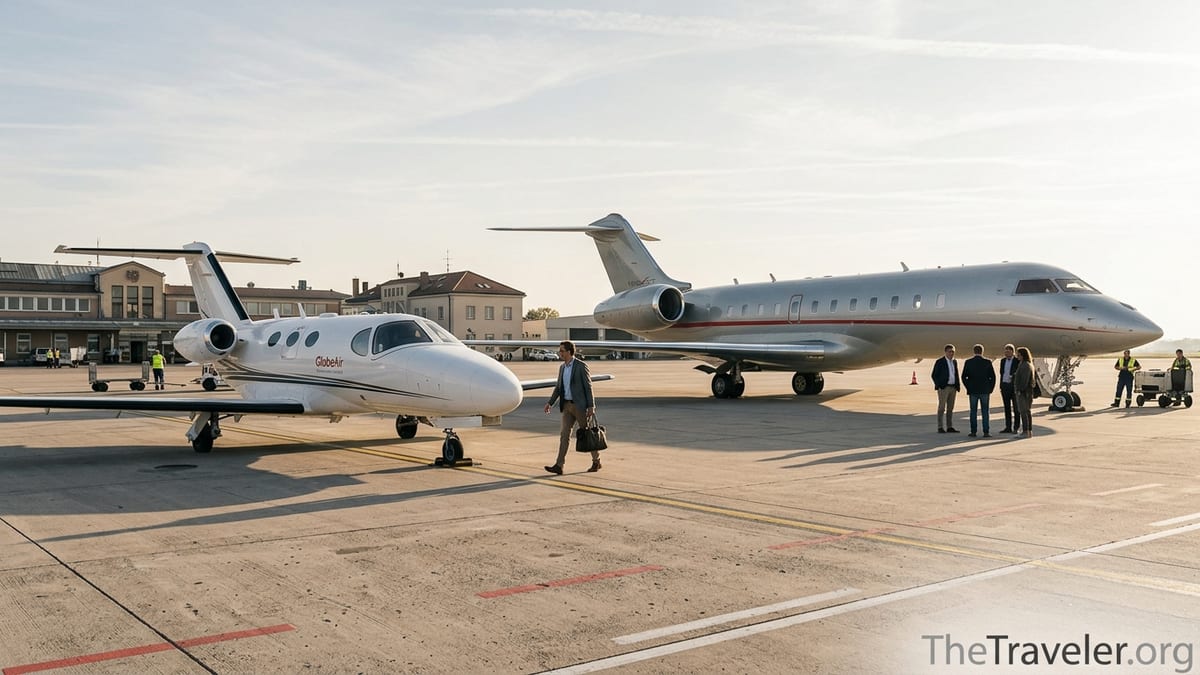
Two Very Different Private Aviation Models
GlobeAir and VistaJet share a similar promise: consistent, premium private jet service without the hassles of ownership. Yet they execute that promise in very different ways. GlobeAir is a European operator built entirely around very light jets, focusing on short-haul hops between regional cities. VistaJet, part of the Vista ecosystem, is a global player offering midsize, large-cabin, and ultra-long-range jets with a strong emphasis on guaranteed availability and a branded, uniform onboard experience.
In practice, this means a Milan to Nice weekend trip, or Geneva to Ibiza for a small group of friends, is the sort of mission where GlobeAir’s Cessna Citation Mustang fleet shines. By contrast, a nonstop New York to London business run, or a multi-leg tour covering Dubai, Singapore, and Sydney, is squarely in VistaJet’s territory, where its Bombardier Challenger and Global aircraft provide the necessary range and cabin size.
Choosing between the two is less about which brand is “better” and more about how and where you fly. A traveler doing 20 to 30 short European segments per year will look at GlobeAir very differently from a family that wants to cross oceans several times a season with pets, nannies, and luggage in tow. Understanding each company’s core model is the first step to making an informed decision.
Fleet and Cabin Experience: Mustang vs Global
GlobeAir operates what it describes as the world’s largest fleet of Cessna Citation Mustang very light jets in Europe, with close to 20 aircraft focused on point-to-point missions across the continent. These four-passenger jets are designed for sectors of roughly 1.5 to 2.5 hours, such as Zurich to Paris or Vienna to Rome. The cabins are compact but intelligently laid out, with club seating for four, a small refreshment center, and space for carry-on bags and a few suitcases, ideal for one to three travelers who prioritize time savings over sprawling space.
VistaJet, by contrast, is built around a homogeneous branded fleet of Bombardier aircraft, including Challenger 350 super-midsize jets and Global 5000, 6000, and 7500 long-range jets. These aircraft typically seat between 8 and 14 passengers, with stand-up cabins, lie-flat beds, large galleys, and generous baggage holds. A Global 7500, for example, can operate very long routes like Los Angeles to Hong Kong or London to Buenos Aires with a full-size bedroom and separate living areas, something no very light jet can approach.
The onboard experience mirrors these hardware differences. On a typical GlobeAir leg from Munich to Florence, you might expect a streamlined service: a quick boarding at a small fixed-base operator, seating for up to four, basic catering like snacks and drinks, and a short, efficient flight that gets you into smaller regional airports closer to your final destination. With VistaJet on a New York to London overnight flight, the cabin might feature bespoke interiors, curated wine lists, full hot meals served on fine china, and a crew trained for multi-course service and turndown, allowing you to arrive rested and ready for meetings.
If your typical trip is under two hours and involves one or two colleagues heading to European financial centers or resort towns, the intimacy and efficiency of the Mustang cabin may feel perfectly adequate. If you often travel with a larger entourage, require sleeping space, or want to cross multiple time zones on a single leg, VistaJet’s larger cabins will feel more aligned with your expectations.
Where They Fly: Regional Europe vs Global Reach
GlobeAir is very clearly positioned as a European specialist. The company promotes on-demand charter access to hundreds of airports around Europe, from major hubs like London, Paris, and Frankfurt to smaller regional fields in the Alps, the Mediterranean, and central Europe. Examples include flights such as Linz to Hamburg or Hamburg to Munich, where GlobeAir advertises limited offers around the high four-figure euro range for a single leg on its Mustang fleet, targeting time-sensitive travelers who value speed between secondary cities.
Because the Citation Mustang’s range is modest, GlobeAir is best suited for itineraries like Geneva to Olbia, Zurich to Cannes, or Vienna to Milan. For ski season, that might mean routing into smaller airports closer to the slopes, such as Innsbruck or Sion, avoiding long transfers from big hubs. For summer, it could mean flying directly into island or coastal airports serving Sardinia, the Balearics, or the Greek islands, often with a total travel time that rivals or beats commercial schedules when you factor in short check-in times and private terminals.
VistaJet, on the other hand, markets itself as a truly global operator, with clients having flown to thousands of airports in nearly all countries worldwide. Its long-range Bombardier Global fleet can easily operate missions like London to Cape Town, New York to Riyadh, or Hong Kong to Sydney nonstop, while the Challenger fleet covers transcontinental and transatlantic routes such as Los Angeles to New York or Geneva to Dubai. VistaJet’s program members typically use the service for complex itineraries where guaranteed availability in multiple regions is critical.
In practice, this means that a European entrepreneur who spends most of the year between London, Zurich, and Barcelona, plus the occasional hop to Ibiza, could comfortably rely on GlobeAir. However, a private equity partner who splits time between New York, London, and Dubai, and needs consistent service standards across continents, would find VistaJet’s global reach more compelling. If most of your flights start and end within the Schengen zone, GlobeAir will likely match your pattern. If you regularly cross oceans, GlobeAir will not meet your needs without involving separate operators or connections, while VistaJet is built exactly for that use case.
Pricing, Membership, and Real-World Cost Examples
One of the most important differences between GlobeAir and VistaJet lies in how they price and package their services. GlobeAir is primarily an on-demand charter operator with the option of jet card programs. Clients pay per trip, with pricing influenced by route, aircraft positioning, and demand. External brokers list typical hourly rates for GlobeAir’s Citation Mustang in the low 3,000s of euros per flight hour, which aligns broadly with what many travelers see on quotes for short European trips. A 1.5-hour hop such as Zurich to Rome might therefore be priced in the 4,500 to 6,000 euro range one way, before taxes and handling fees, depending on aircraft availability and timing.
GlobeAir’s own site highlights specific example routes, such as Linz to Hamburg or Hamburg to Munich, where promotional offers can sit in the high four-figure euro range for limited-time fares. Travelers who fly more frequently can purchase a jet card, prepaying for a block of hours on the Mustang fleet at fixed hourly rates, which buys both predictability and priority access during busy periods like August in the Mediterranean or February in the Alps.
VistaJet follows a different approach. Rather than pure ad hoc charter, its flagship product is a program that resembles a membership subscription: clients commit to a minimum number of flight hours per year, often starting around 50 hours, and in return receive guaranteed availability at fixed hourly rates on a specific cabin class. Third-party analyses of VistaJet’s pricing in 2026 describe it as a premium option with hourly rates that sit above typical charter averages, reflecting the global access and consistent cabin experience. However, because VistaJet prices point-to-point without always charging for repositioning back to base, some long-haul examples can be competitive with traditional charter operators on similar routes.
As a rough real-world comparison, a two-hour Europe-only hop for four passengers on GlobeAir might total around 6,000 to 7,000 euros one way when booked as a standalone charter, whereas a transatlantic flight of eight to nine hours on a large-cabin jet through a premium operator like VistaJet can easily run into the mid to high five figures in US dollars or euros per leg, and sometimes beyond that when demand is high or routes are unusual. The key takeaway is that GlobeAir offers an entry point to private jet travel in Europe at a lower absolute cost, while VistaJet focuses on larger, longer missions with pricing that reflects the aircraft size and global service infrastructure.
Booking Experience, Flexibility, and Empty Legs
Both GlobeAir and VistaJet emphasize hassle-free booking and tight turnaround times at the airport, but they cater to slightly different expectations. GlobeAir targets time-poor executives and leisure travelers within Europe who may book short-notice trips. The company promotes boarding times as short as 15 minutes before departure from private terminals and often handles flights between smaller airports where commercial options are limited or poorly timed. For instance, a family leaving Vienna after work on a Friday for a weekend in Sardinia might depart in the early evening and land in Olbia in time for a late dinner, bypassing hub connections.
GlobeAir, like many operators, also relies on repositioning flights, which creates “empty leg” opportunities: discounted one-way flights when the aircraft would otherwise fly empty. The company states that empty leg deals can reduce the regular price by up to a significant percentage, a compelling option for flexible travelers willing to adapt to set routes and timings. A traveler in Nice might spot an empty leg to London or Olbia at a fraction of the usual cost if they can leave at short notice.
VistaJet’s booking experience is more program-centric. Members typically work with dedicated account managers or a 24/7 operations team to schedule flights anywhere in the world with relatively short call-out times, often 24 hours or less depending on the program tier and region. Because VistaJet operates a large, uniform fleet, it can reposition aircraft across continents to meet member demand. While this flexibility comes at a price, it gives high-frequency travelers confidence that an aircraft will be available even during peak periods like New Year’s in the Caribbean or major global events.
For travelers who fly only a few times a year, the structure of these offerings matters. Booking a single Geneva to Ibiza charter with GlobeAir is as simple as requesting a quote, signing a contract, and paying before departure. With VistaJet, the most advantageous economics typically appear when you are ready to commit to a program and a certain number of hours per year. If you only need five or six hours annually, you might access VistaJet indirectly through brokers or specific one-off charters, but you will not be using the brand in the way its core clientele does.
Who Each Brand Fits Best: Profiles and Scenarios
Thinking in terms of traveler profiles can clarify which service is more appropriate. Imagine a Geneva-based wealth manager who travels two or three times a month to Paris, Milan, and London for client meetings, typically with one colleague. Flight sectors are under two hours, and time-saving at smaller airports is more valuable than cabin size. GlobeAir’s Mustang fleet, on-demand pricing, and European focus align well with this pattern: the client can book short-notice flights, land closer to city centers where feasible, and keep overall costs materially lower than chartering midsize jets for the same routes.
Now consider a New York family that spends summers in the south of France, winters in Aspen, and frequently visits Dubai and London for business and leisure. They often travel as a group of six to eight people, sometimes including staff or extended family. Their ideal solution is a service that provides large-cabin jets, lie-flat sleeping, and consistent service standards across multiple continents. VistaJet’s Program membership, with guaranteed availability on a Global or Challenger aircraft, fits this profile far better than a European light-jet operator could.
A third scenario might involve a fast-growing tech founder in Berlin who flies roughly 40 to 60 hours per year. Half of those hours are short intra-European hops for investor meetings; the rest involve at least one or two transatlantic trips to New York or San Francisco. This traveler might blend solutions: using GlobeAir or similar light-jet operators for quick European runs, while relying on VistaJet, another global provider, or even first-class commercial for the long-haul sectors. In real life, many private aviation users end up mixing providers rather than living inside one ecosystem exclusively.
The critical question is where the majority of your flying hours sit. If 80 percent or more of your flights are under two hours within Europe, GlobeAir is structurally aligned with your needs. If a large proportion of your travel is intercontinental, with overnight sectors and more than four passengers on most trips, VistaJet’s fleet composition and program structure will likely offer better overall value and comfort despite higher hourly costs.
The Takeaway
GlobeAir and VistaJet represent two distinct interpretations of modern private aviation. GlobeAir focuses on making short-haul private jet travel within Europe more accessible and efficient, leveraging a homogeneous fleet of very light jets to keep costs comparatively lower while serving a wide network of regional airports. For travelers whose lives orbit European business hubs, ski resorts, and Mediterranean islands, it offers a pragmatic way to reclaim time and avoid the frictions of commercial travel.
VistaJet, in contrast, builds its value proposition on global reach, larger cabins, and a membership model that guarantees availability and standardizes the onboard experience across continents. Its Bombardier fleet is designed to move clients comfortably between financial centers and resort destinations worldwide, often nonstop and accompanied by a level of onboard service closer to a boutique hotel than a mode of transport.
Choosing between them is ultimately about matching the tool to the job. Map out a typical year of travel: where you fly, how far, how often, and with how many people. If the answer is mostly short, intra-European hops with small groups, GlobeAir or a similar light-jet specialist likely offers the better fit. If your calendar is dotted with long-haul missions, complex multi-city itineraries, and larger traveling parties, VistaJet’s global program is closer to what you need.
Either way, the evolution of private aviation means travelers no longer have to own an aircraft to enjoy tailored, flexible flying. With a clear understanding of your patterns and priorities, GlobeAir and VistaJet each offer credible paths to designing a private travel experience that feels less like a splurge and more like a strategic advantage.
FAQ
Q1. Is GlobeAir cheaper than VistaJet for typical trips?
In absolute terms, GlobeAir is generally cheaper for short European flights because it uses smaller Citation Mustang jets and focuses on regional routes, while VistaJet operates larger and longer-range aircraft with a more premium membership model.
Q2. Can GlobeAir fly me from the United States to Europe?
No. GlobeAir’s fleet and operating model are designed for short-haul flights within Europe. For transatlantic or intercontinental routes, you would need a long-range operator such as VistaJet or another large-cabin provider.
Q3. How many people can fly on a typical GlobeAir jet?
GlobeAir’s Cessna Citation Mustang jets are configured for up to four passengers. They are ideal for one to three travelers plus light luggage rather than large groups.
Q4. What kind of aircraft does VistaJet operate?
VistaJet focuses on Bombardier business jets, including super-midsize Challenger 350 aircraft and long-range Global 5000, 6000, and 7500 models, with cabins typically seating 8 to 14 passengers.
Q5. Do I need to buy a membership to fly with VistaJet?
You do not strictly need a membership, but VistaJet’s core product is its program, where clients commit to a set number of hours for guaranteed availability and fixed hourly rates. Occasional travelers may access VistaJet through brokers or one-off arrangements, often at higher effective costs.
Q6. Are empty leg flights a realistic way to save money with GlobeAir or VistaJet?
Yes, but only if you are flexible. Empty legs are discounted one-way flights when an aircraft needs to reposition. Both operators may offer them, but routes and times are fixed and can change at short notice.
Q7. Which service is better for family vacations to Mediterranean resorts?
If you are already in Europe and traveling with up to four people, GlobeAir is often more cost-effective for short hops to Mediterranean destinations. For larger families, long-haul access from other continents, or those who want more cabin space, VistaJet or similar large-cabin providers will be more suitable.
Q8. How far in advance should I book with GlobeAir or VistaJet?
Both can often accommodate short-notice requests, sometimes within 24 hours, but availability and pricing are better when you book earlier, especially during peak seasons like August in Europe or major holiday periods worldwide.
Q9. Is private jet travel with these companies safer than commercial aviation?
Both GlobeAir and VistaJet operate under strict safety regulations and emphasize high maintenance and crew standards. The overall safety record of reputable private jet operators is strong, but as always, it is wise to verify certifications and safety ratings with your advisor.
Q10. Can I bring pets on GlobeAir and VistaJet flights?
Both operators can typically accommodate pets, subject to aircraft space, cleaning requirements, and the import rules of your destination. It is important to declare pets in advance so the operator can arrange appropriate documentation and onboard preparations.