


Lecce is one of southern Italy’s most rewarding cities to explore without a car. Its compact historic center is built for wandering, with late baroque facades, cool churches and café-lined piazzas all within a short walk of each other. The moment you start dreaming of Salento’s beaches, however, the picture changes. Coastal towns like Otranto, Gallipoli and Santa Maria di Leuca can be reached by train or summer buses, but timetables, seasons and last departures matter far more than in many other regions of Italy. This guide uses the latest published schedules and ticket information to map out what is realistically possible from Lecce without renting a car, and where four wheels begin to make sense.
Get the latest updates straight to your inbox!
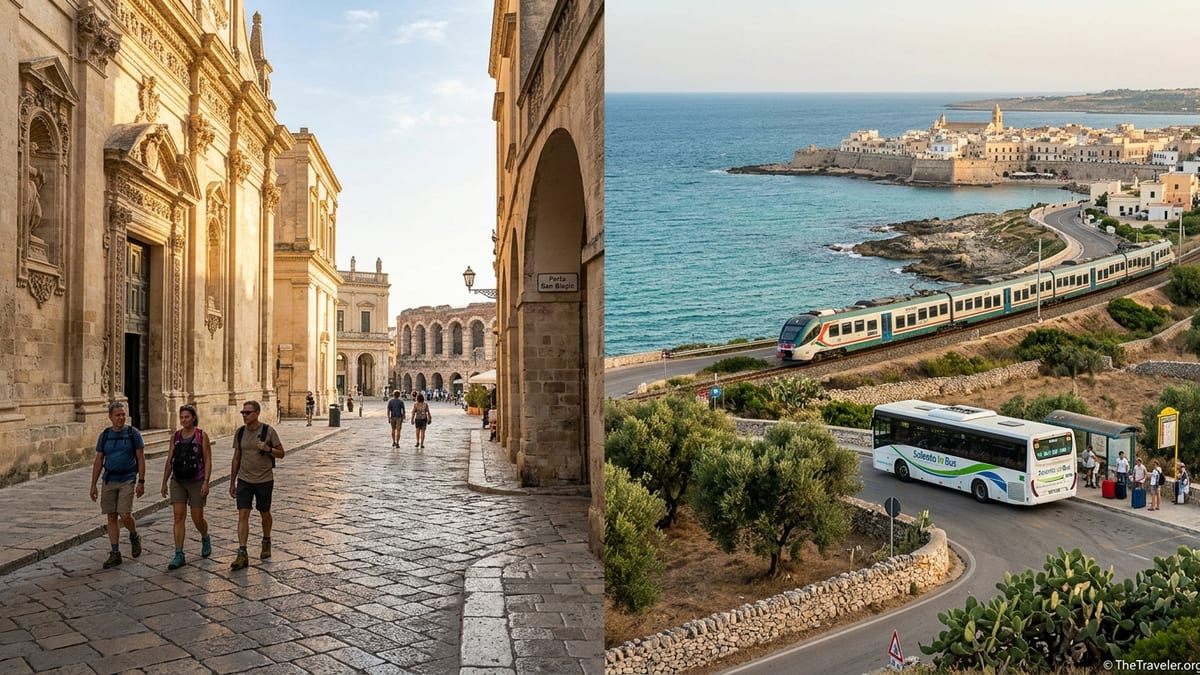
Verdict: Walkable Lecce, Seasonal Salento
Lecce’s historic center is genuinely car-free friendly. From Lecce railway station, it is around 10 to 15 minutes on foot to Porta San Biagio, one of the main gates to the baroque core. Once inside the walls, distances are short: Basilica di Santa Croce, Piazza Duomo, the Roman Amphitheatre and Porta Napoli all sit within a rough triangle of streets that can be walked comfortably in an afternoon. The main challenges are summer heat from June to September and uneven paving stones underfoot, not traffic.
The wider Salento peninsula is a different story. Ferrovie del Sud Est (FSE) regional trains and buses still form the backbone of inland public transport, but many coastal services now rely on the seasonal “Salento in Bus” network, coordinated by regional operators and active in 2026 from mid-June to mid-September. Outside that window, buses to the beaches are sparse or nonexistent, and you often need combinations of train, replacement bus and taxi to reach the sea.
The practical verdict for travelers in 2026 is clear. Lecce itself is perfectly enjoyable without a car for two or three days. Reaching one or two major coastal towns such as Otranto or Gallipoli is possible year-round using FSE rail and bus. Once you start targeting specific beaches, late evening swims or shoulder-season stays in smaller resorts like Porto Cesareo or Torre dell’Orso, you are dependent on Salento in Bus summer timetables and may need expensive taxis outside the core months.
Understanding FSE Trains, Buses and the Salento in Bus Network
Ferrovie del Sud Est operates regional trains from Lecce towards Otranto, Gallipoli and the southern tip of the peninsula. According to the current regional timetable valid from 14 June to 12 December 2026, the Lecce to Otranto route is still active but partly covered by bus replacements on some departures. For example, a mid-morning service shows as a substitute bus departing Lecce around 10:30 and arriving in Otranto just before noon, while other departures run as regional trains with journey times of roughly 90 minutes.
In practice, this means that reaching Otranto usually involves one of two options. You either take a direct FSE service, which may be a train all the way or a bus for part of the route, or you travel by train from Lecce to Maglie and then transfer to a connecting service on the Maglie to Otranto branch line. Travel times sit in the 1 hour 20 minutes to 1 hour 40 minutes range. Seats do not require reservations and base one-way fares are typically around 5 to 7 euro per person when bought as simple regional tickets.
Beyond the rail backbone, the Salento in Bus network is the main tool for car-free beach trips. For summer 2026, provincial and consortium operators have announced services from 13 June to 13 September, including Line 101 Lecce to Torre dell’Orso and Otranto, Line 104 Lecce to Porto Cesareo and Gallipoli, and Line 108 from Lecce to Gallipoli and Santa Maria di Leuca. These lines run several times a day and are timed to connect with inland towns and main beaches. Outside these summer dates, only scattered local buses remain, often aimed at commuters rather than tourists.
How To Reach Key Coastal Towns Without a Car
Otranto is the most straightforward coastal destination from Lecce if you plan around the timetable. With FSE, you can currently expect around four to six daily connections in each direction, combining trains and occasional substitute buses. Examples in the 2026 schedule include a morning departure around 6:50, arriving close to 8:30 with one change, and a late-morning service around 10:30 arriving around 12:00. Last returns tend to leave Otranto late afternoon or early evening, often before 20:00, so staying for dinner and a late stroll along the seafront may require checking the very latest return times just before travel.
Gallipoli can be reached year-round by FSE via the Lecce to Gallipoli rail line, usually with a change in Zollino or a direct service depending on the day. Typical journey times range between 1 hour and 1 hour 30 minutes. In summer, Salento in Bus Line 104 and Line 108 add direct bus options from Lecce that route via Porto Cesareo or the coast, but these are more valuable if your accommodation is along the bus corridor. Last summer returns from Gallipoli to Lecce by bus have often been early evening, around 19:00 to 21:00, so day trippers should avoid planning late dinners before checking the season’s exact schedule.
Santa Maria di Leuca is at the extreme southern tip of Salento and is the hardest of the major towns to reach without a car. There is no direct rail service from Lecce. One option in summer is Line 108 from Lecce, which runs via Gallipoli towards Leuca and is designed for tourists. Outside the Salento in Bus period, your main choices are slow local buses through inland towns or a mix of FSE train to Gagliano del Capo and a local bus or taxi for the final stretch. Total travel times can exceed two and a half hours in each direction, and last buses back to Lecce are generally in the late afternoon. Leuca makes sense as an overnight stop without a car, but it is a demanding day trip.
Comparing Otranto, Gallipoli, Porto Cesareo, Torre dell’Orso and Leuca
From Lecce, Otranto is the most balanced combination of reasonable journey time, simple connections and a scenic old town on the sea. Rail and bus journeys are around 1 hour 30 minutes each way, with roughly hourly or every-few-hours frequencies across the day in summer and a thinner but workable pattern the rest of the year. In high season, Salento in Bus Line 101 adds a direct bus that links Lecce, Torre dell’Orso and Otranto, giving you more options and later returns from the coast.
Gallipoli is slightly further in terms of time. Expect 1 hour 20 minutes or so by FSE train with at least one change, plus walking from the modern station area across the causeway to the island old town. In summer, Line 104 and Line 108 provide bus alternatives from Lecce. Travel times by bus are usually in the 1 hour 30 minutes range, with approximately three services per day in each direction, such as morning, mid-afternoon and evening departures. Last return departures to Lecce often leave Gallipoli around 21:00 in peak summer, but shoulder-season services may finish earlier.
Porto Cesareo and Torre dell’Orso are more beach-focused than town-focused and depend almost entirely on Salento in Bus for car-free access. Porto Cesareo sits on Line 104, which in recent seasons has offered three direct buses per day between Lecce’s Viale Gallipoli stop near the station and Porto Cesareo, continuing to Gallipoli. Torre dell’Orso benefits from Line 101, which again has run several times daily in summer. Outside the mid-June to mid-September window, there may be only sporadic local buses and no evening returns that work for day-trippers. Santa Maria di Leuca on Line 108 has the longest journey time at roughly two hours from Lecce by summer bus and becomes very hard to reach on a day trip outside the Salento in Bus period.
For a single-base stay in Lecce, Otranto and Gallipoli stand out as realistic day trips across much of the year, while Porto Cesareo, Torre dell’Orso and Santa Maria di Leuca are very dependent on summer-season routes. Once Salento in Bus stops running in mid-September, those beaches effectively become impractical for most visitors without either a rental car or a willingness to pay 60 to 100 euro for taxis each way, especially if you want to return after sunset.
Lecce’s Baroque Heart on Foot: A Logical Walking Route
A classic walking route through Lecce’s historic center starts at the station and ends at Porta Napoli, linking the key monuments in a logical loop. From the station forecourt, walk straight up Viale Oronzo Quarta and into the old town via Porta San Biagio. Here the pavements narrow and the stone underfoot becomes more irregular, so sturdy shoes help, especially for travelers with reduced mobility.
From Porta San Biagio, continue along Via dei Perroni and Via dei Templari to reach Piazza Sant’Oronzo, the city’s central square. On one side, slightly below street level, lies the Roman Amphitheatre, which can be admired from the balustrade for free. From the piazza, turn along Via Vittorio Emanuele II, a café-lined street that leads gently towards Piazza Duomo. The cathedral square is one of southern Italy’s most atmospheric urban spaces, with the Duomo, bell tower and Palazzo Vescovile forming a closed rectangle that is especially beautiful in the evening light.
Entrance to Lecce’s main ecclesiastical monuments is managed through the LeccEcclesiae circuit. A combined ticket, available at Piazza Duomo and the Basilica di Santa Croce, grants access to the Duomo and crypt, Santa Croce, Santa Chiara, San Matteo and the Ancient Seminary with its museum. The most recently published conditions list a standard adult ticket at around 11 to 12 euro, with slightly reduced rates for children and students, and opening hours that typically run from mid-morning to early evening, with a break at lunchtime on some days. Visitors should always verify the current price and times a few days before visiting, as details can change between seasons.
From Piazza Duomo, walk north through narrow baroque streets such as Via Palmieri towards the Basilica di Santa Croce. The facade here is the emblem of Lecce’s baroque style, carved with animals, fruits and heraldic symbols in warm, honey-colored stone. After visiting the interior on your LeccEcclesiae ticket, continue a short distance northwest to reach Porta Napoli, a monumental arch that once marked the northern entrance to the city. This gate area has more modern traffic, but pavements are broad and it is a convenient point to catch regional and summer buses that stop along Via Calasso and Viale dell’Università.
Where to Stay in Lecce Without a Car
Car-free visitors will find three main accommodation areas practical: near the station, inside or just outside the historic center, and around Porta Napoli and the university. Hotels and guesthouses close to Lecce station are the most convenient if you plan multiple day trips by train or Salento in Bus. You can wheel luggage from the platforms in a few minutes, and morning departures to Otranto, Gallipoli and the coast are easy to catch. The trade-off is heavier traffic, occasional night-time noise from buses and trains, and a slightly longer walk to the prettiest parts of the old town.
Staying inside the historic center offers the richest atmosphere and the easiest access to Lecce’s churches, bars and restaurants. Many boutique hotels and B&Bs occupy baroque palazzi or converted townhouses within five to ten minutes’ walk of both Piazza Duomo and the Roman Amphitheatre. For car-free travelers, this means maximum convenience in the evening and no need to think about public transport at night. The drawbacks are luggage logistics on arrival and departure, as many lanes are pedestrian or restricted-traffic zones, and some properties may have several steps or no elevators.
The Porta Napoli and university district offers a compromise that works well for those focused on day trips. This area sits at the northern edge of the historic core, roughly 15 minutes on foot from the station and only a few minutes from key bus stops on Viale Calasso and Viale dell’Università. You are close to the LeccEcclesiae sights and evening restaurants yet better placed for early buses to Otranto, Torre dell’Orso or Gallipoli that often call at stops outside the walls. This zone is generally quieter at night than streets immediately around Piazza Sant’Oronzo but can be busy with students in term time.
Two and Three Day Itineraries Without a Car
For a focused two-day visit, spend Day 1 entirely in Lecce. After arriving by train, drop luggage at your accommodation and follow the walking route from the station through Porta San Biagio, Piazza Sant’Oronzo, the Roman Amphitheatre and on to Piazza Duomo. Use a LeccEcclesiae ticket to visit the Duomo, crypt and at least one other church, then pause for lunch at a trattoria near Via dei Templari. In the afternoon, tour the Basilica di Santa Croce and wander the side streets towards Porta Napoli, stopping for a caffè leccese and pasticciotto pastry. In the evening, return to Piazza Duomo or Piazza Sant’Oronzo for dinner in the pedestrian streets.
On Day 2, take a day trip. If you are visiting outside the mid-June to mid-September Salento in Bus season, the simplest choice is Otranto by FSE. Plan around a morning departure between 8:00 and 10:30 from Lecce, reaching Otranto late morning. Explore the old town, cathedral and seafront, and, if you wish to swim, use the town beach just below the ramparts, which is reachable on foot and does not require additional transport. Aim for an afternoon or early-evening train or replacement bus back to Lecce, leaving a margin so that any missed connection does not strand you after the last service.
With three days, you can combine more coast. One realistic plan is to base all three nights in Lecce. Day 1 mirrors the city exploration described above. Day 2 becomes a full-day excursion to Otranto using FSE out and back, giving you time to walk south along the coastal promenade and choose a lido with sunbeds and parasols, some of which have accessible ramps but many of which sit directly on sand. Day 3, if traveling in the Salento in Bus summer period, can target Torre dell’Orso or Porto Cesareo using Lines 101 or 104. Take the first available bus from the Lecce city terminal or Viale Gallipoli stop, enjoy a few hours at the beach, then return on a mid-afternoon coach to avoid relying solely on the last departure of the day.
An alternative three-day plan for those willing to move base adds an overnight stay on the coast. Spend Night 1 in Lecce, Night 2 in Otranto or Gallipoli, then return to Lecce on Day 3 for an evening train north. This structure reduces the pressure of catching last buses and lets you enjoy the sea at quieter times, such as early morning or dusk, when heat is lower. It also shortens the longest journeys, particularly helpful if you are sensitive to motion sickness or traveling with children.
Budgets, Tickets and When Rail Passes Make Sense
For two travelers in 2026, a short car-free stay in Lecce and Salento is easier to budget when you look at concrete ticket prices. FSE regional tickets from Lecce to Otranto and Lecce to Gallipoli have recent online examples around 5 to 8 euro per person one way, depending on route and whether part of the journey is on a bus. A simple day trip for two adults from Lecce to Otranto and back can therefore cost in the region of 20 to 30 euro in total for transport, bought as individual tickets at machines or ticket offices.
Summer Salento in Bus fares depend on the operator’s tariff, but a single ride from Lecce to Porto Cesareo, Torre dell’Orso or Gallipoli has recently sat roughly in the 4 to 8 euro per person range. For a couple, a round-trip beach day by bus might therefore cost around 20 to 30 euro in total for tickets. Taxis, in contrast, can be significantly more expensive. Anecdotal reports for 2025 and 2026 mention quotes of 70 to 100 euro each way for a private transfer between Lecce and Santa Maria di Leuca, with Porto Cesareo and Torre dell’Orso sometimes priced in the 50 to 80 euro each-way range depending on time of day and season.
Regional rail passes rarely pay off for such short distances unless you are stringing together multiple Salento towns on consecutive days. Because most journeys are under two hours and fares modest, two travelers doing, for example, Lecce to Otranto one day and Lecce to Gallipoli the next are usually better off buying simple point-to-point tickets. You might look at wider Italian rail passes only if Lecce and Salento are part of a longer itinerary involving multiple high-speed trains across several regions.
Accommodation for two adults in 2026 in Lecce shows a wide range but some consistent patterns. A mid-range hotel or well-rated B&B inside the historic center in shoulder seasons like April or October can often be found around 90 to 140 euro per night for a double room with breakfast. Near the station or in less atmospheric streets, prices can drop to 70 to 100 euro for similar comfort. Peak August nights may be significantly higher, especially during festivals. Adding up transport, entrance tickets and two restaurant meals per day, a realistic daily budget for two adults staying in central Lecce might sit in the 180 to 260 euro range in high season and somewhat less outside it, assuming modest but not rock-bottom choices.
Heat, Accessibility and Practical Challenges
Extreme heat is one of the main obstacles to car-free exploration in Salento. In July and August, daytime temperatures around Lecce and the coast can exceed 35 degrees Celsius, with strong sun reflecting off pale stone streets. Without a car, you will wait for buses in exposed stops and may need to walk 10 to 20 minutes between stations, terminals and beaches. Planning activities early in the morning and after 17:00, carrying plenty of water and using sun protection are not just recommendations but essential safety measures.
Lecce’s historic center also presents accessibility challenges. Many streets are paved with uneven stone slabs, and kerbs can be high near older churches. The main LeccEcclesiae sites have made efforts to improve access, but travelers using wheelchairs or with limited mobility should expect some steps and occasional narrow doorways. On the coast, the situation is even more varied. Some larger lidi at Torre dell’Orso, Gallipoli and Otranto offer boardwalks, ramps and accessible restrooms, but many public stretches of beach are reached via sandy paths or flights of steps from the road. Without a car, it is harder to pick and choose among beach clubs for specific accessibility needs.
Bus stop locations matter in the heat. In Lecce, Salento in Bus lines typically use the City Terminal north of the center and key roadside stops on Viale Gallipoli and Viale Calasso. From a hotel near Piazza Sant’Oronzo, this can mean a 10 to 15 minute walk on paving that is partly shaded, partly exposed. At the coast, stops are often set back from the sand on the main road. In Torre dell’Orso, for example, expect to walk downhill for several minutes from the bus stop to the main lido area and then climb back up at the end of the day. Travelers with mobility issues or heavy beach gear may find this exhausting.
In shoulder seasons like April, May, late September and October, the limitation is less heat and more scarcity of services. Many beach clubs close or operate only at weekends, and Salento in Bus is not yet running or has already stopped. Reaching specific beaches such as Porto Cesareo’s protected coves or the further bays beyond Santa Maria di Leuca may be practically impossible without arranging private transfers. In these months, it is sensible to refocus on town-based excursions where the train or bus drops you close to the center, such as Otranto, Gallipoli or even inland villages connected by FSE.
Ranked Car-free Day Trips and When a Rental Car is Worthwhile
Looking at journey times, transfers, frequency and last departures, the easiest car-free day trip from Lecce in 2026 is Otranto. It combines relatively frequent FSE services, a compact walkable center, a town beach within minutes of the station and additional high-season Salento in Bus links that improve flexibility. Otranto is practical for almost every traveler, in every season, as long as you plan return times carefully.
Second place goes to Gallipoli, thanks to its rail connection and extra summer buses. The slight downside is a longer walk between modern Gallipoli and the island old town, but for visitors comfortable with one change on the rail network and a 1 hour 20 minute journey each way, it is very manageable. Third is a tie between Torre dell’Orso and Porto Cesareo. Both are highly appealing for pure beach days in summer, yet heavily reliant on Salento in Bus Lines 101 and 104, which only run from mid-June to mid-September and with limited evening returns.
Fourth comes Santa Maria di Leuca. It has the dramatic lighthouse, boat trips along the cliffs and a real end-of-Italy feel, but its remote position and long journey times make it an ambitious day trip without a car, even during the Salento in Bus season. Outside those dates it is, in practical terms, a destination for determined hikers finishing multi-day routes or for travelers who are willing to pay for a private transfer and stay at least one night.
All of this leads to a simple, honest recommendation. If you are visiting Lecce mainly for its baroque center and one or two coastal towns, and your trip falls between April and early June or late September and October, you can handle everything without a car by using FSE trains and occasional buses. If, however, you are traveling in peak summer and want to hop between multiple beaches at your own pace, stay out late in seaside towns, or visit small coves away from main roads, a rental car quickly becomes worthwhile. For families with children, travelers with mobility issues, or anyone planning three or more separate beach days in Salento, the flexibility and shade that a car provides are often worth the cost and the hassle of parking.