


Landing at Rafael Núñez International Airport in Cartagena and heading straight to a beach hotel in Bocagrande is one of the easiest airport-to-hotel journeys in Colombia. The airport sits only a few kilometers from the main hotel zone, and you can usually be checking in and looking at the Caribbean Sea within 20 to 30 minutes. Still, the mix of official taxis, Uber and other apps, and prebooked private transfers can be confusing for first-time visitors. This guide breaks down each option with real-world prices, timing, and tips so you can choose the best way to start your Cartagena stay.
Get the latest updates straight to your inbox!
Understanding the Route: Rafael Núñez Airport to Bocagrande
Rafael Núñez International Airport (CTG) is on Cartagena’s northern edge, very close to the historic center and the modern hotel strip. Bocagrande runs along a narrow peninsula lined with high-rise hotels and apartment buildings, including popular stays such as Hyatt Regency Cartagena, Hotel Capilla del Mar, Hotel Caribe by Faranda, and many beachfront Airbnb towers. The distance from the airport to central Bocagrande is roughly 7 to 9 kilometers, depending on your exact hotel.
In normal daytime traffic, the journey from the airport to a mid-Bocagrande hotel like the Hyatt Regency or Estelar Cartagena de Indias usually takes around 15 to 25 minutes by car. Travel time can increase to 30 minutes or slightly more if you arrive during weekday rush hour, heavy rain, or holiday weekends when the beachfront avenue fills with cars heading to the mall and beach.
The route is straightforward: taxis and transfers leave the airport, follow the coastal road past Marbella beach, skirt the walled Old City and Getsemaní, and then curve into Bocagrande along Avenida San Martín or the oceanside Avenida Malecon. Because the distance is short and the route is direct, almost every transportation option is viable; the real differences are in price, comfort, and convenience, not travel time.
For most first-time visitors, this combination of short distance and fixed or predictable prices makes Cartagena one of the less stressful airport arrivals in Latin America. Even if your Spanish is limited, there is a clear system for official taxis, and private transfers and apps are now familiar to many travelers from North America and Europe.
Official Airport Taxis: Easiest Option for Most Travelers
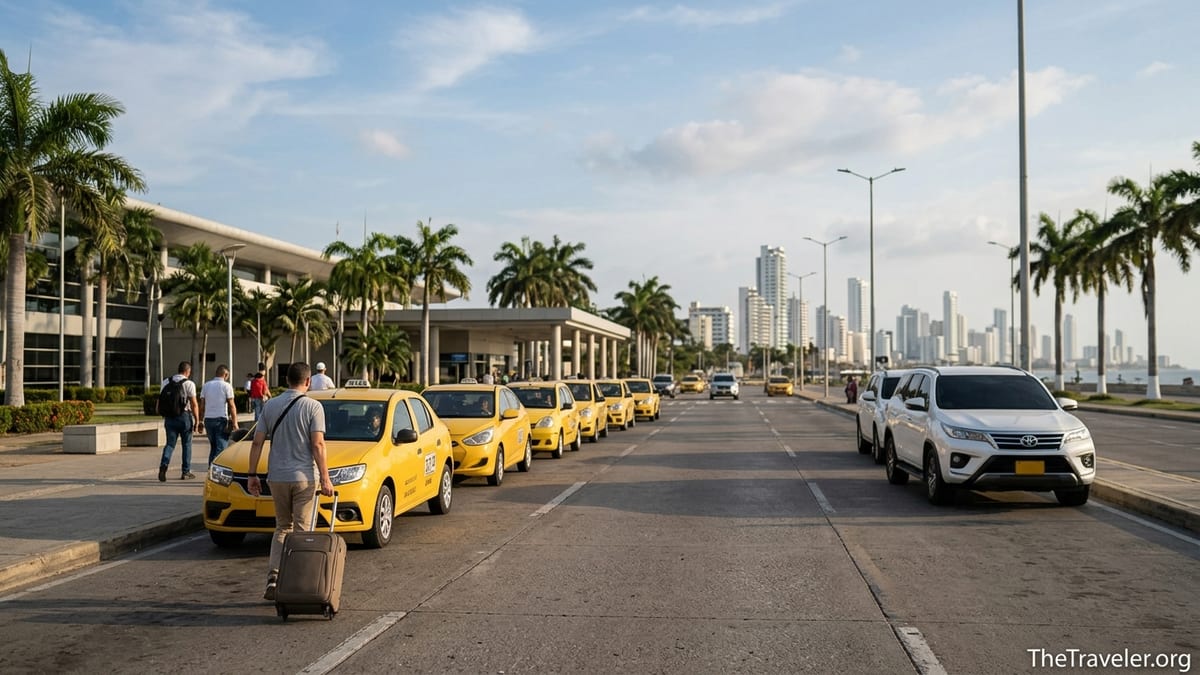
Official airport taxis are the default choice for many visitors, especially those arriving for the first time or landing in the middle of the day. At Rafael Núñez, you step out of the arrivals hall and follow the signs to the official taxi line. Before you get into a car, an attendant at a small stand or kiosk asks where you are going and gives you a printed or written slip with the official fare based on city zoning. This system is designed to avoid haggling and clearly shows how much you should pay for a ride to areas like Bocagrande, El Laguito, or the historic center.
City decrees set taxi tariffs each year, and local travel guides regularly summarize the approximate airport fares. Recent guides for 2024 and 2025 indicate that the airport-to-Bocagrande flat fare is typically in the range of about 30,000 to 40,000 Colombian pesos, often quoted around 34,000 COP for the Bocagrande / Laguito zone. That is roughly 8 to 10 US dollars at current exchange rates, though your card or cash exchange rate will vary. You pay the driver directly at the end of the ride, and tipping is optional; most locals simply round up a bit, for example paying 35,000 COP on a 34,000 COP fare.
Vehicles in the official taxi fleet are usually small sedans. They comfortably carry two travelers with luggage or three people with lighter bags. A family of four with two or three big suitcases will likely find it tight and may need to put smaller bags in laps or the front seat. If you are staying at a large resort-style property like Hotel Caribe by Faranda with beach gear and multiple suitcases, consider whether a standard sedan taxi will be enough or whether to arrange a larger vehicle.
For a typical arrival, though, the process is quick. Imagine a couple landing on an early afternoon flight from Bogotá with one checked suitcase and two carry-ons. After clearing immigration and customs, they follow signs outside, tell the kiosk “Bocagrande, Hotel Capilla del Mar,” receive a slip with the official fare around the mid-30,000s COP, hand it to the driver, and arrive about 20 minutes later. They do not need to open an app, connect to data, or negotiate a price in Spanish. This simplicity is why official airport taxis are often recommended as the most straightforward option for first-time visitors.
Uber and Other Ride-Hailing Apps: Flexible but Semi-Informal
Uber, DiDi, and inDrive are active in Cartagena and commonly used by both locals and visitors to move between Bocagrande, the walled city, and other neighborhoods. However, ride-hailing in Colombia operates in a semi-gray legal area, and pickup at airports can feel less straightforward than taking an official taxi. In practice, many travelers use apps from Rafael Núñez without incident, but you should understand how it works on the ground.
Recent traveler reports and local advice suggest that ordering an Uber from the airport usually involves meeting your driver slightly away from the main taxi stand, often closer to the departures area or a specific corner of the parking lot. People commonly recommend requesting your car just before exiting the arrivals hall, watching the map, and then walking calmly to the agreed pickup point. Cars that appear in the Uber app are frequently also licensed taxis or private vehicles driving on multiple platforms, so you may step into a standard yellow taxi that simply received your request through Uber.
Pricing on apps is dynamic but typically competitive with the official airport taxis. On a normal weekday afternoon, a ride from the airport to a Bocagrande hotel might show in the app at around 25,000 to 40,000 COP depending on demand, route, and time. During peak congestion, such as Sunday evening or a major festival, surge pricing can push the cost higher than the fixed official taxi fare. On the other hand, late at night when there is little traffic, you may see significantly lower prices than the board rate at the taxi kiosk.
Ride-hailing can be particularly attractive later in your stay when moving from Bocagrande to restaurants in Getsemaní or nightspots in the Old City. For the airport arrival, though, it trades the comfort of seeing a fixed, regulated fare for the comfort of booking in an app, storing your route, and paying by card. If you are already comfortable using Uber or DiDi in other countries and you like to track your route digitally, this can be a good choice, but for a first-time, non-Spanish-speaking visitor arriving at a busy hour, the official taxi line still feels simpler.
Private Transfers: Most Comfortable for Groups and Heavy Luggage
Prebooked private transfers have become increasingly popular in Cartagena, especially among groups, families, and travelers staying at higher-end hotels or rental apartments. Many local operators and international transfer platforms offer door-to-door service from Rafael Núñez Airport to Bocagrande. You pay a fixed price in advance, and a driver waits for you at arrivals with a sign, then escorts you to a vehicle parked directly outside.
Recent listings show that a standard private transfer from the airport to Bocagrande for up to three passengers often starts in the range of 18 to 25 US dollars per vehicle, depending on the provider and whether you book directly with a local company or through a global platform. Some services quote prices in pesos; for example, a sedan or small SUV transfer might run around 80,000 to 120,000 COP, while larger vans for six to ten passengers can cost more but remain good value when split among friends or family. The cost is higher than a single official taxi, but you are paying for meet-and-greet, a guaranteed vehicle type, and more generous luggage capacity.
Consider a real-world scenario. A family of five from the United States arrives with three large checked suitcases, two carry-ons, and a stroller, heading to a beachfront Airbnb tower near Bocagrande’s Plaza Bocagrande mall. Squeezing into one small airport taxi would be uncomfortable and possibly not allowed. Booking a private van transfer means a driver meets them inside the terminal, helps with luggage, and loads everything into a larger vehicle. The fare, around 120,000 COP, split across the group, works out to roughly the cost of two official taxis but with less stress, no risk of separation, and better luggage handling.
Private transfers also make sense for those arriving late at night, with limited Spanish, or with mobility needs. Some companies can provide child seats, which taxis do not typically carry. For business travelers attending conferences at hotels like the Hilton Cartagena or Hyatt Regency, a prebooked executive sedan is often arranged through the hotel concierge or travel agency and charged back to a corporate card, trading a bit of extra cost for predictability and comfort.
Comparing Costs, Traffic, and Luggage Handling
On pure price, official airport taxis generally win for solo travelers and couples going directly to a standard Bocagrande hotel with modest luggage. With the fixed tariff set by the city, you have a clear ballpark figure in the low- to mid-30,000 COP range, and you are usually inside your lobby in under half an hour. For someone splitting that cost with a companion, it is a budget-friendly arrival experience that still feels safe and reasonably comfortable.
Ride-hailing apps can compete on price or even undercut official taxis, especially outside peak times, but their real advantage is digital convenience. You see the price before accepting, you can pay by card, and you have GPS tracking of your route. However, occasional surge pricing during busy periods can erase that savings, and you may spend extra time coordinating a pickup spot. For a short hop from Bocagrande to the Old City or back, this trade-off is minimal, but right after a flight it may feel like extra effort.
Private transfers tend to be the highest-cost option if you look only at the number for a one- or two-person booking. Yet once you factor in luggage and group size, they become competitive. Two official taxis for four adults with large suitcases might total around 70,000 COP, while a prebooked van for the same group could cost 100,000 to 120,000 COP with the comfort of staying together and having driver assistance with bags. In high heat and humidity, that service level can be worth the premium, especially after a long international flight.
Traffic influences experience more than cost, because the airport taxi fare to Bocagrande is based on zones rather than a running meter, and most private transfers and ride-hailing quotes are fixed once booked. At around 2 p.m. on a weekday, a visitor heading to the InterContinental Cartagena de Indias along the bay might report a 20-minute trip. By contrast, someone arriving on a Friday evening of a holiday weekend could take 35 minutes or more to clear the same distance, with slow stretches passing the Old City and along the beachfront. None of the modes has a major edge in coping with traffic on such a short route, although private transfers and app rides in newer vehicles often feel more comfortable when you are stuck in a slow-moving line of cars.
Choosing the Best Option for First-Time Visitors
For a first-time visitor staying in Bocagrande, the default recommendation is straightforward: use an official airport taxi, unless you have a specific reason to prefer a private transfer. The official taxi gives you a transparent, regulated fare; a clearly marked pickup point; and drivers who are accustomed to taking tourists directly to the main hotels. You do not need a local SIM card, and you can pay in pesos with no extra coordination. If you are nervous about arriving in a new country, this simplicity is reassuring.
Private transfers become the best choice in a few situations. If you are traveling in a group of four or more with several checked bags, if you are arriving very late at night, or if you have limited mobility or small children, a prebooked transfer removes many small frictions. The driver meets you in the arrivals hall, helps with luggage, knows exactly which hotel to find, and provides a larger or more comfortable vehicle. For example, a group of three couples heading to a spacious three-bedroom apartment near the southern tip of Bocagrande may find that a single private van transfer is easier and only slightly more expensive per person than two separate taxis.
Uber and other apps are best kept as a secondary or backup option for airport arrivals, but they shine once you are settled in the city. From your Bocagrande hotel, using Uber or DiDi to reach dinner in the Old City or a rooftop bar in Getsemaní is easy, and you can compare prices between apps. For the first journey from the airport, though, the combination of a fixed tariff and highly visible taxi organization means that official taxis remain the most friction-free choice for someone new to Cartagena.
One useful compromise is to walk out, inspect the taxi kiosk and fare table, and compare it with the price shown in your Uber app. If the app quote is significantly lower and you are comfortable coordinating a pickup, you can choose the ride-hail. If the figures are similar, the official taxi wins on simplicity. Either way, you have options and do not need to commit before landing.
Hotel-Zone Nuances: Bocagrande, Castillogrande, and El Laguito
The “Bocagrande” label on hotel booking sites covers several closely connected areas, and understanding them helps you set expectations for your transfer. Central Bocagrande runs along Avenida San Martín and Avenida Malecon, where you will find properties like Hyatt Regency Cartagena, Hampton by Hilton Cartagena, and a mix of midrange hotels and apartment buildings. To the south, El Laguito has a cluster of tall towers, including Hotel Dann Cartagena and many beachfront vacation rentals. On the bay side, Castillogrande is more residential and upscale, with quieter streets and some high-end apartments used for short-term stays.
From an airport transfer perspective, all three sit in roughly the same tariff band, and the driving time difference between the northern part of Bocagrande and the far end of El Laguito is only a few extra minutes. Official taxi prices from the airport typically group Bocagrande, Castillogrande, and El Laguito together in a single zone. Private transfer and ride-hailing quotes also tend to be similar across these neighborhoods, though some platforms may list slightly different prices depending on whether you type in a specific hotel or a general area.
When giving your destination to a taxi kiosk or transfer driver, always mention the neighborhood and the hotel name. Saying “Bocagrande, Hotel Caribe” or “El Laguito, Hotel Dann Cartagena” is clearer than only giving a street address, as drivers know landmarks better than block numbers. Many apartment buildings, such as those near Plaza Bocagrande or along the bay side, are also well known by name to local drivers.
If you are heading instead to the historic center or Getsemaní and then moving to Bocagrande later in your trip, note that taxis between these areas are plentiful. A short hop from a Bocagrande hotel to the Old City usually costs only a few thousand pesos, often in the 10,000 to 15,000 COP range, depending on traffic and time of day. That means you do not have to worry about being “too far” from the restaurants and nightlife of the walled city if you choose to sleep next to the beach.
The Takeaway
Transfers from Rafael Núñez International Airport to Bocagrande’s hotel zone are short, straightforward, and relatively inexpensive compared with many other beach destinations. All three main options – official airport taxis, ride-hailing apps, and prebooked private transfers – work reliably in 2026, but they serve slightly different traveler profiles.
Official airport taxis offer the best balance of cost, clarity, and convenience for most first-time visitors, especially couples and solo travelers with light to moderate luggage. Ride-hailing apps add digital comfort and route tracking and are excellent for moving around once you are already in Bocagrande, even if they require a bit more coordination for the initial pickup at the airport.
Private transfers come into their own for groups, travelers with lots of bags, families with children, and anyone who values a meet-and-greet experience and a guaranteed larger vehicle. The per-person cost often narrows once you divide the fare among several people, and the added comfort can make your first impressions of Cartagena feel smoother and more relaxed.
Whichever option you choose, the key advantage is proximity. With only a few kilometers between you and the Caribbean, a well-chosen transfer means you will be dropping bags in your room, stepping out onto Bocagrande’s beachfront promenade, and listening to the waves within minutes of leaving the airport arrivals hall.
FAQ
Q1. How long does it take to get from Rafael Núñez Airport to Bocagrande?
The drive usually takes 15 to 25 minutes in normal traffic, and around 30 minutes or slightly more during peak rush hours or holiday weekends.
Q2. How much does an official airport taxi to Bocagrande cost?
City regulations set fixed zone fares, and recent guidance puts airport-to-Bocagrande rides roughly in the 30,000 to 40,000 COP range, depending on the current year’s tariff.
Q3. Is it safe to take a taxi from the airport at night?
Official airport taxis are generally considered safe at all hours. Use the official taxi line at arrivals, confirm the fare slip from the kiosk, and avoid unmarked or unofficial cars.
Q4. Can I use Uber or other apps directly at Rafael Núñez Airport?
Yes, apps like Uber and DiDi operate in Cartagena. Many travelers use them at the airport, typically meeting drivers slightly away from the main taxi stand as agreed in the app.
Q5. Are private transfers worth it for solo travelers?
For solo travelers, private transfers cost more than a taxi, but they may be worth it if you arrive late, have heavy luggage, or want a guaranteed meet-and-greet service.
Q6. Which option is best for a family with young children and lots of luggage?
A prebooked private transfer with a larger vehicle is usually best, as it offers more space for bags, the possibility of child seats, and help loading and unloading everything.
Q7. Do I need to tip taxi or transfer drivers in Cartagena?
Tipping is not strictly required, but it is appreciated. Many people round up the fare slightly or add a small amount, especially if the driver helps with luggage.
Q8. Will taxi drivers know my Bocagrande hotel if I only give the name?
Most drivers are very familiar with major hotels and well-known apartment buildings. Saying the neighborhood and hotel name is usually enough for them to find your destination.
Q9. Is traffic between the airport and Bocagrande usually bad?
Traffic can be heavier at weekday rush hours and on holiday weekends, but the distance is short. Even in slow conditions, the trip rarely takes more than about 30 to 35 minutes.
Q10. Should I book a transfer in advance or decide on arrival?
If you like simplicity and are traveling light, deciding on arrival and taking an official taxi works well. If you are in a group or want extra comfort, prebooking a private transfer is a good idea.