


Rafael Núñez International Airport (CTG) is the compact gateway to Cartagena’s Caribbean coast, but its busy arrivals area, taxi exits and pickup points can feel chaotic, especially at peak hours and for first-time visitors. This guide walks you step by step through the terminal layout so you know exactly where to go for baggage claim, official taxis, rides, parking and car rentals, and where many travelers typically get confused.
Get the latest updates straight to your inbox!
Understanding the Overall Layout of Rafael Núñez Airport
Rafael Núñez International Airport sits along Avenida Santander in the Crespo neighborhood, a short drive north of Cartagena’s walled city. The terminal is relatively small compared with major hubs, but it has distinct domestic and international zones that share one continuous building. Recent expansion works and a planned new international terminal mean some areas are being remodeled, yet the basic arrival flow has stayed consistent: planes park on the apron, passengers deplane by jet bridge or stairs to buses, then funnel into immigration, baggage claim and a compact public arrivals hall.
Domestic arrivals usually feed into the western side of the terminal, closer to airlines like Avianca and LATAM that run frequent routes from Bogotá and Medellín. International arrivals are typically processed on the eastern side, where flights from cities such as Miami, Orlando, New York, Panama City and Madrid arrive. In practice, once you pass immigration or leave the domestic arrivals corridor, both streams merge into the same general baggage and arrivals area. That is where you will find currency exchange counters, small cafés, SIM card kiosks in some seasons, car rental desks and the interior taxi booths before you step outside into the heat.
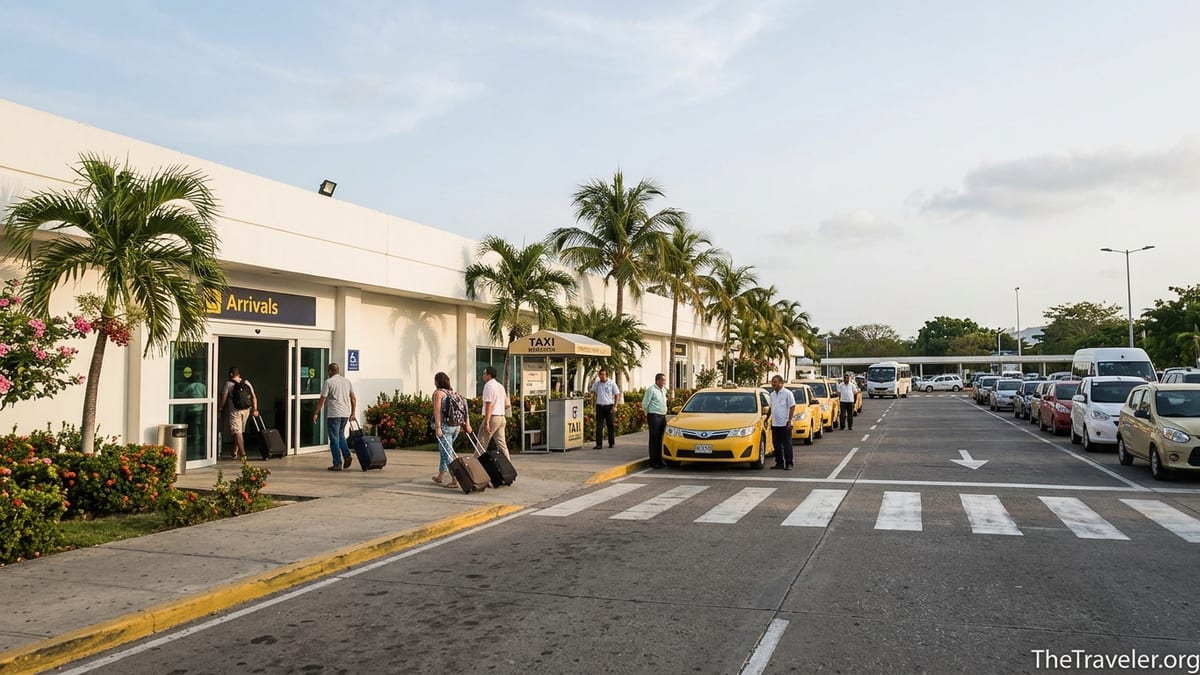
Outside, the terminal opens onto a one-way roadway that loops past the building with separate curb space for private vehicles, hotel shuttles and official taxis. There is surface parking directly across from the terminal and additional long-stay lots slightly farther back. Because there is only one main road in and out, vehicles often stack up in several lanes, and there is little shade. Knowing ahead of time where you intend to meet your ride, and which doors to use, can save you several confusing minutes as you navigate crowds and touts.
For orientation, imagine the terminal as a rectangle parallel to the runway, with departures on the upper or front side of the building and arrivals flowing out at ground level toward the parking lots and main road. You will spend almost all your arrival time at ground level, moving from the aircraft side of the building to the street side in a straight line: immigration or domestic corridor, then baggage claim, then customs and finally the public arrivals hall and exit doors.
Domestic vs International Arrivals: What Changes and What Stays the Same
Domestic and international passengers at Rafael Núñez follow slightly different routes at first, then end up in a similar place. If you land on a domestic flight from Bogotá, Medellín or Cali, you are taken directly from the aircraft to a short corridor leading to domestic baggage claim, without passport control. Within minutes you will find yourself at a belt dedicated to your flight, often in a space that feels more like a regional bus terminal than a large airport. Overhead signage in Spanish and English points you toward “Reclamo de Equipaje / Baggage Claim” and then “Salida / Exit.”
International arrivals, by contrast, pass through immigration before reaching baggage claim. Depending on how many international flights land together, queues here can be short or stretch to 30–45 minutes. After passports are stamped, you descend or walk forward into the baggage hall, where the carousels serve both international and, in some periods, some domestic flights. Customs screening in Cartagena is usually straightforward. Officers may ask you to send your luggage through an X-ray machine and may briefly inspect bags, especially if you are carrying large electronics or boxed items.
From a layout point of view, the key difference is timing, not distance. Domestic passengers typically reach the public arrivals hall faster, sometimes within 10–15 minutes of landing if they have only carry-on luggage. International travelers might spend closer to 30–60 minutes from touchdown to exit, depending on queues. However, both groups exit through the same general doors at ground level, where drivers, family and tour reps wait behind barriers or just outside the sliding glass doors.
A common point of confusion for mixed groups is assuming there are separate public exits for domestic and international arrivals. In practice, friends or drivers who are meeting you can usually wait in the same outside area and still connect with travelers arriving on either type of flight. If you are coordinating with someone, agree to meet “outside arrivals by the taxi kiosks” or “just beyond the main sliding doors near the parking lot crosswalk” rather than referring to “domestic” or “international” exits.
Inside Arrivals: Baggage Claim, Customs and First Services
Once you enter the arrivals section, your first priority will likely be baggage claim. The area is not large, so it is easy to see all belts from the center of the room, but monitors can be slow to update. Look for your flight number on the baggage screens rather than relying only on staff announcements. Luggage carts may or may not be abundant at peak times; bring a simple wheeled suitcase if possible so you are not dependent on finding a cart.
After collecting bags, you walk a short distance to customs. Officers sometimes wave passengers through in flows, and at other times require every bag to pass an X-ray. The corridor can narrow here, and this is often where lines back up. Keep your passport and customs form or QR confirmation handy, and avoid blocking the exit by stopping to repack bags until you have fully cleared into the public arrivals hall. If you are carrying duty free liquids such as rum or perfume, keep them sealed and in their original bags to avoid delays.
Just beyond customs is where you will find many of the immediate arrival services that matter to travelers. Depending on the season and the hour, you may see currency exchange desks, a small café or snack stand, and telecom counters run by Colombian operators such as Claro or Tigo offering prepaid SIM cards. Travelers writing online frequently report being able to buy a local SIM for roughly the equivalent of 8 to 15 US dollars for a week of data, but stock and pricing change, and kiosks do not always operate late at night, so it is wise to have at least minimal roaming enabled on your main phone.
This interior arrivals area also holds some of the airport’s car rental counters. Brands serving Cartagena often include international names alongside local firms, and most operate small booths rather than full offices. If you have reserved a car in advance, follow the “Alquiler de Autos / Car Rental” signs after you exit customs and look for your company’s logo. The staff will usually complete paperwork at the counter and then escort you or direct you to their parking slots in the lot across the road. Travelers who wait to book upon arrival should understand that inventory can be tight during holiday periods, and walk-up prices can be significantly higher than pre-booked rates.
Where to Exit: Taxi Doors, Pickup Points and Rideshares
At Rafael Núñez, almost every arriving traveler eventually funnels toward the same set of sliding glass doors at the front of the arrivals hall. Immediately before those doors you will see official taxi kiosks or desks staffed by uniformed attendants. These kiosks are the starting point for most taxi rides into town. You tell the attendant your destination, such as “Centro Histórico,” “Getsemaní” or “Bocagrande,” they consult a printed table of fixed fares, and they print or hand you a ticket that shows the price. You then take that ticket outside, where an official taxi driver accepts it and drives you to your destination, usually with no need to negotiate again.
Official taxi fares from the airport into Cartagena’s main tourist areas are generally set in Colombian pesos and periodically updated. For example, travelers often report paying the rough equivalent of 7 to 12 US dollars for a ride into the walled city or Bocagrande in recent years, depending on traffic, fuel prices and exchange rates. This can change, so treat any figure you have seen online as an estimate, not a guarantee. What remains constant is the advantage of using the kiosk system: you know your approximate price before you step into the car, and you greatly reduce the risk of being overcharged by an opportunistic driver.
Once you step outside, you enter a wide curb area with several parallel lanes for traffic. The official taxi line is typically closest to the terminal. Attendants may whistle or gesture you toward the next available car. If you have prebooked a private transfer, your driver may wait farther down the curb holding a sign with your name, or in some cases in the small plaza between the terminal and parking lot. In all cases, it is helpful to keep moving forward through the crowd and out of the doorway so you do not block others exiting behind you.
Rideshare services are more variable. In Cartagena, app-based rides such as Uber or InDriver have at times operated in a gray zone, and usage patterns change. Many visitors rely instead on official taxis or pre-booked private cars for airport transfers. If you do plan to use a rideshare, you will typically meet your driver in the parking area or on the outer lanes of the roadway, not directly in the official taxi line. Communicate via the app to confirm the exact pickup spot, and be prepared to walk a short distance, for example across the crosswalk into the main parking lot, to avoid blocking active taxi lanes.
Parking, Meeting Points and Private Vehicle Pickups
The main public parking lot at Rafael Núñez sits directly opposite the terminal, separated by the arrival roadway. The lot is open-air, with marked spaces for short- and longer-stay parking. Locals who come to pick up friends or family typically park here, then walk across the zebra crossing to stand near the arrivals doors. Parking fees are charged in Colombian pesos and usually calculated by the hour or by fractional periods. Rates are modest by North American standards but can add up if you are waiting several hours for a delayed flight, so drivers often wait to enter until an arrival is close to landing.
If you are being collected by a friend or hotel driver, agree in advance whether they will park and meet you on foot or simply circle the roadway and pull up to the curb once you are outside with bags. The curbside area can get congested at peak times in the late afternoon and evening, when multiple domestic and international flights arrive close together. Security staff sometimes wave vehicles forward and discourage drivers from lingering, so a parked meeting arrangement is usually less stressful than trying to spot a moving car from the doorway.
Within the arrivals forecourt, informal meeting points have emerged over time. One of the most common is just outside the sliding doors, in front of the taxi kiosks and close to the crosswalk leading to the parking lot. Another is beside a recognizable feature such as a small café kiosk or a specific pillar near the curb. When you coordinate with a driver or fellow traveler over messaging apps, describe both your location inside (“next to the SIM card counter in arrivals”) and your plan once you step outside (“I will cross to the parking lot and wait by the entrance booth”). This extra detail helps reduce confusion in a space that is small but often crowded.
Some hotels and tour companies station representatives in the arrivals hall holding branded signs. If you have booked a transfer included with your accommodation, look carefully at the line of agents just beyond the customs exit. At busy times, several large groups may gather around these signs, creating a dense knot in the middle of the hall. To avoid getting stuck there, step to the side while you scan for your name or hotel logo, then move forward only once you have located your contact.
Car Rental Locations and How Pickups Work
Car rentals at Rafael Núñez are arranged in two stages: paperwork inside the terminal, and vehicle handover outside in the parking area. Inside the arrivals hall, after customs, you will find small booths for major international brands alongside Colombian and regional rental companies. Hours of operation generally align with scheduled flight arrivals and departures, but late-night services can vary by company. If you are landing after midnight, confirm in advance that your agency will remain open until your flight arrives, and carry your booking confirmation in print or as a screenshot in case of connectivity issues.
At the counter, staff will verify your reservation, request your driver’s license and a credit card, and often place a security hold that can be substantial relative to local daily rates. Insurance can be a point of confusion for many travelers. In Colombia, basic liability coverage is mandatory, but collision and theft coverage vary by policy. Many visitors rely on credit card coverage, but rental companies sometimes require additional local coverage regardless. To avoid a long discussion at the counter while tired from travel, read your rental terms in advance and consider contacting the company by email to confirm what will be required on arrival.
Once the contract is completed, agents typically direct you to an assigned parking space in the lot across from the terminal or escort you there. The walk is short, but the path crosses active roadways and can be hectic in the afternoon heat. Inspect the vehicle carefully before driving off, taking pictures of any pre-existing dents or scratches and confirming fuel level and mileage. When you return the car at the end of your trip, you will usually enter the same parking area and follow signage or verbal instructions to a designated return row, then head into the terminal on foot for departure.
For travelers who only need a car for part of their stay, a common strategy is to take a taxi from the airport to a hotel in the Old City or Bocagrande, then rent a car on a separate day from an in-town branch. This allows you to recover from your flight and get oriented before driving Colombian roads. However, starting and ending a rental at the airport can be more convenient if you plan road trips to destinations like Barranquilla or the Rosario Islands’ mainland jump-off points and want to avoid extra taxi fares.
Typical Confusion Points and How to Avoid Them
Even though Rafael Núñez is a small airport, first-time visitors often find a few parts of the arrival process unintuitive. One frequent confusion point is the difference between official taxi kiosks inside and informal drivers who approach you outside. As you exit customs, you may hear, “Taxi, taxi, amigo!” from people offering rides without going through the kiosk system. They might quote prices in US dollars or offer to beat the official rate. To keep things simple and safer, it is generally best to ignore unsolicited offers, go directly to the staffed taxi desk inside, and pay or obtain your fare ticket there before exiting the building.
Another area that causes stress is coordinating with app-based rides. Because regulations and enforcement attitudes toward rideshares can shift, drivers may ask you to walk away from the busiest curb areas to meet them in the parking lot or on a side street. For a jet-lagged traveler unfamiliar with the airport, this can feel confusing. If you choose this route instead of using an official taxi, use precise location descriptions, agree on a landmark like the entrance to the main parking lot, and avoid getting into any car that does not clearly match the details in your app.
Inside the terminal, signage for services like SIM cards, ATMs and food can change with ongoing renovations. Some visitors arrive expecting a large food court or a bank of international ATMs, only to find a handful of small outlets that close early. To avoid last-minute surprises, arrive with a small amount of Colombian pesos already on hand, or plan to obtain cash in the city center where options are more abundant. Likewise, enable at least basic roaming on your phone so you are not fully dependent on finding an open SIM counter at the airport.
Finally, the compact design of the arrivals area means bottlenecks can form quickly. Travelers sometimes stop right in front of the sliding exits to check messages, repack bags or look for friends, creating a plug of people at the doorway. To keep your own arrival smoother, step a few meters to the side once you exit customs or step outside, then take your time arranging transport. Not only is this more comfortable, it also makes you less of a target for overly insistent touts looking for confused newcomers.
The Takeaway
Rafael Núñez International Airport is far from the world’s largest hub, but its combination of tight spaces, heavy tourist traffic and a mix of official and informal transport options can surprise first-time visitors. Understanding the basic layout helps enormously: domestic and international flights feed into the same compact arrivals hall, baggage claim flows straight into customs, and nearly everyone exits through a small cluster of doors facing the taxi stands and parking lot.
For a stress-free arrival, focus on a few fundamentals. Use the official taxi kiosk inside the terminal or a pre-booked private transfer rather than negotiating ad hoc outside. Agree in advance on a simple meeting point if someone is collecting you, such as the crosswalk entrance to the parking lot. If you are renting a car, complete paperwork inside and expect a short walk across active lanes to your vehicle. Bring a bit of local currency and basic mobile connectivity so you are not scrambling for cash or data on the spot.
By anticipating these details and recognizing where other travelers commonly get confused, you can turn what might feel like a hectic first impression into a straightforward gateway experience. That leaves you free to focus on Cartagena itself: the sea breeze along the ramparts, the late-afternoon light on the colonial facades and the sound of salsa drifting through the streets, just a short ride from the airport curb.
FAQ
Q1. Are domestic and international arrivals in separate terminals at Rafael Núñez Airport?
Domestic and international flights use different processing areas inside the same overall terminal, but both streams lead into a shared arrivals hall and similar exit doors at ground level.
Q2. How long does it usually take to get from the plane to the arrivals exit?
Domestic passengers with only carry-on bags can sometimes be outside in 10 to 20 minutes, while international arrivals may take 30 to 60 minutes depending on immigration and baggage queues.
Q3. Where do I find baggage claim after landing?
After leaving the jet bridge or bus, follow the signs for “Reclamo de Equipaje / Baggage Claim.” The baggage hall is small, with a few carousels and overhead screens listing arriving flights and belt numbers.
Q4. How do I get an official taxi from the airport into Cartagena?
Walk through customs into the public arrivals hall, look for the official taxi kiosks, tell the staff your destination, then take the printed or written ticket outside to the taxi line where an authorized driver will accept it.
Q5. Can I use Uber or other rideshare apps at Rafael Núñez Airport?
Rideshare availability and rules change over time. Some travelers arrange app pickups in the parking lot or outer lanes, but many choose official taxis or pre-booked transfers for a simpler, more predictable arrival.
Q6. Is there parking if someone wants to pick me up in their own car?
Yes, there is an open-air parking lot directly opposite the terminal. Your driver can park there and walk to meet you at arrivals, or coordinate a quick curbside pickup once you are outside with your bags.
Q7. Where are the car rental counters and how do vehicle pickups work?
Car rental counters are located in the arrivals hall after customs. Paperwork is completed at the desk, and then you are directed across the road to the main parking area where the actual rental vehicles are parked.
Q8. Can I buy a local SIM card or get cash on arrival?
Depending on the time of day, there are often small telecom counters and ATMs in or near the arrivals hall, but opening hours and availability vary, so it is prudent to have basic roaming and some local currency in advance.
Q9. What is the safest way to avoid being overcharged for a ride into the city?
The most straightforward approach is to use the official taxi kiosk inside the terminal, where fares are based on fixed tables by destination, or to arrange a private transfer with clear pricing before you land.
Q10. I am meeting friends arriving on a different flight. Where should we connect?
A convenient spot is just outside the arrivals doors near the crosswalk to the main parking lot. It is easy to describe, close to the taxi area and less congested than standing directly in the doorway.