


Landing at Rafael Núñez International Airport in Cartagena and heading straight to Getsemaní is one of the great pleasures of arriving on Colombia’s Caribbean coast. The ride is short, but first-time visitors are often surprised by the heat, the crowds and the maze of narrow colonial streets once they reach the neighborhood. This guide explains, in practical detail, how to get from the airport to your hotel in Getsemaní smoothly and safely, at any hour, with real-world advice on taxis, ride-hailing apps, private transfers, luggage logistics and late-night arrivals.
Get the latest updates straight to your inbox!
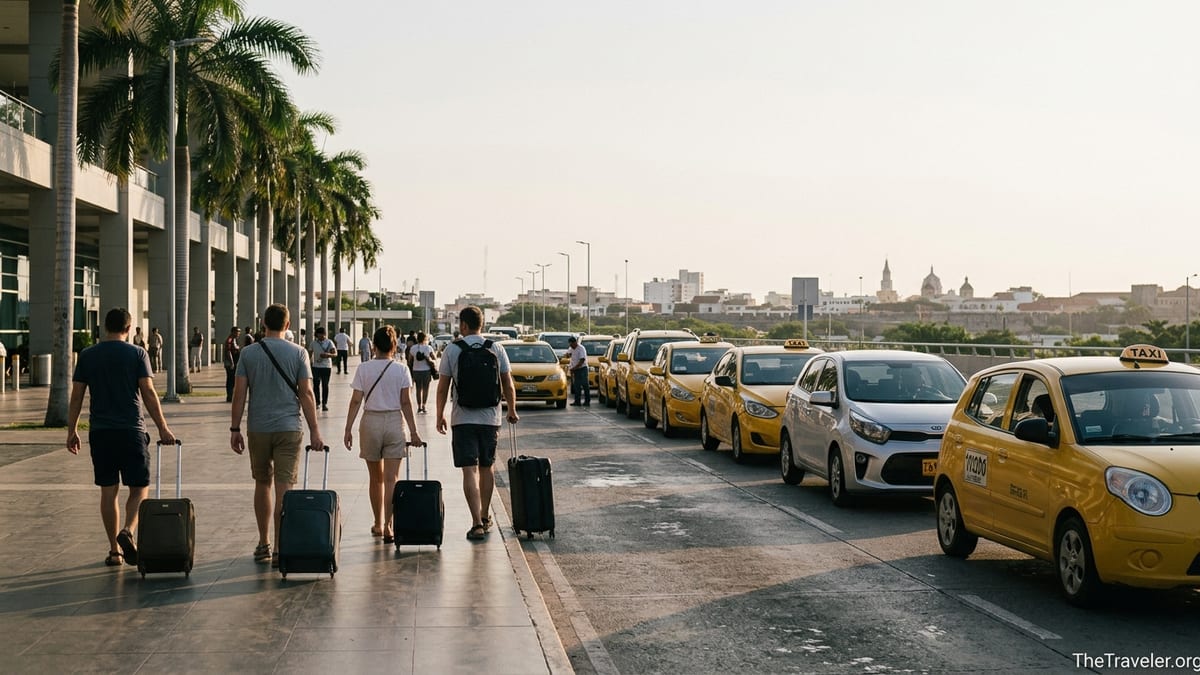
Understanding the Route: Airport to Getsemaní in 15–25 Minutes
Rafael Núñez International Airport sits in the Crespo district, just a few kilometers north of Cartagena’s historic center and Getsemaní. In normal daytime traffic, the transfer to most Getsemaní hotels takes around 15 to 20 minutes. At rush hour, especially late afternoon when flights from Bogotá and Medellín arrive, the same journey can stretch closer to 25 minutes as traffic slows near Marbella beach and the entrances to the walled city.
Most routes follow the same basic pattern. Vehicles exit the airport through Crespo, run parallel to the Caribbean along Avenida Santander, pass the beachfront neighborhoods of Crespo and Marbella, then skirt the old city walls near El Cabrero before looping around toward Parque del Centenario and Getsemaní. Drivers may take slightly different turns depending on traffic, but if you hear landmarks like Marbella, Centro Histórico or Parque del Centenario, you are broadly on the right path.
Because the distance is short, the main differences between transfer options are not travel time but convenience, comfort, cost and how well they cope with the reality of Getsemaní’s narrow streets. An economy taxi, an Uber-style ride-hail and a private transfer will all reach the neighborhood in similar time if traffic conditions are the same. The decision comes down to how much luggage you have, whether you speak some Spanish, what time you land and how much you value being dropped as close as possible to your hotel door.
Getsemaní itself starts just across Parque del Centenario from the old walled city. Streets like Calle Larga, Calle de la Sierpe and the blocks around Plaza de la Trinidad are where many small hotels and guesthouses cluster. These are attractive, lively areas, but they were not designed for cars, which means that the last few hundred meters from the main avenue to your hotel can be the trickiest part of the trip.
Official Airport Taxis: Easiest Option on Arrival
For most travelers arriving in Cartagena for the first time, the official airport taxi line is the simplest and most straightforward way to get to Getsemaní. After exiting customs, you will see a clearly marked taxi desk or kiosk before the main doors. Staff there quote a fixed airport fare based on your destination zone and give you a printed slip with the price and the area, which you hand to the driver outside. This system is designed to reduce bargaining and ensure that visitors are not overcharged.
Fares are set annually by the city government. As of 2026, the airport-to-city rates have risen in line with Cartagena’s updated taxi tariff decree, but the ride from Rafael Núñez to Getsemaní still typically comes out to the equivalent of roughly 20,000 to 30,000 Colombian pesos for a standard yellow taxi, depending on the specific zone classification and any supplements. In practice, recent visitors report paying amounts in that approximate band when using the official queue for hotels near Plaza de la Trinidad or along Calle Larga.
The process is straightforward. With your slip in hand, you walk to the signed taxi rank, where an attendant directs you to the next available registered cab. Most drivers know the main Getsemaní hotels by name, but it helps to have your hotel address written down or ready to show on your phone. A guest staying at a boutique property on Calle San Andrés, for example, might simply show the address and let the driver choose the best approach through the neighborhood, while another staying near the busy Calle de la Sierpe might be dropped at a nearby corner if traffic is too heavy.
Official taxis are particularly convenient if you are tired after a long flight, traveling with children or arriving late in the evening. There is no need to open an app, connect to airport Wi-Fi or negotiate on the curb. You pay the driver in cash at the end of the ride, usually in Colombian pesos. Some drivers may accept cards via mobile terminals, but you should not rely on this. Have small bills ready and, if service is polite and careful, consider a modest tip on top of the metered or fixed amount.
Ride-Hailing Apps: Uber, inDrive and Local Practices
Ride-hailing apps such as Uber and inDrive operate in Cartagena in a gray area. They are widely used by both locals and visitors, and many travelers report using them successfully between Rafael Núñez Airport and Getsemaní, particularly after the sun has set. However, because the legal status of app-based rides can be sensitive in parts of Colombia, the service sometimes works slightly differently than in cities where it is fully regulated.
From the airport, app drivers often prefer to pick up passengers just outside the main taxi ranks, sometimes near the parking lot or along the street in front of the terminal. A common routine for recent visitors has been to request an Uber or inDrive as they leave baggage claim, message the driver in the app to confirm the meeting point, and then walk a short distance, following the driver’s instructions such as “in front of departures” or “across from the main exit under the trees.” It is wise to check the vehicle’s license plate and confirm the driver’s name before getting in.
Prices on ride-hailing apps fluctuate with demand, but for a daytime trip from the airport to Getsemaní, travelers regularly see estimates that are similar to or slightly lower than the official taxi rate, sometimes in the 18,000 to 25,000 Colombian pesos range for a basic car. During busy periods such as holiday weekends or late-night bar closing times, surge pricing can push that higher. inDrive, which allows passengers to propose a fare that drivers can accept or counter, is also commonly used for this route; in that case you will see what other riders are paying and can choose a price that seems reasonable without being unrealistically low.
Ride-hailing apps are most attractive to travelers who are comfortable using their phones on arrival, already have mobile data or can quickly connect to the airport Wi-Fi. They offer some advantages: digital receipts, the ability to track the route on the map and, in many cases, smoother vehicles with air conditioning set to a comfortable level. English is not guaranteed, but younger app drivers are often more accustomed to visitors and may use translation tools if needed. For a solo traveler arriving around midnight who prefers to avoid cash, a pre-priced ride requested inside the terminal while waiting for luggage can feel reassuring.
Private Transfers and Hotel Pickups: Stress-Free but Pricier
Many mid-range and upscale hotels and guesthouses in Getsemaní now offer airport transfer services, either directly or through partner agencies. For example, a boutique hotel near Plaza de la Trinidad might quote a flat price in advance, arrange a driver to meet you with a sign at arrivals, and include a WhatsApp number for updates if your flight is delayed. Private transfer companies also sell this route as part of a wider Cartagena arrival service, sometimes packaged with a brief city orientation.
Prices for pre-booked private transfers are typically higher than taxis or ride-hailing apps, reflecting the meet-and-greet and guaranteed vehicle type. A comfortable sedan or SUV for up to three passengers from Rafael Núñez to Getsemaní might run in the approximate range of 60,000 to 90,000 Colombian pesos, while larger vans suitable for families or small groups with several suitcases can cost more. The upside is predictability: you know who is meeting you, what you will pay and that there is room for luggage without squeezing.
Private transfers are especially appealing for very late-night or early-morning arrivals, or when traveling with older relatives or small children. A family arriving on an international flight from the United States at 1:00 a.m., for instance, might value having a Spanish- and English-speaking driver waiting at the exit, helping them with bags and driving them directly to the door of a small hotel on one of Getsemaní’s tighter streets. Some operators also track your flight and adjust pickup times if your plane is late, saving you the worry of rebooking a taxi at short notice.
Another use case is travelers with special luggage, such as photographers carrying hard cases or divers with equipment bags. While a standard yellow taxi can usually swallow two large suitcases and a couple of backpacks in the trunk and on laps, an oversized case or multiple hard-shell backpacks may be more comfortable in a pre-booked SUV or van. Before booking, it is wise to email your hotel with details of your arrival time, number of people and luggage size so they can recommend the most suitable option.
Luggage, Narrow Streets and Reaching Your Hotel Door
Getsemaní’s charm is visual and atmospheric: colorful low-rise houses, balconies dripping with bougainvillea and street art murals around almost every corner. The flip side is that many streets are narrow, one-way and crowded with pedestrians, café tables and parked motorcycles. At busy times of day and night, particularly around Plaza de la Trinidad and Calle de la Sierpe, cars may not be able to stop directly in front of your hotel, even if the address appears simple on the map.
In practice, most arrivals play out in one of two ways. If your hotel is on or just off a wider street such as Calle Larga, your driver can usually pull into a brief loading space or stop near the curb long enough to unload bags. This is common for guests staying at small hotels and hostels clustered near the Parque del Centenario side of Getsemaní, where the streets are slightly more forgiving. If, however, your accommodation is deeper in the neighborhood, on a lane facing busy Plaza de la Trinidad or along particularly tight streets like parts of Calle de la Sierpe, your driver may instead drop you at the nearest accessible corner and point you down the block.
To make this last stretch easier, pack with mobility in mind. Wheeled suitcases work on most of Getsemaní’s pavements, but the surfaces are uneven and occasionally broken, so a mid-sized rolling bag plus a backpack is more manageable than a giant hard-shell trunk. For example, a guest staying at a guesthouse on a pedestrian-heavy side street off Calle del Pozo might find they only need to roll their bag for two or three minutes to reach the door, but it will feel more comfortable if they are not wrestling with an oversized suitcase in the evening heat.
Many smaller hotels and apartment rentals in the neighborhood are familiar with these constraints and will offer practical instructions in their booking confirmations. It is increasingly common to receive a message that reads something like: “Your taxi will drop you at the corner of Calle Larga and Callejón Ancho; from there, walk 100 meters to the plaza and turn left, we will be waiting at the door.” Some properties, especially family-run guesthouses, will even send a staff member to meet you at a nearby landmark if you send a message when you leave the airport.
If you expect to arrive after dark with multiple bags, consider asking your hotel in advance about the best drop-off point and whether they can assist with luggage. Not only does this make the walk easier, it also helps you avoid wandering up and down side streets looking for an unmarked door while tired and distracted, which is when phones and bags are most vulnerable to opportunistic theft.
Late-Night Arrivals and Safety from Airport to Getsemaní
Cartagena is one of the more tourist-oriented cities in Colombia, and both the airport area and the main routes to the historic center are commonly used by visitors even late into the evening. For most travelers, taking an official airport taxi, a pre-booked private transfer or a ride-hailing app from Rafael Núñez to Getsemaní at night is considered a normal part of visiting the city. However, conditions do change after dark, and it pays to adapt your habits accordingly.
At the airport itself, arriving flights from the United States and other international destinations often land in the evening. The official taxi desk and rank are accustomed to late-night arrivals, and there are usually plenty of cabs waiting outside. Using this organized system rather than accepting offers from individuals inside the terminal or in the parking lot is an important safety measure. If you prefer ride-hailing apps, order the car only once you are curbside and able to double-check the license plate; avoid walking off to an isolated corner of the lot to meet a driver.
In Getsemaní, the picture is mixed but generally positive for visitors who stick to the main streets and plazas. Key areas such as Plaza de la Trinidad, Calle de la Sierpe and the blocks closest to the old city walls remain lively into the late evening with street food, music and socializing. This busy atmosphere can feel reassuring, but it also creates ideal conditions for pickpockets and phone snatchers. Travelers returning to their hotels after midnight often report that the short walk from a taxi drop-off on Calle Larga to a side street near the plaza feels fine when they stay aware, keep phones put away and avoid very quiet, poorly lit edges of the neighborhood.
Local advice and recent visitor reports converge on a few simple rules: at night, avoid cutting through deserted back streets on the outskirts of Getsemaní just to save a minute or two, be cautious walking alone deep into the neighborhood after bars close, and keep jewelry and high-end watches at home. If you are unsure about walking the last stretch alone late at night, ask your hotel staff to meet you near a main corner or arrange for a trusted driver to take you as close as possible to the door.
Practical Safety Tips for Transfers and First Nights
Moving between Rafael Núñez Airport and Getsemaní is usually uneventful, but as with any busy tourist route, there are recurring patterns in the small problems travelers encounter. The most frequent issues reported are misunderstandings about price, confusion over addresses in the narrow streets, and minor thefts involving phones, wallets or unattended bags rather than serious confrontations. Thinking through these scenarios before you land can make a noticeable difference to how smooth your first hours in Cartagena feel.
On the cost side, stick to the official taxi system or app-quoted fares wherever possible. At the airport, use the official taxi counter inside the terminal and confirm that the driver accepts the printed fare slip with no extras. If someone approaches you with offers of cheaper rides, politely decline and head to the line. When using apps, avoid bargaining aggressively on inDrive or similar platforms; offering a fair, market-level price tends to attract more reliable drivers and reduces the risk of frustration or cancellation when you are standing at the curb with luggage.
For personal security, a few habits go a long way. Keep your main phone out of sight until you are inside the vehicle, and resist the urge to hold it loosely out the window or use it continuously once you are in crowded streets near the old city. If you need to check the route, do so discreetly, perhaps on the seat between you and the door. Once in Getsemaní, walk with purpose from the drop-off point to your hotel, preferably along busier routes. Couples and small groups are generally left alone when they move confidently along well-lit streets where other people are present.
Inside taxis and private cars, always check that child locks are not engaged if you are concerned, and that your bags are placed in a way you can see or feel them. In the unlikely event a driver suggests a detour that does not make sense to you, politely ask why or use the map on your phone to verify. Most drivers take pride in helping visitors and will be happy to explain that they are avoiding traffic near the walls or using a side street to get around a blocked intersection.
The Takeaway
The journey from Rafael Núñez International Airport to Getsemaní is short, but it is your first real encounter with Cartagena’s heat, colors and rhythms. Choosing the right transfer option and understanding how the neighborhood’s narrow streets work will help you arrive at your hotel in a calmer frame of mind, ready to enjoy the plazas, music and street food that make this part of the city so popular.
For most visitors, official airport taxis offer the best mix of simplicity and value, especially by day and in the early evening. Ride-hailing services like Uber and inDrive appeal to those who prefer app-based payments and clear digital pricing, while private transfers and hotel pickups are worth considering for families, late-night landings or travelers carrying bulky luggage. Whatever you choose, a little advance planning about where your driver can safely stop, how you will handle your bags and which streets you will walk in Getsemaní pays off once you step out into the warm Caribbean night.
Above all, remember that thousands of travelers make the same trip every week without problems. By sticking with official services, keeping an eye on your belongings and avoiding unnecessarily quiet back streets at night, you can focus on the more enjoyable part of your arrival: that first glimpse of Cartagena’s old city walls and the lantern-lit alleyways of Getsemaní, just minutes away from the airport.
FAQ
Q1. How much should I expect to pay for a taxi from Rafael Núñez Airport to Getsemaní?
For a standard yellow taxi using the official airport system, most travelers pay in the approximate range of 20,000 to 30,000 Colombian pesos for hotels in central Getsemaní, depending on the exact zone and any small supplements. Always confirm the price on the printed slip at the taxi desk inside the terminal before heading to the taxi rank.
Q2. Is it safe to take an Uber or inDrive from the airport to Getsemaní at night?
Many visitors use Uber and inDrive safely for airport transfers, including in the evening, but you should follow basic precautions: request the ride from inside or just outside the terminal, verify the license plate and driver details, sit in the back seat and avoid walking to isolated pickup spots. If you feel unsure on arrival, using the official taxi line or a pre-booked hotel transfer is the more straightforward option.
Q3. Can taxis and cars reach my hotel door in Getsemaní, or will I have to walk?
It depends on your street. Hotels on or near wider streets such as Calle Larga are usually accessible directly by car, while properties deeper inside the neighborhood, particularly around Plaza de la Trinidad or on very narrow lanes, may require a short walk from a nearby corner. Ask your hotel in advance about the best drop-off point and how far you will need to walk with luggage.
Q4. What is the safest way to pay for my airport transfer?
Paying in cash in Colombian pesos is still the norm for taxis and many transfers. Use the official taxi desk so the price is clear in advance, and carry small bills to avoid change issues. If you prefer card payments or digital receipts, ride-hailing apps or pre-booked private transfers arranged through your hotel are more likely to offer secure electronic payments.
Q5. Is it safe to walk from my taxi drop-off point to my hotel in Getsemaní at night?
The main streets and plazas of Getsemaní are generally busy and feel reasonably safe for visitors who use common sense, even into the evening. Stick to well-lit routes, avoid very quiet side streets late at night, keep phones and valuables out of sight and, if you feel uncomfortable walking alone, ask your hotel to meet you at a busier corner such as near Plaza de la Trinidad or along Calle Larga.
Q6. Should I pre-book a private transfer, or can I rely on taxis when I land?
If you arrive during the day or early evening and are comfortable using taxis, you can usually rely on the official airport queue without problems. Pre-booked private transfers are worth considering if you land very late at night, are traveling with young children or older relatives, or are carrying oversized luggage. In those cases, having a named driver waiting can reduce stress and speed up your arrival.
Q7. Do drivers from the airport usually know where hotels in Getsemaní are?
Most airport taxi and app drivers are familiar with the main streets, plazas and well-known hotels in Getsemaní, but they may not recognize every small guesthouse or apartment by name. Having the full address written down, plus a screenshot of the location on a map, makes it much easier. Showing a nearby landmark, such as Plaza de la Trinidad or Parque del Centenario, also helps drivers choose the best approach.
Q8. Is it safe to travel from the airport to Getsemaní as a solo traveler?
Yes, many solo travelers make this journey every day without incident. Choose official or pre-booked transport, keep your belongings close, avoid accepting rides from unofficial drivers and walk confidently along busier streets when you reach the neighborhood. Solo visitors often find Getsemaní’s lively atmosphere in the evening reassuring as long as they stay aware of their surroundings.
Q9. What should I do if my flight is delayed and I arrive after midnight?
If you know you will arrive very late, contact your hotel as soon as possible to let them know your new time and ask for updated instructions. They may be able to adjust a pre-booked transfer or confirm that the reception will be open. On landing, you can still use the official taxi system, which typically serves late flights, but avoid unofficial offers and confirm that your hotel is expecting you before setting off.
Q10. Are there any areas between the airport and Getsemaní I should avoid at night?
Most visitors travel directly along the main coastal route between Crespo, Marbella and the historic center, which is standard for airport transfers at all hours. You do not need to worry about specific zones if you stay in your vehicle and use an official taxi, ride-hailing app or pre-booked transfer. Problems for tourists are more likely to arise from walking alone through very quiet back streets than from the road route itself.